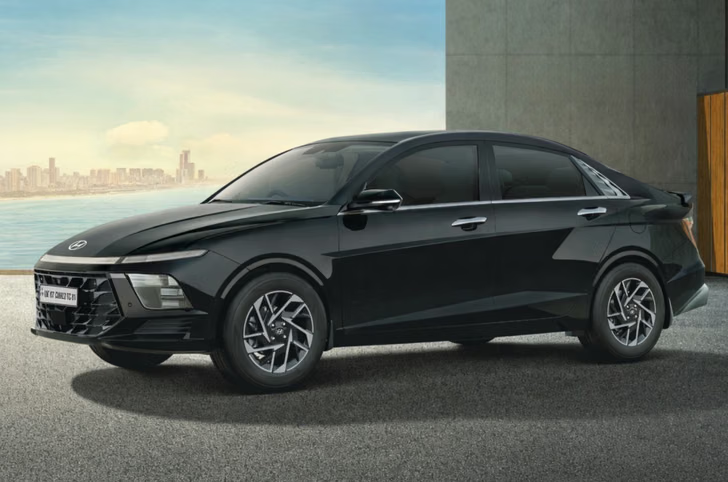
2026 Hyundai Verna Facelift Launched With Over 25 Upgrades: Hyundai didn’t just update the Verna for 2026. They quietly turned it into the most feature-loaded midsize sedan you can buy in India under ₹20 lakh — and the pricing, frankly, is harder to argue with than I expected. Launched on March 9, 2026, the 2026 Hyundai Verna facelift starts at ₹10.98 lakh and packs in over 25 upgrades, including Level 2 ADAS, seven airbags, a factory-fitted dashcam, and a Bose audio system that most cars at this price point wouldn’t even list as an aspiration.
TL;DR / Key Takeaways
- The 2026 Hyundai Verna facelift launched in India on March 9, 2026, starting at ₹10.98 lakh (ex-showroom) and going up to ₹18.25 lakh for the top HX10 turbo-DCT variant.
- Over 25 upgrades span design, safety, comfort, and technology — including several segment-first features: an integrated dashcam, driver seat memory with welcome retract, electric passenger walk-in device, and a rear window sunshade.
- Safety has taken a major leap: 7 airbags, Level 2 ADAS, disc brakes on all four wheels, and more than 75 advanced safety features now come standard or available across the range.
- The infotainment and audio package — dual 10.25-inch curved screens, Bose 8-speaker sound system, wireless Android Auto and Apple CarPlay, and Hyundai BlueLink with 70+ connected features — is among the strongest in the segment.
- The engines remain unchanged: 115 PS naturally aspirated and 160 PS turbocharged — the latter still being the most powerful engine in the midsize sedan segment at this price point.
The 40-Word Answer: What Is the 2026 Hyundai Verna Facelift?
The 2026 Hyundai Verna facelift, launched on March 9, 2026, is a mid-cycle refresh of Hyundai’s midsize sedan, starting at ₹10.98 lakh (ex-showroom) and going up to ₹18.25 lakh. It brings over 25 upgrades across exterior design, interior comfort, connectivity, and safety — including Level 2 ADAS, seven airbags, and several segment-first features.
Price and Variants: Every Number You Need
The 2026 Hyundai Verna is available in six variants — HX2, HX4, HX6, HX6+, HX8, and HX10 — with prices starting at ₹10.98 lakh and going up to ₹18.25 lakh (ex-showroom), depending on powertrain and transmission choice.
Here’s the complete picture:
2026 Hyundai Verna — India Prices (Ex-Showroom)
| Variant | Engine | Transmission | Approx. Price |
|---|---|---|---|
| HX2 | 1.5L MPi NA Petrol | 6-speed Manual | ₹10.98 lakh |
| HX4 | 1.5L MPi NA Petrol | 6-speed Manual / IVT | ₹12–14 lakh (est.) |
| HX6 | 1.5L MPi NA Petrol | IVT | ₹14–15 lakh (est.) |
| HX6+ | 1.5L MPi NA Petrol | IVT | ₹15–16 lakh (est.) |
| HX8 | 1.5L Turbo GDi Petrol | 6-speed Manual / 7-speed DCT | ₹16.28 lakh |
| HX10 | 1.5L Turbo GDi Petrol | 7-speed DCT | ₹18.25 lakh |
With this update, the base-spec Verna has become pricier by ₹18,000, while the top-end variant costs ₹1.1 lakh more than its predecessor. That’s a modest increment for the amount of content Hyundai has added — and I’ll explain exactly why that matters.
The 1.5L turbo petrol engine is exclusive to HX8 and HX10 trims, priced from ₹16.28 lakh to ₹18.25 lakh. If the turbo is what you’re after — and it should be, if spirited driving matters to you — budget for at least ₹16.28 lakh. Below that, you’re in naturally aspirated territory, which is perfectly competent but won’t light up your commute.
The pricing structure is sensible. The real story is what you get inside these price bands.
What’s Actually New: The 25+ Upgrades Unpacked
The phrase “over 25 upgrades” risks sounding like marketing noise. Let me be specific, because several of these changes are genuinely meaningful — not just trim reshuffles.
Exterior: A Sharper Face Without Losing the Plot
The 2026 Hyundai Verna gets a new black chrome grille, projector LED headlights, slightly refreshed bumpers, and 16-inch alloy wheels. The full-width LED light bar at the front — one of the Verna’s most distinctive visual elements — is retained but made thicker, giving it more visual mass. The rear bumper now has an integrated diffuser element with a silver insert, while the stepped rear spoiler carries over unchanged.
Hyundai has also introduced two new exterior colour options — Classy Blue and Titan Grey Matte — to further expand the sedan’s palette. The matte grey finish in particular is a smart addition; it gives the Verna a premium, contemporary appearance that punches above its sticker price. The full colour roster now includes Starry Night, Titanium Black, Titan Grey, Atlas White, and an Atlas White dual-tone with a black roof.
The dimensions stay unchanged — 4,565 mm in length, 1,765 mm wide, with a 2,670 mm wheelbase — making it the widest body in the segment. That wheelbase number matters for a sedan: it translates directly to rear legroom, which is often where Indian family sedan buyers make their final call.
Interior: Where the Upgrades Hit Hardest
Walk inside and the changes become more substantial. The new Verna has a driver-oriented cockpit with a D-cut steering wheel, an 8-way electrically adjustable driver’s seat with memory and a “welcome retract” function, and a 4-way electrically adjustable passenger seat with a first-in-segment electric walk-in device.
Let me explain why that walk-in device matters. It’s the kind of feature that sounds like a footnote until someone in the back seat actually needs to use it — in heavy evening traffic in Bengaluru or Mumbai, where getting in and out of a sedan is a daily negotiation with space. The front passenger seat automatically slides forward to make rear access easier. That’s thoughtful engineering, and Hyundai is the first in this segment to offer it.
The new Verna also gets leatherette seat upholstery, ambient lighting, and a massive 528-litre boot with a smart trunk. The Bose 8-speaker premium audio system also makes its segment debut here. Dual integrated 10.25-inch panels make up the digital cluster and the multimedia centre, with wireless support for Android Auto and Apple CarPlay, a wireless charger, and an electric sunroof.
Hyundai’s BlueLink connected car technology supports over 70 connected features and more than 350 voice commands. Remote lamp control, over-the-air updates, geo-fencing alerts, and real-time vehicle tracking are part of that connected ecosystem.
The Safety Story: Why 75+ Features Is More Than a Buzzword
“The new 2026 Verna now offers more than 75 safety features, aimed at delivering greater occupant protection and improved driving confidence.” — Hyundai Motor India, official launch statement, March 9, 2026
Seventy-five safety features. I’ll admit my first reaction was skepticism — that number sounds like someone counted every ABS-related function separately. But the specifics are genuinely substantive.
The 2026 Verna has more than 75 advanced safety features, including Level 2 ADAS, seven airbags, and a dashcam. The car gets disc brakes all around and is equipped with Hill Start Assist Control, ABS with EBD, ESC with VSM, TPMS, ISOFIX, and rear parking sensors. The Verna facelift is also equipped with blind spot monitor and rear parking sensors.
Level 2 ADAS — short for Advanced Driver Assistance System — means the car can manage steering, braking, and acceleration assistance simultaneously under certain conditions. It’s not autonomous driving, but it’s the kind of real-world support that reduces fatigue on long expressway drives. The Hyundai Verna is one of very few cars to offer L2 ADAS under ₹20 lakh in India.
The integrated dashcam is a segment first. Most urban Indian drivers either buy an aftermarket dashcam (₹3,000–₹8,000) or go without — and in a city where traffic disputes and insurance claims increasingly rely on video evidence, having factory-fitted recording is genuinely useful, not a gimmick.
Seven airbags — front, side, curtain, and driver knee — is a reassuring number. India’s Bureau of Indian Standards now mandates six airbags in vehicles above a certain price band; the Verna’s seven puts it above the minimum and signals that Hyundai is thinking beyond regulatory compliance.
The safety package alone justifies serious consideration — especially if you’re upgrading from a car that’s three to five years old.
Engines: Unchanged, and That’s Perfectly Fine
Two petrol engine choices continue with the updated model. The first option is a 1.5-litre naturally aspirated petrol engine producing 115 PS and 144 Nm, paired with a 6-speed manual or IVT automatic. The second is a 1.5-litre turbo petrol that delivers 160 PS and 253 Nm, available with a 6-speed manual or 7-speed DCT automatic.
Here’s the thing: not changing the engines was the right decision. The 1.5L turbo GDi is already the most powerful engine in the midsize sedan segment at this price point — the turbo petrol unit produces 160 PS of power and 253 Nm of torque, making it one of the most powerful engines in the midsize sedan segment. The Honda City tops out at 121 PS. The Skoda Slavia’s 1.0 TSI makes 115 PS. The Verna’s turbo variant isn’t even in the same conversation on paper.
The IVT (Intelligent Variable Transmission) paired with the naturally aspirated engine is smooth in city traffic but not exciting. If you’re buying the Verna for highway drives, weekend road trips, or any situation where overtaking confidence matters, stretch your budget to the turbo. The 7-speed DCT is responsive and makes the 160 PS feel accessible at a variety of speeds, not just the top of the rev range.
The drive modes — Eco, Normal, and Sport — plus paddle shifters on DCT variants let you adjust character based on your mood. Idle Stop & Go improves fuel economy in stop-go urban traffic without requiring you to think about it.
2026 Hyundai Verna vs The Competition: Where It Stands
The new Verna continues to compete with rivals such as Honda City, Skoda Slavia, and Volkswagen Virtus. That segment trio hasn’t changed in a while, and Hyundai knows it.
Here’s my honest read of the competition:
The Honda City at ₹11.89–₹15.74 lakh (e-HEV variants go higher) is the comfort choice — trusted, spacious, and refined. But it doesn’t get Level 2 ADAS, a dashcam, or a Bose audio system at equivalent price points. Honda’s hybrid variant is compelling on fuel efficiency, but if you’re not a hybrid buyer, the City’s feature-per-rupee ratio has fallen behind.
The Skoda Slavia and Volkswagen Virtus are built on VW Group’s MQB A0 IN platform and offer arguably the best driving dynamics in this segment. The Slavia’s 1.5 TSI EVO is genuinely quick and fun. But Skoda’s service network in smaller Indian cities is thinner than Hyundai’s, and the feature density — particularly on safety tech — doesn’t match the 2026 Verna.
What the 2026 Verna does better than all three: safety feature count, connected car integration via BlueLink, audio quality (Bose vs Honda’s non-premium default), and segment-first features like the dashcam, walk-in passenger device, and driver seat memory. Where it trails: the Slavia/Virtus combination on pure driving dynamics.
If you buy a car primarily to drive it hard on weekend roads, look at the Slavia 1.5 TSI. If you buy a car to use it every day in an Indian city, own it for five to seven years, and want the most safety and tech for your money — the Verna’s case is strong.
The “Respect the Young” Angle: Hyundai’s Bet on India’s Aspirational Buyer
Hyundai has also introduced a new marketing campaign titled “Respect The Young,” celebrating the growing influence of young Indians across different sectors. According to the company, the campaign reflects how the new Verna is positioned as a performance-focused premium sedan for young and aspirational buyers.
I find this positioning more interesting than it first appears. The midsize sedan segment in India has been under pressure from compact SUVs for the past several years — buyers who might have bought a Verna or City in 2018 are now choosing a Creta or Seltos instead. Hyundai is making a deliberate argument that sedans still have something SUVs don’t: a lower centre of gravity, a purer driving experience, superior aerodynamics at highway speeds, and a styling elegance that the tallboy crossover format struggles to match.
The target buyer Hyundai has in mind is a 28–38-year-old urban professional who wants a car that feels premium without crossing the ₹20 lakh threshold, and who values technology and safety as seriously as the people who buy cars twice this price. The feature set — Bose audio, Level 2 ADAS, BlueLink, dashcam, ventilated seats, dual 10.25-inch screens — is calibrated precisely for that buyer.
Whether the campaign works is a different question. But the product underneath the campaign is genuinely competitive.
The Verna has always been a strong seller. The 2026 facelift is Hyundai’s argument that it should also be a first choice, not just a sensible choice.
A Sedan That Refuses to Be Overlooked
The midsize sedan’s obituary has been written many times in the age of the Indian SUV boom. And yet the Verna keeps showing up — better spec’d, better priced, and this time genuinely more safety-conscious than before. The 2026 facelift doesn’t reinvent the car. It doesn’t need to. It takes something that already worked and makes the argument for it more compelling.
What Hyundai has done with this update is remove the excuses. If someone passed on the Verna because the previous model lacked an ADAS suite, there’s no that excuse now. If someone hesitated because the audio system felt average, the Bose upgrade closes that gap. If safety-conscious parents pushed a buyer toward an SUV, seven airbags and a dashcam are serious counters.
The Verna won’t outsell the Creta. That battle was decided years ago. But in its own segment — against the City, the Slavia, and the Virtus — the 2026 facelift is the sharpest the Verna has ever been. And at ₹10.98 lakh to start, that sharpness starts from a number that makes rational sense.
Are you considering the 2026 Hyundai Verna facelift, or are you still leaning toward an SUV at this budget? I’d genuinely like to know what’s driving the decision. Drop a comment, or share this with someone in the market for a premium midsize sedan — there’s a good chance this update changes the conversation.
FAQ
What is the 2026 Hyundai Verna facelift starting price in India?
The 2026 Hyundai Verna facelift starts at ₹10,98,400 (ex-showroom) for the base HX2 variant with the 1.5-litre naturally aspirated petrol engine and 6-speed manual transmission. The top-end HX10 turbo-DCT variant is priced at ₹18.25 lakh (ex-showroom). Both prices are as of launch on March 9, 2026.
When was the 2026 Hyundai Verna facelift launched in India?
Hyundai Motor India launched the 2026 Verna facelift on March 9, 2026. The updated sedan is available at Hyundai dealerships across India from the date of launch.
What are the segment-first features in the 2026 Hyundai Verna facelift?
The 2026 Verna introduces several segment-first features, including a factory-fitted integrated dashcam, a driver seat memory function with welcome retract, a 4-way electrically adjustable passenger seat with an electric walk-in device, and a rear window sunshade. The Bose 8-speaker premium sound system also makes its segment debut in the 2026 Verna.
Does the 2026 Hyundai Verna have Level 2 ADAS?
Yes. The 2026 Hyundai Verna is equipped with Level 2 ADAS (Advanced Driver Assistance System), making it one of the very few midsize sedans in India under ₹20 lakh to offer this capability. It also comes with 7 airbags, disc brakes on all four wheels, ESC with VSM, TPMS, and over 75 advanced safety features in total.
How many variants does the 2026 Hyundai Verna facelift come in?
The 2026 Hyundai Verna is offered in six variants: HX2, HX4, HX6, HX6+, HX8, and HX10. The turbo petrol engine (160 PS, 253 Nm) is exclusive to the HX8 and HX10 trims, priced from ₹16.28 lakh onwards.
How does the 2026 Hyundai Verna facelift compare to the Honda City?
The 2026 Verna beats the Honda City on safety features (7 airbags vs City’s 6, Level 2 ADAS, dashcam), connected car technology (BlueLink’s 70+ features), and audio quality (Bose 8-speaker system). The Honda City counters with its proven refinement and, in hybrid form, significantly better fuel economy. For most non-hybrid buyers, the Verna offers stronger value-per-rupee in 2026.