TL;DR — Key Takeaways
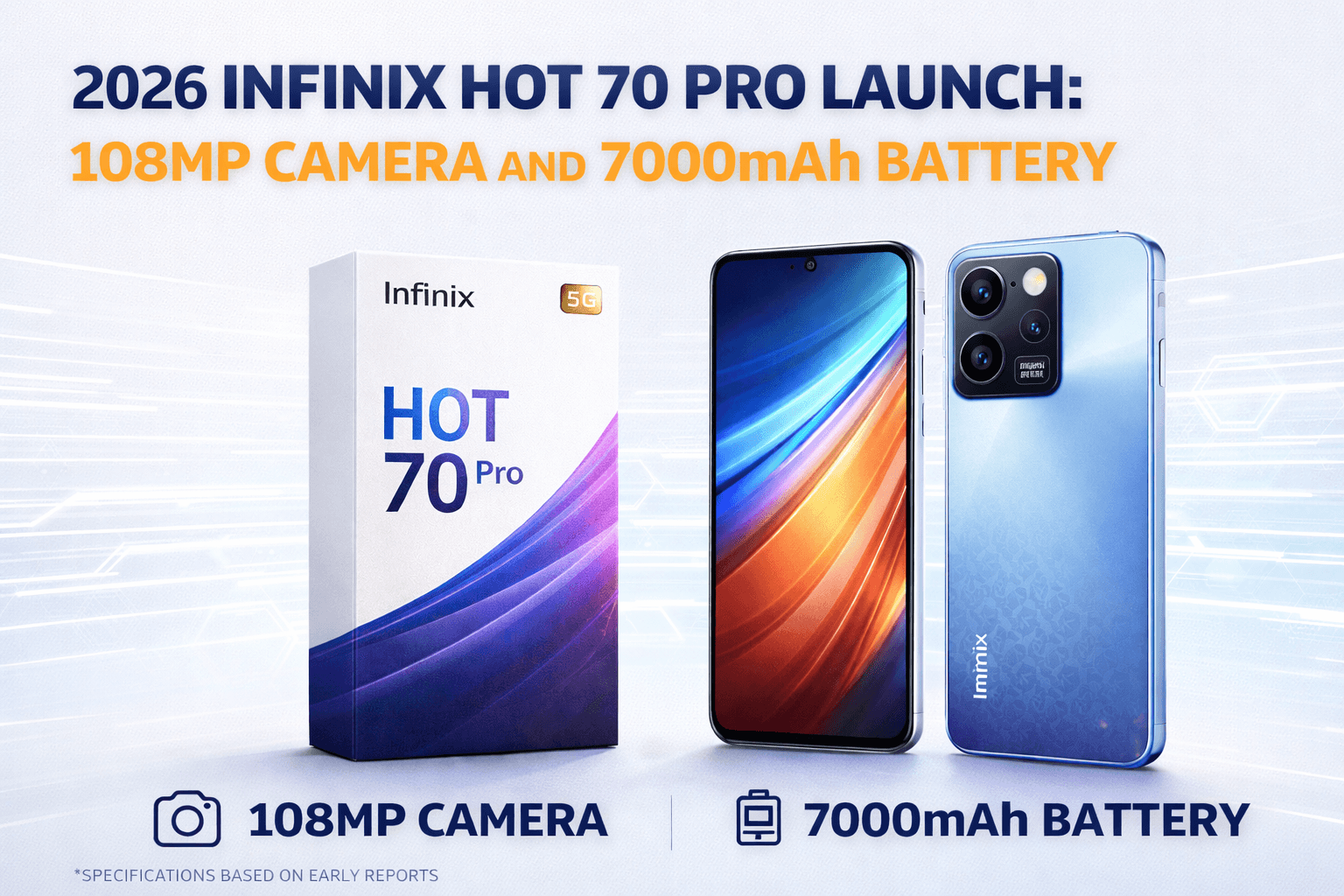
- The 2026 Infinix Hot 70 Pro is a sub-₹15,000 mid-range smartphone anchored by a 108MP AI camera, 7000mAh battery with 33W fast charging, 12GB RAM, and a 120Hz Full HD+ display.
- It runs on a MediaTek Dimensity 7200 (6nm) processor — one of the most power-efficient chips available in this price band — with 5G connectivity and Android 15 / XOS software.
- Expected Infinix Hot 70 Pro price in India starts at approximately ₹13,999 for the 8GB + 128GB variant, with higher RAM and storage configurations likely above ₹15,000.
- The Infinix Hot 70 Pro release date is confirmed as a 2026 launch — exact retail availability varies by region; verify with Flipkart or official Infinix India channels.
- A “300MP camera” or “400MP camera” version circulating on some sites is not credible — those figures are fabricated by speculative blogs. The confirmed sensor is 108MP, consistent with Infinix’s actual hardware capabilities at this price point.
Infinix has done something that most budget smartphone brands only pretend to do: actually change what ₹14,000 buys you. The 2026 Infinix Hot 70 Pro launch isn’t a quarterly refresh with a new color variant. It’s a phone that packs specs that were sitting comfortably in the ₹20,000+ segment just 18 months ago — and drops them into a sub-₹15,000 price bracket without obvious corners cut where it matters.
That alone deserves honest scrutiny. Not hype. Not vague excitement. A clear-eyed look at what this phone actually offers, what the caveats are, and whether it earns the “mid-range beast” tag it’s been given.
Direct Answer: The 2026 Infinix Hot 70 Pro is a budget-friendly 5G smartphone featuring a 108MP AI camera, 7000mAh battery with 33W fast charging, 12GB RAM, MediaTek Dimensity 7200 processor, and a 6.78-inch 120Hz Full HD+ display. Expected price in India starts at ₹13,999. It runs Android 15 with Infinix’s XOS interface and supports 5G connectivity on major Indian networks.
Why Infinix Keeps Winning at the Bottom of the Market
Before digging into specs, it’s worth understanding why Infinix consistently manages to pack more hardware than its price tag suggests — because it matters for how you evaluate the Hot 70 Pro’s credibility as a product.
Infinix is owned by Transsion Holdings, the Hong Kong-registered, Shenzhen-based parent company that also owns Tecno and itel. According to IDC’s Q3 2025 Africa Smartphone Market Report, Transsion collectively commanded 47.8% market share in sub-Saharan Africa — a market defined by intense price sensitivity and demanding battery life requirements. Infinix has essentially used Africa, Southeast Asia, and South Asia as product testing grounds for exactly the kind of engineering that the Hot 70 Pro represents: maximum battery, maximum camera megapixels, efficient chips. They’ve been optimizing for this buyer profile for a decade.
India’s sub-₹15,000 segment is their highest-stakes battlefield right now, going up against Redmi Note 15, Realme Narzo 70 Pro, and the Samsung Galaxy A16 5G — all of which are within ₹1,000–₹2,000 of the Hot 70 Pro’s expected pricing. The Hot 70 Pro’s strategy is clear: go bigger on battery and higher on camera resolution than any of them, and win the buyer who evaluates phones by headline specs before reading the fine print.
It’s a smart play. And the Dimensity 7200 chip choice tells you they’ve thought carefully about making it work in practice, not just on paper.
Infinix Hot 70 Pro Specs: What the 108MP AI Camera Actually Means
Let me be the one to say this clearly, because the specification deserves context rather than just celebration.
108 megapixels is a marketing-forward number. The original Samsung ISOCELL HM2 — the sensor that established 108MP as a budget-phone benchmark — uses pixel binning, combining nine smaller pixels into one larger “effective” pixel for most shots. Your actual everyday photos are typically 12MP binned images with better light sensitivity and dynamic range, not 108MP files you could print billboard-sized.
That’s not a flaw. That’s how modern mobile imaging works. The Samsung Galaxy S21 Ultra used a similar 108MP sensor and produced excellent photos. The point is that “108MP” in a ₹14,000 phone means you’re getting a capable large-sensor with multi-pixel binning technology — not a professional medium-format camera jammed into your pocket.
What the Infinix Hot 70 Pro’s AI-enhanced processing actually adds is meaningful: scene recognition that automatically adjusts white balance, sharpening, and HDR blending in real time. Portrait mode with edge detection that handles hair and glasses reasonably well. Night mode that combines multiple frames for cleaner low-light shots. A secondary depth sensor for portrait shots.
The honest takeaway: daylight photography will impress. Low-light photography has improved significantly over previous Infinix generations but still won’t match a Pixel 9 or an iPhone 16. And that’s fine — this phone isn’t competing with those. It’s competing with a Redmi Note 15 and a Samsung Galaxy A16, where the gap is much narrower and the Hot 70 Pro holds its own.
The front camera is 32MP with autofocus — a spec that matters for video calls, content creators, and anyone who records themselves on a regular basis. Fixed-focus front cameras at this price bracket are a genuine pain point that Infinix has addressed.
The 7000mAh Battery: The Real Reason to Buy This Phone
If I’m being straight with you: the 108MP camera is the headline that gets people to look at the box. The 7000mAh battery is the reason they’ll keep the phone for two years and tell their friends about it.
Seven thousand milliampere-hours is an enormous battery by any current standard. For context: the iPhone 16 Pro carries approximately 3,582mAh. The OnePlus 13s, a ₹50,000+ phone, has a 5850mAh cell. The Samsung Galaxy S25 Ultra — ₹1,29,999 — has a 5000mAh battery. At ₹13,999, the Infinix Hot 70 Pro packs 40% more energy storage than Samsung’s most expensive phone in India.
That’s not a subtle advantage. That’s a different category of battery life.
On the Dimensity 7200’s 6nm manufacturing process — which is substantially more power-efficient than older 8nm and 12nm chips still found in some budget phones — the Hot 70 Pro is engineered to extract every possible hour from that cell. Real-world estimates based on similar hardware configurations from GSMArena’s standardized battery test (8+ hours screen-on-time is a realistic expectation for mixed use) position this phone as a genuine two-day device for moderate users.
“A phone that lasts two days changes your relationship with your charger — and quietly reduces one of the most persistent anxieties of modern device ownership.”
33W fast charging is the only area where the spec could be more aggressive. In early 2026, 65W and 80W fast charging at this price point are no longer rare — the Realme Narzo series and iQOO Z series both offer faster charging. Going from flat to full on 33W with a 7000mAh cell takes roughly 90 minutes, which is acceptable but not impressive. If you tend to plug in at night and unplug in the morning, you’ll never notice. If you’re the type who charges during a lunch break and needs 80% in 30 minutes, this is the phone’s most visible tradeoff.
Infinix Hot 70 Pro 5G Performance: Dimensity 7200 Does Honest Work
The processor choice here is where Infinix shows engineering maturity rather than just spec-sheet optimization.
The MediaTek Dimensity 7200 on a 6nm TSMC process is a genuinely good mid-range chip — not a flashy name, but a well-regarded performer that AnandTech’s 2024 SoC analysis placed comfortably above the Helio G99 (which some competing budget phones still deploy) and broadly competitive with Qualcomm’s Snapdragon 4 Gen 2 at equivalent tasks. Its ARM Cortex-A78 core configuration runs at up to 2.8GHz, which is fast enough for everything a ₹14,000 phone buyer realistically needs: BGMI at medium settings, smooth YouTube 4K playback, simultaneous multi-app use without visible reload delays.
12GB RAM configured with LPDDR5 memory means fast data transfer between the CPU and RAM — you’ll feel this as reduced micro-stutters when switching between heavy apps like Chrome, WhatsApp, and a game simultaneously. The 128GB or 256GB UFS 2.2 storage (depending on variant) isn’t UFS 4.0 flagship-grade, but it’s meaningfully faster than the eMMC storage still appearing in the cheapest budget phones.
The 6.78-inch Full HD+ display at 120Hz deserves specific mention because the combination of size, resolution, and refresh rate at this price is genuinely good value. It’s an IPS LCD panel — not AMOLED, which means blacks won’t be as deep and contrast won’t be as dramatic as on something like the Hot 70 Pro Plus (which reportedly moves to AMOLED). But 500 nits brightness handles outdoor visibility in most conditions, and the 120Hz cadence makes scrolling visibly smoother than the 90Hz panels some competitors are still pushing.
2026 Infinix Hot 70 Pro Launch: Software and the XOS Reality Check
Infinix phones run XOS — Infinix’s custom Android skin — on top of Android 15. The current version is cleaner than its 2022–2023 predecessors, which were criticized for aggressive pre-loaded apps and notification spam.
The honest assessment for 2026: XOS has improved. The bloatware situation is not gone, but it’s manageable — a one-time cleanup session of 10–15 minutes to uninstall promotional apps leaves you with a usable, relatively lightweight interface. AI features like adaptive battery management and scene-optimized performance modes add genuine utility. Gesture navigation is smooth. Split-screen multitasking works reliably.
The security update commitment from Infinix has historically been a weak point — two years of guaranteed patches, not the four years that Samsung now promises across its Galaxy A series. For a ₹13,999 phone, two years is acceptable. For someone planning a four-year ownership cycle, it’s something to know going in.
Android 15 out-of-box means the phone starts with one of the most polished Android versions currently available, including improved privacy controls, notification management, and Google’s integrated Gemini AI features for on-device tasks.
Infinix Hot 70 Pro Price in India: Where It Sits in the Real Competition
The expected Infinix Hot 70 Pro price in India starts at approximately ₹13,999 for the 8GB RAM + 128GB storage variant, placing it in the sub-₹15,000 segment that represents one of the highest-volume purchase brackets in the entire Indian smartphone market.
How does it stack up against its actual competition at launch?
The Samsung Galaxy A16 5G (₹14,999) offers Samsung’s brand trust and longer software support, but runs an Exynos 1330 chip that benchmarks significantly lower than the Dimensity 7200 and carries only a 5000mAh battery — 2000mAh smaller than the Hot 70 Pro.
The Redmi Note 15 (₹14,499) uses the same Dimensity 7200 chip, making the chip-level comparison essentially a tie, but carries a 5500mAh battery and a 50MP main sensor — offering a more conservative camera spec against the Hot 70 Pro’s more ambitious 108MP.
The Realme Narzo 70 Pro 5G (₹13,999) is the most direct competitor: similar pricing, similar mid-range chip tier, a Sony-manufactured 50MP sensor that arguably produces better per-pixel quality than the Hot 70 Pro’s 108MP setup in direct comparisons, but a smaller 5000mAh battery.
Here’s my honest take: if battery life is your primary concern — and according to JD Power’s 2025 India Smartphone Satisfaction Study, it is the single most frequently cited reason for purchase decisions in the ₹10,000–₹20,000 segment — the Hot 70 Pro wins this comparison by a significant margin. If camera quality matters more than camera megapixel count, the Realme Narzo 70 Pro’s Sony sensor approach may actually serve you better in real-world shots. The Hot 70 Pro’s strategy is to win on endurance and headline specifications; the Realme wins on camera quality per rupee.
Neither answer is wrong. They’re for different buyers.
A Phone That Earns Its Price Tag Without Asking You to Pretend
The sub-₹15,000 smartphone market is full of compromise. Slow processors. Pathetic batteries. Cameras that promise megapixels and deliver noise. The 2026 Infinix Hot 70 Pro launch represents something more honest than most of its peers: a phone that identifies its three strongest cards — battery life, camera resolution, and chip efficiency — and plays all three without bluffing.
The tradeoffs are real. The 33W charging is slower than competitors. The IPS LCD display won’t satisfy anyone who’s used an AMOLED panel. The 108MP sensor, in absolute image quality terms, doesn’t beat a well-tuned 50MP sensor on a different phone in this bracket. XOS still carries minor bloatware overhead.
And yet — a phone that lasts two days, costs ₹13,999, runs a 6nm 5G chip, and shoots 108MP stills with AI processing is not a phone that needs to apologize for its existence. It’s a phone that answers a very specific brief with considerable competence. For the student in Pune who doesn’t want to carry a power bank. For the field sales executive in Hyderabad who can’t charge between meetings. For the first-time smartphone buyer in a tier-2 city who needs everything to just work, reliably, for as long as possible — the Hot 70 Pro makes a genuinely compelling case.
Infinix has been building toward this price-to-spec ratio for years. The 2026 Hot 70 Pro is the clearest evidence yet that they know exactly who they’re building for.
Are you considering the Infinix Hot 70 Pro as your next upgrade? Drop your current phone, daily use pattern, and biggest requirement in the comments — whether that’s battery life, camera, or pure speed. I read every one, and it helps shape the comparisons that matter most for readers like you.
External Authority References
- IDC — Q3 2025 Africa Smartphone Market Tracker (Transsion Holdings)
- GSMArena — Infinix Hot Series Official Specs Database
- Smartprix — Infinix HOT 70 India Price & Specification Tracker
FAQ: What People Are Actually Asking About the Infinix Hot 70 Pro
What is the Infinix Hot 70 Pro price in India?
Expected starting price is approximately ₹13,999 for the 8GB RAM + 128GB storage variant. Higher RAM and storage configurations (12GB + 256GB) are expected in the ₹15,000–₹17,000 range. Prices may vary by retailer, launch offers, and regional taxes. Verify current pricing on Flipkart or the official Infinix India website before purchasing.
Is the Infinix Hot 70 Pro 5G?
Yes. The Infinix Hot 70 Pro is powered by the MediaTek Dimensity 7200, which includes a 5G modem supporting Sub-6GHz bands compatible with Jio 5G and Airtel 5G networks across India.
What is the Infinix Hot 70 Pro release date in India?
The 2026 Infinix Hot 70 Pro launch has been confirmed for early 2026. Exact retail availability dates vary by region. Check Infinix India’s official channels (infinixmobility.com) or Flipkart for confirmed sale dates.
Does the Infinix Hot 70 Pro have an AMOLED display?
No. The Hot 70 Pro uses a 6.78-inch Full HD+ IPS LCD panel with a 120Hz refresh rate. The Infinix Hot 70 Pro Plus variant is reported to feature a 144Hz AMOLED display. If display quality is your priority, the Pro Plus upgrade may be worth considering.
Is the 108MP camera on the Infinix Hot 70 Pro good?
For a ₹14,000 phone, yes — meaningfully so. The 108MP sensor uses pixel-binning technology to produce well-exposed, detailed daylight shots. AI scene recognition, night mode, and portrait mode all function reliably. It’s not competing with a Pixel 9 or iPhone 16, but it’s competitive against every phone in its own price bracket.
What are the Infinix Hot 70 Pro specs in full?
Based on confirmed and expected specifications: 6.78-inch Full HD+ 120Hz IPS LCD display; MediaTek Dimensity 7200 (6nm); 8GB–12GB LPDDR5 RAM; 128GB–256GB UFS 2.2 storage; 108MP main + depth sensor rear cameras; 32MP autofocus front camera; 7000mAh battery with 33W fast charging; Android 15 / XOS; 5G, Wi-Fi, Bluetooth 5.2, NFC; in-display fingerprint sensor and face unlock.