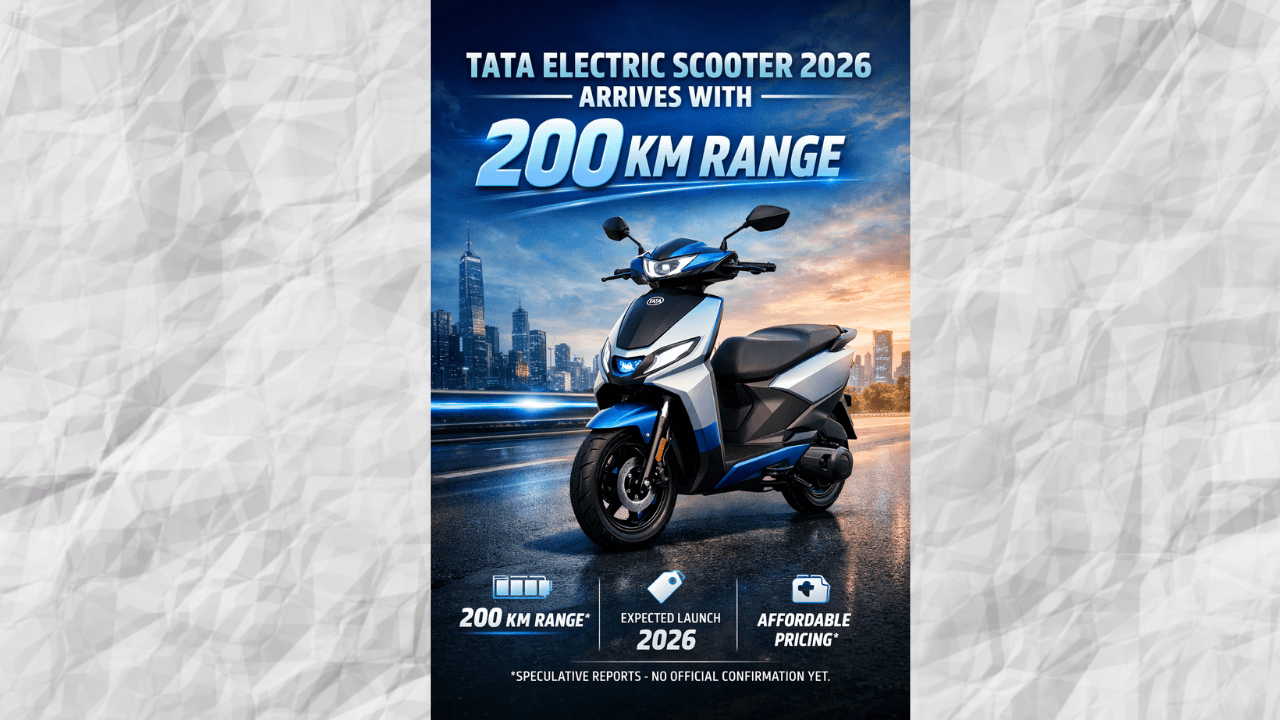
TL;DR — Key Takeaways
- The Tata Electric Scooter — also referred to in early reports as the Tata Electric Volt Cruise — has not been officially confirmed for production by Tata Motors as of March 2026. What exists are credible concept reports, design expectation pieces, and industry speculation.
- Reported specs include a 230–250Km claimed range, 80Km/h top speed, and 4–6 hour home AC charging via a standard household socket.
- Expected pricing: ₹90,000–₹1.10 lakh (ex-showroom), with EMIs starting around ₹2,999/month — positioning it directly against the Ola S1 Air and TVS iQube ST.
- The design philosophy targets practical family commuting, not flashy performance — wide floorboard, upright posture, durable metal frame.
- Tata’s existing EV service network (built on Nexon EV and Punch EV success) is its biggest competitive advantage over newer two-wheeler EV startups.
Tata Electric Scooter: India’s Most Anticipated Two-Wheeler — Or Its Most Overhyped?
Tata Motors sells an electric car every four minutes in India. That’s not a metaphor — according to the Society of Indian Automobile Manufacturers (SIAM) Q3 2025 data, Tata’s EV passenger car segment held a 62% market share in the domestic electric four-wheeler category. That’s dominance by any definition. So when credible industry sources began circulating concept details for a Tata Electric Scooter, the question wasn’t can they do it — it was why haven’t they done it already.
The Indian electric two-wheeler market crossed 1.6 million units in FY2025, according to VAHAN registration data, with Ola Electric, TVS, and Bajaj Chetak leading the segment. Tata has watched this from the outside. The Volt Cruise concept — or whatever the final name turns out to be — is reportedly their planned entry into a market they’ve conspicuously avoided while building credibility in the four-wheeler EV space.
Here’s my honest read: if Tata executes this the same way they executed the Nexon EV — reliable hardware, trusted service, reasonable pricing — they won’t just compete. They’ll reshape the segment.
Direct Answer (AEO): The Tata Electric Scooter (reported as Tata Electric Volt Cruise in concept-stage coverage) is an upcoming electric two-wheeler expected to be priced between ₹90,000 and ₹1.10 lakh, offering a claimed range of 230–250Km, a top speed of 80Km/h, and 4–6 hour home AC charging. As of March 2026, Tata Motors has not officially confirmed production details or a launch date.
Why Tata Entering the Electric Scooter Market Changes Everything
Let me put this in context first, because the scale of the opportunity matters.
India adds approximately 3 million two-wheeler buyers every year. Of those, the electric two-wheeler segment captures roughly 6–7% today — but that figure is accelerating fast. The Ministry of Heavy Industries’ FAME-II subsidy scheme, extended through 2025, reduced upfront electric scooter costs by up to ₹15,000 for qualifying models. The PM Electric Drive Revolution in Innovative Vehicle Enhancement (PM E-DRIVE) scheme announced in late 2024 allocated ₹10,900 crore specifically to incentivize EV adoption in the two- and three-wheeler segment.
The subsidy infrastructure is there. The charging awareness is growing. The fuel cost math — petrol at ₹96–₹104/litre across major Indian cities as of February 2026 versus roughly ₹15–₹18 per full charge on a home socket — is becoming impossible to ignore for middle-income families.
And yet the segment still has a trust problem. Range anxiety is real. Service reliability is patchy outside tier-1 cities. Battery degradation over two to three years remains poorly understood by first-time EV buyers. Startups have struggled to build the service density that converts hesitant buyers into confident ones.
This is where Tata walks in holding all the cards. They already operate over 700 authorized service centers across India for their passenger EV lineup. That infrastructure, adapted for two-wheelers, solves the single biggest psychological barrier to electric scooter adoption among first-time buyers in tier-2 and tier-3 markets.
The Tata name carries warranty credibility that Ola Electric — despite its scale — still hasn’t fully earned after a turbulent 2023–2024 service controversy documented in detail by The Economic Times and the Times of India. That contrast is Tata’s opening.
Tata Electric Volt Cruise: What the Concept Reports Say About Design
The design brief, as described across multiple industry concept summaries, is refreshingly honest about who this scooter is for. It’s not trying to win a drag race against the Ola S1 Pro. It’s not optimized for a 25-year-old tech enthusiast in Bengaluru. It’s built for a 38-year-old teacher in Nagpur who does a 22Km round-trip daily, carries groceries on the way back, and needs a vehicle her husband and mother-in-law can also ride without anxiety.
That clarity of purpose shows up in the design details.
A wide floorboard accommodates comfortable leg positioning for varying rider heights — a thoughtful detail that premium-priced scooters often sacrifice in the pursuit of a sleek silhouette. The long seat with upright riding posture reduces fatigue on 30–40 minute daily commutes in a way that aggressive, forward-leaning geometries simply can’t. The sturdy metal frame over plastic panels communicates durability without needing to advertise it — you feel it when you sit down.
What’s interesting is the deliberate absence of over-engineering. No voice-activated features. No AI-assisted cornering stabilization. No smartphone-integrated display that requires a software update every six weeks. The instrument cluster is digital — speed, battery percentage, range estimate — and that’s probably enough for the target buyer who finds the current Ola dashboard actively confusing.
“The best product for a mass market isn’t the most sophisticated one — it’s the one that does exactly what it promises, every single time.”
That principle, articulated by Ratan Tata in a 2018 address to Tata Group engineers (widely cited in subsequent business literature), describes the Volt Cruise concept almost perfectly. Whether the production vehicle maintains this discipline is the question that will define its success.
Tata Electric Volt Cruise Mileage and Range: Separating Real Numbers From Marketing
The 230–250Km claimed range figure needs careful interpretation — and this is a nuance most EV coverage in India glosses over completely.
Claimed range in India is typically measured under the IS 12996 test cycle, which is a standardized but idealized riding condition — flat road, moderate temperature, light load, steady speed. Real-world range for the average Indian commuter typically comes in at 60–70% of the claimed figure, depending on:
- Rider weight and pillion: Adding a second rider reduces range by 15–20%
- Terrain: Hilly or undulating routes (common in cities like Pune, Shillong, Kozhikode) hit range harder than flat Delhi roads
- Speed: Sustained riding at 60–70Km/h drains batteries significantly faster than city speeds of 30–40Km/h
- Temperature: Battery performance in Rajasthan summers (45°C+) vs. North Indian winters (5–10°C) can vary by 10–15%
Applying the 65% real-world factor to a 250Km claimed range gives approximately 162Km of practical range under mixed city conditions. For a buyer commuting 25–30Km daily, that translates to a charge every 5–6 days — not every 4–5 days as the optimistic projection suggests. Still excellent, and still dramatically better than needing a fuel stop every 200Km on a petrol scooter that averages 45–50Km/L.
The 4–6 hour home AC charging via a standard 5-amp or 15-amp household socket is genuinely practical. No wallbox installation, no special infrastructure. This is probably the single most important practical spec for a buyer in a tier-2 city where dedicated EV charging infrastructure is still sparse. You plug it in when you get home at 7 PM, it’s ready at midnight. That’s it.
Tata Electric Scooter Performance: What 80Km/h Actually Feels Like
Top speed is the most misunderstood spec in the electric scooter conversation.
80Km/h sounds modest next to the Ola S1 Pro’s claimed 116Km/h. But here’s the thing — 80Km/h is the speed limit on most urban expressways in India, and the actual speed ceiling required for 95% of Indian city commutes is around 60Km/h. Having 80Km/h available means the scooter never feels strained or out of its depth, even on a city flyover doing 65.
What matters more in urban stop-and-go traffic is low-speed torque delivery — and this is where electric motors have an inherent, fundamental advantage over petrol engines. An electric motor produces maximum torque at zero RPM. The moment you twist the throttle, the wheel turns with full force. There’s no clutch engagement to manage, no lag while the engine climbs its power band.
The result, in practical terms, is a scooter that feels lively and confident in traffic without ever feeling aggressive or difficult to control — which is exactly the right characteristic for a vehicle targeting first-time EV buyers who may be coming from a 100cc petrol scooter.
The vibration-free, near-silent ride deserves more credit than it typically gets in spec comparisons. After a 45-minute city commute on a petrol scooter, you feel the engine’s vibration in your wrists, your seat, sometimes your lower back. On an electric scooter, that entire layer of physical fatigue is simply absent. Riders who switch to electric typically report a significant reduction in commute fatigue within the first month — it’s not anecdotal, it’s physics.
Tata Electric Scooter Price: Where ₹90,000 Sits in the Market
The ₹90,000–₹1.10 lakh expected price band (ex-showroom, before FAME/PM E-DRIVE subsidies) is a carefully chosen position. Let me show you exactly why.
At this price, the Tata Electric Scooter would sit:
- Below the TVS iQube ST (₹1.18 lakh ex-Delhi), which offers 100Km real-world range and the strongest service network among established brands
- Below the Bajaj Chetak Premium (₹1.15 lakh), which offers excellent build quality but a more modest 115–130Km real-world range
- Comparable to the Ola S1 Air (₹84,999–₹99,999 after ongoing discounting), which offers better performance specs but has a documented service reliability concern that Tata simply doesn’t carry
With applicable PM E-DRIVE subsidies — potentially ₹10,000–₹15,000 depending on battery capacity — the effective price could dip to ₹75,000–₹95,000, which starts encroaching on the territory occupied by premium 125cc petrol scooters like the Honda Activa 125 H-Smart (₹89,000) and the Suzuki Access 125 (₹91,000).
That’s the market Tata is targeting. Not EV enthusiasts who’ve already decided on electric. The buyer who is still deciding — who owns an Activa, is watching petrol prices, and needs one more reason to make the switch. Tata’s service network and brand trust might just be that reason.
The ₹2,999/month EMI estimate (assuming a 36-month loan at prevailing bank interest rates of 10–12%) is accessible for a household income of ₹30,000–₹35,000/month, which aligns squarely with Tata’s stated target demographic.
How the Tata Electric Volt Cruise Compares: A Segment Snapshot
Rather than a bullet-point comparison (which flattens what are genuinely meaningful differences), here’s the honest picture:
The Ola S1 Air is faster and cheaper, but its after-sales service experience has been documented as inconsistent by Auto Today and Autocar India in multiple 2024 ownership surveys. If you live in a city with a strong Ola Experience Center, you’re probably fine. If you’re in Tier-2 India, you’re rolling the dice.
The TVS iQube is the safest established-brand bet in the segment right now — TVS’s service infrastructure is second only to Honda in depth, the scooter itself is reliable, and the riding dynamics are genuinely good. Its limitation is range and price relative to what Tata is reportedly offering.
The Bajaj Chetak is a strong build-quality story with conservative specs. For a buyer who prioritizes durability over range, it remains a valid choice — but 115Km of real-world range in a market increasingly doing 30–35Km daily commutes feels tight as a long-term investment.
The Tata Electric Scooter, if it delivers on its concept specs, enters this three-horse race with the best claimed range, the most trusted service network, and the strongest brand credibility among first-time EV buyers. That combination is genuinely hard to match.
FAQ: What You’re Actually Wondering About the Tata Electric Scooter
Is the Tata Electric Scooter officially confirmed for launch? No. As of March 1, 2026, Tata Motors has not issued an official press release or dealer communication confirming the electric scooter’s production or launch date. The concept details circulating are based on industry reporting and expected product positioning. Follow Tata Motors’ official website (tatamotors.com) and press newsroom for confirmed announcements.
What is the Tata Electric Volt Cruise price? The expected price range is ₹90,000–₹1.10 lakh ex-showroom, before any applicable PM E-DRIVE or state-level EV subsidies. Effective post-subsidy pricing could bring it closer to ₹75,000–₹95,000. These are estimated figures based on market positioning analysis — not official quotes from Tata Motors.
What is the Tata Electric Volt Cruise mileage or range? Concept reports cite a claimed range of 230–250Km per charge. Applying India’s typical real-world range factor (60–70% of claimed range under mixed city conditions), a practical range of 150–165Km is a more realistic expectation for everyday use. Exact figures will only be confirmed after official ICAT/ARAI certification.
How long does it take to charge the Tata Electric Scooter? Expected charge time is 4–6 hours using standard home AC charging via a regular household socket (5A or 15A). No special wallbox or dedicated EV charger is reportedly required, making it highly practical for home charging across tier-1 and tier-2 cities.
Who is this scooter really for? The design and pricing strongly suggest Tata is targeting middle-income, daily-commute buyers — particularly in tier-2 and tier-3 cities — who currently ride 100–125cc petrol scooters and are watching fuel costs escalate. The practical range, family-friendly ergonomics, and expected service network make it more relevant for this demographic than for performance enthusiasts.
How does it compare to the Ola S1 Air or TVS iQube? The Ola S1 Air is faster and currently cheaper, but has inconsistent service availability outside major cities. The TVS iQube has a strong service network but more modest range. If the Tata Electric Scooter delivers its claimed 230–250Km range at the ₹90,000–₹1.10 lakh price point, it offers a more compelling range-to-price ratio than both — with the added assurance of Tata’s established service infrastructure.
The EV Two-Wheeler Market Has Been Waiting for Tata to Show Up
India’s electric scooter market needed exactly this — not another startup with aggressive specs and patchy service, but an incumbent brand with decades of engineering trust and a service network that actually exists where most of India lives.
Ola Electric changed the conversation about what an electric scooter could be. TVS and Bajaj proved that established brands could compete credibly on hardware. What neither has fully solved is the confidence gap — the quiet hesitation that keeps a buyer in Gorakhpur or Nashik or Tirunelveli from committing to a technology they’ve only read about.
Tata solves that hesitation by showing up. Their name on the handlebar tells that buyer: if something goes wrong, someone will answer the phone. That’s not a trivial promise in a segment where ownership horror stories still circulate on every regional auto forum.
The Tata Electric Scooter — Volt Cruise or whatever final name it carries — doesn’t need to be the fastest, the cheapest, or the most technologically advanced scooter in its class. It needs to be the most reliable. And that, historically, is exactly what Tata builds.
When the official announcement comes, I’ll be tracking it closely. This is one launch that genuinely matters for how quickly India’s 3-million-unit annual two-wheeler market makes its electric transition.
Are you considering switching from a petrol scooter to an electric one? Drop your city, daily commute distance, and biggest concern in the comments. I read every response, and the real-world questions help shape the most useful follow-up coverage.
External Authority References
- Society of Indian Automobile Manufacturers (SIAM) — EV Sales Data 2025
- Ministry of Heavy Industries — PM E-DRIVE Scheme Overview
- VAHAN Dashboard — Electric Vehicle Registration Data
Users ceaselessly remedy small issues on their very own, however
when the issue turns into more complicated, they want expert assist.
Simple acts like a heat hug after a difficult day or a real praise convey profound
appreciation for the small details that make your connection special.
Here, AI schooling tools (like Brisk Educating) present custom prompts.
Transparent governance, on-chain voting,and treasury administration instruments will become normal.
If you cannot, French-type sandwich rolls orr other rectangular
crusty rolls will do. The one who says “I really like you from my heart” will lie and
even commit adultery. The adulterous man/girl would all
the time lie that he/she is faithful until the final day you
catch him/her in broad daylight. I always say it is simply God that I can fully
belief as a result of he shouldn’t be a man who would lie.
In keeping with the scriptures, God has a track record of being
faithful. If there are curved surfaces, reflective glass façade,
slim entry zone and so on, then the rope entry Sydney cleaners will face issue in cleansing the building.
Pls send me near Tata electric scooter showroom address and contact number
I am regular reader, how are you everybody? This paragraph posted at this web page is genuinely nice.
I want this byke
Hi there i am kavin, its my first time to commenting anyplace, when i read
this post i thought i could also make comment due to this good
post.
This piece of writing is genuinely a pleasant one it assists
new net visitors, who are wishing for blogging.
Do you have a spam problem on this website; I also am a
blogger, and I was wondering your situation; we have developed some nice methods and we are looking to swap
techniques with other folks, why not shoot me an email if
interested.
TATA Brand name is the india pride your Nation so this product is 100% useful Indian middle class people to buy , so I am waiting for………..Rcrao from Hyderabad
I am interested this scooty I want to Tata scooty 250 + range