TL;DR — Key Takeaways
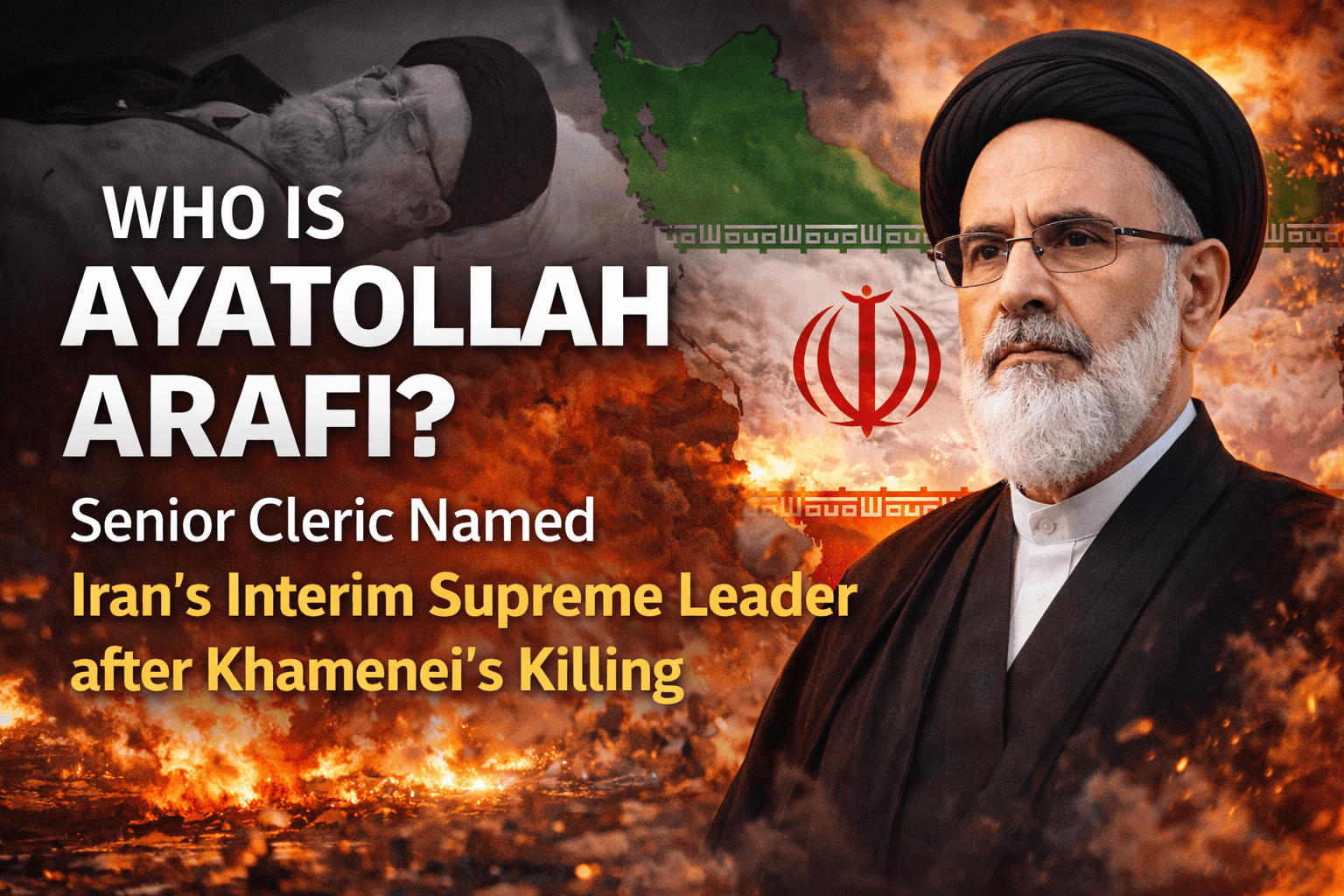
- On March 1, 2026, Ayatollah Alireza Arafi (67) was named Iran’s interim Supreme Leader after Ayatollah Ali Khamenei was killed in a joint US-Israeli airstrike on his Tehran compound.
- Arafi serves as the clerical member of a three-person transitional council alongside President Masoud Pezeshkian and Chief Justice Gholam-Hossein Mohseni-Eje’i — a constitutional mechanism activated immediately upon the Supreme Leader’s death.
- Born in 1959 in Meybod, Yazd Province, he simultaneously held three of Iran’s most influential positions: Director of the Islamic Seminary system, member of the Guardian Council, and member of the Assembly of Experts.
- He is a trusted Khamenei loyalist — described by Middle East Institute scholar Alex Vatanka as someone Khamenei had “a great deal of confidence in” — fluent in Arabic and English, and notably focused on using technology to extend Iran’s ideological reach.
- His appointment signals continuity of the Islamic Republic, not reform. But whether he becomes the permanent Supreme Leader — or merely a transition figure — is a question the 88-member Assembly of Experts will answer in the coming weeks.
Forty-eight hours ago, most of the world had never heard his name. Now Ayatollah Alireza Arafi is the most consequential cleric on Earth.
On the morning of March 1, 2026, as Tehran absorbed the shock of Supreme Leader Ali Khamenei’s death in a US-Israeli airstrike, Iran’s constitutional machinery moved with unexpected speed — naming a 67-year-old cleric from a small city in Yazd Province as the jurist member of the country’s transitional leadership council. The name on everyone’s screen: Ayatollah Arafi. The question on everyone’s lips: who is he?
Direct Answer: Ayatollah Alireza Arafi is a 67-year-old Iranian Shia cleric born in 1959 in Meybod, Yazd Province. He serves as Director of Iran’s Islamic Seminary system, a member of the Guardian Council, and a member of the Assembly of Experts. On March 1, 2026, he was appointed the clerical member of Iran’s transitional leadership council following the death of Supreme Leader Ali Khamenei in US-Israeli airstrikes. He is widely regarded as a loyal Khamenei confidant and a signal of ideological continuity for the Islamic Republic.
The Man Behind the Title: Who Ayatollah Arafi Actually Is
Let me be specific about something most coverage is vague about: Arafi is not a surprise pick from obscurity. He is, in fact, exactly the kind of figure you would expect the Islamic Republic’s constitutional machinery to produce in a moment of crisis — deeply embedded in the system, trusted at the highest levels, ideologically reliable, and relatively unknown to the outside world precisely because his power has always operated through institutions rather than public profile.
Born in 1959 in Meybod, a historic town in central Iran’s Yazd Province, Arafi comes from a clerical family with roots that, according to the Middle East Institute, trace back to Zoroastrians who converted to Islam in the 19th century. His father, Ayatollah Mohammad Ibrahim Arafi, was depicted in Iranian state media as a close associate of Ayatollah Ruhollah Khomeini — the founder of the Islamic Republic. That lineage matters in Iran’s clerical culture, where proximity to revolutionary legitimacy carries real institutional weight.
Arafi is not a Sayyed — meaning he does not claim direct descent from the Prophet Muhammad, a credential that both Khomeini and Khamenei held. This distinction is theologically significant in Twelver Shia tradition, and it has been cited by Iran scholars as a potential limitation on his candidacy for the permanent Supreme Leadership. And yet — as Middle East Institute analyst Alex Vatanka noted in his profile of Arafi — Grand Ayatollah Hossein-Ali Montazeri was not a Sayyed either when he was initially designated Khomeini’s deputy supreme leader. The lack of the title is a weakness, not a disqualifier.
What Arafi does have — and what his appointment makes immediately legible — is the rarest of assets in Iran’s clerical hierarchy: Khamenei’s documented, repeated, institutional trust. Every significant position he has held in his career was a direct appointment by the Supreme Leader himself. The Friday Prayer leadership in Meybod in 1992. The chairmanship of Al-Mustafa International University in 2009. The headship of all Iranian seminaries nationwide in 2016. The seat on the Guardian Council in 2019. Khamenei didn’t just tolerate Arafi. He built him.
Three Roles That Made Him the Regime’s Most Trusted Operator
Understanding why Arafi was chosen requires understanding what he actually did before March 1, 2026 — because those three concurrent roles are not incidental to his appointment. They are the reason for it.
Director of Iran’s Islamic Seminary System
Since July 6, 2016, Arafi has headed Iran’s Centre for the Management of Islamic Seminaries — the body overseeing every theological school (hawza) in the country, most critically the revered seminaries in Qom, the Vatican of the Shia Islamic world. This is not an honorary title. It is operational control over the educational infrastructure that produces Iran’s next generation of clerics, judges, and political operatives.
Under his leadership, he systematically restructured the seminaries’ curricula to align with the ideological priorities of the Office of the Supreme Leader — replacing independent scholarly traditions with what critics describe as an increasingly centralized, Khomeinist orthodoxy. As UANI (United Against Nuclear Iran) documented, he led the charge to replace standard humanities textbooks with Khomeinist-aligned versions, and used his institutional authority to enforce what he called the “Islamization” of Iranian educational systems.
Control the seminaries, and you shape the clerical class for a generation. Khamenei understood this. That’s why he gave Arafi the job.
Member of the Guardian Council
The Guardian Council is the Islamic Republic’s ultimate constitutional gatekeeper. Its 12 members — six Islamic jurists appointed by the Supreme Leader, and six lawyers elected by parliament — have the authority to veto any legislation and disqualify any candidate for elected office. Arafi joined this body in 2019, replacing the relatively moderate Mohammad Momen, a move that was widely read at the time as a shift toward greater hardline consolidation of the council’s composition.
The Guardian Council is also, critically, the body constitutionally tasked with organizing and verifying the election of the Assembly of Experts — the cleric body that will now choose the next Supreme Leader. Arafi’s presence inside the Guardian Council while the succession process unfolds creates an interesting structural overlap: the man managing the interim period is also embedded in the body that oversees the mechanism for choosing his successor.
Member of the Assembly of Experts
The Assembly of Experts is an 88-member body of senior clerics elected by the public every eight years. Its constitutional mandate is unambiguous: it selects the Supreme Leader, and it supervises his conduct. When Khamenei died on March 1, the process for choosing his permanent replacement formally fell to this assembly — the same body Arafi belongs to.
He also served as its second deputy chairman, giving him a formal leadership role within the deliberative body that will now determine Iran’s future. The constitutional tension here is real: can he serve as both an interim decision-maker and a participant in the permanent succession process? Iran’s constitution is not entirely clear on this, and how the Assembly manages this question in the coming weeks will be one of the most consequential procedural debates in the Islamic Republic’s history.
Al-Mustafa University: The Ideological Export Machine That Defined His Career
No single institution has shaped Ayatollah Arafi’s career — or his reputation — more than Al-Mustafa International University in Qom, which he chaired from 2008 to 2018.
Al-Mustafa is not a conventional university. It was conceived by Khamenei as the Islamic Republic’s primary mechanism for exporting Shia ideology internationally — training non-Iranian students to become clerics who would then return to their home countries carrying Iran’s theological and political worldview. As the Middle East Institute noted, Arafi was reportedly instrumental in designing its practical structure, “an effort that Khamenei has repeatedly praised.”
“Even if you achieve 30 percent of what you have set out, then it is a success.” — Ayatollah Ali Khamenei to Arafi on the founding of Al-Mustafa University, as cited by the Middle East Institute.
The institution today has dozens of seminaries and religious centers both inside Iran and internationally. It is also subject to US counterterrorism sanctions, having been designated for serving as an intelligence recruitment center for the IRGC’s Quds Force — with the Revolutionary Guards using the university’s student networks to recruit for the Fatemiyoun and Zaynabiyoun Brigades operating in Syria.
Arafi’s famous claim — that Al-Mustafa had successfully converted 50 million people to Shia Islam during his tenure — became a source of significant ridicule among Iran scholars and was described by multiple experts as “unbelievable and unachievable.” But the underlying ambition the claim reveals is not trivial: a man who ran an institution explicitly designed to spread the Islamic Republic’s ideology globally, and who made that his career’s signature achievement, is not likely to be a reformist moderating force in Iran’s current crisis.
This matters because some Western analysts, noting his polyglot education and technologically forward-looking statements, have cast Arafi as a potential modernizer. A nuanced read of his actual record suggests something more specific: he is a modernizer of methods, not of ideology. He wants Iran to use artificial intelligence and digital platforms to spread its revolutionary worldview more efficiently. The worldview itself remains unchanged.
How Iran’s Succession Works — And What Happens Next
The constitutional mechanism now in motion is precise and, given the circumstances, historically unprecedented in its context. It is worth understanding clearly.
Under Article 111 of Iran’s Constitution, if the Supreme Leader dies or is incapacitated, a transitional leadership council comprising three members assumes his duties: the President (Masoud Pezeshkian), the Chief Justice (Gholam-Hossein Mohseni-Eje’i), and a cleric from the Guardian Council — that last slot being the one now filled by Arafi. This council operates until the Assembly of Experts selects a permanent successor.
The Assembly has only carried out this function once in the Islamic Republic’s history: in June 1989, when Ali Khamenei was selected as Khomeini’s successor, a choice that surprised many observers at the time given that Khamenei held the relatively lower scholarly rank of Hojatoleslam rather than Ayatollah when chosen. His title was subsequently elevated — a precedent that demonstrates the Assembly’s ability to be politically pragmatic when doctrinal qualifications collide with institutional necessity.
The 88-member Assembly will now convene to deliberate candidates. Potential names circulating among Iran analysts, according to CNN’s reporting on March 1, include Hassan Khomeini (grandson of the Islamic Republic’s founder, considered less hardline), Ahmad Jannati (elderly, serving as Guardian Council secretary), and Mahmoud Hashemi Shahroudi (died 2018 — highlighting how Iran’s succession bench has genuinely thinned).
What’s honest to acknowledge: there is no clear, dominant successor candidate the way there was once an expectation around Mojtaba Khamenei (the son) or Ebrahim Raisi (who died in a helicopter crash in 2024). The Islamic Republic faces a genuine succession crisis, unfolding simultaneously with an active military conflict, a Strait of Hormuz closure threat, and unprecedented domestic and regional instability.
Arafi as permanent Supreme Leader cannot be ruled out. He checks the institutional boxes. He holds Khamenei’s documented trust. He controls the seminaries and has a Guardian Council seat. What he lacks is the Grand Ayatollah scholarly rank (a marja) that would give him religious credibility with independent Shia communities, and the Sayyed lineage that confers symbolic authority in the tradition.
Whether those absences prove decisive will depend on how quickly the Assembly needs to act — and how much external pressure Iran is absorbing when it does.
What His Appointment Signals to the World
Arafi’s selection as interim jurist was not accidental and is not neutral. Every analyst I’ve read on this in the past 24 hours — from Vatanka at the Middle East Institute to UANI’s succession analysis — reads the appointment the same way: it is a signal of continuity, not change.
As WION News summarized succinctly: he “is viewed by the IRGC and the political elite as a completely safe, trusted loyalist.” That descriptor — safe and trusted — tells you everything about the logic of his appointment. Iran’s establishment, in the most destabilizing 48 hours in the Islamic Republic’s history, chose the man they could count on to not surprise them.
The IRGC knows him through Al-Mustafa University. The clerical establishment knows him through the seminaries. The Guardian Council knows him as a colleague. The Assembly of Experts knows him as a senior member. He is, in the most literal sense, an insider’s insider.
What remains genuinely unknown is whether he has the political bandwidth — the relationships with competing power centers, the theological authority that inspires popular reverence, the strategic clarity — to actually lead Iran through an active war, a succession crisis, and profound public uncertainty simultaneously. Being trusted by the establishment and being capable of governing a nation in crisis are not always the same credential.
FAQ: What the World Is Actually Asking About Ayatollah Arafi
Who is Ayatollah Alireza Arafi?
Ayatollah Alireza Arafi is a 67-year-old Iranian Shia cleric born in 1959 in Meybod, Yazd Province. He has simultaneously served as Director of Iran’s Islamic Seminary system, a member of the Guardian Council, and a member of the Assembly of Experts. On March 1, 2026, he was appointed the jurist member of Iran’s three-person transitional leadership council following the death of Supreme Leader Ali Khamenei.
Is Ayatollah Arafi the new permanent Supreme Leader of Iran?
No. Arafi has been named to the transitional council — not as the permanent Supreme Leader. Under Iran’s constitution, the permanent successor must be selected by the Assembly of Experts, an 88-member clerical body. Arafi will serve in the interim council until that selection is made. Whether he then becomes a candidate for the permanent role is an open question.
Who was Khomeini’s successor and how was he chosen?
Ayatollah Ali Khamenei was Ayatollah Ruhollah Khomeini’s successor, chosen by the Assembly of Experts in June 1989 following Khomeini’s death. His selection surprised many at the time — he held the relatively lower scholarly rank of Hojatoleslam and was not among the most senior clerics. His title was elevated to Ayatollah after his appointment. He served as Supreme Leader for 37 years until his death on March 1, 2026.
What is the Supreme Leader of Iran’s role?
The Supreme Leader of Iran is the highest political and religious authority in the Islamic Republic. Under Iran’s constitution, the Supreme Leader controls the armed forces (including the IRGC), appoints the head of the judiciary, appoints six members of the Guardian Council, and has final say over major state policies. The role combines religious authority (as the highest representative of Islamic jurisprudence in the state) with absolute political power.
Does Arafi have what it takes to become permanent Supreme Leader?
He has significant institutional credentials: control of the seminary system, Guardian Council membership, Assembly of Experts membership, and Khamenei’s documented trust. His limitations include the absence of the Grand Ayatollah (marja) scholarly rank that commands independent religious authority, and his lack of Sayyed lineage. According to Alex Vatanka of the Middle East Institute, Khamenei demonstrated “a great deal of confidence” in Arafi’s bureaucratic and administrative capabilities — but acknowledged he “doesn’t have close ties to the security establishment,” a significant gap in Iran’s current military crisis.
What happens if the Assembly of Experts can’t agree on a successor?
Iran’s constitution doesn’t offer a clean answer for extended deadlock, though it allows the transitional council to continue functioning. In practice, prolonged inability to agree on a successor would signal a serious fracturing of the Islamic Republic’s political cohesion — a scenario that US and Israeli strategic planners may be actively hoping to engineer through the current military campaign.
The Weight of a Title No One Planned For
There’s something quietly extraordinary about Alireza Arafi’s situation on March 1, 2026. He did not seek this moment. He was not positioned for a dramatic rise. He was, by every analysis, the consummate institutional man — the one who built systems, ran universities, managed seminary curricula, vetted election candidates. The machinery of the Islamic Republic, not its public face.
And now the machinery has elevated him to the most visible position in Iran at the most dangerous moment in the Republic’s history.
Whether he grows into the role, uses it as a platform for the permanent succession, or simply holds the system together long enough for the Assembly of Experts to make a considered choice — all of those outcomes remain genuinely open. What is not open is the significance of the moment he now inhabits.
Iran’s theocratic state was built on the doctrine of velayat-e faqih — the guardianship of the Islamic jurist. Khomeini gave it meaning. Khamenei gave it continuity. Arafi now carries it, however briefly, in conditions its architects never imagined.
What he does with it matters — not just for 90 million Iranians, but for the global order that has spent decades building its assumptions around the Islamic Republic’s existence.
Are you following the Iran succession crisis in real time? Share your analysis, questions, or regional perspectives in the comments — this story will continue developing for weeks, and informed discussion from across the world adds something that wire coverage alone cannot.
External Authority References
- Middle East Institute — Profile of Alireza Arafi
- CNN — Who Might Be Iran’s Next Supreme Leader?
- Al Jazeera — Iran Forms Interim Council After Khamenei’s Killing