TL;DR — Key Takeaways
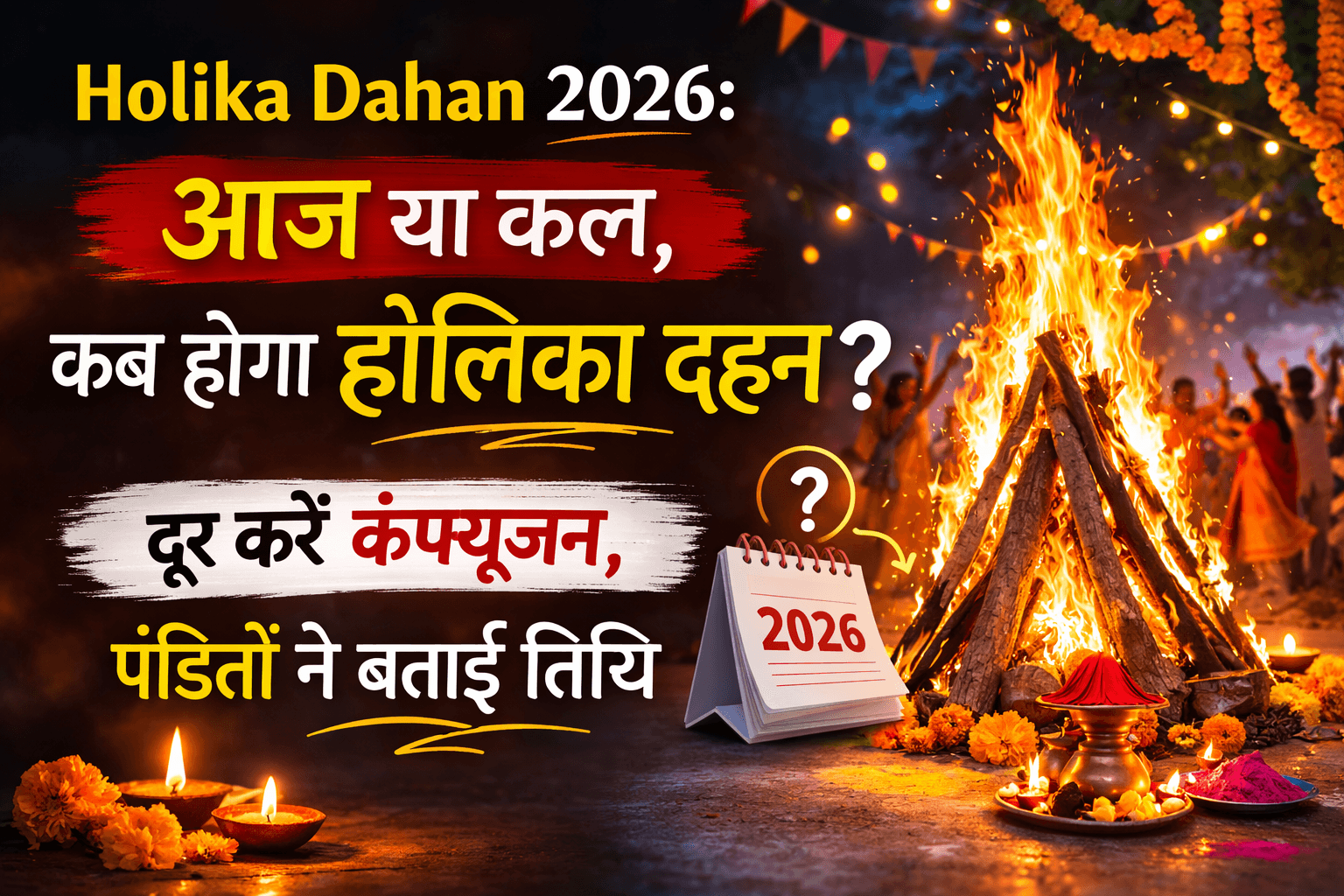
- Holika Dahan 2026 should be performed on the evening of March 2 — specifically between 6:22 PM and 8:53 PM IST — as confirmed by jyotishacharyas citing Drik Panchang and multiple traditional panchangs.
- Bhadra Kaal begins on March 2 at approximately 5:28 PM–5:58 PM (sources vary slightly) and continues until 5:23–5:30 AM on March 3 — making March 3 evening unsuitable for Holika Dahan.
- A Chandra Grahan (Total Lunar Eclipse) occurs on March 3, 2026, with the eclipse beginning at 3:20 PM IST and the maximum eclipse visible at 6:33–6:40 PM IST. The Sutak Kaal for the eclipse begins at 9:39 AM on March 3 for the general public.
- Rangwali Holi (Dhulandi) — the festival of colours — is confirmed for Wednesday, March 4, 2026.
- Mathura and Vrindavan Holi celebrations are unaffected; the Barsana lathmar Holi has already concluded, and March 4 brings the main rang celebration at Banke Bihari Temple and Dauji Temple.
I’ve been following Holi Panchang for years, and this is the year that genuinely required some untangling. Not because the tradition has changed — it hasn’t, not by a syllable. But because three celestial events are coinciding in 2026 in a way they haven’t for decades: Purnima tithi falling across two dates, Bhadra Kaal arriving at an awkward hour, and a Total Chandra Grahan landing right in the middle of it all on March 3.
If your family WhatsApp group has been running a respectful but increasingly urgent debate about which evening to light the bonfire — you’re in the right place.
Direct Answer: Holika Dahan 2026 should be observed on the evening of March 2, 2026, between 6:22 PM and 8:53 PM IST. This is the shubh muhurat recommended by jyotishacharyas because it falls within Pradosh Kaal while Purnima tithi is active and before Bhadra Kaal becomes dominant. March 3 is unsuitable due to the Chandra Grahan and associated Sutak Kaal. Rangwali Holi is on March 4, 2026.
Why This Year’s Holika Dahan Timing Is Unusually Complex
Let me walk you through the Panchang logic carefully — because once you understand it, the confusion dissolves completely.
The rule is ancient and consistent: Holika Dahan must be performed on Purnima Tithi, during Pradosh Kaal, in a period free from Bhadra. That’s the three-way requirement. Miss any one of them, and the ritual falls outside its prescribed shubh window.
Here’s what the 2026 Panchang says. According to Drik Panchang — one of the most widely referenced digital Panchang sources among both traditional scholars and contemporary practitioners — Phalguna Purnima Tithi begins on March 2 at 5:55–5:57 PM IST and ends on March 3 at 5:07–5:08 PM IST. So Purnima technically spans both dates. That’s the source of the initial confusion: technically, both March 2 and March 3 fall under Purnima.
The reason March 3 gets eliminated is what happens on that date. Bhadra Kaal begins on March 2 at approximately 5:28–5:58 PM (different panchangs show slightly different minute-level readings) and runs through until 5:23–5:30 AM on March 3. Scripturally, Bhadra is inauspicious for Holika Dahan — the Agni is not lit during Bhadra. The brief window between Bhadra’s end (around 5:23 AM on March 3) and the beginning of Sutak Kaal for the Chandra Grahan (9:39 AM on March 3) is technically available — but practically, it falls in the early hours of the morning, not during the traditional evening Pradosh Kaal that characterises the Holika Dahan ritual.
And then the Chandra Grahan itself begins at 3:20 PM on March 3, with Sutak Kaal starting at 9:39 AM for adults and 3:28 PM for children, the elderly, and pregnant women. Performing any shubh ritual — and Holika Dahan is among the most significant annual rituals — during Sutak is considered inappropriate across virtually all traditional authorities.
The conclusion of senior jyotishacharyas quoted by Aaj Tak, Amar Ujala, and India TV News is unified: March 2, 2026, evening, between 6:22 PM and 8:53 PM IST, is the correct and auspicious time for Holika Dahan.
Holika Dahan 2026 Shubh Muhurat: The Exact Window and What to Do In It
Time is specific this year. Don’t rush — but don’t delay either.
The confirmed shubh muhurat is: 6:22 PM to 8:53 PM IST on March 2, 2026.
This window represents the overlap of three conditions: Pradosh Kaal (the period beginning approximately 1 hour 36 minutes after sunset), active Purnima Tithi (which begins at 5:55 PM on March 2), and the narrow pre-Bhadra gap before Bhadra becomes fully dominant. Most traditional authorities recommend performing the actual dahan (lighting of the bonfire) as early in this window as possible — ideally between 6:22 PM and 7:30 PM — so that the ritual is well-established before the Bhadra period deepens into the night.
The puja samagri — the offerings for the Holika Dahan ritual — typically includes raw cow dung or cow dung cakes (for constructing the Holika), wood, roli (red paste), akshat (unbroken rice), flowers, a coconut, new wheat ears (jau), and a garland of cotton thread (moli). The puja begins with the symbolic construction of Holika — the demoness in the legend — and Prahlad figures from cow dung, placed at the base of the bonfire.
The circumambulation (parikrama) of the burning Holika is traditionally done three or seven times while offering the samagri and chanting mantras. The most commonly recited mantra during Holika Dahan is:
“असितो देव सहसा त्वमसि प्रमाणम्।”
The burning coconut placed in the fire represents the ego — the arrogance of Holika — being reduced to ash. The wheat ears roasted in the fire are brought home and shared among family members as prasad, symbolic of the purification of one’s household through the sacred flame.
Understanding Bhadra Kaal: Why These Hours Are Off-Limits
Bhadra — also known as Vishti Karana in Panchang terminology — is one of the eleven Karanas that govern specific time periods in the Hindu calendar. Shastrically speaking, Bhadra is associated with Shani (Saturn) and represents an energetically inauspicious period for auspicious undertakings.
For Holika Dahan specifically, the prohibition on Bhadra is explicit in the Dharma Sindhu, one of the authoritative texts on Hindu ritual timings: “Bhadra mukhe holikam na dahet” — “Do not perform Holika Dahan during Bhadra Mukha.” The Bhadra is divided into two portions — Bhadra Puchha (the tail, considered less inauspicious) and Bhadra Mukha (the face, strictly prohibited). Some traditions permit performing Holika Dahan during Bhadra Puchha, which as per Drik Panchang on March 2 falls between 1:25 AM and 2:35 AM on the night of March 2–3. However, most householders and priests prefer to work within the earlier 6:22–8:53 PM shubh muhurat rather than wait until the middle of the night.
“Shastriya maryada ke anusar, yadi kisi varsh Purnima tithi par grahan ho raha ho, to grahan se poorv ki raat bhadra rahit samay mein Holika Dahan karna shubh rehta hai.” — According to Amar Ujala’s jyotish desk quoting traditional Dharma Sindhu guidelines, March 2, 2026
The reason so many families feel confused this year is that Bhadra begins on March 2 at almost exactly the same time that Purnima Tithi begins (5:55 PM vs 5:28/5:58 PM depending on your panchang). This creates what appears to be an impossible situation — how can you perform Holika Dahan on Purnima but before Bhadra, when they start almost simultaneously? The answer is that Pradosh Kaal, which governs the Holika Dahan window, begins approximately 90 minutes after sunset — and because Bhadra begins at around the time of sunset, there is a small but valid window between Bhadra’s commencement and its full dominance that scholars identify as the shubh muhurat.
Chandra Grahan on 3rd March 2026: Full Timing and What It Means
The Chandra Grahan on 3rd March 2026 is a Total Lunar Eclipse — also called a Blood Moon — and it falls squarely on Phalguna Purnima, the same Purnima that governs Holi. This conjunction hasn’t occurred in this combination for a significant number of years, which partly explains why the 2026 Holi calendar has been discussed so widely.
Here are the confirmed eclipse timings according to Drik Panchang, as cited by Goodreturns:
The Penumbral Eclipse begins at 1:30 PM IST on March 3. The Partial Eclipse begins at 2:34 PM IST. The Total Eclipse (Grahan) begins at 3:20 PM IST. The Maximum Eclipse — the deepest, most visible phase, when the Moon turns its characteristic copper-red or blood-orange colour — occurs at 6:33–6:40 PM IST. The Total Eclipse ends at 7:53 PM IST. The Partial Eclipse ends at 8:47 PM IST, and the Penumbral Eclipse concludes at 10:00 PM IST.
Grahan Time on 3rd March: What Is and Isn’t Visible in India
The critical detail for Indian observers: this Total Lunar Eclipse is visible from India. The eclipse reaches its maximum during early evening on March 3, meaning the blood-red moon will be rising or already risen by the time it reaches totality — visible across most of the subcontinent in clear sky conditions.
Sutak Kaal: The Rules That Govern Ritual Activity During Eclipse
Sutak Kaal is the period of ritual abstinence before a grahan during which religious activities — puja, yagna, any major shubh karma — are traditionally suspended. Since this Chandra Grahan is visible in India, Sutak Kaal applies.
Per the confirmed Panchang calculations: General public Sutak begins at 9:39 AM on March 3, 2026. The eclipse concludes at approximately 6:46–6:47 PM IST on March 3, at which point Sutak ends and religious activities can resume.
For children under 16, elderly individuals, and pregnant women, a shorter Sutak window applies — beginning approximately 3 hours before the grahan itself, i.e., around 3:28 PM on March 3.
What this means in practical terms: major temple doors across India are being kept closed for variable durations on March 3. According to Dainik Bhaskar’s reporting on temples in Madhya Pradesh, the doors of Mata temples in the Sendhwa region remained closed for approximately 12 hours and 24 minutes on March 3 due to the combined Bhadra and Grahan impact. Mathura’s major temples — including Banke Bihari, Dwarkadhish, and others — have similarly announced modified darshan timings for March 3.
Holi in Mathura and Vrindavan 2026: When the Real Magic Happens
Mathura and Vrindavan experience Holi not as a single day but as a full fortnight of celebrations, beginning with Barsana’s famous Lathmar Holi (where women playfully beat men with lathis, and men defend with shields) and continuing through to the Rangpanchami celebrations five days after Holi.
The Holika Dahan at Nandgaon and Phalen — traditional to Braj culture and distinct from the common bonfire ritual — was observed on the designated auspicious timing. The main Rangwali Holi at Vrindavan’s Banke Bihari Temple and Mathura’s Vishram Ghat will take place on March 4, 2026.
Kathavachak Devkinandan Thakur Ji — the widely followed Mathura-based spiritual speaker — addressing his followers on the do’s and don’ts during Chandra Grahan, specifically advised: performing Holika Dahan on March 2 in the prescribed evening window; refraining from food cooked before Sutak during the Grahan period; bathing after the Grahan concludes before resuming any religious activity; and avoiding looking directly at the eclipsed moon without proper ritual context (the astronomical eclipse is distinct from its Shastric treatment, and both can be observed alongside each other with appropriate intention).
The Legend Behind the Fire: Why Holika Dahan Carries This Weight
The bonfire isn’t just a bonfire. It carries one of Hinduism’s oldest parables about the indestructible nature of genuine faith.
Prince Prahlad — an ardent devotee of Lord Vishnu — was the son of the demon king Hiranyakashipu, who had acquired a boon that made him effectively invincible within a long list of specific conditions. Furious at his own son’s unwavering devotion to Vishnu (whom he considered his enemy), Hiranyakashipu ordered multiple attempts on Prahlad’s life, each of which failed. His sister Holika had a boon of her own: she could not be burned by fire. Hiranyakashipu directed her to sit in a bonfire with Prahlad in her lap, confident the boy would perish while Holika survived.
What happened instead: Prahlad’s absolute, unquestioning surrender to Lord Vishnu created a protection that no earthly boon could override. Holika’s immunity, activated through malicious intent, failed her. She burned. Prahlad walked out unharmed.
“Holika Dahan is not a ritual about fire. It is a ritual about what fire cannot touch — the faith that Prahlad carried in his chest.”
This is why the parikrama of the Holika bonfire matters. You are not circling a fire. You are circling the moment that proved faith is more durable than power, more real than boons, and more protective than any earthly armour. Carrying your sorrows, your anxieties, your past year’s accumulated weight around that fire and offering them to the flame — that’s the spiritual technology Holika Dahan gives you, one night a year.
What to Do and Avoid During the Chandra Grahan Period on March 3
This section is practical and grounded in traditional guidance — not superstition, but long-observed ritual protocol.
What to do during Sutak and Grahan (9:39 AM to 6:46 PM on March 3): Chant the name of Ishta Dev — Lord Vishnu’s name, specifically the Vishnu Sahasranama or the simple japa of “Om Namo Bhagavate Vasudevaya,” is particularly auspicious during Chandra Grahan according to both traditional texts and contemporary scholars. Pregnant women should remain indoors during the grahan period and may carry a blade of Kusha grass near them as a traditional protective measure. After the grahan concludes, bathe, change into fresh clothes, and perform evening puja before eating.
What to avoid: Avoid cooking and eating food during the full Sutak period if you follow traditional practice — food cooked before Sutak can be kept by adding Tulsi leaves (Tulsi is believed to maintain sanctity). Avoid starting new undertakings — signing contracts, financial transactions, and major decisions traditionally wait until after the Grahan. Temple darshan is suspended during the eclipse period at most traditional temples; check your local temple’s announced schedule.
The Night the Sky and the Earth Celebrate Together
There is something unusually beautiful about Holi 2026 — if you can step back far enough from the timing confusion to see it.
A Blood Moon on Phalguna Purnima. The full moon of the festival that celebrates colour and fire and the defeat of darkness — turning itself blood-red in the sky. The bonfire below and the crimson moon above. I don’t know the last time this particular visual coincidence occurred on this exact festival. I know it won’t happen again for years.
Light your bonfire on March 2 evening, in the shubh muhurat between 6:22 PM and 8:53 PM. Do the parikrama with your family. Offer whatever you want to let go of to the Agni. And then, the next night — March 3 — once the eclipse concludes and Sutak ends after 6:47 PM, step outside and look up. The moon that was blood-red during Grahan will be clearing, returning to its full white brightness. There’s a certain rightness to that image: the darkness passing, the light returning, Prahlad walking out of the fire.
Holi is always about that moment. This year, the sky is putting it on rather spectacular display.
Shubh Holika Dahan. Happy Holi 2026.
Tell me in the comments: which city are you celebrating in this year, and how does your family’s Holika Dahan tradition differ? I’d love to hear about the regional variations — especially from Mathura, Vrindavan, Gujarat, and Maharashtra, where Holi has its own distinctive flavour.
External Authority References
- Drik Panchang — Holika Dahan 2026 Muhurat Calculator
- Aaj Tak — Holika Dahan 2026 Jyotishacharya Guidance, March 2, 2026
- Amar Ujala — Holika Dahan 2026 Panchang and Bhadra Timing, March 2, 2026
FAQ: Everything Your Family Is Still Asking
Is Holika Dahan on March 2 or March 3 in 2026?
Holika Dahan 2026 should be performed on March 2, 2026, between 6:22 PM and 8:53 PM IST. March 3 is not suitable due to the Chandra Grahan and associated Sutak Kaal, which begin at 9:39 AM on that date and restrict all major religious rituals.
What is the Chandra Grahan time on 3rd March 2026?
The Total Lunar Eclipse on March 3, 2026 begins its total phase at 3:20 PM IST. The maximum eclipse (Blood Moon) is visible at 6:33–6:40 PM IST. The total phase ends at 7:53 PM IST, and the eclipse concludes fully at approximately 10:00 PM IST. Sutak Kaal for the general public runs from 9:39 AM to 6:46 PM on March 3.
When does Holi 2026 (Rangwali Holi / Dhulandi) take place?
Rangwali Holi — the festival of colours — is on Wednesday, March 4, 2026, across most of India. In Braj region (Mathura-Vrindavan), the celebration continues through Rangpanchami on March 8.
Can Holika Dahan be performed during Bhadra Puchha on the night of March 2–3?
Yes, but only if you cannot observe it in the primary 6:22–8:53 PM window. Bhadra Puchha — the tail portion of Bhadra, which is less inauspicious than Bhadra Mukha — falls between 1:25 AM and 2:35 AM on the night of March 2–3. Performing Holika Dahan during this window is Shastric-ally permissible but logistically difficult for most households.
Should we look at the Blood Moon on March 3?
From an astronomical standpoint, a Total Lunar Eclipse (Blood Moon) is completely safe to view with the naked eye — unlike a solar eclipse, which requires protective eyewear. The red colour is caused by Earth’s atmosphere refracting sunlight around the planet onto the moon’s surface. From a traditional ritual standpoint, viewing the grahan in a meditative, devotional spirit while chanting is considered positive.
What temples will be closed on March 3 due to the Chandra Grahan?
Most traditional temples across India will close their gates during the Sutak and Grahan period (roughly 9:39 AM to 6:47 PM on March 3). Mata temples in Madhya Pradesh’s Barwani district have announced closures of approximately 12 hours 24 minutes. Mathura temples, including Banke Bihari, are operating on restricted darshan schedules. Contact your local temple directly for confirmed timings.