Quick Summary
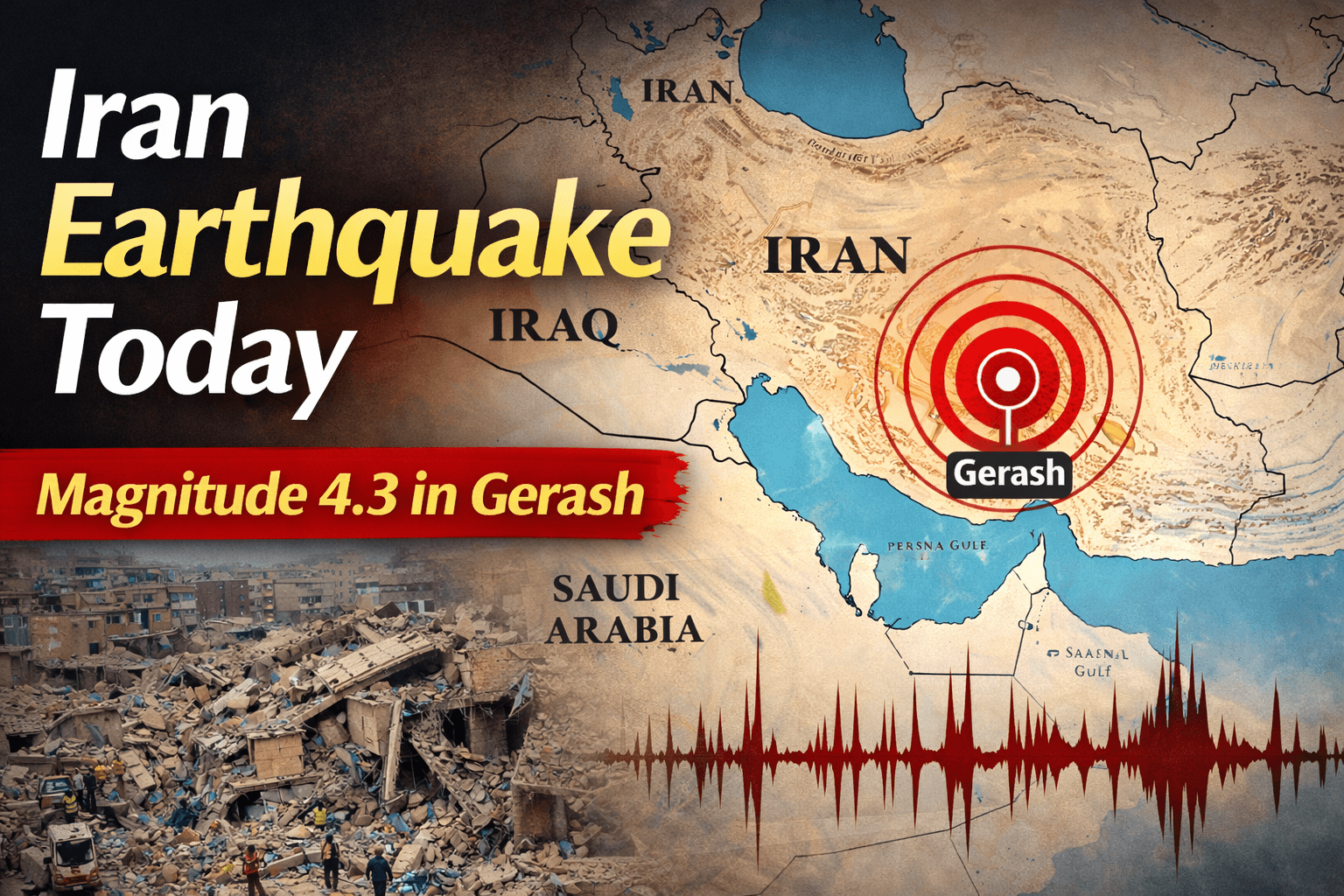
- A magnitude 4.3 earthquake struck near Gerash in southern Iran.
- No confirmed reports of casualties or major damage.
- “Iran nuclear” searches rose alongside the earthquake.
- No official link between the tremor and nuclear facilities.
- The region is geologically prone to earthquakes.
A magnitude 4.3 earthquake struck southern Iran today, triggering a spike in searches across India and other regions. The tremor, reported near the city of Gerash, was felt locally but, as of early updates, there are no immediate reports of major damage or casualties.
Searches for “Iran earthquake today,” “earthquake today in Iran,” and “Iran earthquake news” rose sharply within hours of the incident. Queries linking the quake to nuclear facilities and geopolitical tensions also began trending, reflecting wider regional concerns.
Here is a clear breakdown of what happened, where it struck, and what it means.
Where Did the Earthquake Strike?
The earthquake occurred near Gerash, a city located in the southern part of Iran in Fars province. Gerash lies in a region known for periodic seismic activity due to its proximity to active fault systems.
According to initial seismic data circulating through monitoring agencies, the tremor registered at magnitude 4.3. The epicenter was located close to Gerash, though exact depth and coordinates may vary slightly depending on the reporting seismic center.
Southern Iran sits within one of the world’s most active seismic belts, where the Arabian tectonic plate pushes against the Eurasian plate. This geological interaction makes the region prone to moderate and, at times, powerful earthquakes.
What Was the Magnitude and How Strong Is 4.3?
A magnitude 4.3 earthquake is classified as a light to moderate tremor. At this strength:
- Shaking is noticeable indoors.
- Hanging objects may sway.
- Minor cracks can occur in weak structures.
- Significant structural damage is unlikely.
For comparison, earthquakes above magnitude 6.0 often cause serious structural damage, while those above 7.0 can be devastating.
In today’s case, early reports suggest the tremor was felt locally but did not cause widespread destruction.
Were There Any Casualties or Damage?
As of the latest available updates:
- No confirmed fatalities have been reported.
- There are no immediate reports of major infrastructure damage.
- Local authorities are assessing the situation.
In earthquake events of this scale, emergency teams typically conduct rapid assessments of public buildings, hospitals, and transportation systems to ensure structural safety.
If aftershocks occur, authorities may issue advisories urging residents to remain cautious.
This article will be updated if official damage reports emerge.
Why Is “Iran Nuclear” Trending Alongside the Earthquake?
One of the most notable aspects of today’s search trend is the parallel rise in queries such as:
- “Iran nuclear”
- “Iran nuclear test”
- “Iran earthquake nuclear”
- “Iran Israel war”
This appears to be driven by online speculation rather than confirmed information.
Iran’s nuclear facilities, including those in Natanz and other regions, are frequently discussed in global news due to geopolitical tensions. Whenever seismic activity occurs in the country, some social media users speculate about possible links to underground tests or military developments.
However, at this stage:
- There is no official statement linking the earthquake to nuclear activity.
- No credible agency has reported signs of an explosion.
- Seismic data indicates a natural tectonic event.
It is important to rely on verified information rather than speculation, especially in geopolitically sensitive contexts.
Is Iran Prone to Earthquakes?
Yes. Iran is one of the most seismically active countries in the world.
The country lies along the boundary where the Arabian plate collides with the Eurasian plate. This collision has created multiple fault lines stretching across the region.
Historically, Iran has experienced devastating earthquakes, including:
- The 2003 Bam earthquake (magnitude 6.6), which caused widespread destruction.
- Several strong tremors in western and southern provinces over the past decade.
Moderate earthquakes like today’s 4.3 magnitude tremor are not uncommon in southern Iran.
How Do Authorities Respond to Moderate Earthquakes?
In incidents like this, the typical response involves:
- Immediate seismic analysis by national monitoring agencies.
- Field inspections by local disaster management teams.
- Public advisories regarding aftershocks.
- Structural safety checks in schools and hospitals.
Aftershocks can follow initial tremors, though they are usually weaker.
Residents in affected regions are often advised to:
- Avoid damaged buildings.
- Stay alert for falling debris.
- Follow updates from official channels.
Understanding Aftershock Risk
After a magnitude 4.3 earthquake, aftershocks are possible but typically mild. The probability of a significantly stronger aftershock following a moderate tremor is low, though not impossible.
Seismologists generally monitor:
- Depth of the quake
- Fault activity in the region
- Stress distribution patterns
Southern Iran’s fault systems can produce clusters of smaller tremors over days or weeks.
Why Is This Trending in India?
Google Trends data from the past four hours shows a sharp rise in searches from India. Several factors may explain this:
- High public interest in global geopolitical developments.
- Ongoing discussions around Iran’s nuclear program.
- General curiosity about international earthquake events.
- Algorithm-driven amplification of trending topics.
When a country like Iran trends alongside keywords such as “nuclear” or “Israel war,” search behavior typically accelerates.
This pattern reflects not just concern about natural disasters, but also broader geopolitical awareness among digital audiences.
What Is Gerash and Where Is It Located?
Gerash is a city in Fars province in southern Iran. It is not among the largest cities in the country, but it lies within a region historically affected by seismic movement.
The province itself has experienced periodic earthquakes over the years due to tectonic plate interactions.
Understanding the location helps clarify that today’s tremor occurred in a geologically active zone rather than near major metropolitan centers like Tehran.
Earthquake Monitoring and Seismic Transparency
Modern seismic monitoring allows agencies worldwide to detect earthquakes within minutes. Multiple international centers cross-verify magnitude and epicenter location.
Data points usually include:
- Magnitude (on the Richter or moment magnitude scale)
- Depth of the quake
- Latitude and longitude coordinates
- Time of occurrence (UTC)
If this tremor had been linked to a man-made explosion, seismic signatures would differ. Experts analyze wave patterns to distinguish between natural tectonic movement and artificial detonations.
At this time, there is no verified evidence suggesting anything other than natural seismic activity.
What Happens Next?
In most cases involving moderate earthquakes:
- News attention peaks within 12–24 hours.
- Updates clarify damage and casualty status.
- Search interest gradually declines.
If no significant aftershocks or damage reports emerge, this event will likely remain classified as a minor seismic incident.
However, if further tremors occur, coverage may expand.
Final Word
Today’s Iran earthquake appears to be a natural tectonic event of moderate intensity. While search trends have linked it to broader geopolitical topics, no verified reports suggest anything beyond routine seismic activity.
As with all developing situations, updates will depend on official confirmations from local authorities and seismic monitoring agencies.
For now, the focus remains on monitoring aftershocks and ensuring public safety in the affected region.
This article will be updated if new verified information becomes available.
FAQs
What was the magnitude of the Iran earthquake today?
The tremor measured 4.3 in magnitude.
Where did the earthquake occur?
It struck near Gerash in southern Iran.
Was the earthquake linked to a nuclear test?
There is no official confirmation or credible evidence linking it to nuclear activity.
Were there casualties?
As of early reports, no fatalities have been confirmed.
Is Iran earthquake-prone?
Yes, the country sits along active tectonic fault lines.