Inside the U.S. Submarine Torpedo Strike That Sank Iran’s IRIS Dena
The Incident That Shocked the Indian Ocean
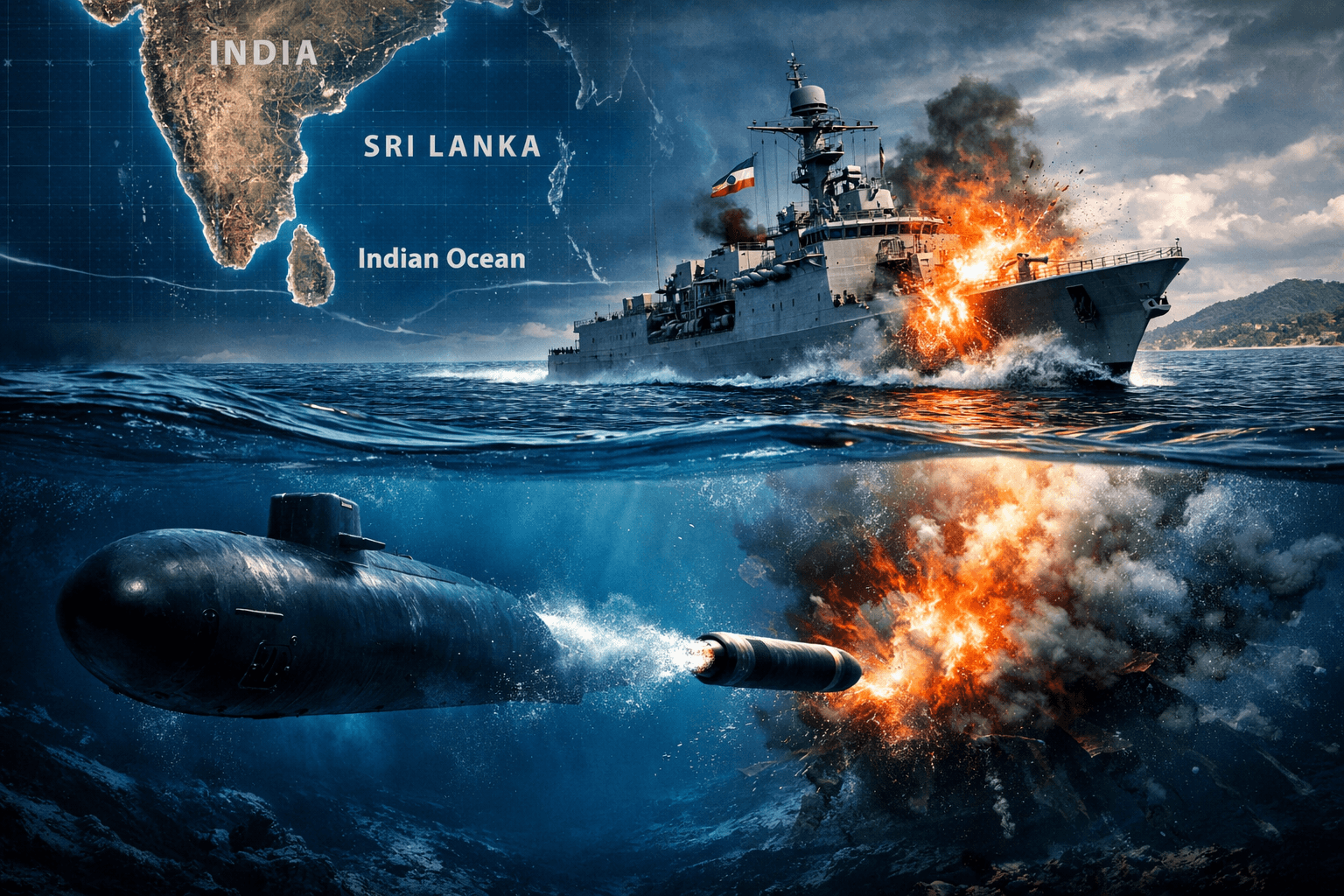
In one of the most dramatic naval incidents in decades, a United States Navy submarine torpedoed and sank the Iranian frigate IRIS Dena in the Indian Ocean near Sri Lanka on 4 March 2026. The strike killed at least 87 sailors, with dozens still missing, and immediately raised fears that the escalating confrontation between Washington and Tehran had expanded beyond the Middle East into South Asia’s strategic waters.
The warship went down roughly 40 nautical miles south of Galle, Sri Lanka, after a U.S. submarine launched a Mark-48 heavyweight torpedo, one of the most powerful anti-ship weapons in the U.S. naval arsenal.
What makes the event even more remarkable is that it marks the first confirmed instance of a U.S. submarine sinking an enemy warship with a torpedo since World War II, a rare and highly consequential moment in modern naval warfare.
But one question has dominated global headlines since the attack: Why was an Iranian warship operating in the Indian Ocean near Sri Lanka in the first place?
Why the Iranian Ship Was in the Indian Ocean
The Iranian frigate IRIS Dena had recently participated in MILAN 2026, a major multinational naval exercise hosted by India in Visakhapatnam on the Bay of Bengal.
Key reasons for the ship’s presence in the region:
1. Participation in India’s MILAN naval exercise
MILAN is one of the largest multinational naval drills in the Indo-Pacific, bringing together dozens of navies for exercises focused on maritime security, humanitarian assistance, and interoperability.
Iran sent IRIS Dena as part of its effort to expand diplomatic and military engagement beyond the Persian Gulf.
2. Demonstrating Iran’s “blue-water navy” ambitions
Iran’s navy has long sought to operate outside its traditional regional waters. Deploying a modern frigate to the Indian Ocean and Bay of Bengal helps Tehran showcase its ability to conduct long-range naval missions.
3. Strengthening strategic ties
Participation in international exercises allows Iran to maintain defense relationships and visibility in global maritime forums despite sanctions.
4. Return voyage to Iran
When the attack occurred, the ship was reportedly returning to Iran after the exercise, sailing through the Indian Ocean shipping lanes.
In short, the vessel was not on an offensive mission, but on a transit voyage after attending an international naval event.
What Happened During the Submarine Attack
According to U.S. defense officials, a nuclear-powered American submarine tracked the Iranian frigate before launching a single Mark-48 torpedo.
The torpedo detonated beneath the ship’s hull, creating a massive underwater explosion that split the vessel and caused it to sink rapidly.
Key facts about the attack
- Date: 4 March 2026
- Location: Indian Ocean, south of Sri Lanka
- Target: Iranian Moudge-class frigate IRIS Dena
- Weapon: Mark-48 heavyweight torpedo
- Crew onboard: ~180 sailors
- Casualties: 87 confirmed dead, dozens missing
- Survivors rescued: 32 sailors by Sri Lankan navy
Sri Lanka launched a search-and-rescue operation after receiving a distress call, recovering bodies and survivors from the water.
What Is IRIS Dena?
IRIS Dena was one of Iran’s most advanced domestically built warships.
Technical overview
- Class: Moudge-class guided-missile frigate
- Commissioned: 2021
- Displacement: ~1,500 tonnes
- Length: ~95 meters
- Top speed: ~30 knots
- Armament: anti-ship missiles, torpedoes, naval guns, surface-to-air missiles
- Aircraft: helicopter landing pad
The vessel was considered a key component of Iran’s strategy to modernize its navy and operate beyond regional waters.
Why the Strike Is Strategically Significant
The sinking of IRIS Dena is not just a battlefield incident—it signals a major shift in the geography of the Iran-US conflict.
1. Conflict spreading into the Indian Ocean
Until now, most Iran-related confrontations had occurred in the Persian Gulf, Iraq, Syria, or Israel-Iran theater.
This attack took place thousands of kilometers away, bringing tensions into India’s maritime neighborhood.
2. Strategic shipping lanes at risk
The Indian Ocean hosts some of the world’s busiest shipping routes linking:
- the Middle East
- South Asia
- Southeast Asia
- Europe
Any escalation here could affect energy supply chains and global trade.
3. Rare submarine combat
Submarine attacks on surface warships are extremely rare today.
Military historians note the last comparable event was during the Falklands War in 1982, when a British submarine sank Argentina’s cruiser ARA General Belgrano.
Iran’s Reaction and International Concerns
Iran condemned the strike, calling it an act of aggression and warning that retaliation could follow.
Analysts say the incident could trigger several consequences:
- escalation in the Middle East conflict
- increased naval deployments in the Indian Ocean
- diplomatic pressure at the United Nations
- concerns among regional powers like India, Sri Lanka, and China
Some legal experts have also questioned whether the strike violated international maritime law if the ship was not actively engaged in combat operations.
Why the Location Matters for India
The attack happened near Sri Lanka—within the broader Indian strategic maritime zone.
This matters because:
- India hosts MILAN naval exercises that include multiple global navies
- the Indian Ocean is central to India’s Indo-Pacific security strategy
- the region includes major energy routes and military bases
For India, the event highlights how quickly distant geopolitical conflicts can spill into nearby waters.
What Happens Next?
Several developments are expected in the coming weeks:
Possible scenarios
1. Naval escalation
More warships and submarines may enter the Indian Ocean.
2. Diplomatic pressure
Iran could pursue international legal action or sanctions.
3. Maritime security tightening
Shipping lanes around Sri Lanka and the Arabian Sea may see increased patrols.
4. Regional strategic recalibration
Countries such as India, China, and Gulf states will likely reassess naval deployments.
The Bigger Picture
The sinking of IRIS Dena may ultimately be remembered as a turning point in modern naval warfare.
It demonstrates:
- how submarine warfare remains one of the most lethal tools at sea
- how regional conflicts can rapidly expand into global maritime spaces
- how strategic waterways like the Indian Ocean are becoming new arenas of great-power rivalry
For now, the tragedy has left dozens of sailors dead and raised a pressing geopolitical question:
Is the Indian Ocean becoming the next front line of global conflict?
FAQ
What Iranian ship was sunk in the Indian Ocean?
The Iranian naval vessel that sank in the Indian Ocean was IRIS Dena, a Moudge-class guided missile frigate operated by the Iranian Navy. The ship reportedly went down near Sri Lanka after being struck by a torpedo launched from a U.S. submarine. IRIS Dena had previously participated in India’s MILAN 2026 naval exercise before beginning its return journey to Iran.
Why was the Iranian ship in the Indian Ocean?
The Iranian frigate IRIS Dena was in the Indian Ocean after attending the MILAN 2026 multinational naval exercise hosted by India in Visakhapatnam. The exercise included several international navies and focused on maritime cooperation and security. After the event, the Iranian ship was sailing back toward Iran when the attack reportedly occurred near Sri Lanka.
Where did the submarine attack happen?
The submarine strike reportedly occurred south of Sri Lanka in the Indian Ocean, a region that lies along one of the world’s busiest maritime trade routes. The area connects shipping lanes between the Middle East, South Asia, and Southeast Asia.
What weapon was used to sink the Iranian warship?
Reports indicate that a Mark-48 heavyweight torpedo was used in the attack. This torpedo is one of the most advanced submarine-launched weapons used by the United States Navy and is designed to destroy large naval vessels by detonating beneath the hull.
How many sailors were on the Iranian warship?
The Iranian frigate IRIS Dena reportedly had around 180 crew members onboard. Early reports indicated dozens of casualties, while rescue operations by Sri Lankan authorities recovered survivors from the sea.
What is the IRIS Dena warship?
IRIS Dena is a Moudge-class Iranian guided-missile frigate commissioned into service in 2021. It was built domestically by Iran as part of the country’s effort to expand its naval capabilities and operate beyond the Persian Gulf.
Key features include:
anti-ship missiles
naval guns
air defense systems
helicopter landing deck
The ship represents one of Iran’s more advanced indigenous naval platforms.
Why is the Indian Ocean strategically important?
The Indian Ocean is one of the most critical maritime regions in the world because it connects major global trade routes linking the Middle East, Asia, Africa, and Europe. Large volumes of oil, gas, and commercial cargo pass through these waters daily, making the region strategically important for global security and economic stability.
Could this incident escalate tensions between the U.S. and Iran?
Military analysts warn that incidents involving warships and submarines can significantly increase geopolitical tensions. The sinking of an Iranian naval vessel could potentially lead to diplomatic disputes, military escalation, or increased naval deployments in the region.