TL;DR — Key Takeaways
- Nothing Phone 4a launch date in India is confirmed: March 5, 2026 at 4:00 PM IST, exclusively on Flipkart. Sales begin March 12, 2026 for the standard model.
- Expected Nothing 4a price in India: ₹31,999 for the base 8GB + 256GB configuration (per multiple leaks via Smartprix, Digit, Analytics Insight — not yet officially confirmed).
- The phone features Snapdragon 7s Gen 4, a 6.7-inch 120Hz OLED display, triple 50MP cameras, and a 5,200–5,400mAh battery with 50W charging — confirmed via Beebom Gadgets and 91mobiles’ specification roundup.
- A new Glyph Bar replaces the classic Glyph Interface — six square lights and nine programmable mini-LEDs, brighter and more expressive than previous generations.
- Nothing Phone 4a Pro launches on the same date (March 5) but goes on sale March 26, 2026, at an expected ₹41,999–₹48,999. It upgrades to a 6.88-inch display and a larger 5,080mAh battery.
Nothing pulled a genuinely clever move last week. While the entire tech internet had its eyes on Apple’s March event, London-based Nothing dropped a deliberate, pointed teaser directly positioning the Phone 4a launch alongside it — same week, same audience, much better price. Bold is understating it.
The Nothing Phone 4a has been building anticipation since early 2026 through a steady drip of official teasers — first the Glyph Bar reveal, then the white colourway, then the pink. And now, three days before the actual launch event on March 5, the spec picture is tight enough that you can make a real purchase decision without waiting for the livestream.
The Nothing Phone 4a is a mid-range 5G smartphone launching in India on March 5, 2026, at 4:00 PM IST, exclusively on Flipkart. Expected India price is ₹31,999. It features a Snapdragon 7s Gen 4 processor, 6.7-inch 120Hz OLED display, triple 50MP camera system, 5,200mAh battery with 50W charging, and the new Glyph Bar lighting system. The Nothing Phone 4a Pro launches the same day at an expected ₹41,999–₹48,999.
Why Nothing Is Winning the Design Conversation in Mid-Range — Again
Before we get into specs, let’s talk about what Nothing is actually selling, because specs are only part of the story here.
Nothing was founded in 2020 by Carl Pei — the co-founder of OnePlus — with a single, specific bet: that there was a segment of smartphone buyers who were exhausted by anonymous-looking plastic and glass rectangles and wanted something that felt designed, not assembled. The Phone 1 proved the bet was right. The Phone 2 refined it. The 3a series validated that the aesthetic could work at sub-₹30,000 price points. And now the 4a series is doing what every good product generation does — raising the baseline while keeping the soul intact.
The new Glyph Bar is the physical proof of that evolution. Previous Nothing phones used the Glyph Interface — a collection of individually controlled LED segments on the back that could display notifications, charging status, and timers in a way that was genuinely novel. The Glyph Bar on the Phone 4a replaces those line segments with six square lights and nine programmable mini-LEDs. According to Nothing’s official reveal, the new system is brighter, more expressive, and — critically — more customisable via the Glyph developer kit that Nothing opened to third-party apps in late 2024.
This matters because the Glyph system isn’t a gimmick. It’s the thing that makes Nothing phones recognisable from across a café table. That recognisability — that “wait, what phone is that?” moment — is what Nothing’s brand is built on, and the 4a’s Glyph Bar takes it further than any previous model.
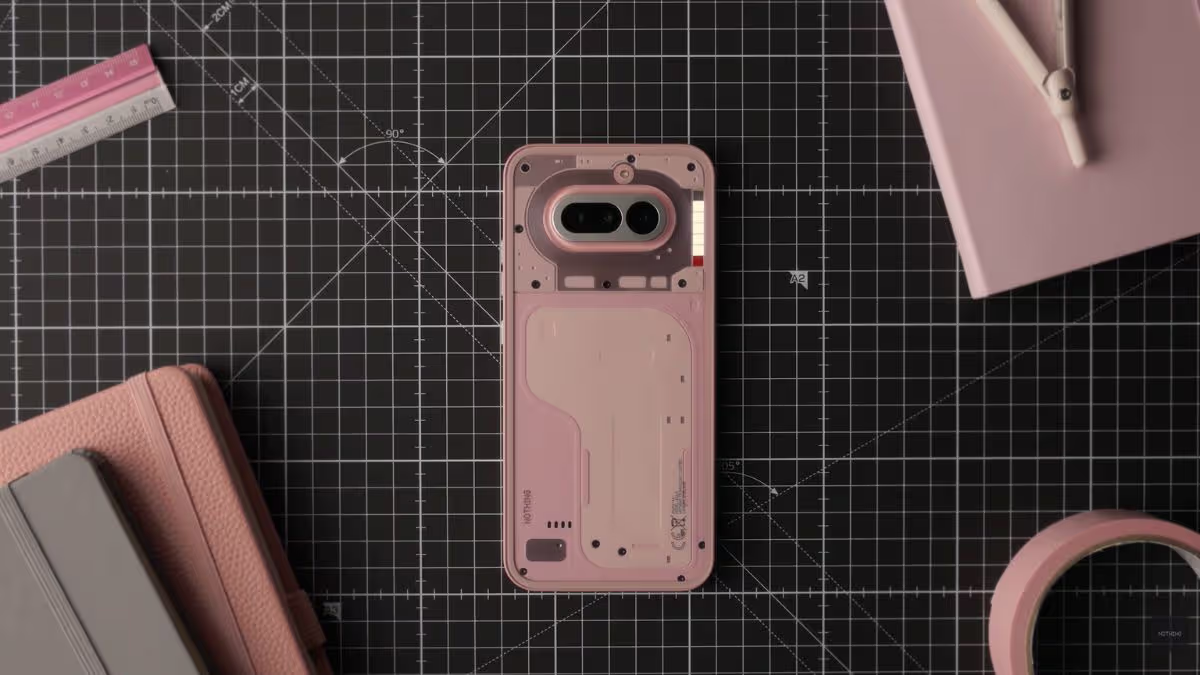
The pink colourway, teased by Nothing directly and covered extensively by Mashable in early March 2026, is the most unexpected design choice in the lineup. It’s not a muted, apologetic pastel. It’s a confident, saturated pink that Nothing showed off in official product photography knowing exactly what kind of conversation it would start. The pink 4a, alongside Black, White, Blue, and Yellow options, is a statement that Nothing’s target buyer isn’t a stereotyped demographic — it’s anyone who takes design seriously.
Nothing Phone 4a Specs: What’s Confirmed and What Isn’t (As of March 3)
I want to be precise here about sourcing, because the pre-launch spec environment for Nothing is always slightly chaotic — the company is better at teasers than traditional spec reveals, which means leaks fill the gap.
The Confirmed Hardware (Official Nothing sources + 91mobiles confirmed data)
Processor: Qualcomm Snapdragon 7s Gen 4 — confirmed via official Nothing teasers and corroborated by 91mobiles, Beebom Gadgets, and Digit India’s specification roundups.
Display: 6.7-inch OLED panel with 120Hz refresh rate — confirmed via official Nothing first-look imagery. Gorilla Glass Victus 2 protection has been mentioned in multiple reports.
Camera: Triple rear camera — 50MP primary + 50MP telephoto + 8MP ultrawide — confirmed via official Nothing communications per Smartprix and Beebom Gadgets. Front camera: 32MP with autofocus.
Battery: 5,200–5,400mAh (sources vary slightly in the 200mAh range) with 50W wired fast charging.
Software: Android 15 running Nothing OS 3.0 at launch, with Android 16 update confirmed for eligible Nothing phones.
Glyph Bar: Confirmed by Nothing — six square lights plus nine programmable mini-LEDs.
5G connectivity: Confirmed for all variants.
Specifications Still Being Clarified
The RAM configuration has been reported as both 8GB and 12GB across sources — consistent with a likely dual-configuration launch (8GB + 256GB base, 12GB + 256GB higher tier). The Cashify specification listing suggests the higher RAM variant at 12GB may be the expected norm; Digit India reports 12GB as the maximum.
UFS storage tier: 3.1 has been cited by multiple sources; a UFS 4.0 upgrade would be aspirational but hasn’t been confirmed.
The 144Hz AMOLED specification appearing in some listings (notably Cashify and Bajaj Finserv) likely refers to the Phone 4a Pro rather than the standard 4a, which is confirmed at 120Hz OLED. This is a common mix-up in pre-launch coverage when two variants share similar model names.
Nothing Phone 4a Price in India: The Number That Changes Everything
Here’s where the conversation gets genuinely consequential for buyers.
The Nothing Phone 3a launched in India at ₹19,999 — and at that price, it made every competing phone at ₹20,000 look slightly embarrassed. According to a Sportskeeda Tech report cited in the brief, the Phone 4a’s price leak suggests it will cost “significantly more” than the 3a. The emerging consensus across Smartprix (₹33,999), Digit India (₹31,999), and Analytics Insight (₹31,999–₹41,999 for the range) points to a ₹31,999–₹33,999 starting price for the base 8GB model.
That’s a ₹12,000 jump over the 3a’s launch price. It’s real money. And it puts the Nothing Phone 4a in direct competition with phones that, until recently, occupied a meaningfully different price tier.
“Nothing is no longer a budget brand trying to look premium. The Phone 4a’s pricing signals that Carl Pei is deliberately moving upmarket — and betting that enough buyers will follow the design.”
The phones now in the 4a’s crosshairs include the Redmi Note 15 Pro (₹27,999), the Samsung Galaxy A36 5G (expected ~₹35,000), the Motorola Edge 50 Fusion (₹24,999), and the Realme GT 6T (₹29,999). Smartprix’s own analyst note specifically flagged concerns about “value against Indian competitors like Oppo Reno 14” — a reasonable observation that underscores the competitive pressure Nothing faces at this price point.
The honest context: Nothing’s previous pricing advantage was structural — you got ₹35,000-worth of design and software at ₹20,000. At ₹32,000, the design and software argument still holds, but the hardware spec-per-rupee competition tightens considerably. Whether buyers value the Glyph Bar and Nothing OS’s aesthetic coherence at ₹12,000 premium over the 3a is the real question the March 5 launch will answer.
Nothing Phone 4a Pro: The One to Watch for March 26
The Nothing Phone 4a Pro is the more interesting device for power users, and its March 26 sale date gives you three weeks after the standard 4a’s March 12 availability to make a considered comparison.
The Pro upgrades are specific and meaningful. The display steps up to 6.88 inches with what multiple reports suggest is a 144Hz AMOLED panel — a real upgrade over the standard 4a’s 120Hz OLED both in refresh rate and in display technology (AMOLED’s true blacks and superior power efficiency in dark content are tangible advantages). The battery moves to 5,080mAh (slightly smaller than some 4a spec reports, but paired with what’s expected to be a more efficient display).
The chip situation in the Pro is where sources diverge most significantly. Beebom Gadgets lists Snapdragon 7s Gen 4 for both models; Analytics Insight mentions Snapdragon 8 Gen 3 for the Pro — which would represent a significant chip tier jump. The Snapdragon 8 Gen 3 is a 2023 flagship chip that still benchmarks comfortably above mid-range competition; its inclusion in a ~₹42,000-₹49,000 phone would be a strong value play. Given that the standard 4a uses 7s Gen 4, a Pro upgrade to 8 Gen 3 is plausible but requires official confirmation on March 5.
The Nothing Phone 4a Pro price is expected at ₹41,999–₹48,999, with the upper end of that range appearing in Beebom Gadgets’ most recent specification listing.
At ₹42,000–₹49,000, the Pro competes with the OnePlus 13s 5G (if officially launched by then), the Samsung Galaxy S24 FE (₹34,999, slightly below), and the iQOO Z10 Turbo (₹29,999, significantly below but with stronger raw chip performance). The Pro’s differentiators — the aesthetic, the larger display, the software experience, and Nothing OS’s consistent Android updates — are real. Whether they justify the premium over a functionally superior chip in a less distinctive chassis is a value judgment only the buyer can make.
The Software Story: Nothing OS and Why It Actually Matters
Nothing OS is consistently underrated in specification discussions because software doesn’t appear in a comparison table. But for anyone who has used a Nothing phone daily, it’s the reason they come back.
Nothing OS on the Phone 4a runs on Android 15 at launch, with Nothing OS 3.0 introducing several AI-powered features: on-device transcription improvements, enhanced Glyph customisation through third-party app integration, and tighter Material You theming that remains visually coherent across the entire interface.
The commitment to 3 years of Android OS updates and 4 years of security patches from Nothing is now confirmed policy — lower than Samsung’s 7-year promise on Galaxy A series but consistent with what most competing Android brands offer at this price. Given Nothing’s relatively young age as a company, the 3-year OS update commitment is a meaningful signal of software longevity intent.
What Nothing OS specifically excels at is cohesion. The typography — the Dot Matrix font, the monochrome icon system, the consistent spacing — makes the phone feel designed from the inside out, not assembled from disparate settings menus. For buyers who have spent three years fighting with MIUI notification management or Samsung’s One UI feature density, the Nothing OS experience is a genuine and immediately perceptible relief.
The Glyph developer kit — opened to third-party developers in late 2024 — means the Phone 4a’s Glyph Bar can be programmed to display custom notifications from apps like Google Maps, Zomato, Uber, and productivity tools. This is the feature that rewards long-term ownership in a way the spec sheet doesn’t capture.
Should You Buy the 4a or Wait for the Pro?
I want to give you a direct recommendation here rather than sitting on the fence, because you’ve probably already been on the fence for two months reading leaks.
Buy the standard Nothing Phone 4a if: you’re upgrading from a Nothing Phone 3a or any phone in the ₹20,000–₹25,000 bracket and want a clean step up; you care more about battery life and software experience than camera versatility; and the ₹12,000 savings over the Pro matter to your budget.
Wait for the Nothing Phone 4a Pro if: the display upgrade to AMOLED and higher resolution matters to you (and it should — for daily content consumption, AMOLED at 144Hz is noticeably better than OLED at 120Hz); you shoot a lot of photos and want the improved camera system; and you plan to keep this phone for three or more years, where the higher chip tier starts to justify itself.
Consider neither if: your primary benchmark for mid-range phones is raw processing power, in which case the iQOO Z10 Turbo (Dimensity 9300i) or OnePlus 13s (Snapdragon 8 Elite) offer significantly more compute at comparable or lower prices. Nothing’s value is in design and software coherence — if those dimensions don’t move you, the spec table doesn’t favour the 4a at ₹32,000.
Three Days to Launch. Here’s What I’d Do.
When the March 5 livestream drops at 4:00 PM IST, the two numbers that will tell you everything you need to know arrive in the first five minutes: the confirmed price and the confirmed chip specification for the Pro. Everything else — camera samples, display reviews, long-term software performance — will take weeks of hands-on testing to verify properly.
What I know right now: Nothing has built something worth watching closely. The Glyph Bar evolution is genuine. The pink colourway is genuinely bold. The move to Snapdragon 7s Gen 4 across both models (with a possible 8 Gen 3 in the Pro) represents a real performance generational upgrade.
Whether the pricing holds at ₹31,999 for the 4a and ₹41,999 for the Pro — or pushes higher — is the variable that will determine whether the Nothing Phone 4a is the mid-range story of Q1 2026 or simply a premium curiosity. Carl Pei has said publicly, repeatedly, that Nothing’s mission is to make technology feel human again. The Phone 4a is the most direct test yet of whether that mission has a large enough audience at a higher price point.
Three days. Watch the Flipkart page.
Are you planning to buy the Nothing Phone 4a or the Pro? Drop your current phone and the one feature that would make you commit in the comments. Especially interested in anyone cross-shopping with the OnePlus 13s or Samsung A36 5G — that’s the comparison most buyers are running right now.
External Authority References
- 91mobiles — Nothing Phone 4a Series Roundup: Launch Date, Specifications, and Expected Price
- Beebom Gadgets — Nothing Phone 4a Confirmed Specifications
- Digit India — Nothing Phone 4a Pro India Launch, Colours, and Price
FAQ: What You’re Actually Wondering Before March 5
What is the Nothing Phone 4a price in India?
The expected Nothing 4a price in India starts at ₹31,999 for the 8GB + 256GB variant, based on pre-launch leaks cited by Digit India, Analytics Insight, and Smartprix. Final official pricing will be confirmed at the launch event on March 5, 2026 at 4:00 PM IST. Check Flipkart for confirmed pricing immediately after the livestream.
When is the Nothing Phone 4a launch date in India?
Confirmed: March 5, 2026 at 4:00 PM IST. The launch will be live-streamed on Nothing India’s official website and Flipkart. Sale date for the standard 4a is March 12, 2026, exclusively on Flipkart.
What is the Nothing Phone 4a Pro price?
Expected at ₹41,999–₹48,999 in India, per Beebom Gadgets and Digit India’s specification roundups. The Pro goes on sale March 26, 2026, three weeks after the standard model.
Does the Nothing Phone 4a come in pink?
Yes. Nothing has officially teased the Phone 4a in Pink alongside White — both revealed in official product photography. Expected colour options across the 4a series include Black, White, Pink, Blue, and Yellow, though not all colours may be available at launch in all markets.
What is the Glyph Bar on the Nothing Phone 4a?
The Glyph Bar is Nothing’s updated rear lighting system on the Phone 4a, replacing the previous Glyph Interface. It features six square lights and nine programmable mini-LEDs on the back panel, customisable through Nothing OS to display notifications, charging status, timers, and third-party app alerts. It is confirmed by Nothing as a key feature of the 4a series.
How does the Nothing Phone 4a compare to Nothing Phone 3a?
The 4a upgrades the processor from Snapdragon 7s Gen 3 to Snapdragon 7s Gen 4, adds a triple camera system (including telephoto), upgrades the Glyph Interface to Glyph Bar with more LEDs, and increases battery capacity. The price jump is approximately ₹12,000 over the 3a’s ₹19,999 launch price — a meaningful increase that places the 4a in direct competition with the broader ₹30,000–₹35,000 mid-range field.