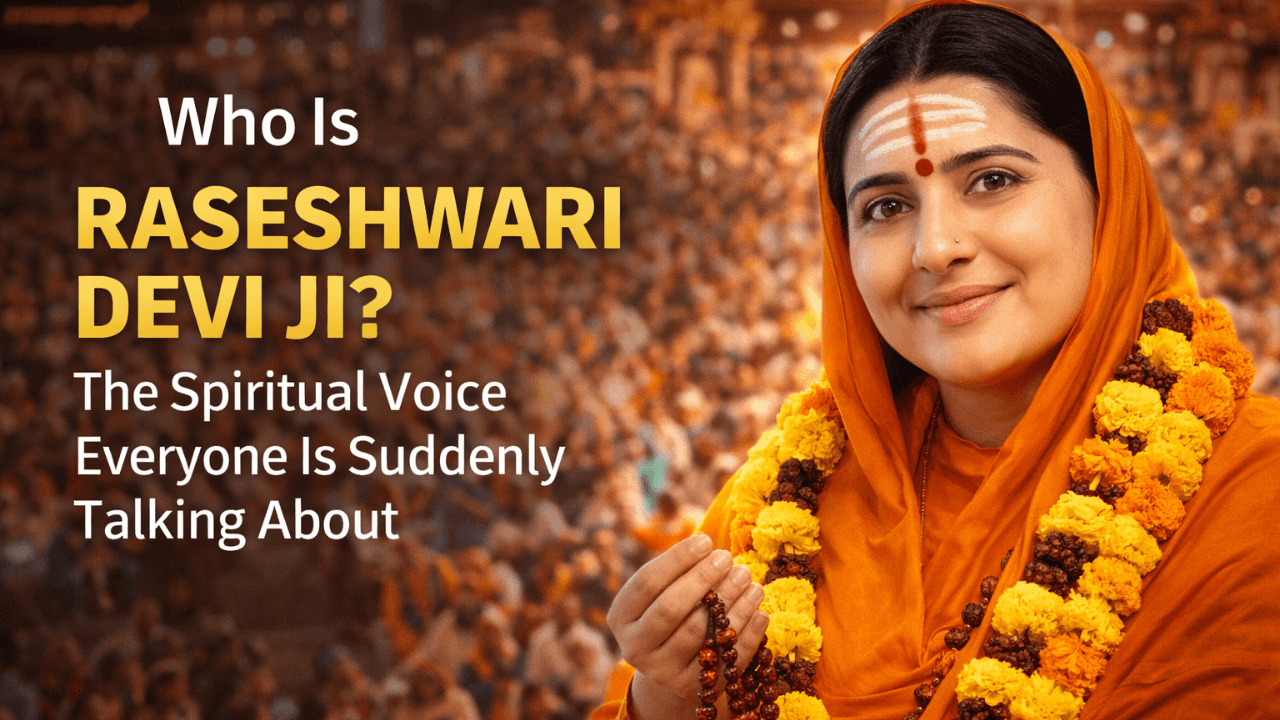
TL;DR — Key Takeaways
- On February 23, 2026, Pujaniya Raseshwari Devi Ji was awarded the prestigious Seva Samman Award at the Spiritual Conclave Odisha 2026, presented by Surama Padhy, Hon’ble Speaker of the Odisha Legislative Assembly.
- Born on January 12, 1968 in Bhilai, Chhattisgarh, she took sannyas at age 22 on October 15, 1988 — giving up a planned engineering career to become a full-time spiritual teacher.
- A devoted disciple of Jagadguru Kripalu Maharaj, she has conducted over 300 spiritual programs across 140 cities in 11 Indian states and established 21 meditation and spiritual practice centres, primarily in Odisha.
- She founded the Braj Gopika Seva Mission (BGSM) in 1996, which runs youth programs including Bal Sanskar Shivir (2007) and Yuva Utthan Shivir (2014), touching thousands of children and young people annually.
- In October 2025, she met President Droupadi Murmu at Rashtrapati Bhavan to discuss the role of Sanatan Dharma in holistic empowerment.
She gave up an engineering degree to sit in satsang. And in doing so, she has reached more people than most engineers ever will.
Pujaniya Raseshwari Devi Ji — spiritual teacher, Upanishadic scholar, and founder of Braj Gopika Seva Mission — has been quietly building one of the most extensive grassroots spiritual networks in modern India for over three decades. The latest Raseshwari Devi news has pushed her name into wider public consciousness: the Seva Samman Award at Odisha’s Spiritual Conclave 2026, presented by the Speaker of the Odisha Legislative Assembly, marks a moment of formal national recognition for a journey that began in a small city in Chhattisgarh in 1988.
But the recognition, for those who have followed her work, is long overdue.
Direct Answer: Pujaniya Raseshwari Devi Ji is an Indian spiritual teacher, Upanishadic scholar, and disciple of Jagadguru Kripalu Maharaj who took sannyas in 1988 at age 22. She founded the Braj Gopika Seva Mission in 1996, has conducted over 300 programs across 140 cities in 11 states, and received the Seva Samman Award at the Spiritual Conclave Odisha 2026 for her contributions to spiritual education and social upliftment.
The Beginning: A Prophecy, a Letter, and the Road Not Taken
Some spiritual journeys begin with a dramatic moment of crisis — illness, loss, collapse. Raseshwari Devi Ji’s began with a letter.
She was born on January 12, 1968 in Bhilai, Madhya Pradesh (now Chhattisgarh), into a family deeply devoted to Jagadguru Shri Kripalu Ji Maharaj. According to accounts documented on her official biography, she was barely 21 days old when Shri Maharaj Ji visited Bhilai for a discourse, met her parents, and made a quiet prophecy about the infant: “When she grows up, she will spread Shri Krishna’s bhakti across the world.”
Those who are skeptical of such stories should at least acknowledge this: the prophecy turned out to be accurate.
Growing up, Raseshwari Devi Ji was by all accounts a sharp, analytically gifted student — she completed her graduation in Mathematics from Bhilai University with distinction, and her post-graduation was in English. She had plans. Concrete ones. She wrote to Shri Maharaj Ji describing her intention to pursue engineering. His reply was immediate, direct, and just one word: “No.”
What followed was not immediate capitulation. It was a sustained period of correspondence, guidance, and deepening spiritual clarity that led her to make one of the most consequential decisions of her life. On October 15, 1988, at the age of 22, she took sannyas — renouncing material pursuit entirely — and committed herself to the propagation of Shri Krishna Bhakti and Upanishadic philosophy.
Her first public discourse took place in Durg, Chhattisgarh, in 1989. She was 21 years old. The audience was modest. The resolve was not.
What Pujaniya Raseshwari Devi Ji Actually Teaches — And Why It Resonates
To understand the scale of the response she generates, you have to understand what she’s actually saying — not just that she’s saying it.
The Upanishads are among the most demanding texts in all of Indian philosophical literature. They deal with the nature of Brahman, the relationship between Atman and the universal consciousness, the mechanics of karma and dharma, and the methodology of moksha. This is material that scholars spend careers untangling. Most public spiritual discourse in India either oversimplifies these texts to the point of meaninglessness or restricts them to an audience already fluent in Sanskrit philosophy.
Raseshwari Devi Ji does neither. As New York Weekly reported in May 2025, describing her teaching approach: she presents Upanishadic principles as living, applicable frameworks — ethical, societal, and spiritual guides for how to actually navigate a contemporary Indian life. Her discourses move between siddhant (principle) and bhav (devotional feeling) with a fluency that even advanced seekers find rare.
“She explains the highest truths in a way that both beginners and advanced seekers can understand — without ever diluting their essence.” — News24, August 2025
The Rupadhyana Meditation technique she teaches is specifically designed for modern practitioners. It’s Vedic in its roots but adapted to contemporary lifestyle constraints — a meditation form that students report reduces exam-related anxiety, improves concentration, and builds emotional resilience. This is not speculative: her Bal Sanskar Shivir programs, running since 2007, have introduced this practice to thousands of schoolchildren across India, with teachers and parents documenting behavioral improvements in focus, confidence, and self-regulation.
That’s not just spirituality. That’s measurable human development.
Building a Movement: 300 Programs, 140 Cities, 21 Centres
The scale of what Raseshwari Devi Ji has built deserves more attention than it typically receives, because it is genuinely extraordinary by any metric.
Over 35 years of active teaching, she has conducted more than 300 spiritual programs across 140 cities in 11 Indian states, according to multiple credible reports including Newspatrolling and Sangri Today. The geographic spread is deliberate — she has not concentrated her mission in metro cities where spiritual audiences are large but comfortable. She has gone to semi-urban Odisha, coastal communities, smaller towns in Chhattisgarh, rural camps where Upanishadic philosophy had not previously arrived in accessible form.
Under her guidance, 21 meditation and spiritual practice centres have been established, the majority in Odisha — a state she has treated as a primary mission field for over two decades. In 2023, she expanded BGSM’s reach through digital platforms, bringing recorded discourses, online satsangs, and guided meditation to villages and coastal communities that don’t have an accessible centre nearby. This digital expansion during and after the COVID-19 period was strategic, not reactive — she recognized that rural Odisha has smartphone penetration without temple infrastructure, and she met people where they were.
The Braj Gopika Seva Mission, which she founded in 1996, runs two flagship youth programs that have become significant cultural institutions in their own right. Bal Sanskar Shivir, launched in 2007, focuses on children — building moral values, cultural awareness, and self-discipline through structured residential camps. Yuva Utthan Shivir, launched in 2014, is aimed at young adults — helping them navigate the specific pressures of career competition, peer influence, and identity formation through a framework rooted in Sanatan Dharma rather than Instagram wellness culture.
The 12th Yuva Utthan Shivir, held at Jagadguru Kripalu Dham in Puri in December 2025, drew participants from across India. The contrast between what a youth retreat built on Vedic principles looks like versus what a motivational seminar circuit offers is not subtle. One addresses the surface of success; the other works on the foundation.
Raseshwari Devi Seva Samman Award: What February 23, 2026 Means
The Raseshwari Devi Seva Samman Award ceremony at the Spiritual Conclave Odisha 2026 was not a small event, and the context of who presented it matters.
Surama Padhy, the Hon’ble Speaker of the Odisha Legislative Assembly — the first woman to hold that position in Odisha’s history — personally presented the Seva Samman Award to Raseshwari Devi Ji on February 23, 2026. The conclave was hosted by MBC TV and BS TV, and the attendees read like a cross-section of Odisha’s most prominent figures: Pabitra Sounta, MLA of Laxmipur; Mangu Khilla, MLA of Chitrakonda; Golaka Mohapatra, Vice President of BJP Odisha; former Cabinet Minister Arabinda Dhali; Sudarshan Sahoo, Padma Vibhushan awardee; and Adwaita Gadanayak, Padma Shri awardee.
This was not a symbolic award in a small hall. This was a formal state-level recognition, in front of Odisha’s political, cultural, and spiritual establishment, of a woman who has worked in this state for over two decades — often in communities where state infrastructure hadn’t arrived first.
The significance, as observers at the event noted, is twofold. First, it validates the kind of grassroots spiritual education work that rarely makes national headlines but shapes communities from within. Second, it signals growing institutional acknowledgment that bhakti and social service are not separate tracks — that a spiritual leader who runs youth camps, establishes meditation centres, and expands digitally into rural communities is doing work that the state recognizes as developmental.
That recognition is rarer than it should be. When it comes, it matters.
The Meeting at Rashtrapati Bhavan: A Milestone Worth Understanding
The Seva Samman Award wasn’t the only significant event in recent months. On October 15, 2025 — her sannyas diwas, the anniversary of the day she took sannyas in 1988 — Raseshwari Devi Ji met President Droupadi Murmu at Rashtrapati Bhavan in New Delhi.
The meeting was reported by DNA India and Times Now, and the substance of it was specific: the discussion focused on how Sanatan Dharma can contribute to holistic empowerment in contemporary India. Raseshwari Devi Ji presented the work of BGSM to the President, explaining how the mission’s programs focus on character building, spiritual development, and integration of traditional Indian knowledge systems into modern education.
President Murmu — herself deeply connected to tribal and indigenous cultural traditions of Odisha, and a figure who has spoken consistently about the importance of India’s spiritual heritage — received the presentation with evident warmth, according to reports from the event.
What’s worth noting here is the timing. This meeting came at a point when public conversations about Sanatan Dharma had become politically charged in ways that sometimes obscure their content. Raseshwari Devi Ji’s approach — grounded in Upanishadic philosophy, oriented toward service and self-development, and presented without political framing — represents the living practice of that heritage rather than its political deployment. The distinction matters to the millions of Indians who take their spiritual lives seriously and want leadership that reflects the depth of the tradition, not its surface.
The Deeper Question: Why Is This Voice Resonating Right Now?
It would be convenient to attribute Raseshwari Devi Ji’s growing visibility solely to institutional recognition — the award, the presidential meeting, the national media coverage. But I think that misses something important.
India in 2025–2026 is a country experiencing acute contradictions. Economic growth and material aspiration have accelerated faster than any previous generation’s experience. And alongside that acceleration, there is a very visible, very widespread hunger for something the growth metrics don’t capture — for moral grounding, for a sense of meaning that isn’t indexed to income, for practices that quiet the mind rather than stimulate it further.
The wellness industry tries to fill this hunger with breathing apps and sound baths. Corporate culture tries to fill it with “purpose-driven” mission statements. What Raseshwari Devi Ji offers is neither of these things. She offers the actual tradition — the Upanishads as a living philosophical system, Krishna Bhakti as a felt practice, meditation as a real discipline rather than a productivity tool. And she offers it in a language and register that a 28-year-old software engineer in Bhubaneswar and a 55-year-old farmer in coastal Odisha can both receive.
That range is almost impossible to achieve. She has built it over 35 years of showing up — in cities, in towns, in digital spaces, in halls full of dignitaries and rooms full of children.
This matters because India’s spiritual tradition is its deepest inheritance. And when that inheritance is transmitted with intellectual rigor, emotional authenticity, and genuine social commitment — when it builds meditation centres and runs youth camps and meets the President and accepts a Seva Samman from the Speaker of a state legislature — it becomes something more than personal practice. It becomes public good.
FAQ: What People Are Asking About Raseshwari Devi Ji
Who is Pujaniya Raseshwari Devi Ji? Pujaniya Raseshwari Devi Ji is an Indian spiritual teacher, Upanishadic scholar, and disciple of Jagadguru Kripalu Maharaj, born January 12, 1968 in Bhilai, Chhattisgarh. She took sannyas at age 22 in 1988 and has since dedicated her life to spreading Shri Krishna Bhakti and Upanishadic philosophy. She is the founder and president of Braj Gopika Seva Mission (BGSM), established in 1996.
What is the Raseshwari Devi Seva Samman Award? The Seva Samman Award was conferred on Raseshwari Devi Ji at the Spiritual Conclave Odisha 2026 on February 23, 2026. It was presented by Surama Padhy, Speaker of the Odisha Legislative Assembly, recognizing her contributions to Upanishadic education, community development, and spiritual upliftment across India, with particular impact in Odisha.
What is the Braj Gopika Seva Mission? BGSM is a non-profit spiritual and charitable organization founded by Raseshwari Devi Ji in 1996. It runs programs including Bal Sanskar Shivir (children’s values camps, since 2007), Yuva Utthan Shivir (youth development camps, since 2014), Rupadhyana Meditation sessions, and operates 21 spiritual practice centres primarily in Odisha. Its mission is to spread Shri Krishna Bhakti and Upanishadic teachings across India and internationally.
What is Rupadhyana Meditation? Rupadhyana is a meditative technique taught by Raseshwari Devi Ji, rooted in Vedic tradition but adapted for contemporary practitioners. It is designed to reduce stress, improve emotional resilience, enhance concentration, and cultivate inner peace. It has been incorporated into BGSM’s youth programs and reported by participants to be particularly effective for students managing academic pressure and exam anxiety.
When did Raseshwari Devi Ji meet President Droupadi Murmu? On October 15, 2025 — her sannyas diwas — Raseshwari Devi Ji met President Droupadi Murmu at Rashtrapati Bhavan, New Delhi. The meeting focused on the role of Sanatan Dharma in holistic development and BGSM’s work in character building, spiritual education, and social service across India.
Where can I attend Raseshwari Devi Ji’s programs or satsangs? BGSM operates 21 centres primarily in Odisha, with programs also held across 140 cities in 11 Indian states. Since 2023, the mission has expanded significantly through digital platforms, making discourses and guided meditation available online. The official website raseshwarideviji.org carries the schedule of upcoming programs, retreats, and shivirs.
A Life That Is Still Being Written
There’s a moment I keep returning to when I think about Raseshwari Devi Ji’s story. It’s not the Seva Samman ceremony, not the meeting at Rashtrapati Bhavan — both significant as those are. It’s the image of a 22-year-old mathematics graduate, sharp enough for any engineering college in India, choosing instead to sit in sannyas in a tradition that offered no salary, no title, no social media footprint — nothing that her generation was trained to value.
And then spending the next 35 years building something anyway. Quietly. Systematically. City by city, camp by camp, centre by centre, child by child.
The Seva Samman Award at Spiritual Conclave Odisha 2026 is one form of recognition. The presidential meeting is another. But the real measure of her work is the 28-year-old sitting in a Rupadhyana session in coastal Odisha who discovers, for the first time, that the tradition she inherited is also a living tool she can use right now.
That is what Pujaniya Raseshwari Devi Ji has spent three decades building. And if the growing wave of recognition is any indication, it’s only becoming more visible.
Have you attended a BGSM program or encountered Raseshwari Devi Ji’s teachings? I’d genuinely like to hear what resonated — especially if you’ve been to a Yuva Utthan Shivir or tried Rupadhyana Meditation. Drop your experience in the comments.