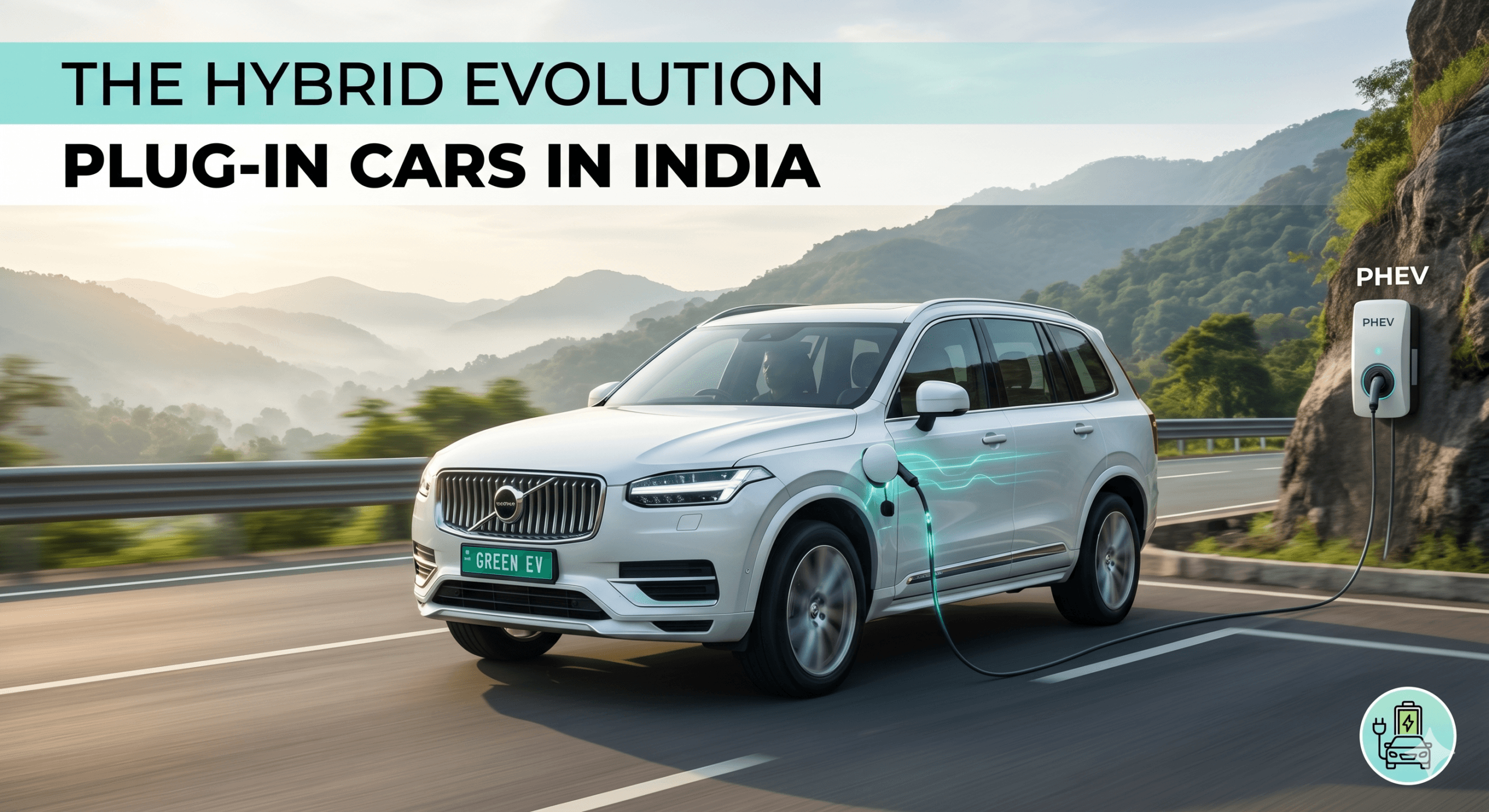
Here’s the uncomfortable truth most car listicles won’t tell you: the majority of people searching “plug-in hybrid cars in India” don’t actually want a plug-in hybrid. They want a hybrid — and those are two very different cars, with very different price tags.
| THE SHORT ANSWER True plug-in hybrids (PHEVs) in India are still a luxury product — think Mercedes S 450e, BMW X5 and Volvo XC60, all charged from a socket with 40–115 km of electric range. The affordable “hybrids” everyone actually cross-shops — the Toyota Hyryder, Maruti Grand Vitara and Victoris — are strong (self-charging) hybrids with no plug and just 1–3 km of electric range. For most Indian buyers in 2026, a strong hybrid or a full EV makes far more financial sense than a plug-in hybrid. |
01 / THE DISTINCTION: The word “hybrid” is hiding three very different cars
In India, “hybrid” is used for three things at once: mild hybrids (a 48V system that just trims fuel use by 8–12%), strong / self-charging hybrids (a real electric motor and battery, 35–45% better efficiency, no plug), and plug-in hybrids (a big battery you charge from a socket for 40+ km of pure-electric driving). They are not interchangeable, and confusing them is how people overspend by lakhs.
The mental model that actually works: think of a smartphone. A strong hybrid is a phone with a good battery that tops itself up as you use it — you never plug it in, you never think about it. A plug-in hybrid is that same phone with a power bank you have to remember to charge every night. Forget to charge the power bank and you’re just carrying dead weight around.
That metaphor isn’t just cute — it’s the entire buying decision. A plug-in hybrid only earns its price premium if you genuinely plug it in, nearly every day. The Indian reality is that a lot of people won’t, and that’s where the money gets wasted.
THE THREE “HYBRIDS”, COMPARED
| Type | Electric range | Needs a plug? | Fuel saving | Who it suits |
| Mild hybrid | 0 km | No | ~8–12% | Budget buyers wanting a small nudge |
| Strong / self-charging | 1–3 km | No | ~35–45% | City & mixed driving, no charging access |
| Plug-in hybrid (PHEV) | ~40–115 km | Yes (daily) | Up to ~100% on short trips if charged | Home charging + short commute + luxury budget |
02 / WHAT YOU CAN ACTUALLY BUY: Every true plug-in hybrid on sale in India right now
As of mid-2026, almost every genuine plug-in hybrid you can buy in India sits in the luxury bracket. The cheapest real PHEVs are upcoming premium SUVs like the Hyundai Tucson and Kia Sportage; an affordable, sub-₹20 lakh mass-market plug-in hybrid is not expected before roughly 2030.
PLUG-IN HYBRIDS IN INDIA — INDICATIVE, MID-2026
| Model | Approx. EV range | Segment | Indicative price* |
| Mercedes-Benz S 450e | ~115 km | Flagship luxury sedan | ₹1.5 Cr+ |
| BMW X5 xDrive45e | ~87 km | Luxury SUV | ₹1 Cr+ |
| Volvo XC60 Recharge | ~81 km | Luxury SUV | ₹70 L+ |
| Toyota Vellfire PHEV | Plug-in | Luxury MPV | ₹1.2 Cr+ |
| Hyundai Tucson PHEV (incoming) | ~50 km | Premium SUV | TBC (mid-2026) |
| Kia Sportage PHEV (incoming) | ~55 km | Premium SUV | TBC |
Look at that list and the pattern is obvious: if your budget is under ₹60–70 lakh, the true plug-in hybrid market simply doesn’t have a car for you yet. That’s not a gap the brochures advertise, but it’s the single most useful fact in this entire guide.
03 / WHAT YOU PROBABLY MEANT: The strong hybrids most “PHEV searchers” actually want
If you’re cross-shopping ₹10–20 lakh “hybrids,” you’re looking at strong (self-charging) hybrids, not plug-ins. The headline options in 2026 are the Toyota Urban Cruiser Hyryder, Maruti Grand Vitara, Maruti Victoris and Honda City e:HEV — no plug, no charging hunt, and a genuine 35–45% efficiency gain over petrol.
STRONG HYBRIDS WORTH SHORTLISTING — INDICATIVE, MID-2026
| Model | Claimed efficiency | Indicative starting price* |
| Maruti Victoris (hybrid) | ~28.6 kmpl | ₹10.5 L |
| Toyota Urban Cruiser Hyryder | ~28 kmpl | ₹11 L |
| Maruti Grand Vitara (hybrid) | ~28 kmpl | ₹12.4 L |
| Honda City e:HEV | High-20s kmpl | ~₹19 L |
| Toyota Innova Hycross (hybrid) | City MPV | ~₹26.8 L |
This is the honest redirect: for the overwhelming majority of people typing “plug-in hybrid cars in India” into Google, a strong hybrid is the car they’re describing — they just don’t have the vocabulary yet. No range anxiety, no nightly charging ritual, no dependence on a charger that may not exist near them, and a real fuel saving they’ll feel every month at the pump.
04 / THE RUPEES-PER-KM TRUTH: When a plug-in hybrid is genuinely the wrong purchase
Here’s the maths nobody puts in the headline. A plug-in hybrid carries roughly a ₹10–15 lakh premium over an equivalent petrol model, because the bigger battery and dual powertrain are expensive to build. You earn that premium back only by running on cheap home electricity instead of petrol — which means you have to actually charge it, and your daily drive has to fit inside the electric range.
Miss either condition and the economics invert fast:
- No reliable charging? Your PHEV runs on petrol while hauling a heavy, expensive battery it never uses. You’ve paid a luxury premium for a worse petrol car.
- Long daily commute beyond the EV range? Most of your kilometres burn fuel anyway, so the electric bit is a rounding error on your running cost.
- Charging access patchy outside the metros? Public charging in India is still concentrated in big cities and inconsistent elsewhere — a real constraint, not a theoretical one.
And there’s a long-tail cost people forget: after 8–10 years, a hybrid battery typically holds only 70–80% of its original capacity, and a dual powertrain is mechanically more complex to maintain. That’s a resale and service-cost conversation worth having before you sign, not after.
05 / THE VERDICT: So should you buy a plug-in hybrid in India?
Buy a true PHEV only if all three are true: you have dependable home or office charging, your daily drive comfortably fits inside the electric range (roughly sub-50 km), and you’re already shopping in the ₹60 lakh-plus luxury bracket. In that narrow case, it’s a brilliant car — silent electric commutes on weekdays, petrol reassurance for the highway run on weekends.For nearly everyone else, the smarter call in 2026 is one of two cars. If you can’t charge reliably or you drive mixed city routes, a strong hybrid (Hyryder, Grand Vitara, Victoris) gives you most of the efficiency with none of the hassle. If you can charge at home and your routes are predictable, a proper EV usually wins on rupees-per-kilometre outright. The plug-in hybrid is the answer to a surprisingly specific question — make sure it’s actually your question before you pay the premium.
*Prices and electric-range figures are indicative ex-showroom estimates as of mid-2026 and vary by city, variant and ongoing offers. Verify the current on-road price and specifications with the manufacturer or an authorised dealer before purchase. This guide is general information, not financial or purchase advice.
What is the difference between a plug-in hybrid and a strong hybrid in India?
A plug-in hybrid (PHEV) has a large battery you charge from a socket and can drive roughly 40–115 km on electricity alone. A strong, self-charging hybrid like the Toyota Hyryder or Maruti Grand Vitara has no plug and only 1–3 km of electric range — it recharges itself as you drive.
Which plug-in hybrid cars can you actually buy in India in 2026?
True plug-in hybrids on sale are almost all luxury models: the Mercedes-Benz S 450e, BMW X5 xDrive45e, Volvo XC60 Recharge and Toyota Vellfire PHEV. More accessible plug-in SUVs like the Hyundai Tucson PHEV and Kia Sportage PHEV are only beginning to arrive.
Is a plug-in hybrid worth it in India?
It’s worth it only if you have home or office charging, a daily commute under about 50 km, and a luxury budget. Without nightly charging a PHEV becomes a heavier, costlier petrol car — so most buyers are better off with a strong hybrid or a full EV.
What is the cheapest plug-in hybrid car in India?
As of mid-2026 there’s no affordable mass-market PHEV; the cheapest true plug-in hybrids are upcoming premium SUVs like the Hyundai Tucson PHEV. A sub-₹20 lakh plug-in hybrid isn’t expected before roughly 2030. The cheapest hybrids you can buy today are strong hybrids like the Maruti Victoris and Toyota Hyryder.
Plug-in hybrid vs EV vs petrol — which is cheapest to run in India?
If you can charge at home and drive predictable routes, a full EV is usually cheapest per kilometre. A plug-in hybrid is cheapest only when charged daily and driven within its electric range. If you can’t charge reliably, a strong hybrid beats both an uncharged PHEV and a petrol car — with no range anxiety.