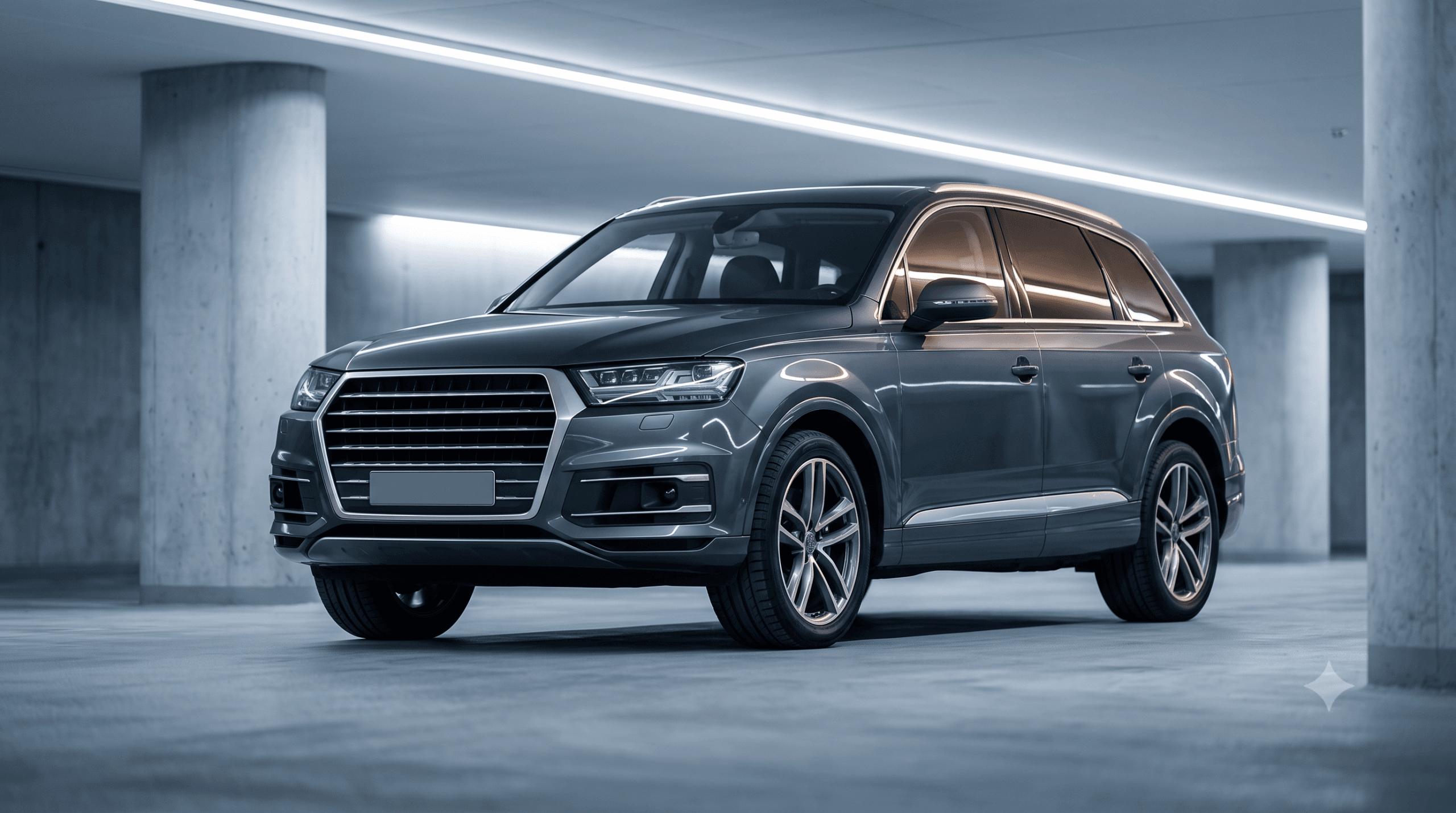
Volkswagen India is expanding the Tayron three-row SUV lineup with a new, lower-priced variant launching on July 10, 2026, giving buyers a way into the flagship SUV without paying for the fully loaded R-Line trim that’s been the only option since launch. The new variant is expected to land roughly Rs 2-3 lakh below the R-Line’s Rs 46.99 lakh ex-showroom price, putting it in the Rs 44-45 lakh range — a meaningful gap that could widen the Tayron’s addressable buyer pool considerably.
For a market where premium three-row SUVs have historically been sold as single, fully-specced variants, a deliberate move to introduce a lower trim is worth watching closely — it’s a signal about how Volkswagen reads demand elasticity in this segment.
Why This Launch Matters
Since its introduction, the Tayron has only been available in India as the range-topping R-Line, priced at Rs 46.99 lakh (ex-showroom) — a strategy that let Volkswagen position it as an unambiguous premium offering but also capped the addressable market to buyers willing to pay top dollar from day one. Adding a second, more accessible variant is a classic mid-cycle move to capture buyers who wanted the Tayron’s space and badge but were priced out of the R-Line specifically, without Volkswagen having to discount the flagship trim itself and dilute its premium positioning.
What’s Different: Design and Trim
Based on Volkswagen’s teaser campaign ahead of launch, the new variant is visually distinguishable from the R-Line in a handful of specific ways:
- New five-spoke alloy wheels, expected to be a size smaller than the R-Line’s 19-inch units
- Simpler, less aggressive front and rear bumpers, dropping the R-Line’s sportier styling cues
- No “R” badging on the doors or steering wheel — the most immediate visual tell for anyone spotting the two variants side by side
- Dual-tone seat upholstery, replacing the R-Line’s all-black interior treatment
What Volkswagen has notably kept unchanged is the front-end lighting signature — the new variant retains the same projector LED headlight units, connected light bar, and illuminated Volkswagen logo as the R-Line, along with the free-standing touchscreen infotainment system, 10.25-inch digital driver’s display, panoramic sunroof and metal pedals. That’s a deliberate choice: Volkswagen is trimming cosmetic sportiness and top-tier trim details, not the core technology and comfort features that buyers actually interact with daily.
Engine and Performance: No Changes Under the Hood
According to Volkswagen’s own specifications for the R-Line, the new variant is expected to carry over the identical 2.0-litre turbo-petrol engine producing around 201bhp and 320Nm of torque, paired with the same 7-speed dual-clutch automatic (DSG) transmission. That’s a notable decision — rather than pairing the lower trim with a detuned or smaller engine, as many manufacturers do to justify a lower price point, Volkswagen appears to be keeping the driving experience identical and differentiating purely on styling and feature content. For performance-focused buyers specifically, that means the new variant isn’t a compromise on what actually matters behind the wheel — the R-Line’s 0-100kmph time of roughly 7.3 seconds and top speed of 224kmph should carry over largely unchanged.
Positioning Against Its Rivals
The Tayron currently competes against the Toyota Fortuner, Jeep Meridian, and Skoda Kodiaq in India’s premium three-row SUV space, having effectively replaced the outgoing Tiguan Allspace in Volkswagen’s lineup. A lower-priced variant sharpens the Tayron’s competitive positioning specifically against the Fortuner, which has long dominated this segment on brand trust and resale value even as newer, more tech-forward European rivals have entered the fray. Undercutting the R-Line by Rs 2-3 lakh also puts the new Tayron variant below Volkswagen’s own five-seater Tiguan R-Line, currently priced at Rs 47.11 lakh as a CBU import — an unusual internal pricing overlap that Volkswagen appears to be resolving by making the larger, three-row Tayron the more accessible option rather than the more expensive one.
Safety Credentials Carry Real Weight Here
The Tayron R-Line is expected to secure a 5-star Global NCAP rating, with 9 airbags standard and a full Level 2 ADAS suite including adaptive cruise control, lane keep assist and autonomous emergency braking. If the new lower-priced variant retains this same safety architecture — and early indications suggest core technology carries over — it gives Volkswagen a genuine differentiator against the Fortuner in particular, where safety-tech parity across trims has historically been less consistent. Data shows that ADAS availability across a broader price band, rather than gated to only the most expensive trim, is increasingly a deciding factor for premium SUV buyers who want safety tech without paying flagship pricing.
Why the Timing Matters
This launch lands in the middle of what multiple industry trackers are calling the busiest month for SUV launches in India in 2026, with the Nissan Tekton having debuted just a day earlier on July 9, and further launches from Toyota, Maruti Suzuki, Kia and MG all scheduled across the rest of July. In our experience tracking launch cadences, a manufacturer choosing to drop a new variant into a week this crowded with competing news is either supremely confident in its own newsworthiness or is deliberately trying to ride the broader wave of SUV-launch attention the month is generating — either way, Volkswagen is betting that a lower-priced Tayron variant is distinctive enough to cut through a genuinely noisy news cycle.
What This Means for Buyers Considering the Tayron
For anyone who’s been eyeing the Tayron but found the R-Line’s near-Rs 47 lakh price tag out of reach, this launch is the clearest signal yet that Volkswagen is willing to meet the market partway rather than holding the line on a single premium trim indefinitely. Buyers who prioritize the driving experience and core technology over sportier cosmetic details — the R badging, the more aggressive bumpers, the all-black cabin — stand to get essentially the same SUV for meaningfully less money, assuming the mechanical carryover holds as expected once official specifications are confirmed at launch.
The Broader Strategic Read
We analyzed how Volkswagen has approached variant strategy on its recent India launches, and the pattern with the Tayron breaks from precedent in a useful way. Rather than launching a full spread of trims on day one — the approach VW has typically taken with the Virtus and Taigun — the brand chose to launch the Tayron as a single, maximally-specced variant first, let it establish a premium reputation in the market for several months, and only then introduce a more accessible trim once the flagship had time to set the model’s positioning. That sequencing likely protects the R-Line’s resale value and premium image better than launching both trims simultaneously would have, since early buyers paid full price for a genuinely top-spec product rather than a mid-tier option that immediately looked overpriced next to a cheaper variant sitting beside it in the same showroom.
This also gives Volkswagen a second bite at the same buyer funnel without needing an entirely new nameplate or generation change — a strategy other premium import-heavy brands in India, working with lower volumes and slower model cycles, may find harder to replicate given their more limited variant flexibility on CBU-imported vehicles specifically.
Watching the Sales Data From Here
The real test of this strategy will show up in the monthly sales figures over the next quarter. If the lower-priced variant meaningfully expands Tayron volumes rather than simply cannibalizing R-Line bookings from buyers who would have paid full price anyway, it validates Volkswagen’s bet that price, not specification, was the primary barrier keeping buyers away from the Tayron nameplate. If volumes stay roughly flat and buyers simply shift down to the cheaper trim, that’s a different and less encouraging signal about genuine demand elasticity in this segment — one worth watching closely for anyone benchmarking premium SUV pricing strategy across the industry, including agencies planning campaigns for Volkswagen dealership networks that will want proof of incremental volume before committing bigger budgets to the newly accessible variant.
FAQs
When does the new Volkswagen Tayron variant launch?
July 10, 2026.
How much cheaper is the new Tayron variant than the R-Line?
It’s expected to be priced roughly Rs 2-3 lakh below the R-Line’s Rs 46.99 lakh ex-showroom price, landing around Rs 44-45 lakh.
What’s different on the new variant compared to the R-Line?
Smaller alloy wheels, simpler bumpers, no R-Line badging, and dual-tone interior upholstery instead of all-black.
Does the new variant get a different engine?
No, it’s expected to retain the same 2.0-litre turbo-petrol engine and 7-speed DSG automatic as the R-Line.
What does the Tayron compete against in India?
The Toyota Fortuner, Jeep Meridian and Skoda Kodiaq in the premium three-row SUV segment.
Does the new Tayron variant get ADAS?
Early indications suggest the core safety architecture, including Level 2 ADAS, carries over from the R-Line, though this should be confirmed at official launch.