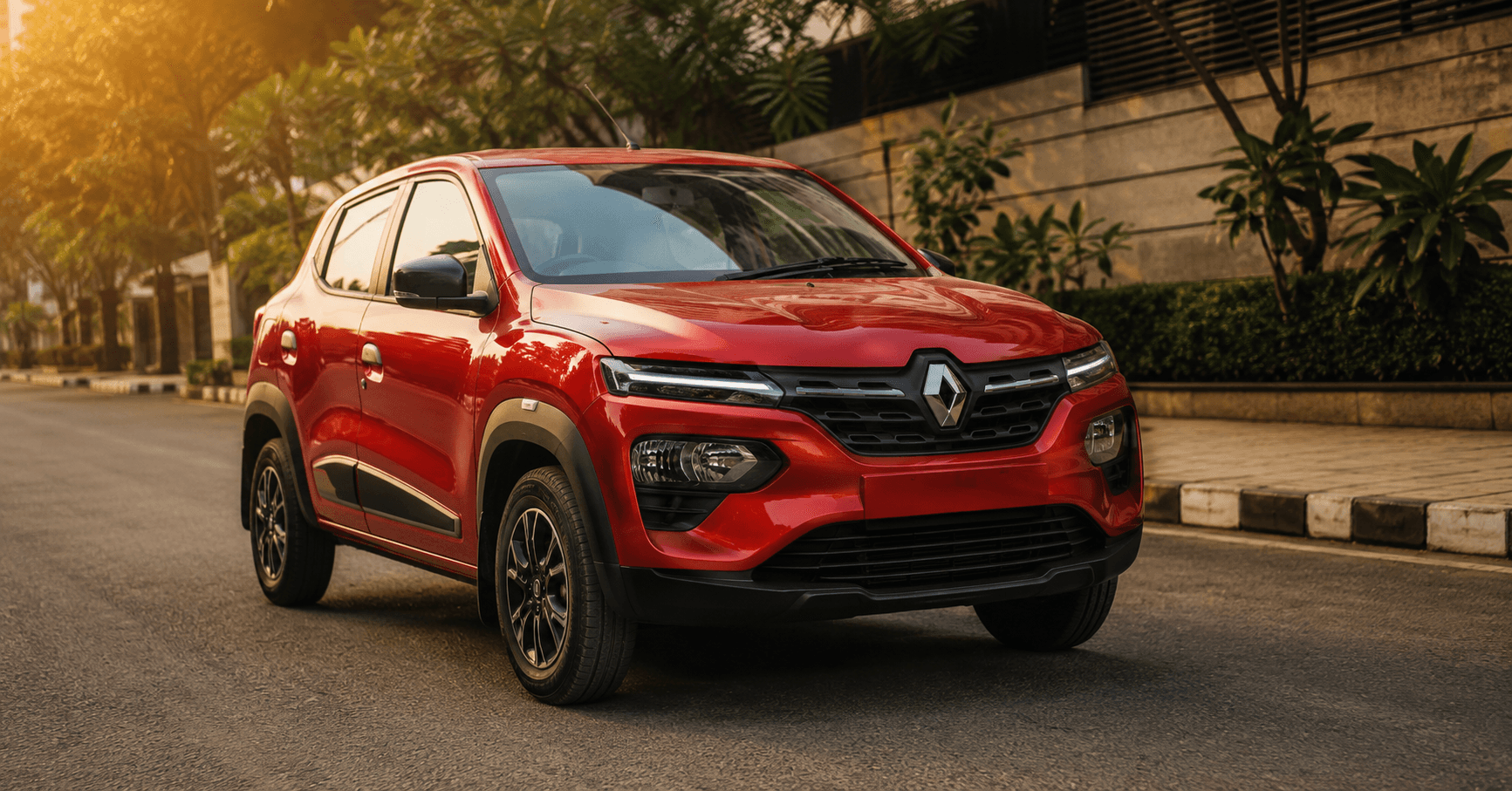
Renault’s 2026 Kwid facelift starts at Rs 4.53 lakh (ex-showroom) for the base Evolution manual and tops out at Rs 5.61 lakh for the Climber AMT, and the honest answer for most first-time car buyers is: it is worth considering only if you specifically want a manual or AMT petrol hatchback with a factory-backed CNG option, because on pure value-for-money the segment has moved on faster than the Kwid has.
What actually changed in the 2026 Kwid
Renault trimmed the Kwid lineup from four trims down to two: Evolution and Climber, both available with a 5-speed manual or an AMT gearbox. The Authentic and Techno variants are gone, which quietly pushes the effective entry price up compared to previous years, even though the sticker price for the base trim looks similar to before.
Mechanically, nothing has changed. The 1.0-litre three-cylinder petrol engine still makes 69hp and 92.5Nm, numbers that were competitive in 2019 and are now the least powerful in the segment. Renault has focused the update on cosmetics and safety instead: new 3D badges, a redesigned dual-tone cover for the 14-inch steel wheels, and a 3-spoke steering wheel borrowed from the Kiger that finally gets audio and telephony controls. The 8-inch touchscreen with wired Android Auto and Apple CarPlay carries over unchanged.
The genuinely useful update is on the safety sheet. The base Evolution now gets dual airbags as standard, and the range-topping Climber gets six airbags, a rear camera with parking sensors, a tyre-pressure monitoring system, and hill-start assist on the AMT. For a car in this price band, six airbags on the top trim is a meaningful improvement and puts pressure on Maruti and Tata to match it.
The CNG angle nobody is highlighting enough
Renault continues to sell the Kwid with a retrofitted CNG kit rather than a factory-fitted one, priced at Rs 70,450 on top of the manual variants only (it isn’t offered with the AMT). That retrofit comes with a 3-year or 1-lakh-km warranty, which removes most of the risk buyers usually associate with aftermarket CNG kits voiding their factory warranty. At current CNG prices, a Kwid running mostly on gas can bring running costs down to roughly a third of what the petrol-only variant costs per kilometre, which matters more to a cab or delivery-fleet buyer than the styling update does.
If your annual mileage is high — think 15,000km or more, common for ride-hailing or delivery use — the CNG Evolution manual is the variant that actually justifies buying a Kwid in 2026 over a rival, purely on running-cost math over a 3-5 year ownership period.
How the Kwid stacks up against the Alto K10 and Tiago
The Kwid’s real competitive set in July 2026 is the Maruti Suzuki Alto K10 and the Tata Tiago, and the numbers tell three different stories:
- Maruti Alto K10 starts around Rs 3.70 lakh, undercutting the Kwid by roughly Rs 80,000-90,000 at entry level, and delivers a claimed 24.39kmpl, the best fuel efficiency of the three. Maruti’s service network is also the densest in the country, which matters disproportionately in tier-2 and tier-3 towns where most Kwid buyers actually live.
- Tata Tiago starts north of Rs 4.5 lakh but brings a larger 1.2-litre engine with noticeably better drivability than the Kwid’s 1.0-litre three-pot, plus a 5-star Global NCAP safety rating on higher trims that the Kwid does not currently match. It also has the longest and widest body of the three, which shows up as real cabin space.
- Renault Kwid wins on ground clearance and wheelbase, which translates to a more stable ride on broken roads and a marginally roomier back seat than the Alto K10, but loses on both price (versus Alto K10) and refinement (versus Tiago).
The practical takeaway: buyers who prioritise the lowest possible EMI should default to the Alto K10, buyers who want the safest and most refined car in the segment should stretch to the Tiago, and the Kwid earns its place only for buyers who specifically want the CNG-with-warranty combination or who value ride height over outright refinement.
What the on-road price actually adds up to
Ex-showroom price is only part of the real cost, and this is where a lot of first-time buyers get caught out. Road tax, registration, insurance, and optional accessories typically add 10-15% on top of the ex-showroom figure in most states, which pushes the “Rs 4.53 lakh” Kwid closer to Rs 5-5.1 lakh on-road in practice, and the top Climber AMT closer to Rs 6.3-6.5 lakh depending on the state’s road tax slab. Comparative pricing data shows this on-road markup is fairly consistent across the Kwid, Alto K10, and Tiago, so it doesn’t change the relative ranking between the three cars — but it does mean buyers budgeting strictly around the advertised ex-showroom number should add a buffer before finalising a loan amount or EMI.
Which 2026 Kwid variant should you actually buy
Automotive safety expert commentary around entry-hatchback crash testing consistently emphasises that airbag count alone doesn’t guarantee occupant safety without a strong structural cage, but within the Kwid’s own range, more airbags is still a meaningful upgrade worth paying for. Skip the base Evolution manual unless budget is the only constraint — dual airbags are welcome, but you’re giving up the six-airbag safety net for a saving of roughly Rs 60,000. If safety is a priority (and Global NCAP data consistently shows entry hatchbacks are where most fatal accidents in India occur), the Climber manual at Rs 5.15 lakh is the variant that makes sense: six airbags, TPMS, and the rear camera, without paying the AMT premium.
Only choose the AMT if you drive predominantly in stop-start city traffic and value convenience over the roughly Rs 40,000-50,000 premium and the slightly worse fuel efficiency AMTs typically carry versus a well-driven manual.
What the sales data actually shows
Society of Indian Automobile Manufacturers (SIAM) sales data has repeatedly shown the entry-hatchback segment (cars priced below Rs 6 lakh) shrinking as a share of total passenger vehicle sales in recent years, while compact SUVs have steadily grown their share over the same period. According to industry analysts tracking this shift, the swing is driven less by hatchbacks getting worse and more by financing becoming easier to stretch: a buyer who could only afford a Kwid five years ago can often get approved for an EMI on a Tata Punch or Maruti Fronx today, at a marginally higher monthly outflow. Renault’s own sales figures reflect this pressure — Kwid volumes have declined even as the car received periodic updates, which is precisely why this 2026 refresh focuses on cost-effective safety additions rather than an expensive ground-up redesign.
That pattern is consistent with how Renault has positioned this refresh: the retrofitted CNG kit, not the six-airbag Climber trim, is arguably the more commercially significant update, since fleet and CNG-conversion demand is one of the few pockets of the entry-hatchback segment that hasn’t shrunk alongside private retail sales.
Does the Kwid still make sense in 2026’s SUV-dominated market?
India’s compact SUV segment has grown faster than the hatchback segment for six consecutive years, and buyers with a similar budget increasingly stretch into a used compact SUV or wait a few months longer to buy a Tata Punch or Maruti Fronx rather than settle for an entry hatchback. That shift is precisely why Renault chose to simplify the Kwid lineup rather than invest in a full redesign — the company is managing the car’s decline rather than fighting for growth in a shrinking segment. For budget-conscious buyers who don’t want an SUV’s higher running costs and insurance premiums, though, the Kwid — specifically the CNG Climber manual — remains one of the few honest, no-frills options left in the market at this price point.
FAQs
Is the 2026 Renault Kwid available with a factory-fitted CNG option?
No. Renault offers a retrofitted CNG kit on manual variants only, priced at Rs 70,450, backed by a 3-year or 1-lakh-km warranty. It is not available on the AMT gearbox.
How many airbags does the 2026 Kwid have?
The base Evolution trim gets dual airbags as standard, while the top-spec Climber trim comes with six airbags along with a rear parking camera, sensors, and TPMS.
Is the Renault Kwid cheaper than the Maruti Alto K10?
No, the Alto K10 starts around Rs 3.70 lakh, undercutting the Kwid’s Rs 4.53 lakh starting price by roughly Rs 80,000-90,000, and also offers better fuel efficiency.
What engine does the 2026 Kwid use?
It continues with the same 1.0-litre three-cylinder petrol engine producing 69hp and 92.5Nm, paired with either a 5-speed manual or an AMT gearbox, unchanged from the pre-facelift model.
Which 2026 Kwid variant offers the best value?
The Climber manual at Rs 5.15 lakh is the sweet spot for most buyers, since it adds the six-airbag safety package and TPMS without the extra cost of the AMT gearbox.
Should I buy a Kwid or wait for a compact SUV in a similar budget?
If your budget realistically stretches within Rs 1-1.5 lakh of a compact SUV like the Tata Punch, it is worth waiting or considering a used SUV, since resale value and safety ratings tend to favour that segment over entry hatchbacks in the long run.