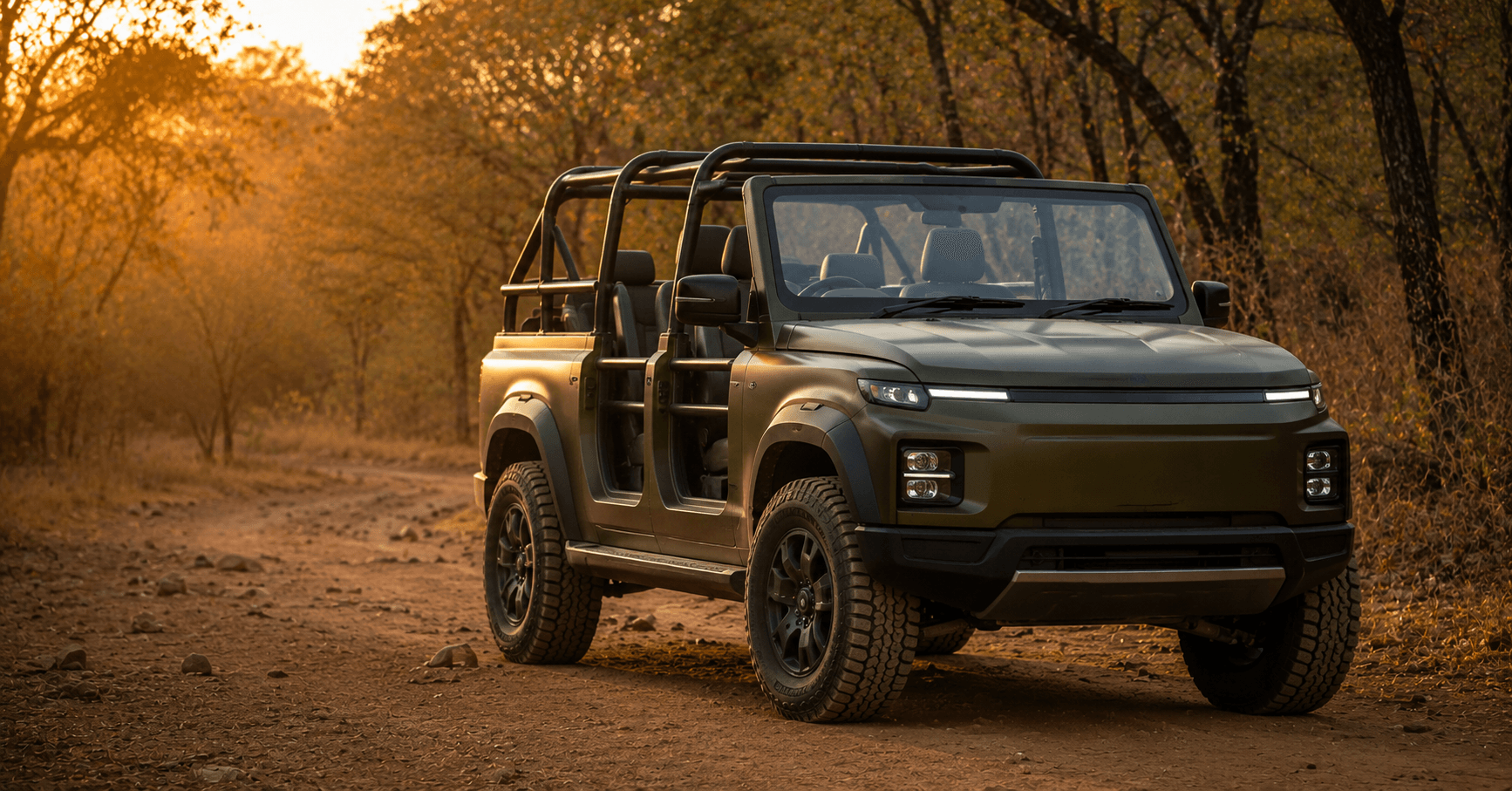
Tata Motors isn’t selling the Sierra EV Sanctuary Edition to anyone — it’s a purpose-built, roofless safari vehicle reserved exclusively for national parks and wildlife sanctuaries, and using a nostalgia-loaded nameplate to launch a non-commercial conservation vehicle is a more calculated brand move than it first appears, one that says more about how Tata plans to milk the Sierra name over the next few years than the mainstream EV’s spec sheet does.
What Tata actually announced
At a launch event at Mumbai’s Jio Convention Centre on June 30, 2026, Tata Motors unveiled the production Sierra EV alongside a surprise: the Sierra EV Sanctuary Edition, a variant stripped of its roof and middle pillars, fitted with a roll cage, all-terrain tyres, a heavy-duty bull bar, an electric winch, extra lighting, side steps, a retractable ladder, and rear flood lamps, and built specifically for wildlife safaris and forest conservation work. It isn’t available for retail purchase at all — it’s intended purely for deployment in national parks and sanctuaries as a quieter, cleaner alternative to the diesel safari vehicles currently used across India’s protected forests. Vivek Srivatsa, Tata Motors’ Chief Commercial Officer, confirmed the company is also considering further special editions for both the ICE Sierra and the Sierra EV before the end of 2026, meaning the Sanctuary Edition is very likely the first of several, not a one-off.
The regular, retail Sierra EV that the Sanctuary Edition sits alongside launched with 63kWh and 75kWh battery options, RWD and AWD configurations, a claimed range of up to 665km, and — in its quad-motor AWD form — 504Nm of torque and a 0-100kmph time of 5.8 seconds, priced from Rs 18.79 lakh as an introductory offer. Deliveries begin July 15, 2026, and bookings are open now.
Why a non-commercial safari vehicle is actually a smart launch move
Launching a vehicle nobody can buy alongside the vehicle everyone can buy sounds like a marketing distraction, but it does real commercial work for Tata. The original Sierra carries genuine nostalgic weight in India — it was the country’s first indigenously developed SUV, launched in 1991 as Ratan Tata’s first major push into passenger vehicles, and it introduced features that were novel in the Indian market at the time, including electric power windows, air conditioning, and a distinctive glass-roofed rear cabin. That history means the Sierra name alone generates attention and emotional buy-in that a purely functional new-model launch wouldn’t. By attaching the Sanctuary Edition to conservation and wildlife tourism — two things with broad, largely non-partisan public goodwill in India — Tata associates the revived Sierra nameplate with purpose beyond commerce, while the retail Sierra EV quietly does the actual volume-selling work in showrooms. It’s a halo-vehicle strategy borrowed from how performance and concept vehicles are used in other markets, adapted here for conservation branding instead of outright performance.
It also lets Tata test extreme-use durability and off-road credibility for the Sierra EV nameplate in a genuinely demanding, monitored environment — national park terrain, sustained heat, dust, and rough tracks — without needing to market that testing directly to retail buyers who’ll never take their Sierra EV anywhere near a safari trail.
How the new Sierra EV compares to the 1991 original
The contrast between the two Sierras is the whole story here. The 1991 Sierra ran a 483 DL engine through a 5-speed manual gearbox with rear-wheel drive, and its standout features — power windows, air conditioning, an adjustable steering wheel — are now baseline expectations in any car above entry-level pricing. The 2026 Sierra EV instead leads with a “Living Room on Wheels” interior concept built around a triple-screen “Horizon View” display layout, Dolby Atmos audio, a 540-degree camera system, and full ADAS, alongside the 665km range and sub-6-second 0-100kmph pace in its quickest configuration. What’s carried over isn’t any specific engineering detail — it’s the design language and the positioning as a distinctive-looking SUV willing to break from generic crossover styling, which is exactly what made the original stand out in 1991 showrooms full of conventional sedans and utilitarian jeeps.
What the conservation angle actually solves for national parks
Wildlife-tourism operators and forest departments across India have relied on diesel Gypsy and Bolero-based safari vehicles for decades, and according to conservation-sector commentary on electrification of park fleets, the case for electric safari vehicles is unusually strong compared to electrifying most other commercial vehicle categories: safari routes are short, fixed, and predictable, charging infrastructure only needs to cover a single depot rather than a distributed network, and a silent vehicle is a genuine wildlife-viewing advantage, since animals are measurably less disturbed by an EV’s near-silent approach than by a diesel engine’s noise and vibration. Tourism data shows visitor demand for “eco-safari” experiences across India’s forest circuits has been rising steadily, giving parks a marketing angle of their own in adopting vehicles like the Sanctuary Edition, independent of whatever commercial success the retail Sierra EV achieves.
That makes the Sanctuary Edition less of a pure marketing stunt than it might first appear — it plausibly solves a real operational problem for forest departments while giving Tata a genuinely differentiated, headline-generating unveiling that a standard trim-level special edition wouldn’t have delivered.
Should retro-nameplate revivals like this work commercially?
Reviving a dormant nameplate carries real risk: buyers with no memory of the original see just another new SUV, while buyers who do remember it can be disappointed if the new car doesn’t meaningfully honour what made the original distinctive. Tata’s approach here — keeping the exterior design language recognizably Sierra-coded while building an entirely modern EV underneath, and reinforcing the emotional connection through a non-commercial conservation vehicle rather than pure retro-styling gimmicks — is a more disciplined version of nameplate revival than badge-engineering alone. Whether it converts into sustained sales will depend less on the Sanctuary Edition (which most buyers will never see in person) and more on whether the retail Sierra EV’s Rs 18.79 lakh starting price and 665km range genuinely hold up against rivals like the Mahindra BE 6 and upcoming competitors once real-world reviews start arriving after the July 15 delivery date.
Where the Sierra EV sits against its actual rivals
According to automotive product expert comparisons of India’s mid-size electric SUV field, the Sierra EV’s 665km claimed range and Rs 18.79 lakh starting price position it directly against the Mahindra BE 6 rather than smaller, cheaper electric SUVs like the Tata Curvv EV or the Punch EV. Unlike Punch-sized rivals, both the Sierra EV and BE 6 are pitched at buyers cross-shopping mid-size ICE SUVs like the Harrier and XUV700, not first-time EV buyers on a tighter budget, which is why Tata’s design and marketing energy — including the Sanctuary Edition unveiling — has gone into making the Sierra EV feel like an aspirational lifestyle purchase rather than a rational downgrade from a diesel SUV. Whether that positioning holds will become clearer once independent range and performance tests are published after the July 15 delivery date, since claimed range figures for Indian EVs have historically run optimistic against real-world highway conditions.
FAQs
Can I buy the Tata Sierra EV Sanctuary Edition?
No. The Sanctuary Edition is not available for retail purchase — it’s a purpose-built variant reserved exclusively for deployment in national parks and wildlife sanctuaries as a safari and conservation vehicle.
What is the price of the regular Tata Sierra EV?
The retail Sierra EV starts at Rs 18.79 lakh (introductory offer, ex-showroom Mumbai), with deliveries scheduled to begin July 15, 2026.
What is the range and performance of the 2026 Tata Sierra EV?
It offers 63kWh and 75kWh battery options with a claimed range of up to 665km, RWD and AWD configurations, and in its quickest AWD form, 504Nm of torque with a 0-100kmph time of 5.8 seconds.
Is the new Sierra EV related to the original 1991 Tata Sierra?
It shares design language and positioning with the original — India’s first indigenously developed SUV — but is an entirely new platform and powertrain; nothing mechanical carries over from the 1991 model.
Will Tata launch more Sierra special editions?
Yes. Tata Motors’ Chief Commercial Officer has confirmed the company is considering additional special editions for both the ICE Sierra and Sierra EV before the end of 2026, following the Sanctuary Edition’s debut.
Why did Tata unveil a vehicle that isn’t for sale at the Sierra EV’s launch event?
Pairing a non-commercial conservation-focused Sanctuary Edition with the retail launch lets Tata associate the revived Sierra nameplate with wildlife conservation goodwill while the standard Sierra EV handles actual retail sales — a halo-vehicle branding strategy rather than a sales offering.