China Controls 72% of the World’s EV Batteries — Here’s What That Actually Means for Your Next Car in India
Seven Chinese companies now supply nearly three-quarters of every electric vehicle battery installed on the planet. According to SNE Research’s January-May 2026 data, CATL alone holds a 40.2% global share and BYD another 14.4%, with the remaining Chinese majors — CALB, Gotion, Eve Energy, Svolt, and Sunwoda — filling out a combined bloc that now stands at roughly 72% of global installations. For the average Indian car or bike buyer scrolling spec sheets, this can look like a distant statistic. It isn’t. It sits underneath almost every EV price tag, delivery date, and range claim you’ll see in an Indian showroom for at least the next three to five years.
The numbers, and why they moved again this month
Global EV battery usage hit 469.2 GWh between January and May 2026, up 16.3% year-on-year, according to SNE Research figures released in early July. CATL’s installations grew 22.9% to 188.4 GWh in that window, extending a lead it has held since 2017. BYD, by contrast, had a flatter run — its installations rose just 0.4% to 67.6 GWh, and its share has been sliding from the 16%+ levels it held a year earlier as its own vehicle sales in China cooled. Combined, CATL and BYD alone account for over 54% of the world’s battery supply, a concentration level that has held steady through every monthly release this year.
What makes this data point different from the usual battery-market trivia is the compounding effect. Chinese firms haven’t just maintained share — collectively they’ve gained roughly two full percentage points year-on-year even as the overall market expanded by double digits. That’s not a company riding a growing tide; that’s active displacement of Japanese and South Korean rivals, whose combined share has fallen toward the low double digits. LG Energy Solution, Panasonic, and SK On, once considered the default non-Chinese options for automakers wanting supply-chain diversification, are now fighting for single-digit slices of a market that keeps expanding around them.
India’s uncomfortable dependency
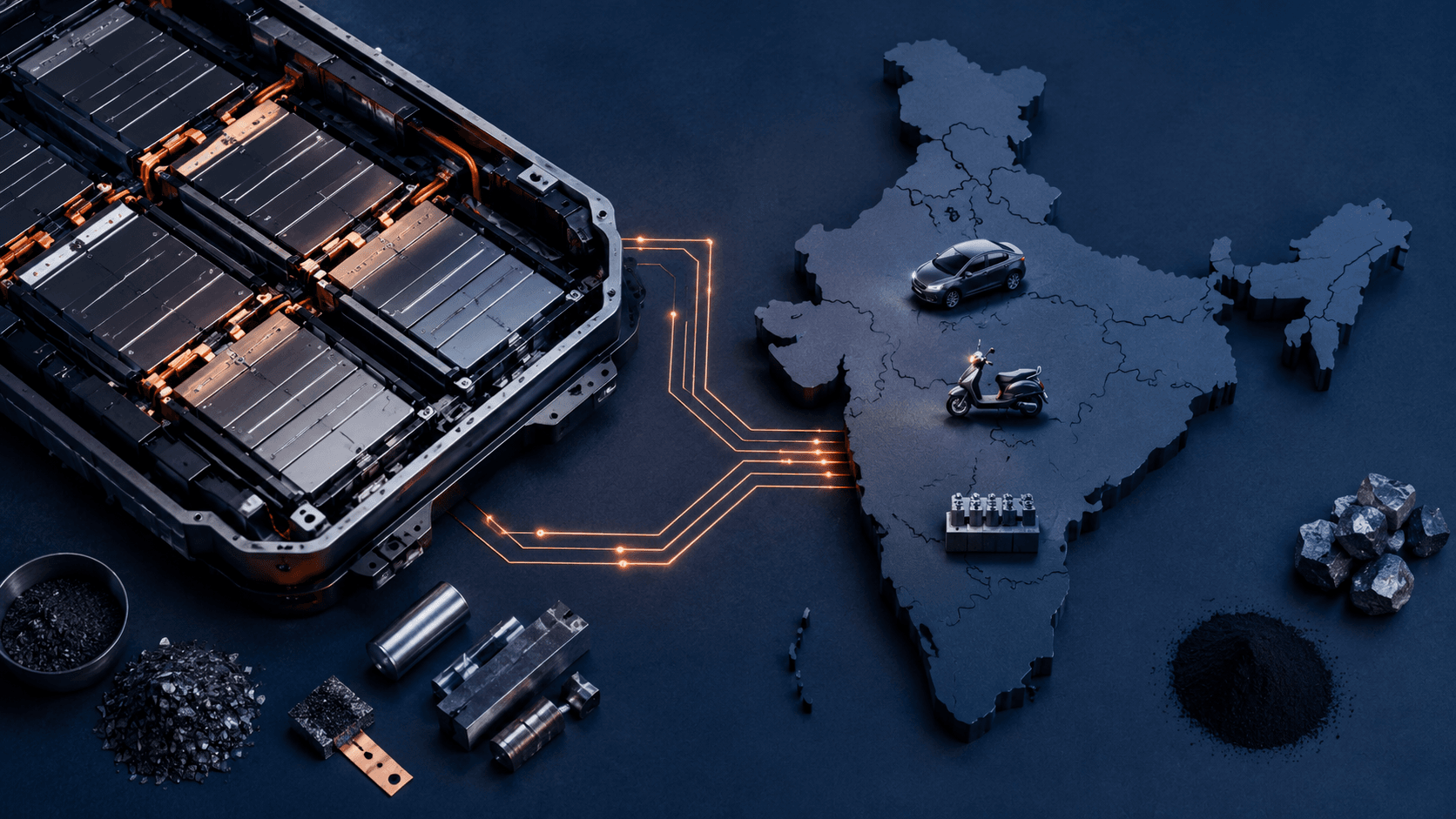
Here’s where this stops being a China story and becomes an India story. India currently imports close to 100% of the lithium-ion cells that power its EVs — cars, two-wheelers, and increasingly its grid-storage projects — and the overwhelming majority of that supply originates in China. This isn’t a minor input-sourcing detail; cells and the materials that go into them (cathode active material, anode active material, copper foil, electrolytes, separators) make up more than 60% of a battery pack’s cost. India imported roughly 18,200 tonnes of lithium compounds in 2025 alone, worth close to $1.2 billion, with 68% of that supply coming from China, per an April 2026 IEEFA assessment.
The government’s flagship response, the Advanced Chemistry Cell (ACC) Production Linked Incentive scheme, was launched back in October 2021 with a Rs 18,100 crore outlay and a target of 50 GWh of domestic cell manufacturing capacity by 2025. As of this year, only about 1.4 GWh — roughly 2.8% of that target — has actually been commissioned, and all of it by a single beneficiary, Ola Electric. Investment under the scheme has reached just over a quarter of its target, and job creation sits at 0.12% of the projected figure. A second, non-PLI wave of capacity — led by Tata’s Agratas, Amara Raja, Waaree, and Adani, totaling roughly 76 GWh of near-term capacity — is coming, but the honest read on this pipeline is that it’s predominantly pack assembly for now, not cell manufacturing. Cells will keep arriving from China for years regardless of how many “Made in India” battery packs roll off Indian assembly lines.
Why this matters when you’re actually shopping
Three practical consequences flow from this concentration, and each one shows up directly in what you’re offered at an Indian dealership.
Pricing floor. Chinese cells, particularly CATL’s and BYD’s Blade LFP chemistry, remain 15-20% cheaper at equivalent energy density than anything India-based manufacturers can currently produce. Domestic PLI incentives (18-20% on net sales) exist specifically to offset that gap — which tells you the underlying economics still favor imported cells. Any EV priced meaningfully below its segment right now is very likely running on Chinese-sourced cells, directly or through a licensed local pack-assembly route.
Delivery and allocation risk. Because Indian OEMs are import-dependent for the highest-value component in an EV, supply shocks anywhere in the China-based chain — tariff changes, export controls, a factory issue, a geopolitical flashpoint — translate quickly into waitlists here. The Reuters reporting from late June 2026 on India’s “hardware dependency” specifically flagged this: a vehicle assembled in India can still carry Chinese intellectual property and Chinese-sourced components under the bonnet, regardless of how the marketing frames it.
The “Make in India” label needs a second look. A battery pack stamped as domestically assembled is not the same as a domestically manufactured cell. Buyers who care about genuine local value addition — for warranty-servicing reasons, for supply-chain-risk reasons, or simply out of preference — should ask dealers directly whether the vehicle’s cells are India-manufactured or imported and pack-assembled locally. Most sales staff won’t volunteer this distinction unprompted.
What’s changing, and on what timeline
There is a genuine effort underway to change this picture, and it’s worth knowing the shape of it so you can judge progress rather than promises. The government is finalizing a new Rs 12,000 crore Battery Component Scheme, separate from ACC PLI, aimed specifically at the upstream materials India currently imports almost entirely — cathode and anode active materials, electrolytes, copper foil, and separators. Officials involved in the scheme’s design have been explicit that it will pay for genuine value addition, not import relabeling. India’s projected ACC demand is set to jump from around 28 GWh in 2025 to a forecast 272 GWh by FY2030, so the gap the scheme needs to close is large and growing.
Realistically, industry analysis puts India five to ten years away from a competitive, vertically integrated cell manufacturing base — assuming execution stays on track, which the ACC PLI scheme’s track record so far gives real reason to question. For anyone buying an EV in the next two to three years, the honest expectation should be: imported Chinese cells, domestically assembled packs, and pricing that continues to track global Chinese battery-cost trends more closely than any “Make in India” narrative would suggest.
The bottom line for buyers
None of this means don’t buy an EV. Battery costs have fallen sharply worldwide precisely because of this Chinese manufacturing scale, and Indian buyers benefit from that same cost curve. But it does mean treating “battery sourcing” as a legitimate spec to ask about — the same way you’d ask about ground clearance or service network — rather than assuming a locally badged EV is running on a fully domestic supply chain. It also means watching India’s Battery Component Scheme rollout over the next 12-18 months as the real signal of whether this dependency narrows, rather than taking any single manufacturer’s localization claim at face value.
FAQs
Does China control the batteries in Indian-made EVs too?
In most cases, yes, at the cell level. Even EVs assembled in India typically use lithium-ion cells imported from Chinese manufacturers like CATL and BYD, with only the pack assembly happening domestically. India’s own cell-manufacturing capacity remains under 3% of its 2025 PLI target.
Are EVs with Chinese-made batteries less safe or lower quality?
No — CATL and BYD are the two largest, most established battery manufacturers in the world by volume, and their cells power vehicles from Tesla to Mercedes to Toyota. The concern here is supply-chain concentration and pricing dependency, not build quality.
Will Indian-made EV batteries become available soon?
Some are already on the market in limited volumes — Ola Electric has commissioned a small share of its ACC PLI capacity. But large-scale, cost-competitive domestic cell manufacturing is realistically five to ten years away, according to industry analysis, even with new incentive schemes in the pipeline.
Does this affect two-wheeler EVs as much as cars?
Yes, arguably more so, since Indian electric two-wheelers compete on price more aggressively than cars, making them even more sensitive to Chinese cell-cost trends and any tariff or supply disruption.
Should I wait to buy an EV until India has its own battery supply chain?
Not necessarily. Waiting five-plus years means missing today’s falling EV prices and improving range, both driven by the same global battery scale this article describes. It’s more useful to factor battery-sourcing transparency into your purchase decision now than to delay the purchase itself.
How can I find out where my EV’s battery cells actually come from?
Ask the dealer directly and check the manufacturer’s official specification sheet or investor disclosures — some OEMs (like Tata, via Agratas) are increasingly transparent about their localization roadmap, while others are less forthcoming.