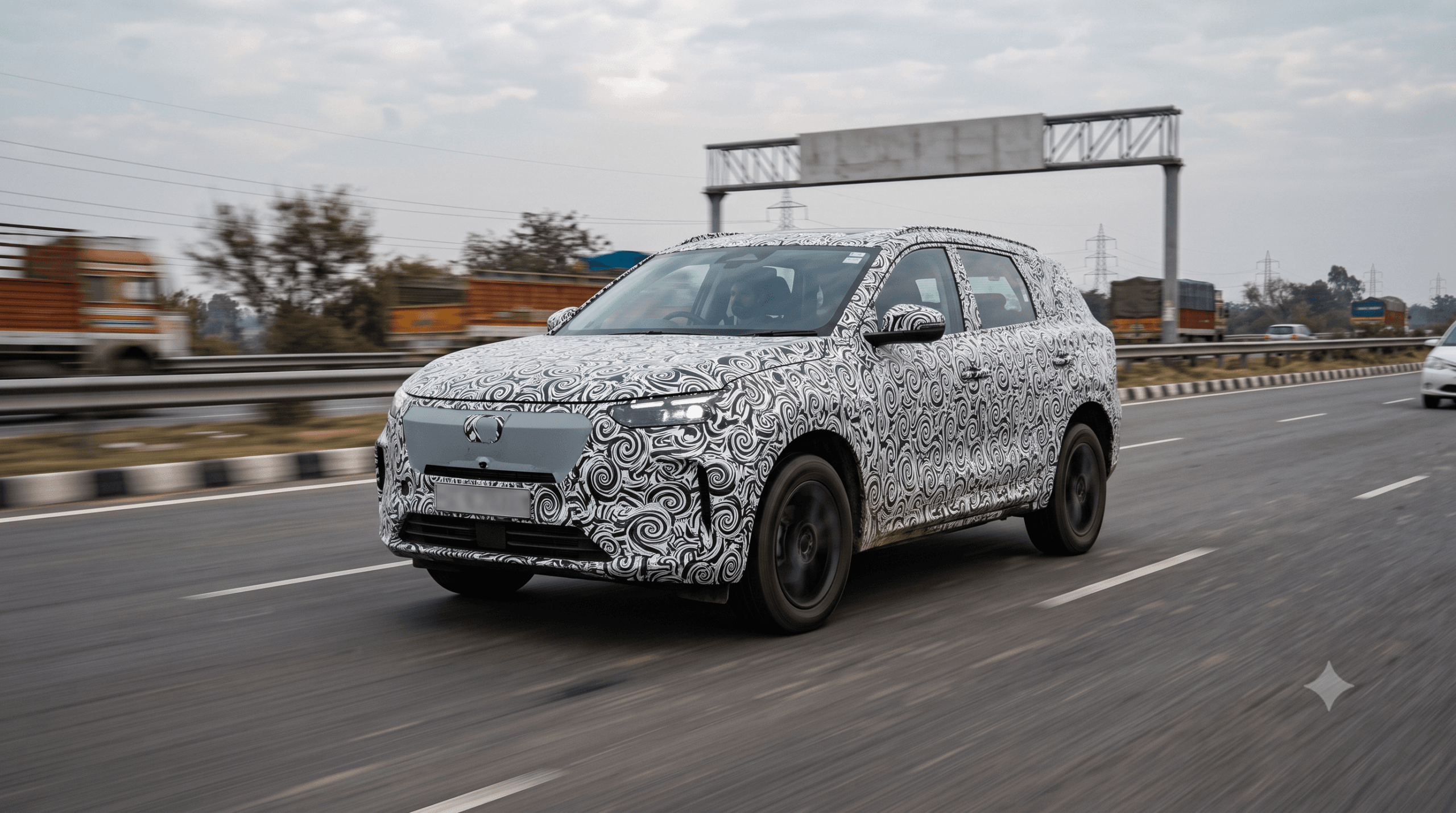
A heavily camouflaged electric SUV was recently caught testing on Indian roads, and much of the internet immediately labelled it the upcoming Tata Avinya. It isn’t. According to Autocar India, the test mule is actually an Exeed Sterra ET — an SUV from Chery’s premium sub-brand — being used as a rolling test bed because it shares the exact platform Tata’s Avinya range will use. That distinction matters, but the genuinely important story sits underneath it: Tata’s premium EV brand has quietly abandoned Jaguar Land Rover’s own architecture in favour of a Chinese-developed platform, and that decision says more about the global EV industry than any spy shot could.
What Was Actually Spied
Let’s clear up the confusion first, because it’s central to reading this correctly. The camouflaged prototype circulating online is not a Tata Avinya. It’s an Exeed Sterra ET — sold as the Exlantix ET in some markets outside China — a near-five-metre SUV from Exeed, a premium brand under Chinese automaker Chery. Autocar India, reporting the story, identified the mule specifically and explained why it’s here: the Sterra ET rides on the same Chery-JLR platform that will underpin Tata’s Avinya range, making it a convenient test bed for validating that architecture on Indian roads.
Worth noting: some coverage has framed the same mule differently, with at least one outlet reporting it as a Chery Exlantix being tested by JSW Motors for its own India plans. The same Chinese SUV is genuinely linked to more than one Indian player, which is part of why the sighting got muddled. But the most authoritative reporting ties this specific testing activity to the Avinya platform programme, and that’s the thread worth following.
The key takeaway: nobody has seen the actual Avinya. What’s been spotted is the donor architecture wearing a Chinese badge. So any “Avinya design revealed” excitement is misplaced — the styling under that camouflage belongs to an Exeed, not a Tata.
The Real News: Tata Ditched JLR’s Platform for a Chinese One
Here’s what actually matters. The Avinya is Tata’s premium electric sub-brand — the name means “innovation” in Sanskrit — positioned above the mainstream Tata.ev range of the Nexon EV, Curvv EV, Harrier EV and Sierra EV. It’s meant to be Tata’s aspirational, globally-competitive electric flagship.
Originally, Tata planned to build the Avinya on Jaguar Land Rover’s Electrified Modular Architecture (EMA) — JLR being Tata’s own British subsidiary. That plan has changed. After JLR reportedly shelved the relevant India EV platform plans, Tata has confirmed the Avinya range will instead be built on the Freelander EV platform developed by Chery-JLR (the JLR–Chery joint venture in China), known as the E0X. Tata is reworking the electronics, software and vehicle systems for the Indian market and layering its own design, engineering and integration on top — but the underlying architecture is Chinese-developed.
Sit with that for a moment. Tata Motors owns Jaguar Land Rover. And yet, for its halo electric brand, Tata has concluded that building on a Chinese-developed platform — one that came out of JLR’s own joint venture with Chery — is the faster, more pragmatic route than using JLR’s in-house architecture. When even the parent company of a storied British marque finds a Chinese EV platform the more sensible foundation for its premium ambitions, that’s a striking statement about where competitive advantage in electric vehicles now sits.
Why This Fits a Pattern
This isn’t an isolated decision; it’s the latest instance of a pattern that’s become one of the defining features of the current market. The same E0X platform underpins the Chery-JLR Freelander 8 — a full-size luxury EREV SUV where a British marque’s name and design sit atop a Chinese platform, battery and software stack. It also underpins a range of Chinese Exeed, Sterra and Luxeed models. Now it’s the base for Tata’s Avinya too.
The logic is consistent across all of these, and it’s worth stating plainly rather than dressing up. According to industry analysts, Chinese manufacturers currently hold genuine advantages in EV platform development — cost, speed to market, and integration of batteries, power electronics and software. Research shows developing a competitive electric architecture from scratch runs into billions and takes years. For a manufacturer that wants a premium EV on the road by 2027, licensing or adopting a proven, advanced platform is a rational way to skip the most expensive and time-consuming part of the job. Tata gets a fast, technically capable foundation and concentrates its own effort on the design, software calibration and India-specific engineering that will actually differentiate the car.
The Honest Tension
There’s a genuine question this raises for the Avinya, and it deserves acknowledging rather than glossing over. Avinya is being positioned as a showcase of Tata’s premium innovation — a brand meant to carry Indian engineering ambition into the global premium EV space. Building that brand on a Chinese-developed platform sits in some tension with that positioning. It’s pragmatic and probably the right commercial call, but “premium Indian innovation brand riding on a Chinese architecture” is a narrative Tata will have to manage carefully, especially as buyers grow more aware of which platforms underpin which cars.
The counterpoint, which is also fair, is that platforms have long been shared and licensed across the industry, and what ultimately defines a car to a buyer is how it drives, looks, feels and is supported — areas where Tata retains control. A great vehicle built on a shared platform is still a great vehicle. Whether the Avinya earns its premium billing will come down to Tata’s execution on the parts it owns, not the origin of the skateboard underneath.
What’s Actually Known — and What Isn’t
For anyone tracking this, rigour matters, because it’s easy to conflate the donor car’s specifications with the Avinya’s. They are not the same.
What the donor Sterra ET offers gives a sense of the platform’s ceiling: an 800V architecture supporting battery packs up to 100kWh, rear- and all-wheel-drive options, a claimed range up to 760km on China’s CLTC cycle in electric form, plus range-extender variants, Level 2 ADAS, over-the-air updates and vehicle-to-load capability. But those are the Chinese donor car’s numbers. Tata’s Avinya specifications remain officially unconfirmed, the brand is expected to remain pure-electric, and reported battery estimates hover somewhere in the 65-95kWh range — estimates, not confirmations.
On timing: the first model, the Avinya X (internally the P2 programme), is expected to launch around 2027, with engineering prototypes anticipated later this year. Production is planned at Tata’s new facility in Panapakkam, Tamil Nadu, with early units likely assembled from kits shipped from China before local manufacturing scales up. At least five models are understood to be under development in the broader programme.
What This Means for Buyers and Watchers
The practical guidance is simple: this is a watch-this-space story, not a buy-or-wait one. There’s no Avinya to see yet, no confirmed specifications, and a launch that’s roughly two years out. Nobody should be making purchase plans around it today.
What’s worth understanding is the signal. The way India’s premium EVs get built is being reshaped by access to advanced Chinese platforms, and the Avinya is now a prominent example. For a buyer, that’s not a bad thing in itself — it can mean more capable, better-value premium EVs arriving faster than they otherwise would. But it does mean the old assumptions about a car’s engineering origins no longer hold, and that a badge’s nationality increasingly tells you less about where the technology underneath actually comes from.
The Bottom Line
The spied mule is an Exeed Sterra ET, not the Tata Avinya — so treat the “Avinya spied” headlines with caution. The substance worth caring about is that Tata has pivoted its premium EV brand from JLR’s own architecture to a Chinese-developed Chery-JLR platform, a decision that’s pragmatic, probably correct, and quietly revealing about who leads in EV technology today. The Avinya X is expected around 2027; until then, this is a signal to understand, not a product to anticipate.
FAQs
Was the Tata Avinya spied testing in India?
Not exactly. The camouflaged SUV widely reported as the Avinya is actually an Exeed Sterra ET — a Chery sub-brand SUV — being used as a test bed because it shares the platform Tata’s Avinya range will use. The actual Avinya hasn’t been seen.
What platform will the Tata Avinya use?
Tata has confirmed the Avinya range will be built on the Freelander EV platform (known as E0X) developed by Chery-JLR, rather than Jaguar Land Rover’s own EMA architecture as originally planned. Tata is reworking the electronics and software for India.
Why did Tata switch from JLR’s platform to a Chinese one?
After JLR reportedly shelved the relevant India EV platform plans, Tata chose the Chery-JLR E0X platform as a faster, more cost-effective route to market. Chinese EV platforms currently offer advantages in cost, development speed and technology integration.
When will the Tata Avinya launch?
The first model, the Avinya X, is expected around 2027, with engineering prototypes anticipated later in 2026. Production is planned at Tata’s Panapakkam facility in Tamil Nadu.
What are the Tata Avinya’s specifications?
They’re officially unconfirmed. The donor Exeed Sterra ET uses an 800V architecture with up to 100kWh batteries and up to 760km CLTC range, but the Avinya’s actual specs will differ. It’s expected to remain a pure-electric vehicle with a battery reportedly in the 65-95kWh range.
Where does the Avinya sit in Tata’s range?
Avinya is Tata’s premium EV sub-brand, positioned above the mainstream Tata.ev models like the Nexon EV, Curvv EV, Harrier EV and Sierra EV, with global premium ambitions.