TL;DR — Key Takeaways
- Vivo Y51 Pro India launch is imminent — the phone has already cleared BIS certification and received Bluetooth SIG approval, both historically reliable pre-launch signals.
- Expected Vivo Y51 Pro price in India: under ₹25,000, with a starting price closer to ₹23,999 (per 91mobiles exclusive leak via tipster Sanju Choudhary, March 3, 2026). An instant cashback of ₹2,500 is also reportedly planned, potentially bringing the effective price down to ~₹21,499.
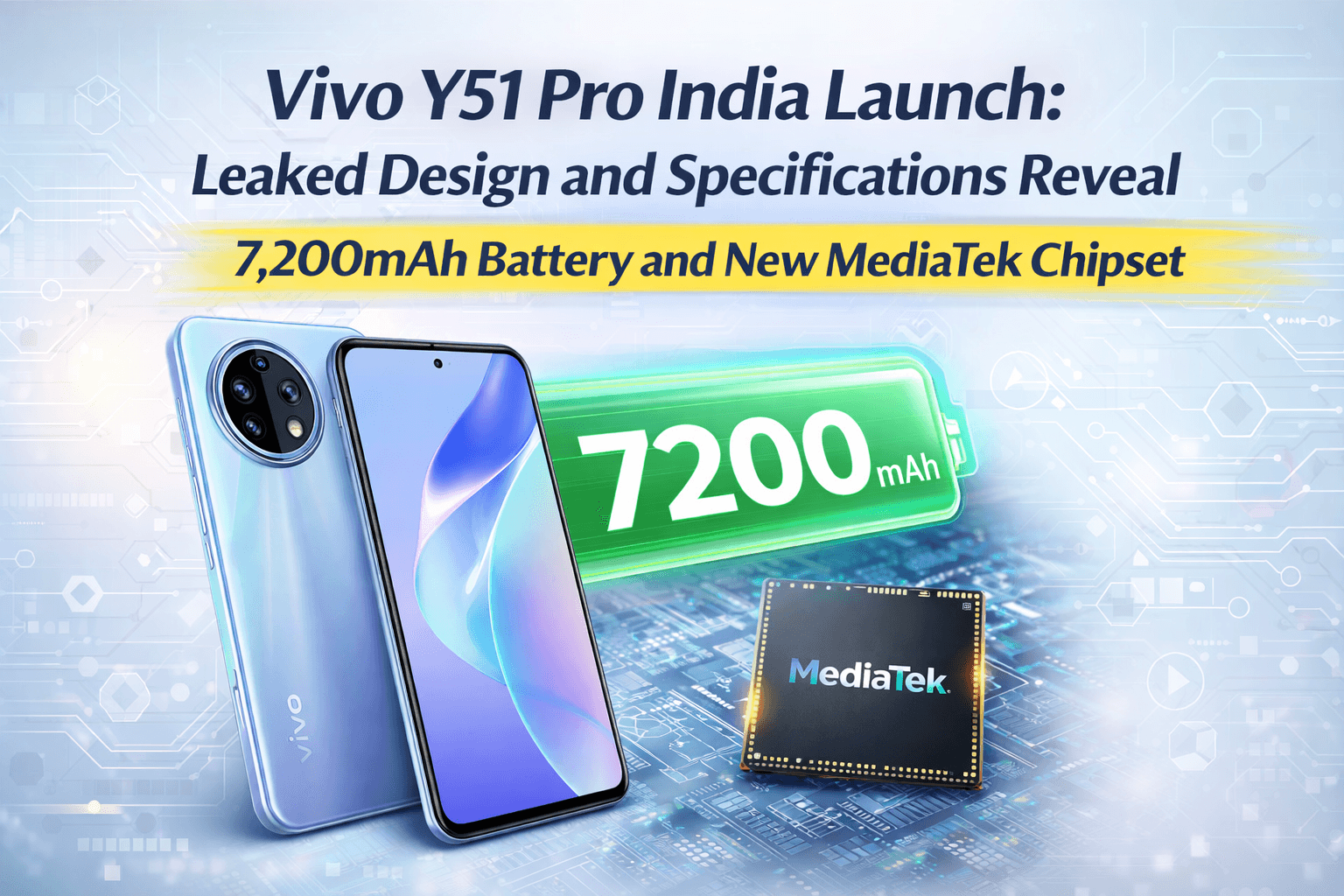
- The phone packs a 7,200mAh battery — a 700mAh upgrade over the Y31 Pro’s 6,500mAh — powered by the new MediaTek Dimensity 7360-Turbo chipset built on a 4nm process.
- Camera setup is a dual rear system led by a 50MP AI sensor with 4K video capability, plus an LED ring light — a design detail usually reserved for Vivo’s premium V-series.
- Durability gets a serious upgrade: IP68 + IP69 dual certification on a mid-range Y-series phone is genuinely unusual, and it’s one of the strongest arguments for this phone over its competition at the ₹20,000–₹25,000 bracket.
Most mid-range phones under ₹25,000 make you negotiate. You get the battery, but not the build quality. Or the processor, but not the durability. Vivo’s upcoming Y51 Pro, based on exclusive promotional material leaked to 91mobiles on March 3, 2026, seems to be attempting something rarer — a phone that doesn’t ask you to pick a compromise.
The Vivo Y51 Pro hasn’t been officially announced yet. And yet, it’s already appeared on the Bureau of Indian Standards (BIS) website and cleared Bluetooth SIG certification — two regulatory hurdles that, in India’s smartphone market, almost always mean a launch is weeks, not months, away. The timing lands right after Vivo’s V70 series rollout, suggesting the brand is deliberately seeding its lineup from the top down before turning its full attention to the mid-range faithful.
The Vivo Y51 Pro is an upcoming 5G smartphone expected to launch in India under ₹25,000, with a starting price of approximately ₹23,999 (per 91mobiles’ exclusive leak). It features a 7,200mAh battery, MediaTek Dimensity 7360-Turbo chipset, 50MP AI rear camera, IP68/IP69 water and dust resistance, and runs Android 16-based OriginOS 6. No official launch date has been confirmed as of March 4, 2026.
The Number That Makes This Phone Worth Paying Attention To
Let me start with the battery, because 7,200mAh at this price tier is genuinely unusual — and the context matters.
Think of battery capacity like a fuel tank. A 5,000mAh phone is a standard hatchback: efficient, adequate for city driving, fine if you’re disciplined about usage. A 6,500mAh phone — like the Vivo Y31 Pro that the Y51 Pro is directly succeeding — is a sedan. Noticeably more range, noticeably more relaxed about heavy days. A 7,200mAh phone is an SUV. You stop worrying about range entirely. You charge it at night, and even with heavy social media, video, navigation, and gaming use through a twelve-hour day, you’re still looking at meaningful reserves come evening.
According to 91mobiles’ exclusive report published March 3, 2026 — sourced via tipster Sanju Choudhary and including promotional marketing material — the Vivo Y51 Pro will carry a 7,200mAh battery, a capacity increase of 700mAh over the Y31 Pro’s 6,500mAh that launched in September 2025. That gap sounds modest on paper. In daily use, it translates to roughly an additional 1.5–2 hours of screen-on time under moderate load — which is the difference between a phone that comfortably lasts a long day and one that will get through a long weekend trip with light charging.
What’s interesting is where Vivo has chosen to engineer this capacity. Silicon-carbon battery technology — the cell chemistry that allows manufacturers to achieve higher energy density without increasing phone dimensions — is slowly entering the sub-₹25,000 segment. A related Latestly report from February 2026 noted that Vivo is reportedly testing a 12,000mAh single-cell silicon battery across its development pipeline, suggesting the brand is systematically pushing energy density across its portfolio. The Y51 Pro’s 7,200mAh cell appears to be the mid-range expression of that same engineering commitment.
The fast charging specification hasn’t been confirmed yet. The Y31 Pro ships with 44W Flash Charging — a meaningful spec in the sub-₹20K market. If Vivo holds or upgrades that charging rate for the Y51 Pro, filling a 7,200mAh battery in under 90 minutes becomes a realistic target. Watch for that number when the official announcement drops.
MediaTek Dimensity 7360-Turbo: Why This Chip Matters at This Price
The Vivo Y51 Pro will be powered by the MediaTek Dimensity 7360-Turbo, a chipset announced in late 2025 that is engineered specifically for gaming performance and improved power efficiency. The “Turbo” designation isn’t marketing fluff — it signals a meaningful clock speed and GPU uplift over the standard Dimensity 7360, which already serves as the foundation chip in several phones launched in early 2025.
Per 91mobiles’ Hindi report, the Dimensity 7360-Turbo runs on a 4nm process node and is capable of clock speeds up to 2.5GHz — a specification that positions it above the Dimensity 7300 used in the Vivo Y31 Pro (which runs at a lower peak clock speed on the same broad process architecture). The upgrade is real.
Here’s why the chip choice matters beyond benchmark scores. The Dimensity 7360-Turbo, combined with a 7,200mAh battery, creates a specific kind of phone: one that can sustain gaming workloads for extended sessions without the aggressive thermal throttling that plagues many mid-range devices after 15–20 minutes of heavy GPU load. The 4nm efficiency means less heat generated per unit of compute — which directly translates to longer gaming windows before performance drops, and less battery drain per frame rendered. For a Y-series phone positioning itself partly on gaming credentials, that pairing is deliberate, not accidental.
The Y51 Pro also ships with OriginOS 6, based on Android 16 — making it one of the first phones in the sub-₹25,000 segment to launch on Android 16 at the point of sale. That’s not a trivial advantage. Android 16’s improved background process management and Adaptive Refresh Rate optimization will tangibly benefit battery life and display smoothness in ways that Android 15-based phones in the same bracket can’t match at launch.
IP68 + IP69: The Feature Nobody Talks About Until They Drop Their Phone in Water
The Vivo Y51 Pro is tipped to feature both IP68 and IP69 ratings for water and dust resistance — a combination that suggests the phone can withstand high-pressure water jets and deep submersion, a level of durability typically reserved for premium or ruggedised smartphones.
Let me spell out what those two certifications actually mean, because this is a spec that gets listed in bullet points without enough explanation.
IP68 means the phone can withstand immersion in fresh water up to 1.5 metres deep for 30 minutes. That covers the dropped-in-the-toilet scenario, the rain-caught-without-cover scenario, and the sweat-during-workout scenario. It’s a solid protection standard.
IP69 goes further. It certifies resistance to high-pressure, high-temperature water jets applied at close range. This is the automotive and industrial standard — the test that simulates being sprayed with a pressure washer. For a smartphone, it means you can rinse it forcefully under a tap, it can survive a beach day with salt spray, and it won’t flinch at the kind of water exposure that would destroy a phone with IP67 or even IP68-only protection.
Having both IP68 and IP69 on a sub-₹25,000 phone is genuinely unusual. The Samsung Galaxy A36 5G, expected at ~₹35,000, carries IP67. The Redmi Note 15 Pro, currently at ₹27,999, has IP68 but not IP69. The Vivo Y51 Pro, if the IP69 claim holds through official confirmation, would offer better water resistance than phones costing ₹10,000–₹15,000 more. That’s a compelling single-sentence argument that will land with buyers who use their phones in demanding physical environments — outdoor professionals, students, construction workers, anyone who’s ever panicked watching a phone go into a sink.
Design and Camera: The V-Series DNA Trickling Down
In terms of design, the Vivo Y51 Pro looks similar to the V70 series, especially with its striking red colour, flat edges, and LED ring light on the rear camera module. This is a significant visual departure for the Y-series, which has historically carried more utilitarian aesthetics compared to Vivo’s premium V and X lines.
The LED ring light specifically — a circular lighting element around the rear camera housing — is a design signature that debuted in Vivo’s higher-end devices. Its appearance on the Y51 Pro signals something deliberate: Vivo is intentionally narrowing the visual distance between its sub-₹25,000 segment and its ₹30,000+ portfolio. For a buyer walking into a store, the Y51 Pro will look like a more expensive phone than its price tag suggests. That perception gap is a real competitive weapon.
“At under ₹25,000, if Vivo delivers IP68+IP69 water resistance, 7,200mAh battery life, and V-series design aesthetics, it won’t just win the spec sheet — it’ll win the shelf.”
Camera hardware consists of a dual rear system led by a 50MP AI-enabled wide sensor capable of 4K video recording. The Y31 Pro, for comparison, also carried a 50MP primary sensor in a dual setup — so the raw megapixel count hasn’t changed, but the “AI-enabled” designation suggests improved scene recognition, night photography processing, and possibly subject tracking improvements tied to OriginOS 6’s computational photography pipeline.
A secondary sensor accompanies the primary, though its specification (depth sensor or ultrawide) hasn’t been confirmed yet in the leaked material. The front camera spec is also unconfirmed — the Y31 Pro used an 8MP front camera, and any improvement here will matter for the Y51 Pro’s positioning against selfie-focused competitors like the Realme Narzo 80 Pro or Infinix Hot 70 Pro in the same price band.
A likely additional colour option beyond the striking red variant is expected at launch — matching Vivo’s standard dual-colourway approach for Y-series launches in India.
Vivo Y51 Pro vs. Competition: The Sub-₹25,000 Landscape Right Now
The sub-₹25,000 5G segment in India as of March 2026 is one of the most fiercely competitive price brackets in the world’s fastest-growing smartphone market. According to TRAI’s Q3 2025 report, India crossed 165 million active 5G subscriptions — a figure that has fundamentally shifted buyer expectations at every price tier. Buyers under ₹25,000 now expect 5G, good battery, and at least a competitive camera as baseline requirements, not premium features.
Here’s how the Y51 Pro is expected to stack up against its most direct rivals:
Redmi Note 15 Pro (₹27,999 — 6GB/128GB): Snapdragon 7s Gen 3, 5,110mAh battery, 50MP triple camera. Stronger in cameras and brand recognition; weaker in battery by a significant margin. Price difference is approximately ₹4,000–₹6,000 depending on Y51 Pro’s final pricing.
Realme Narzo 80 Pro 5G (expected ~₹22,000–₹24,000): MediaTek Dimensity 7300, 5,000mAh battery. The Y51 Pro’s Dimensity 7360-Turbo is a generational step above the 7300, and its 7,200mAh battery is significantly larger. The Narzo 80 Pro leads on display specifications but trails substantially on endurance.
Samsung Galaxy M36 5G (₹24,999 — 8GB/128GB): Exynos 1380, 6,000mAh battery, 50MP camera. Samsung’s brand and after-sales service network are genuine advantages; battery trails by 1,200mAh; no IP69 rating.
Infinix Hot 70 Pro (₹13,999–₹17,000 expected): MediaTek Dimensity 7200, 7,000mAh battery. Comes closest on battery capacity but uses an older chip, lacks IP69, and sits at a lower price tier that reflects the spec trade-offs.
What the Y51 Pro’s spec profile suggests — and this is worth saying clearly — is that Vivo is not trying to win on any single dimension. It’s attempting a configuration that’s hard to beat comprehensively: the largest battery in its class, the newest chip in the segment, the best water resistance rating available, and a design vocabulary borrowed from phones that cost ₹10,000 more. Whether execution matches the spec sheet is the question only post-launch reviews will answer.
How to Prepare for the Vivo Y51 Pro India Launch: A Practical Checklist
Since no official sale date has been announced, here are the concrete steps worth taking before the Y51 Pro goes on sale:
- Check BIS India’s registered products page at bis.gov.in — the Y51 Pro registration is already public, and the model number can confirm if additional variants (storage or RAM configurations) exist beyond the 8GB + 128GB base.
- Enable “Notify Me” on Flipkart and Amazon India for the Vivo Y51 Pro — both platforms typically activate these pages 5–7 days before an official launch announcement.
- Follow Vivo India’s official social channels (Instagram @vivoIndia, Twitter/X @Vivo_India) — Vivo typically teases Y-series launches 3–5 days before the announcement with countdown posts.
- Check the bank card offers at launch — the ₹2,500 instant cashback mentioned in the 91mobiles leak is likely tied to a specific bank card partnership (HDFC, ICICI, or Axis Bank are Vivo’s frequent partners). Identifying your eligible card before sale day prevents missing the deal.
- Compare the final confirmed spec sheet against Redmi Note 15 Pro and Samsung Galaxy M36 the moment official specs are published — those two phones define the competitive benchmark the Y51 Pro will be measured against.
The Battery Race in India’s Mid-Range Has a New Frontrunner
There’s a larger story playing out across India’s sub-₹25,000 segment in 2026, and the Vivo Y51 Pro is part of it. Brands have understood — finally — that battery life is not a secondary spec for Indian buyers. It is the primary one. TRAI’s 5G subscription data, IDC’s Q4 2025 India smartphone shipment report (which flagged battery capacity as the top purchase driver in the ₹15K–₹25K segment), and the consistent success of battery-focused devices from Infinix and Samsung’s M-series all point to the same insight: for a buyer spending ₹20,000–₹25,000 on a phone, the question isn’t “will it run fast?” It’s “will it survive my day without me thinking about it?”
The Y51 Pro’s answer — 7,200mAh, new-generation chipset efficiency, and OriginOS 6’s improved power management — is the most comprehensive attempt at that answer I’ve seen at this price tier in Q1 2026. Whether the execution holds through post-launch reviews is what matters now. The spec promise is strong.
Keep the Vivo India social channels in your peripheral vision. When the launch posts start dropping, they’ll move fast — and at a price under ₹25,000 with these credentials, so will the first sale units.
Are you upgrading from a Vivo Y31 Pro, or cross-shopping against the Redmi Note 15 Pro or Samsung Galaxy M36? The battery-vs-camera trade-off is the decision most buyers in this bracket are actually wrestling with. Share your current phone and the one number that would close the deal for you in the comments.
External Authority References
- 91mobiles — Exclusive: Vivo Y51 Pro India Launch Design and Specs Revealed, March 3, 2026
- Latestly — Vivo Y51 Pro India Launch: Leaked Design and Specifications, March 4, 2026
- Bureau of Indian Standards (BIS) — Product Registration Portal (Vivo Y51 Pro registered; publicly verifiable pre-launch signal)
FAQ: Your Real Questions Before the Y51 Pro Launches
What is the Vivo Y51 Pro price in India?
The Vivo Y51 Pro is expected to launch under ₹25,000 in India, with a starting price of approximately ₹23,999, according to an exclusive 91mobiles report published March 3, 2026, citing promotional material obtained by tipster Sanju Choudhary. An instant cashback of ₹2,500 at launch is also reportedly planned, bringing the effective starting price to around ₹21,499. These figures are pre-launch estimates — the official price will be confirmed at Vivo India’s launch announcement.
When is the Vivo Y51 Pro India launch date?
No official launch date has been announced as of March 4, 2026. The phone has cleared BIS certification and Bluetooth SIG approval — both strong indicators that a launch is imminent, typically within 2–6 weeks of these regulatory clearances. Vivo India has not confirmed a date through official channels as of this writing.
What is the Vivo Y51 Pro 8GB 128GB price in India?
The 8GB + 128GB configuration is the expected base variant of the Y51 Pro, at the reported ~₹23,999 starting price (per 91mobiles’ March 2026 leak). Whether a 12GB + 256GB higher variant will be available at launch is unconfirmed. The Y31 Pro, which the Y51 Pro succeeds, launched at ₹18,999 for 8GB + 128GB in September 2025.
How does the Vivo Y51 Pro compare to the Y31 Pro?
The Y51 Pro upgrades from the Y31 Pro on three key axes: processor (Dimensity 7360-Turbo vs 7300), battery (7,200mAh vs 6,500mAh), and durability (IP68+IP69 vs no IP rating on the Y31 Pro). The camera maintains the 50MP dual rear configuration. The Y31 Pro launched at ₹18,999; the Y51 Pro is expected at ~₹23,999 — a ₹5,000 step up that, on current spec evidence, appears justified.
Does the Vivo Y51 Pro have 5G?
Yes. The MediaTek Dimensity 7360-Turbo chipset supports 5G connectivity. The phone will launch as a 5G device, consistent with Vivo’s India Y-series strategy of making 5G the baseline for all new launches above ₹15,000 since late 2024.
What Android version does the Vivo Y51 Pro run?
The Vivo Y51 Pro is expected to launch with Android 16-based OriginOS 6, making it one of the first sub-₹25,000 phones in India to ship with Android 16 at the point of sale. This is a meaningful differentiation, as most competing phones in this bracket launched on Android 15 and are still awaiting update rollouts.