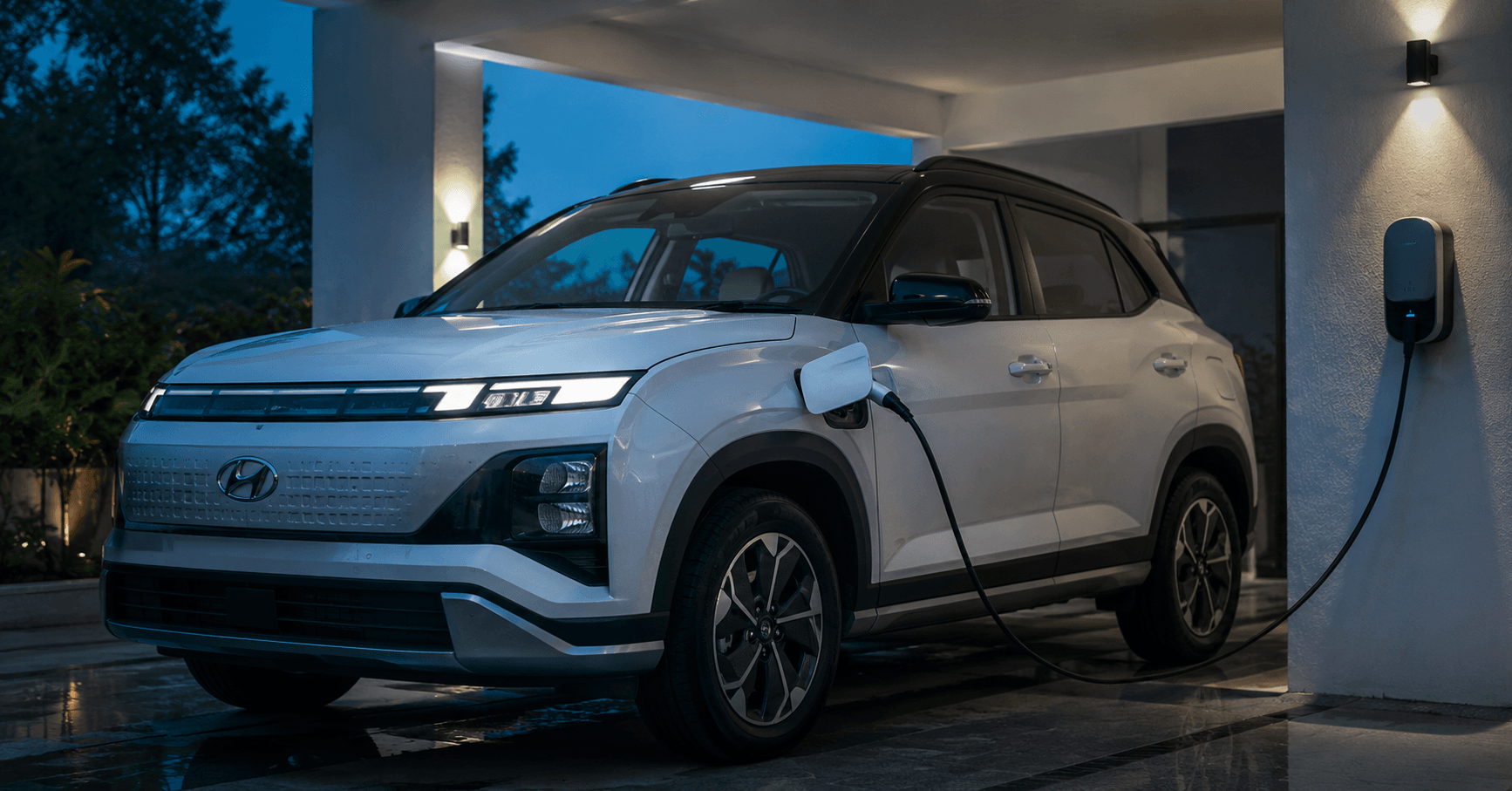
Hyundai’s new Battery-as-a-Service plan drops the Creta Electric’s entry price to Rs 10.99 lakh by renting out the battery separately at Rs 3.90 per kilometre, and whether that is actually cheaper than buying the car outright at Rs 18.03 lakh depends entirely on how many kilometres you drive each year — for most private buyers doing under 40km a day, BaaS works out more expensive over an 8-year ownership period, not less.
How the Creta Electric BaaS plan actually works
Under the new scheme, buyers pay Rs 10.99 lakh (ex-showroom) for the 42kWh Creta Electric without owning the battery pack, and then pay Rs 3.90 for every kilometre driven as a battery rental fee. The alternative is to buy the same car outright starting at Rs 18.03 lakh, rising to Rs 24.70 lakh for the higher 51.4kWh, 510km-range variant. On paper, BaaS looks like it saves buyers Rs 7.04 lakh upfront — and it genuinely does reduce the loan amount and the EMI burden in year one. The question that Hyundai’s marketing doesn’t answer for you is what happens over the years you actually own the car.
Running the actual numbers
The gap between the BaaS price and the outright price is Rs 7.04 lakh. That is effectively the price of the 42kWh battery pack, bundled into a per-kilometre rental instead of a one-time cost. To find out whether renting or buying the battery is cheaper, you only need to compare the per-km rental cost against how many kilometres it would take to “spend” that Rs 7.04 lakh through rental fees.
At Rs 3.90 per km, Rs 7.04 lakh worth of rental fees is used up after roughly 1,80,000 km of driving. That sounds like a lot, but here is where typical Indian ownership patterns matter:
- A low-mileage urban commuter driving around 10,000km a year would take 18 years to hit that breakeven point — far beyond any realistic ownership period, which means the buyer would almost certainly pay less by simply purchasing the battery outright, since they’d sell or trade in the car long before the rental fees add up to the battery’s cost.
- A moderate driver covering 15,000km a year (a common figure for a daily office commute in a metro) reaches roughly Rs 58,500 a year in battery rental. Over 8 years, that’s about Rs 4.68 lakh in rental fees — still noticeably less than the Rs 7.04 lakh price difference, making BaaS mildly favourable at this usage level, though the gap narrows every year the car is kept beyond 8 years.
- A high-mileage driver, such as someone using the Creta Electric for aggregator or long-commute duty at 25,000-30,000km a year, would rack up roughly Rs 97,500-1,17,000 a year in rental fees. Over just 6 years, that crosses Rs 6-7 lakh, matching or exceeding the outright battery cost — meaning high-mileage buyers actively lose money by choosing BaaS instead of owning the battery.
Where BaaS earns its keep beyond the sticker price
The per-kilometre math is only half the picture. Hyundai’s BaaS plan typically bundles battery repair, replacement, and degradation coverage into the rental fee, which removes one of the biggest anxieties EV buyers have: the cost of replacing a battery pack after warranty expiry, which can run into several lakh rupees for a 40kWh+ pack. For a buyer who plans to keep the car only 3-4 years and then sell it, BaaS also tends to preserve resale value better, since the next buyer isn’t inheriting an aging, depreciating battery — they simply take over or renegotiate the rental agreement.
That resale mechanic cuts both ways, though. A used Creta Electric bought under BaaS is a more complicated sale than a conventionally owned EV, because the second buyer has to either continue paying the per-km rental under Hyundai’s terms or separately negotiate to buy the battery outright — a friction point that outright-owned EVs don’t have.
The insurance and warranty fine print buyers tend to skip
BaaS agreements typically require the owner to maintain comprehensive insurance covering the vehicle for its full outright value, including the battery’s replacement cost, even though the buyer never actually owns that battery — this detail is easy to miss when comparing headline prices, since it means the effective insurance premium under BaaS can be closer to what a full-ownership buyer pays than the lower BaaS purchase price would suggest. Buyers should also confirm what happens to unused rental credit or minimum-commitment shortfalls if they sell the car mid-contract, since terms vary and are not always disclosed as prominently as the headline per-km rate during a showroom pitch.
Who should actually choose BaaS
Based on the breakeven math, the ideal BaaS customer for the Creta Electric is a low-to-moderate mileage driver — realistically under 15,000km a year — who wants to lower their upfront loan amount, values the peace of mind of bundled battery coverage, and expects to sell or upgrade the car within 5-6 years rather than keep it long-term. This profile matches a large share of urban SUV buyers who use their car mainly for city commuting and weekend trips rather than long highway runs.
Buyers who log more than 20,000km a year — frequent highway drivers, or anyone using the Creta Electric for a ride-hailing or corporate fleet — should do the math before signing up, because the per-km rental fee will very likely cost more over a realistic ownership window than simply financing the extra Rs 7.04 lakh for outright battery ownership, especially given current EV loan interest rates.
What broader EV financing data shows
Industry data shows battery packs typically account for 35-45% of an EV’s total manufacturing cost, which is exactly the portion BaaS plans convert from a one-time expense into an ongoing rental. Analysts tracking EV subscription financing note that BaaS adoption has grown fastest in fleet and commercial segments, where operators can forecast annual mileage precisely and structure rental agreements around known usage — a very different scenario from a private buyer guessing at how many kilometres they’ll actually drive over the next five years.
According to comparisons published by multiple automotive finance trackers, a conventional EV loan at current interest rates (roughly 9-11% for a five-year tenure) adds a predictable, fixed cost on top of the vehicle price, while a BaaS rental fee scales directly with usage — meaning the “cheaper” option genuinely depends on whether a buyer values cost predictability (favouring a loan on the full outright price) or the lowest possible upfront commitment (favouring BaaS), independent of which one is mathematically cheaper over the full ownership period.
Why Hyundai is pushing BaaS now
The timing lines up with a broader industry pattern: as more Indian automakers introduce battery subscription plans to compete with each other on headline pricing, BaaS has become as much a marketing tool to hit a psychologically lower starting price as it is a genuine financing innovation. Advertising a Creta Electric “from Rs 10.99 lakh” pulls the SUV into a completely different cross-shopping bracket — closer to a loaded Creta petrol or a Tata Nexon EV — than advertising it “from Rs 18.03 lakh” would. Buyers should treat the headline BaaS price as a financing structure to evaluate on its own merits, not as the car’s real cost.
FAQs
Is the Hyundai Creta Electric cheaper with BaaS or outright purchase?
It depends on annual mileage. Buyers driving under roughly 15,000km a year generally pay less over an 8-year period with BaaS, while those driving more than 20,000km a year typically end up paying more in battery rental than the outright battery cost.
How much does the Creta Electric BaaS battery rental cost per km?
Hyundai charges Rs 3.90 per kilometre for the 42kWh battery under the BaaS plan, on top of the Rs 10.99 lakh ex-showroom price for the vehicle without the battery.
What is the price difference between BaaS and outright ownership for the Creta Electric?
BaaS reduces the entry price by about Rs 7.04 lakh compared to the outright-ownership price of Rs 18.03 lakh for the 42kWh variant.
Does BaaS cover battery replacement and repairs?
Yes, battery-as-a-service plans typically bundle repair, maintenance, and replacement coverage into the rental fee, removing the risk of a large out-of-pocket battery replacement cost after the standard warranty period ends.
Is it harder to resell a car bought under a BaaS plan?
Reselling can be more complex, since the next buyer must either continue the battery rental agreement or negotiate to buy the battery outright, which is an extra step compared to selling a conventionally owned EV.
Which Creta Electric variant is available with BaaS?
As of the current launch, BaaS is offered on the 42kWh battery variant with a claimed 420km range; the higher 51.4kWh, 510km-range variant is currently available only through outright purchase.