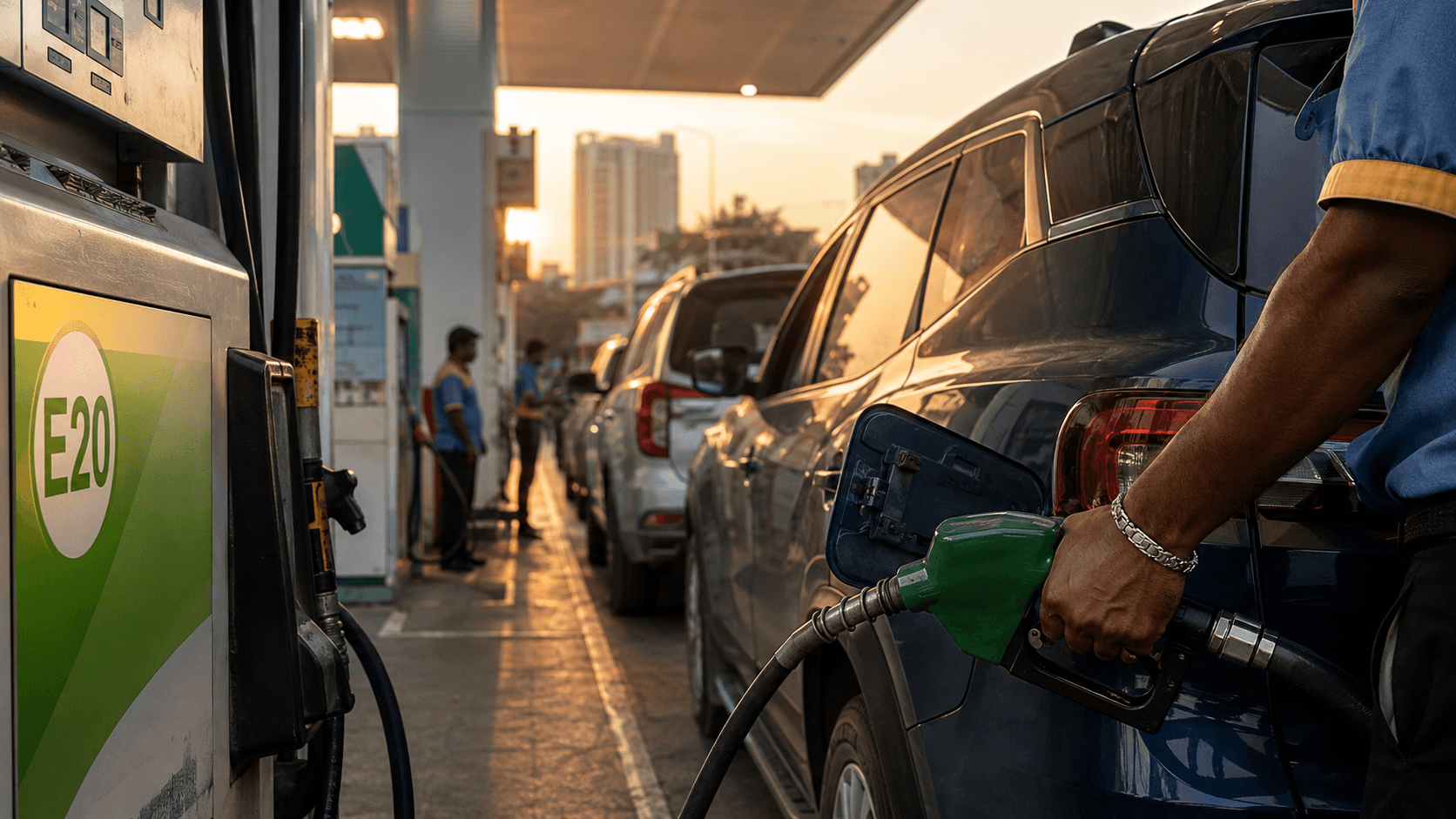
E20 petrol — India’s 20% ethanol-blended fuel — does reduce mileage, but not by the dramatic margins going viral on social media. Government-backed field trials by the Automotive Research Association of India (ARAI) and the Society of Indian Automobile Manufacturers (SIAM) put the real-world efficiency loss at roughly 2-4% for E20-compatible vehicles and up to 3-6% for older, non-calibrated ones — nowhere close to the 60-70% mileage collapse some drivers have reported online. The gap between measured data and viral anecdotes is the actual story, and it matters for anyone budgeting fuel costs or shopping for a car in 2026.
The Video That Restarted the Debate
The latest flashpoint was a video from YouTuber Sourav Joshi, one of India’s most-followed daily vloggers, who said his Mercedes-Benz GLC 300 4MATIC’s fuel efficiency fell from around 17 km/l to roughly 5 km/l within 48 hours of switching to E20 petrol, with his full-tank range dropping from close to 800 km to about 480 km. The clip spread quickly, reviving a complaint pattern that has surfaced repeatedly since 2023 — owners from Bengaluru to Delhi reporting reduced mileage, rougher idling, and more frequent workshop visits after their local pumps switched over to E20-only supply.
Mercedes-Benz India responded with a customer advisory (without naming Joshi directly) stating that all its BS VI petrol vehicles are “materially compatible with E20 fuel” and certified accordingly by the relevant testing authorities. That statement mirrors what nearly every other manufacturer selling BS VI petrol vehicles in India has already said publicly — which is precisely why the more useful question isn’t “is my car compatible,” but “how much mileage will I actually lose, and why.”
What E20 Actually Is
E20 is a blend of 80% petrol and 20% ethanol, a biofuel typically derived from sugarcane and foodgrain surplus. It’s the culmination of the government’s National Policy on Biofuels, which originally targeted 20% blending by 2030 and hit that mark five years early, according to Union Petroleum Minister Hardeep Singh Puri. The stated goals are threefold: cut India’s crude oil import bill, reduce tailpipe carbon emissions (ethanol combustion is estimated to lower emissions by roughly 30% compared to E10), and create a stable, subsidized offtake market for domestic sugarcane and grain farmers.
Since ethanol carries less energy per litre than pure petrol, some mileage reduction is basic chemistry — not a conspiracy or a manufacturing defect. The debate isn’t whether mileage drops; it’s by how much, and whether that decline is uniform across all vehicles.
What the Data Actually Shows
This is where the independent research diverges sharply from viral anecdotes:
- SIAM’s official position, delivered by executive director P.K. Banerjee, states that claims of 50%+ efficiency drops are “unfounded and misinformed,” and that controlled scientific studies show a 2-4% decrease for E20-compatible engines.
- Maruti Suzuki’s executive committee member C.V. Raman has publicly acknowledged that real-world, on-road results can vary more than lab figures because of vehicle maintenance habits and driving style — a nuance that’s frequently lost when a single viral video becomes the only data point people see.
- The Ministry of Petroleum and Natural Gas, responding to a written query in the Rajya Sabha, cited joint field trials by Indian Oil Corporation Limited (IOCL), ARAI, and SIAM concluding there was no negative effect on drivability, startability, or metal/plastic component compatibility — even in legacy (pre-E20) vehicles.
- For vehicles that have crossed roughly 20,000 km, the ministry noted that rubber gaskets and seals not originally designed for ethanol’s higher solvency may need replacement — a low-cost maintenance item, not an engine failure.
- The Supreme Court has already declined to entertain a public interest litigation challenging the mandatory E20 rollout, with the bench dismissing the plea outright — effectively closing the near-term legal challenge to the policy.
Put together, the credible, tested range for mileage loss sits between roughly 2% and 6%, depending on vehicle calibration and age — a single-digit dent, not the double-digit collapse trending on social media. Anecdotal videos like Joshi’s are real experiences, but they’re outliers relative to the aggregated field-trial data, and outliers travel faster online than averages do.
Why the Gap Between Data and Anecdote Exists
Three factors explain why individual experiences diverge so sharply from the aggregate numbers:
- Fuel quality inconsistency at the pump. Ethanol blending ratios can vary slightly between batches and retailers, and any water contamination in ethanol-blended fuel affects combustion more noticeably than in pure petrol.
- Vehicle-specific tuning. Cars engineered from the ground up for E20 (typically newer BS VI models with updated engine control unit mapping) tolerate the blend far better than vehicles retrofitted or those running older-generation fuel injection calibration.
- Confirmation bias in reporting. A driver who notices a mileage dip after a fuel-type change is more likely to attribute it entirely to the fuel, even when contributing factors — tyre pressure, traffic conditions, AC load, driving style — go unaccounted for. This doesn’t make individual complaints illegitimate, but it does mean single anecdotes are a poor substitute for controlled testing.
What Vehicle Owners Should Actually Do
Rather than treating E20 as an unsolvable problem, owners have a few practical, low-cost levers:
- Check your owner’s manual or contact your dealership to confirm your specific engine variant’s E20 compatibility rating rather than relying on the brand’s blanket statement.
- If your vehicle has crossed ~20,000 km, get fuel-line rubber components inspected at your next service — this is the one area where ethanol’s solvent properties genuinely accelerate wear in older parts.
- Track mileage over a full tank-to-tank cycle, not a single 48-hour window, since short-term readings are more sensitive to traffic, AC usage, and driving style than to fuel chemistry alone.
- Budget for a realistic, not a panicked, adjustment — plan for a 2-6% fuel cost increase rather than assuming your running costs have doubled.
The Bigger Picture
E20 isn’t going away — India has already hit its blending target and the government has signalled intent to explore even higher blends like E22, E25, and E30 in the coming years. According to the ministry’s own submissions in Parliament, the ethanol blending programme is also framed as a farmer-income measure, since sugarcane and grain surplus feed directly into ethanol production, giving the policy a constituency well beyond the automotive sector. That context helps explain why a Supreme Court challenge seeking a non-ethanol fuel option was dismissed outright rather than sent for further hearing — the bench treated the underlying policy trade-off as settled.
For car buyers and owners, the practical takeaway is to separate the policy debate (which involves legitimate trade-offs around farmer income, energy security, and emissions) from the mechanical one, where data shows a manageable, single-digit efficiency cost for most modern vehicles. Viral videos are useful for raising real concerns publicly, but for a fuel policy touching every petrol vehicle in the country, the field-trial data — not a single 48-hour test — is what should guide purchase, maintenance, and budgeting decisions.
What This Means If You’re Car Shopping in 2026
For anyone currently comparing a new petrol SUV against a hybrid or EV alternative, the E20 mileage debate is a legitimate factor to weigh — but a modest one. A 2-6% dip in fuel efficiency changes a car’s running-cost math only marginally; it’s a smaller swing than what most buyers already see between city and highway driving, or between an automatic and manual variant of the same model. Buyers cross-shopping a petrol SUV against an EV such as the Tata Sierra EV should weigh E20’s modest efficiency cost against EV charging infrastructure availability in their city and typical daily driving distance, rather than treating viral mileage claims as a reason to rule out petrol vehicles altogether.
FAQs
Does E20 petrol damage car engines?
No credible field study — including joint trials by IOCL, ARAI, and SIAM — has found evidence of E20 causing engine damage in BS VI-compliant vehicles. The main maintenance consideration is that rubber seals and gaskets in older vehicles (typically past 20,000 km) may need replacement sooner due to ethanol’s higher solvency.
How much mileage does E20 actually reduce?
Official field-trial data puts the reduction at roughly 2-4% in vehicles calibrated for E20 and around 3-6% in older, non-calibrated vehicles — far below the 50%+ drops reported in some viral social media claims.
Is my Mercedes-Benz (or other petrol car) compatible with E20?
Mercedes-Benz India has confirmed all its BS VI petrol models are certified compatible with E20. Most manufacturers selling BS VI petrol vehicles in India have issued similar compatibility statements; check your specific model’s documentation or your dealer to be certain.
Can I still buy pure petrol (E0) or lower-blend fuel in India?
In most cities, E20 is now the default and often the only option at fuel stations, following the government’s accelerated rollout. Availability of E5 or E10 blends varies by region and is becoming increasingly rare.
Is there a legal way to challenge the mandatory E20 rollout?
The Supreme Court has already dismissed a public interest litigation seeking an option to buy non-ethanol-blended fuel, effectively closing that avenue for now.
Will India move to even higher ethanol blends like E30?
The government has indicated it intends to explore higher blends such as E22, E25, and E30 in the future, though no confirmed rollout timeline has been announced as of mid-2026.