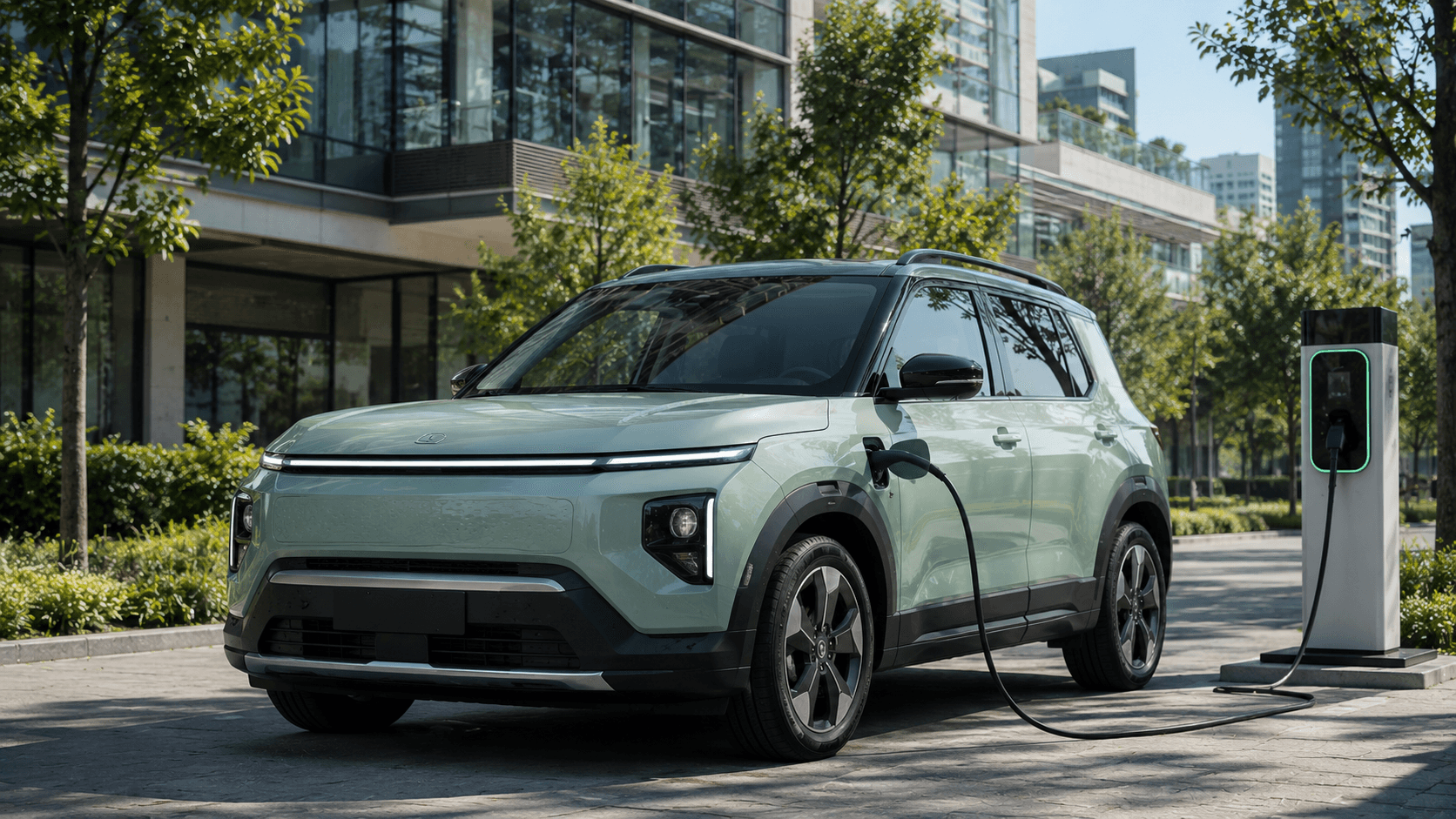
Kia India has unveiled the Syros EV with a segment-leading 526 km ARAI-certified range and opened bookings at ₹25,000, but the number worth paying attention to isn’t the range — it’s the ownership package Kia has bolted onto it. A lifetime battery warranty, an assured buyback programme, and Battery-as-a-Service financing together represent a calculated bet that what’s actually stopping mainstream Indian buyers from going electric isn’t range anxiety anymore, but fear of battery degradation, poor resale value, and high upfront cost. Whether that bet pays off is the real question this launch raises.
What Was Unveiled
The Syros EV is Kia India’s second mass-market electric vehicle, following the Carens Clavis EV, and pre-bookings are now open for a token ₹25,000 through Kia’s website and dealerships nationwide, ahead of an official price announcement expected later in July 2026. It’s offered with two battery options: a 51.4 kWh pack delivering the headline 526 km ARAI-certified range — which Kia says makes it the first in its segment to cross the 500 km mark — and a smaller 42 kWh pack rated at 443 km. Both packs are shared with the Hyundai Creta Electric, a detail that matters for anyone cross-shopping the two.
On paper, the specs are genuinely competitive. The Syros EV produces a best-in-segment 171 PS, does 0-100 kmph in 8.1 seconds with the larger battery, and supports DC fast charging from 10% to 80% in a claimed 39 minutes on a 100 kW charger. Built on Kia’s reinforced K1 platform (shared with the petrol Syros), it uses a liquid-cooled, IP67-rated NMC battery engineered for Indian climate conditions. Feature highlights include a 30-inch wide panoramic display setup, wireless Apple CarPlay and Android Auto, a Harman Kardon sound system, Level 2 ADAS, vehicle-to-load capability, and more than 95 connected features.
The Ownership Package Is the Actual Product
Here’s what separates this launch from a routine spec-sheet EV reveal. Kia has explicitly framed the Syros EV around removing three specific barriers to EV adoption — battery longevity, resale value, and upfront cost — rather than around range or performance. The three tools it’s using are worth examining individually:
- Lifetime High Voltage Battery Warranty — Kia’s headline reassurance on battery durability. Important fine print: the “lifetime” designation is defined in the terms as 15 years, not literally unlimited. That’s still a strong warranty by segment standards, but buyers should understand exactly what they’re getting rather than taking “lifetime” at face value.
- Assured Buyback programme — designed to protect residual value, directly targeting the weak and unpredictable resale market that has made many buyers wary of EVs as depreciating assets.
- Battery-as-a-Service (BaaS) financing — lets buyers lower the upfront purchase price by effectively paying for the battery separately over time, addressing the sticker-price gap between EVs and comparable petrol SUVs.
This is a genuinely different pitch from most EV launches in India, which tend to lead with range and acceleration. Kia is implicitly arguing that the range problem is largely solved — 526 km is more than enough for the vast majority of daily use — and that the remaining friction is financial and psychological. That’s a defensible read of where the mainstream EV market actually is in 2026.
Where It Sits Against the Creta Electric
Because the Syros EV shares its 42 kWh and 51.4 kWh battery packs with the Hyundai Creta Electric, the two will inevitably be cross-shopped, and the comparison is instructive. The Syros EV is a slightly smaller vehicle (measuring roughly 3,995mm long), which is partly how Kia extracts a longer claimed range from the same battery — less mass to move. Buyers choosing between them will likely decide on the basis of size preference, brand loyalty, feature packaging, and — critically — Kia’s ownership package, which the Creta Electric doesn’t fully match. If the lifetime warranty and assured buyback genuinely hold up in practice, they could be the deciding factor for risk-averse first-time EV buyers who find the two vehicles otherwise comparable.
The Honest Caveats
Two things buyers should keep realistic. First, the 526 km figure is an ARAI MIDC-certified number achieved under standardised test conditions — real-world range, especially with air conditioning and highway speeds, will be meaningfully lower, as it is for every EV. Treat it as a best-case ceiling, not a daily guarantee. Second, pricing hasn’t been officially announced; bookings at ₹25,000 secure an early production slot, not a locked-in price. Estimates circulating in the market suggest a starting price somewhere in the region of Rs 15-20 lakh, but until Kia confirms it, buyers are committing without knowing the final number — a reasonable gamble given the refundable token, but worth being clear-eyed about.
Why This Launch Matters Beyond Kia
The Syros EV is a useful signal of where India’s EV competition is heading. The first phase of the market was won on range and price; the next phase looks like it will be won on de-risking ownership — warranties, buyback guarantees, and financing structures that make the switch feel safe rather than adventurous. Kia’s charging ecosystem play reinforces this: its K-Charge network unifies over 20,300 charging points across 23 charge-point operators into a single app-based payment system, tackling the fragmented public-charging experience that frustrates many EV owners. Rivals will likely have to respond with comparable ownership guarantees rather than just matching the range number, which is good news for buyers regardless of which brand they ultimately choose.
The Resale-Value Problem It’s Trying to Solve
The Assured Buyback programme deserves closer attention because it targets what data shows is one of the most under-discussed barriers to EV adoption in India: unpredictable resale value. According to research into EV ownership patterns, first-generation electric vehicles have often depreciated faster and less predictably than comparable petrol cars, partly because used buyers can’t easily verify remaining battery health and partly because rapid technology improvements make older EVs feel dated quickly. Experts note that this resale uncertainty feeds directly into financing decisions — lenders price loans partly on expected residual value, so an assured buyback can improve loan terms as well as buyer confidence. By putting a guaranteed floor under resale value, Kia is addressing a financial-planning concern that pure spec-sheet improvements can’t touch.
How the K1 Platform Choice Shapes the Package
Analysts tracking Kia’s product strategy note that building the Syros EV on the reinforced K1 platform shared with the petrol Syros — rather than a dedicated EV-only architecture — is itself a cost-and-speed decision with trade-offs. Research shows that shared ICE-and-EV platforms let manufacturers bring electric models to market faster and at lower development cost, which supports the aggressive pricing the ownership package depends on. The trade-off is that a shared ICE-and-EV platform typically can’t optimise cabin space, battery packaging, or charging architecture as fully as a ground-up EV design. For most mainstream buyers this is an acceptable compromise, but it’s part of why the Syros EV is positioned as a practical, accessible daily driver rather than a technology showcase.
FAQs
What is the range of the Kia Syros EV?
The Syros EV offers an ARAI-certified range of 526 km with the 51.4 kWh battery pack and 443 km with the 42 kWh pack. Real-world range will be lower depending on driving conditions.
How much does it cost to book the Kia Syros EV?
Pre-bookings are open at a token amount of ₹25,000 through Kia’s website and dealerships. Final pricing hasn’t been officially announced yet.
What does the Kia Syros EV’s “lifetime” battery warranty actually cover?
Kia offers a Lifetime High Voltage Battery Warranty, but the terms define “lifetime” as 15 years rather than unlimited duration.
Does the Kia Syros EV share parts with the Hyundai Creta Electric?
Yes, the Syros EV uses the same 42 kWh and 51.4 kWh battery packs as the Hyundai Creta Electric, though it’s a slightly smaller vehicle.
How fast does the Kia Syros EV charge?
Kia claims a 10% to 80% DC fast charge in 39 minutes using a 100 kW charger, along with 10.8 kW onboard AC charging for home or workplace use.
What is Battery-as-a-Service (BaaS) on the Syros EV?
BaaS is a financing option that lets buyers reduce the upfront purchase price by paying for the battery separately over time, lowering the initial cost barrier to EV ownership.