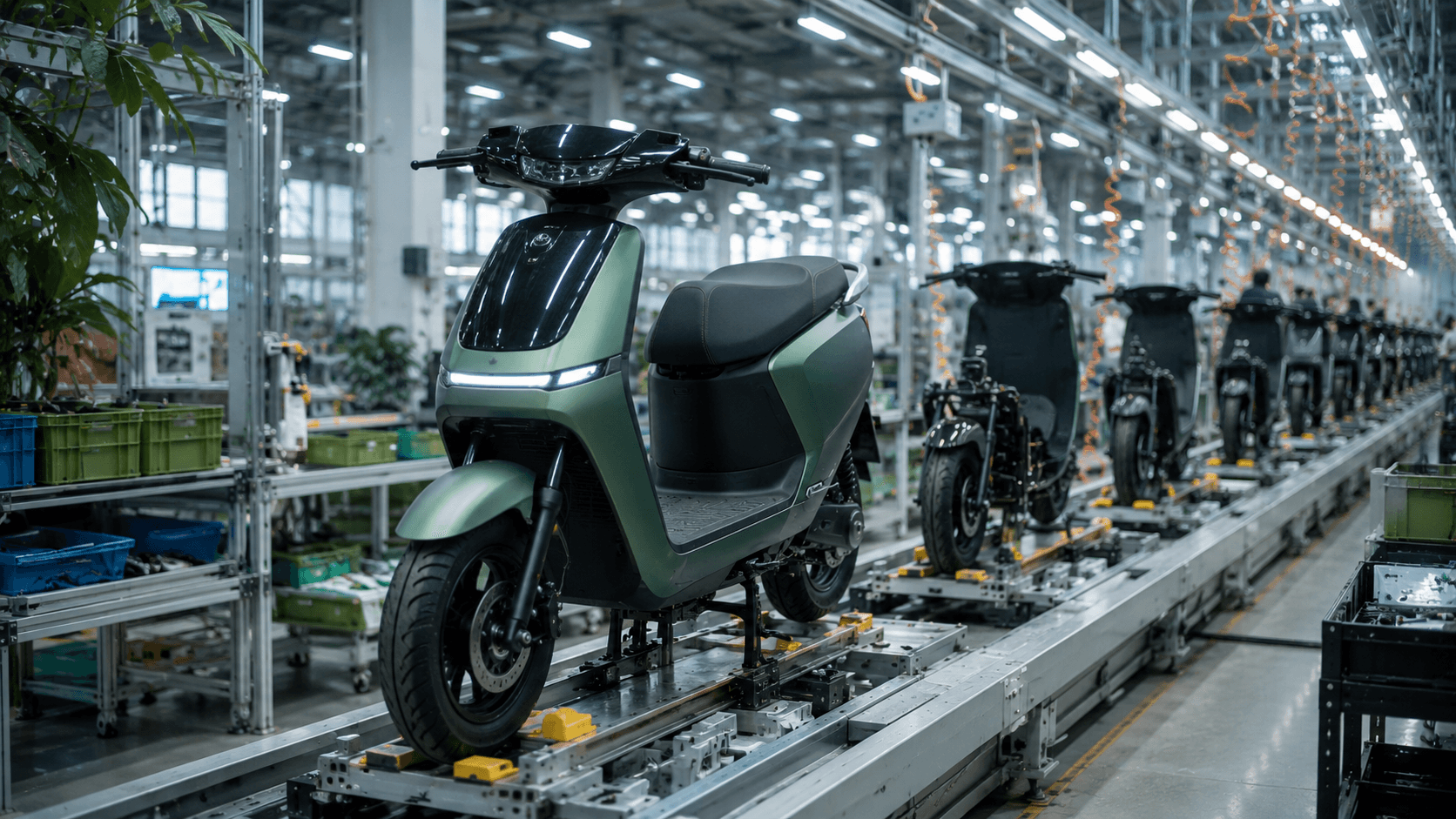
The Government of India is investing ₹200 crore in Ather Energy through the India-Japan Fund, and while that figure is small next to Hero MotoCorp’s ₹960 crore commitment in the same round, the sum matters far less than the signal. When a sovereign-backed investment vehicle enters the cap table of a listed electric two-wheeler company, it’s telling the market that India still treats electric mobility as a strategic industrial priority — not just another consumer sector left to fend for itself. For anyone tracking where India’s EV two-wheeler industry is heading, that signal is the real story here.
What Actually Happened
The ₹200 crore investment is being routed through the India-Japan Fund (IJF), a $600 million bilateral investment platform jointly backed by the Government of India and the Japan Bank for International Cooperation (JBIC), and managed by the National Investment and Infrastructure Fund (NIIFL). This is a structured, sovereign-backed investment through a professional fund — not a direct ministry-style subsidy — which is an important distinction for how it should be read.
It forms part of Ather’s ₹1,200 crore preferential issue, which breaks down across three groups: the India-Japan Fund’s ₹200 crore, Hero MotoCorp’s ₹960 crore through convertible warrants (Hero is already Ather’s largest shareholder), and ₹20 crore each from co-founders Tarun Mehta and Swapnil Jain. This preferential issue is itself part of a broader ₹2,500 crore capital-raising programme that Ather’s board approved in June, the remainder of which includes a separately executed qualified institutional placement (QIP) of up to ₹1,500 crore. The capital is earmarked for manufacturing expansion, research and development, product innovation, and Ather’s charging infrastructure.
The Detail That Actually Matters
The single most revealing element of this deal isn’t any of the headline numbers — it’s that the India-Japan Fund’s participation expanded the round. Ather’s board had originally approved a preferential issue of roughly ₹1,000 crore; the fund’s entry pushed that tranche up by 20% to ₹1,200 crore. That’s a meaningful signal. When a company enlarges a fundraise specifically to accommodate a new investor, rather than that investor simply buying into fixed, pre-set terms, it indicates the company valued the strategic backing enough to accept the additional dilution. In other words, Ather didn’t just take the government’s money because it was offered — it made room for it.
Why would sovereign-backed capital be worth that trade-off? Because the endorsement carries weight beyond the rupees. A government-backed fund investing in an EV company signals to other institutional investors that the sector retains strategic priority status, which can de-risk future capital raises and improve terms. It’s the kind of validation that’s hard to buy with a pure financial round.
The India-Japan Axis Is Doing Real Work Here
The choice of vehicle — the India-Japan Fund specifically — is not incidental. Japan brings deep institutional experience in manufacturing precision, quality systems, and mobility technology, and the IJF is explicitly oriented toward sustainable infrastructure and climate-friendly technologies. For India, channelling capital into domestic EV manufacturing through a Japan-linked fund aligns with several overlapping national objectives at once: reducing fuel imports, cutting urban emissions, building indigenous battery and electronics supply chains, and creating globally competitive clean-mobility companies rather than perpetual importers.
Electric two-wheelers are a particularly logical target for this kind of strategic capital. They’re the highest-volume vehicle category in India, they directly displace petrol consumption in the most price-sensitive segment of the market, and their supply chain — batteries, power electronics, vehicle assembly — is exactly the kind of domestic manufacturing base India is trying to build. Backing a recognised, technology-led brand in this space is a concentrated bet on that broader industrial thesis.
Where Ather Actually Stands
Context matters for reading how much this capital changes Ather’s position. The company listed on the stock exchanges in May 2025, making this its first major capital raise since the IPO. It currently holds the third position in India’s electric two-wheeler market with a 16.2% share — up from 14.7% a year earlier — supported by a roughly 79.5% year-on-year increase in registrations. That’s genuine momentum, but “third place with 16%” also describes a company still fighting hard in a crowded field rather than a runaway leader.
The funding lands just ahead of an ambitious product and capacity cycle. Ather is expected to debut the first scooter built on its new modular EL platform at its flagship community event on August 29, 2026, and its Factory 3.0 at Chhatrapati Sambhajinagar, Maharashtra, is expected to begin commercial operations by October 2026, taking total annual capacity to 1.42 million units. The capital directly supports both — but capacity and platforms are inputs, not outcomes.
The Execution Risks Are Real
None of this guarantees success, and it’s worth being clear-eyed about the challenges the money doesn’t solve. Ather operates in one of the most brutally competitive segments in Indian mobility: legacy giants TVS and Bajaj are scaling their electric offerings fast, Ola Electric remains aggressive on price, and even Hero — Ather’s own largest backer — runs parallel EV ambitions. In that environment, Ather has to grow market share while keeping losses under control, make products that appeal well beyond tech-savvy early adopters, maintain service reliability as it expands into more cities, and manage battery costs and margins against buyers who remain acutely price-sensitive and who still weigh EVs against cheap, proven petrol scooters.
Sovereign backing strengthens the balance sheet and the narrative, but the core commercial challenge — profitable scale in a price war — remains Ather’s to solve. The capital buys runway and credibility; it doesn’t buy the outcome.
The Bottom Line
For industry watchers, the takeaway is layered. The ₹200 crore itself is modest, but the sovereign endorsement it represents is a genuine vote of confidence in both Ather specifically and electric two-wheelers as a strategic sector. The 20% round expansion signals mutual conviction. And the India-Japan framing reflects a deliberate industrial strategy rather than a one-off investment. What it doesn’t do is settle the competitive question — that will be decided by execution over the coming product cycle, not by the composition of a single funding round.
Why the E-2W Segment Attracts This Kind of Capital
According to industry data, electric two-wheelers have consistently been the fastest-penetrating EV category in India, far ahead of electric cars in adoption rate, precisely because their lower price point and shorter daily range requirements make the switch from petrol easier to justify. Data shows the two-wheeler segment accounts for the overwhelming majority of India’s total vehicle sales by volume, which means even modest EV penetration gains translate into large absolute numbers of vehicles and meaningful displacement of imported fuel. This is the structural reason a sovereign-backed fund would prioritise an e-2W player: the category sits at the intersection of the largest addressable market, the most price-sensitive buyers, and the clearest fuel-import-reduction impact. Research shows that India’s clean-mobility policy consistently identifies two- and three-wheelers as the segments where electrification delivers the most emissions and import-bill benefit per rupee of support, which helps explain why strategic capital gravitates here rather than toward higher-profile but lower-volume electric car projects.
How This Fits Ather’s Post-IPO Trajectory
Experts tracking Ather’s financials note that the company’s May 2025 listing changed the calculus for how it raises money — as a public company, it now has access to instruments like the QIP component of this broader programme, but it also faces public-market scrutiny of its path to profitability that private EV startups can defer. The preferential issue structure, with existing backer Hero MotoCorp taking the dominant share, keeps Ather’s strategic ownership relatively stable while bringing in fresh capital, which matters for a company that needs to fund an aggressive capacity expansion without ceding control or triggering the kind of ownership churn that can unsettle a young listed company. The government-backed tranche, small as it is, adds a stabilising, long-horizon investor to that mix at a moment when Ather’s execution over the next few quarters will be closely watched.
FAQs
How much is the government investing in Ather Energy?
The Government of India is investing ₹200 crore in Ather Energy through the India-Japan Fund, a sovereign-backed bilateral investment platform.
What is the India-Japan Fund?
The India-Japan Fund is a $600 million bilateral investment platform jointly backed by the Government of India and the Japan Bank for International Cooperation (JBIC), managed by the National Investment and Infrastructure Fund (NIIFL), focused on sustainable infrastructure and climate-friendly technologies.
How much is Ather Energy raising in total?
The ₹200 crore is part of a ₹1,200 crore preferential issue (which also includes ₹960 crore from Hero MotoCorp and ₹40 crore from the founders), itself part of a broader ₹2,500 crore capital-raising programme that includes a separate QIP of up to ₹1,500 crore.
Why is the government investing in an EV company?
The investment signals that India treats electric mobility — particularly electric two-wheelers — as a strategic industrial priority tied to reducing fuel imports, cutting emissions, and building domestic battery and manufacturing supply chains.
What is Ather Energy’s market position?
Ather holds the third position in India’s electric two-wheeler market with a 16.2% share, up from 14.7% a year earlier, supported by roughly 79.5% year-on-year growth in registrations.
What will Ather do with the funding?
The capital is earmarked for manufacturing expansion (including Factory 3.0 in Maharashtra), research and development, product innovation including its new EL platform, and charging infrastructure.