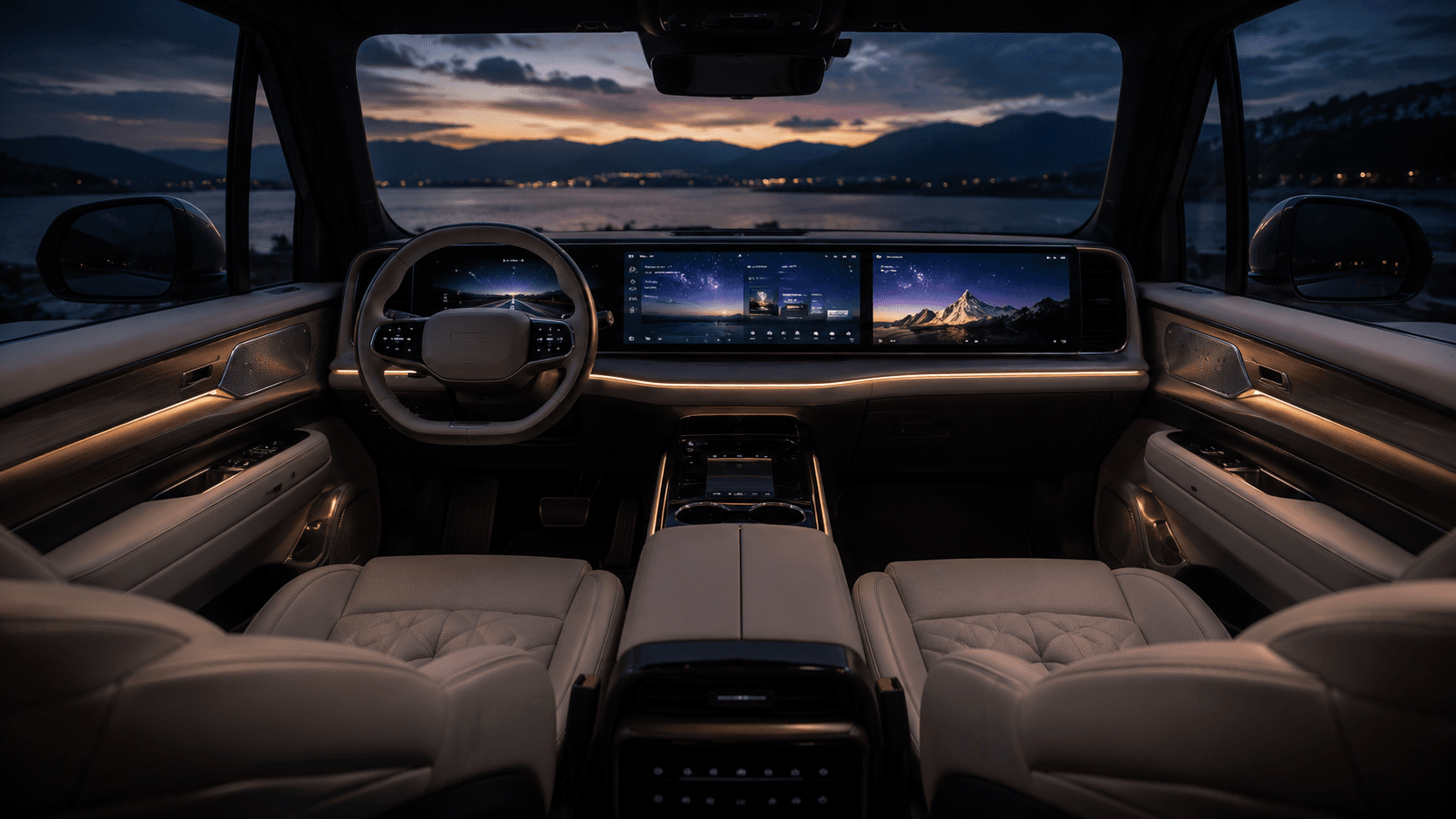
Chery and Jaguar Land Rover have revealed the production interior of the Freelander 8 — a full-size luxury EREV SUV with a 46.3-inch panoramic display, Huawei’s most advanced driver-assistance system, and a lounge-style cabin — but the specifications, impressive as they are, aren’t the most interesting thing about this car. The genuinely notable story is what the joint venture’s structure reveals: a storied British marque is essentially licensing its name and design language to a Chinese partner’s platform and software, even as Jaguar Land Rover winds down its own vehicle production in China. That’s a quiet but striking statement about where leadership in electric and software-defined vehicles now sits.
What Was Revealed
The Freelander 8 is the first production model from Freelander, a standalone new-energy-vehicle brand created by the Chery-JLR joint venture, which was upgraded into an independent brand in March 2026. It revives a nameplate Land Rover used between 1997 and 2015 — but with a twist worth noting: the original Freelander was a compact SUV, while this new Freelander 8 is a full-size flagship measuring between roughly 5,118mm and 5,185mm long on a 3,040mm wheelbase. That makes it larger and heavier than a Range Rover, closer in footprint to a Toyota Land Cruiser Prado. The nameplate is the same; the vehicle’s positioning is completely different.
Inside, the newly revealed cabin is built around a 46.3-inch 8K panoramic display — reported to be the largest in the automotive industry, edging past the BMW iX3’s 43-inch panoramic screen — paired with a 15.6-inch central infotainment touchscreen in a T-shaped layout. It’s a six-seat, 2+2+2 configuration with individual captain’s chairs, a “Commander” driver’s seat and a lounge-style front passenger seat offering around 1,200mm of legroom, plus flourishes like 256-colour ambient lighting and a fragrance diffuser. The powertrain is an extended-range electric (EREV) setup: dual electric motors fed by a roughly 60kWh CATL-developed battery (221km CLTC electric-only range, 800V architecture, up to 350kW charging), with a 1.5-litre turbo-petrol engine acting purely as a generator, for a combined output around 412kW.
The Technology Stack Is the Tell
Look closely at who supplies the Freelander 8’s core technology, and the industry story writes itself. The assisted-driving system is Huawei’s Qiankun ADS 5, and the SUV is among the first to use Huawei’s 896-channel LiDAR (capable of identifying a 14cm object at 120 metres). The infotainment runs on Qualcomm’s latest Snapdragon 8397 automotive chip. The all-terrain system was co-developed with Huawei. The battery is CATL’s. The platform is Chery’s.
What, then, does Jaguar Land Rover contribute? The name, the design direction (led by Phil Simmons, who has worked on the Range Rover Velar and Defender), and its brand equity. This is a meaningful inversion of how the automotive world worked for most of the last century, when Western marques supplied the engineering and Asian partners often provided manufacturing scale. Here, a Chinese partner supplies the platform, the batteries, the software, and the driver-assistance stack, while the British partner supplies heritage and styling. For a brand whose parent invented the modern luxury off-roader, that’s a remarkable division of labour — and an honest reflection of how far the centre of gravity in EV and software-defined vehicles has shifted.
The JLR Wind-Down Makes It Starker
This power shift is underscored by timing. The Freelander 8 will be built at a plant in Changshu, Jiangsu — and reporting around the reveal notes that Jaguar Land Rover has been winding down its own domestically-produced vehicle sales through its China dealership network, with the factory earmarked for Freelander production. In other words, JLR is stepping back from selling its own cars in the world’s largest auto market while simultaneously lending its name to a Chinese-platform brand built for that same market. The joint venture is committing an additional 3 billion yuan (roughly $443 million) to the Changshu plant, with plans for six new Freelander models across China and global markets over five years.
The strategic logic is defensible: rather than pour capital into developing competitive EV platforms and software from scratch — an area where Chinese firms currently hold a cost and speed advantage — JLR is monetising its brand equity while Chery handles the parts of the vehicle that are hardest and most expensive to get right today. Whether that’s shrewd pragmatism or a longer-term erosion of what makes the brand valuable is a genuine open question, and reasonable people in the industry disagree on it.
Does Any of This Reach India?
For Indian readers, the honest answer is that there’s no confirmed India launch for the Freelander 8. Its first market is the Middle East, with right-hand-drive markets including the UK and Australia understood to follow (Australia is confirmed for a 2027 launch). India isn’t on the announced list.
That said, the Freelander 8 is relevant to the Indian market as a signal rather than a product. Chery’s platforms are already being evaluated for India through its separate partnership with JSW Motors, and the broader wave of Chinese-platform SUVs — sold under various brand and joint-venture structures — is a defining feature of where the global, and eventually Indian, market is heading. The Freelander 8 is the most premium expression yet of a pattern Indian buyers will increasingly encounter: technically advanced vehicles built on Chinese platforms, wearing a range of different badges. Whether it arrives here directly is less important than understanding that its underlying template — Chinese platform, global badge — is coming to India one way or another.
The Bottom Line
The Freelander 8 is, on its specifications, a genuinely competitive luxury EREV SUV with class-leading screen technology and a serious software stack. But its real significance is structural. It’s a case study in how legacy Western brands are increasingly choosing to partner with — rather than compete against — Chinese EV and software leaders, contributing heritage and design while ceding the technical core. For an industry watcher, that’s a more important development than any single spec on the sheet, and it’s a dynamic that will shape which vehicles reach markets like India, and under whose name, for years to come.
Why Western Brands Keep Choosing This Path
According to industry analysts, the Chery-JLR arrangement is far from an isolated case — several established Western automakers have entered platform, software, or technology partnerships with Chinese firms over the past two years, reflecting a common calculation. Data shows that Chinese manufacturers currently hold meaningful advantages in EV platform development cost, battery supply chain integration, and time-to-market for software-defined features, advantages that are expensive and slow for legacy brands to replicate independently. Research shows that developing a competitive electric platform and software stack from scratch runs into billions of dollars and multiple years, a burden that’s especially hard to justify for brands with lower volumes. Against that backdrop, licensing brand equity onto a partner’s proven platform becomes a rational, if strategically risky, way to stay present in the fastest-moving segment of the market without shouldering the full development cost.
The Long-Term Question for JLR’s Brand
Experts are genuinely divided on whether arrangements like this strengthen or erode a heritage brand’s long-term value. The optimistic case is that JLR monetises its name in a market and segment it couldn’t competitively serve alone, generating returns it can reinvest in its core Range Rover and Defender products. The cautionary case is that a brand’s value ultimately rests on the engineering and character buyers associate with it, and that repeatedly attaching the name to vehicles engineered entirely by a partner risks hollowing out that association over time. Both readings are defensible, and which proves correct will likely depend on how distinct Freelander-branded products remain from their Chery underpinnings, and whether buyers come to see the badge as a genuine mark of the brand’s values or merely a familiar name on someone else’s engineering.
FAQs
What is the Chery-JLR Freelander 8?
It’s the first production model from Freelander, a standalone new-energy-vehicle brand created by the joint venture between Chery and Jaguar Land Rover. It’s a full-size luxury extended-range electric (EREV) SUV.
Is the Freelander 8 the same as the old Land Rover Freelander?
Only in name. The original Land Rover Freelander (1997-2015) was a compact SUV, whereas the new Freelander 8 is a full-size flagship, larger than a Range Rover.
What technology does the Freelander 8 use?
It features a 46.3-inch 8K panoramic display, Huawei’s Qiankun ADS 5 driver-assistance system with 896-channel LiDAR, a Qualcomm Snapdragon 8397 chip, an 800V architecture, and a CATL-developed battery, on a Chery platform.
What is the Freelander 8’s powertrain?
It’s an extended-range electric vehicle (EREV) with dual electric motors and a roughly 60kWh battery (221km CLTC electric-only range), plus a 1.5-litre turbo-petrol engine that acts solely as a generator, for a combined output around 412kW.
Will the Freelander 8 launch in India?
There’s no confirmed India launch. Its first market is the Middle East, followed by right-hand-drive markets including the UK and Australia (confirmed for 2027).
Who designs and builds the Freelander 8?
Jaguar Land Rover contributes the Freelander name and design direction, while Chery provides the platform, battery technology, and software. It’s built at a plant in Changshu, Jiangsu, China.