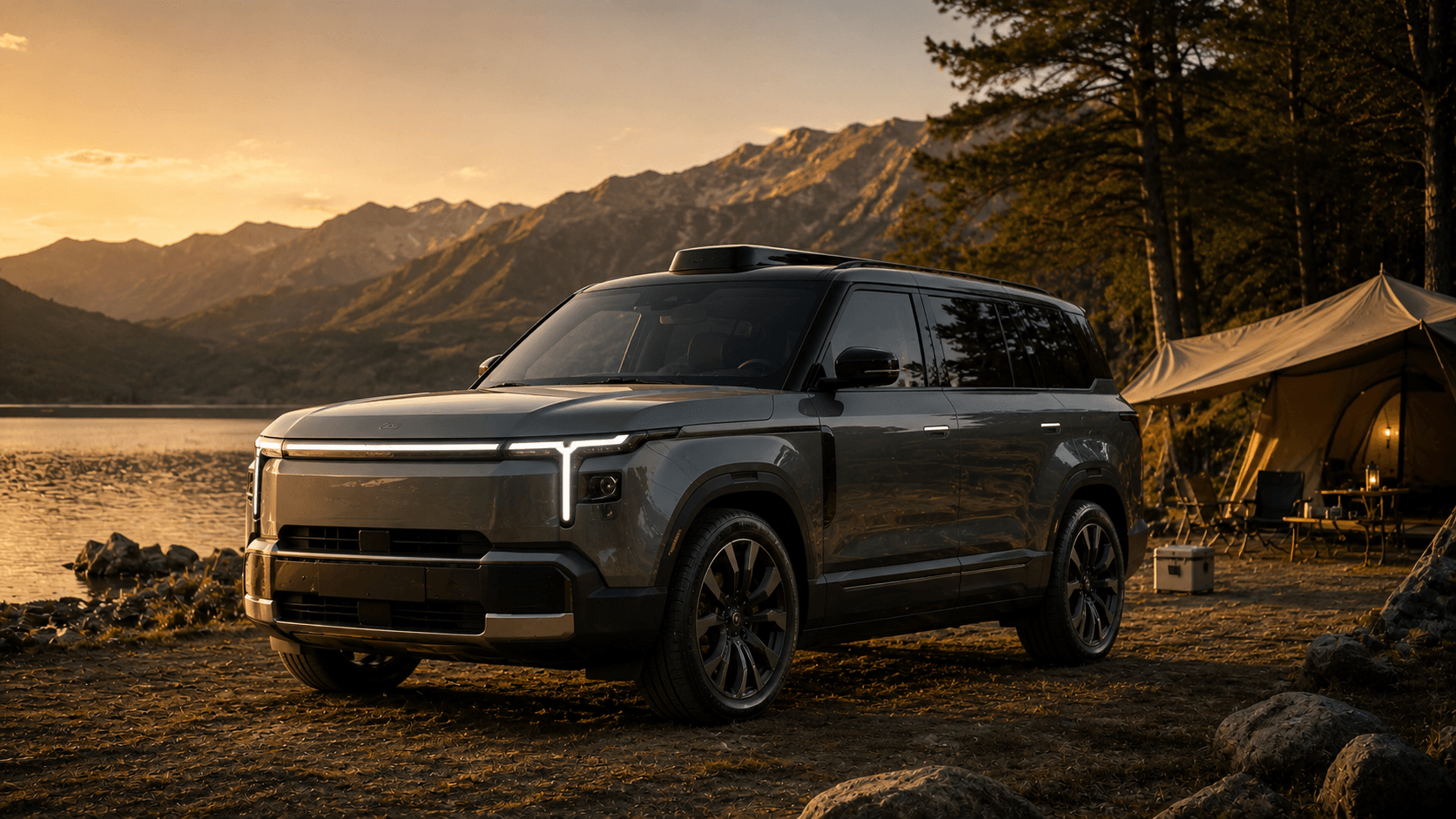
Xiaomi has debuted the SkyNomad N90, a full-size SUV whose front seats swivel 180 degrees to face the second row, whose cabin converts into a lounge, meeting room, or sleeping space, and — most tellingly — whose powertrain is a range-extender hybrid rather than the pure electric setup Xiaomi built its automotive reputation on. Both of those choices, the radical living-space interior and the pivot to hybrid, say something important about where China’s premium SUV market is heading, and by extension where India-bound products may follow. This isn’t just a quirky new SUV; it’s a read on the market.
What Xiaomi Actually Revealed
The SkyNomad N90 is the first model of SkyNomad, a new sub-brand under Xiaomi’s automotive division — not a standalone brand, but a second product line sitting alongside the SU7 sedan and YU7 SUV. Where those two are positioned as driver-focused electric cars, the N90 is deliberately the opposite: a large, boxy, three-row SUV built around cabin space and comfort. Details have emerged largely through a filing with China’s Ministry of Industry and Information Technology (MIIT), which means some specifications remain technically unconfirmed by Xiaomi and vary slightly across sources.
According to the filing, the top-spec N90 Max measures 5,285mm long, 1,998mm wide, and 1,825mm tall on a 3,080mm wheelbase, weighing around 2.8 tonnes — squarely full-size luxury SUV territory, rivalling the Li Auto L9, Aito M9, and Zeekr 9X. It’s built on Xiaomi’s new Kunlun architecture, reportedly developed from scratch over about three and a half years. Reservations opened on July 9, with launch expected late in the third quarter of 2026.
The Interior Is the Product
Where the N90 genuinely breaks from convention is inside. Both front seats can swivel 180 degrees to face the second row (only when parked), converting the cabin into a lounge or a mobile meeting room. Buyers choose between a five-seat and a seven-seat layout, and the two lean into comfort differently: the five-seater drops the third row entirely to fit a large fold-out table between the first and second rows, while the seven-seater gets powered, reclining second-row captain’s chairs with ottomans for a business-class feel. By folding and repositioning seats, occupants can even create a flat sleeping surface. A dedicated Camping Edition adds a pop-up roof, a rooftop bed platform, side cabinets, and a side-tent interface.
Xiaomi’s own framing is that the parked cabin can become “a studio for one, a café for two, a living room for three, or a playground for the whole family.” Stripped of marketing gloss, the point is clear: Xiaomi is selling the interior experience as the primary product, with driving dynamics a secondary concern. That’s a deliberate inversion of how performance-oriented SUVs are usually pitched, and it reflects a broader shift in China’s premium market away from spec-sheet performance wars toward lifestyle and interior-experience differentiation.
Why a Hybrid — And Why That Matters
The more strategically significant choice is under the skin. The N90 is Xiaomi’s first range-extender hybrid — a series-hybrid setup where a 1.5-litre turbo-petrol engine acts purely as a generator to charge the battery and never directly drives the wheels. Dual electric motors produce a combined output around 420hp, drawing on a battery pack (reported between roughly 70 and 80kWh depending on the source) that delivers a claimed electric-only range of 370-500km, with total combined range exceeding 1,500km once the petrol generator is factored in.
Here’s why that’s noteworthy: Xiaomi built its car business on pure electric vehicles, positioning itself as an EV-native tech disruptor. Choosing a range-extender for its family SUV is a deliberate hedge. It signals that even an EV-first brand recognises that a meaningful slice of family and long-distance buyers remain unwilling to commit fully to pure electric — range anxiety on long trips, patchy charging infrastructure outside major cities, and the reassurance of a petrol backup all still matter to this segment. The range-extender architecture offers the electric driving experience most of the time while sidestepping the range concerns that still deter mainstream family buyers. That Xiaomi, of all companies, made this call is a strong signal that the pure-EV-only thesis has real limits in the mass premium market right now.
The Competitive Context
The N90 enters a Chinese extended-range SUV market that Li Auto and Huawei-backed Aito dominated through 2025, taking seven of the top ten best-selling EREV SUVs between them. Chinese media reports suggest the SkyNomad range could start as low as around 200,000 yuan — undercutting both the Li Auto L9 and Aito M9, which sit above 250,000 yuan. That’s a direct pricing shot at the two incumbents, using the familiar Xiaomi playbook of aggressive value plus heavy technology content. It also visually resembles BYD’s similarly-sized Denza N9, a comparison Xiaomi will have to keep answering as the segment fills with large, tech-forward Chinese SUVs competing on both space and gadgetry.
What It Means for India
There’s no announced India launch for the SkyNomad N90, and Xiaomi hasn’t signalled automotive plans for India. So its relevance here is as a directional indicator rather than a purchase prospect. Two trends it embodies are worth watching for anyone tracking where the Indian SUV market is heading. First, the range-extender/series-hybrid architecture is a genuinely sensible fit for a market like India, where charging infrastructure remains uneven and long-distance driving without range anxiety is a real buyer priority — expect more manufacturers to explore this middle path between pure ICE and pure EV. Second, the “car as configurable living space” philosophy, while currently a China-market phenomenon, reflects a maturing of buyer priorities from raw specs toward experience and versatility that tends to eventually influence product design globally. India may not get the N90, but it will likely get vehicles shaped by the same thinking.
The Bottom Line
The SkyNomad N90 is easy to dismiss as a gimmick-laden novelty — swivel seats, fold-out tables, rooftop tents. But the two decisions at its core are serious market signals: a pure-EV brand hedging into hybrids because the mass market isn’t fully ready for pure electric, and a performance-oriented tech company pivoting to sell interior experience over driving dynamics. Both reflect where China’s premium SUV market is genuinely heading, and both are worth watching for how they eventually ripple into markets like India, regardless of whether this specific vehicle ever arrives here.
Why Range-Extenders Are Having a Moment
According to industry analysts, extended-range electric vehicles have been one of the fastest-growing powertrain categories in China precisely because they resolve the central tension holding back mainstream EV adoption: buyers want electric running costs and refinement for daily use but fear being stranded on long trips. Data shows that EREV and plug-in hybrid sales have grown faster than pure battery-electric sales in several recent quarters in China, a pattern that directly informs why even an EV-native brand like Xiaomi would choose this architecture for a family-oriented flagship. The logic is that the range-extender captures buyers who would otherwise stay with combustion vehicles entirely, expanding the addressable market beyond committed EV adopters. Research into powertrain adoption patterns suggests markets with uneven charging infrastructure and long average trip distances — a description that fits large parts of India as well as China — tend to favour this middle-path architecture during the transition period before charging networks mature.
What the “Living Space” Trend Reveals About Buyer Priorities
Experts who track China’s premium SUV segment note that the shift toward configurable, lounge-style interiors reflects a genuine maturation of buyer priorities rather than a passing gimmick. As core specifications like range, acceleration, and screen size converge across competing models — becoming table stakes rather than differentiators — manufacturers are increasingly forced to compete on how the vehicle is actually used and experienced day to day. The swivel seats, fold-out tables, and camping modes are the visible expression of that competition. Whether every one of these features proves genuinely useful or merely marketable is beside the point; the strategic signal is that interior experience has become a battleground, and that’s a shift in what “premium” means in the segment. For markets like India, where multi-generational family use and long road trips are common, elements of this experience-first design philosophy could translate meaningfully even if the specific gadgets don’t all carry over.
FAQs
What is the Xiaomi SkyNomad N90?
It’s the first model from SkyNomad, a new sub-brand under Xiaomi’s automotive division, and a full-size three-row SUV focused on interior space and comfort rather than driving performance.
Is the Xiaomi SkyNomad N90 electric or hybrid?
It’s a range-extender hybrid (series hybrid) — Xiaomi’s first. A 1.5-litre turbo-petrol engine acts solely as a generator to charge the battery and never directly drives the wheels, while electric motors power the vehicle.
What is the SkyNomad N90’s range?
It offers a claimed electric-only range of roughly 370-500km (figures vary by source) with a total combined range exceeding 1,500km once the petrol generator is included.
What makes the SkyNomad N90’s interior special?
Its front seats can swivel 180 degrees to face the second row when parked, and it offers configurations including a fold-out table, reclining captain’s chairs, a convertible sleeping surface, and a Camping Edition with a pop-up roof and rooftop bed.
Will the Xiaomi SkyNomad N90 launch in India?
There are no announced plans for an India launch. Xiaomi hasn’t signalled automotive market entry for India as of mid-2026.
What does the SkyNomad N90 compete against?
In China, it targets full-size extended-range SUVs like the Li Auto L9, Aito M9, and Zeekr 9X, and is expected to undercut the L9 and M9 on price.