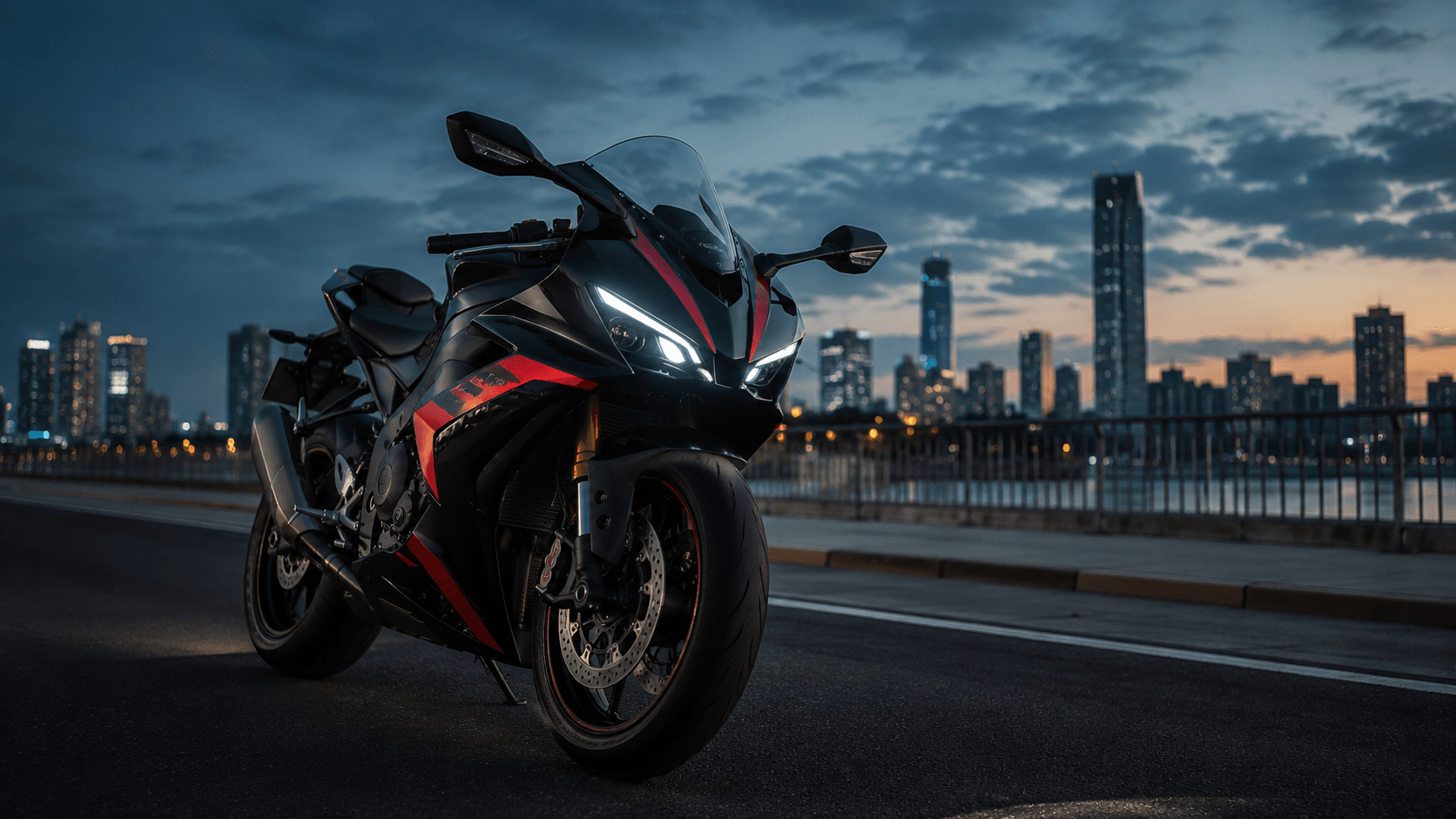
A production-ready Hero Karizma XMR 250 has been spotted completely undisguised at what appears to be a dealership, and the location matters as much as the motorcycle: dealer familiarisation and technician training typically happen only weeks before customer deliveries begin. So a launch looks imminent. But the more interesting question isn’t when the XMR 250 arrives — it’s whether Hero MotoCorp, India’s largest two-wheeler maker by volume but historically a commuter-focused brand, can finally convince aspirational performance riders to take it seriously in the quarter-litre segment it has long ceded to Yamaha, KTM, and others.
What Was Spotted
The Karizma XMR 250 was seen in full production trim, finished in a black-and-red livery, at what looks like a dealership or service facility. That’s a meaningful signal: undisguised motorcycles at dealer locations usually indicate that staff training and service readiness are underway, one of the final steps before an official launch. The motorcycle first broke cover as a concept at EICMA 2024 in Milan and was later shown at the Bharat Mobility Global Expo 2025, so this has been a long-telegraphed launch — the dealership sighting suggests it’s now genuinely close.
Visually, the XMR 250 carries forward the fully-faired supersport styling of the existing XMR 210: a tall windscreen, twin LED daytime running lights flanking a central projector LED headlamp, and integrated aerodynamic winglets. It slots above the XMR 210 to become Hero’s most powerful fully-faired motorcycle to date.
The Engine Is the Point
The core upgrade is the powertrain. The XMR 250 is expected to use Hero’s new 250cc single-cylinder, DOHC, liquid-cooled engine — the same unit that powers the Xtreme 250R — producing around 30 PS and 25 Nm of torque through a 6-speed gearbox. That’s a substantial step up from the 210cc Karizma, and it directly addresses the most common criticism of the XMR 210: that its styling wrote a performance cheque its engine couldn’t quite cash. Many enthusiasts welcomed the Karizma nameplate’s return with the XMR 210 but wanted more punch to match the aggressive looks. The 250cc version is Hero’s answer.
The hardware backing it up is genuinely premium for the segment: a trellis frame, upside-down front forks, a preload-adjustable rear monoshock, disc brakes at both ends, and dual-channel ABS (with switchable ABS expected, as on the Xtreme 250R). The feature list is comprehensive too — full LED lighting, a Bluetooth-enabled digital console with navigation, a lap timer, a drag timer, adjustable clip-on handlebars, split seats, and USB charging. (Note that exact power figures vary slightly across reports, around 29.5-30 PS, and some rumoured additions like cruise control for Hero’s premium range remain unconfirmed.)
The Strategic Play: Hero Wants the Aspirational Buyer
Here’s the bigger picture. Hero MotoCorp dominates India’s two-wheeler market, but that dominance was built on efficient, dependable commuters — Splendors and Passions that sell in enormous numbers. What Hero has historically lacked is credibility in the aspirational performance segment, where younger, enthusiast buyers gravitate toward brands like Yamaha, KTM, and Bajaj-Triumph. The Karizma XMR 250 isn’t a standalone product; it’s part of a coordinated push into the quarter-litre space built around Hero’s new 250cc platform, which also underpins the Xtreme 250R and an upcoming Xpulse 250.
This is a deliberate attempt to change how the brand is perceived. The 250cc segment is one of the most aspirational in the Indian motorcycle market — it’s where buyers make their first real “performance bike” purchase, and brand image carries enormous weight in that decision. For Hero, cracking this segment isn’t just about selling a few thousand XMR 250s; it’s about repositioning the entire brand as one a performance-minded rider would consider, not just a practical commuter default.
Can It Actually Win Over Enthusiasts?
That’s the genuine question, and the answer isn’t guaranteed by a strong spec sheet. The XMR 250 will compete against the Yamaha R25, KTM RC 250, and Suzuki Gixxer SF 250, among others — established names in the faired quarter-litre space. A few things will determine whether it succeeds:
First, pricing. Hero’s traditional strength is value, and if it can undercut the established players meaningfully while offering comparable or better hardware, that’s a compelling proposition for value-conscious enthusiasts. Aggressive pricing is arguably Hero’s single biggest lever here.
Second, real-world performance and refinement. A single-cylinder 250 making around 30 PS is competitive on paper, but riders in this segment care about how the bike actually feels — throttle response, refinement at high revs, and highway composure. Some rivals use twin-cylinder engines that deliver a different character; Hero will need its single to feel genuinely satisfying, not just adequate.
Third, and hardest, brand perception. Enthusiast buyers can be sceptical of a commuter-heavy brand’s performance credentials, fairly or not. Hero has to prove the XMR 250 is a genuine enthusiast machine rather than a commuter dressed in supersport bodywork — and that perception shift takes sustained credibility, not a single launch.
What Buyers Should Do
For riders specifically waiting on the XMR 250, the imminent-launch signal is good news, but the sensible move is to hold for confirmed pricing and, ideally, early ride reviews before committing. The hardware and feature list look genuinely strong for the segment, but the two things that will actually determine whether it’s the right buy — the final price and how the engine performs in the real world — aren’t yet known. Riders cross-shopping the R25, RC 250, or Gixxer SF 250 have proven options available today; the XMR 250 is worth waiting a few weeks to evaluate properly rather than judging on spy shots and spec sheets alone.
The Bottom Line
The Karizma XMR 250’s undisguised dealership appearance signals a near-term launch of Hero’s most serious performance motorcycle yet, backed by a capable engine and premium hardware. But its real significance is strategic: it’s the sharp end of Hero’s bid to be taken seriously in the aspirational quarter-litre segment, not just to dominate commuters. Whether it succeeds will come down to pricing, real-world performance, and Hero’s ability to shift a deeply-held brand perception — and those are questions a spec sheet can’t answer.
Why the Quarter-Litre Segment Is Strategically Important
According to industry data, the 250-300cc motorcycle segment has been one of the faster-growing premium categories in India, as rising incomes push a generation of riders to upgrade from 150-160cc commuters to their first genuine performance machine. Data shows that this “first big bike” purchase carries outsized brand significance, because the badge a rider chooses at this stage often shapes their loyalty as they move up to larger, more expensive motorcycles later. That’s the deeper strategic prize Hero is chasing: not just the margin on each XMR 250, but a foothold in the aspirational ladder that has historically funnelled buyers toward rivals. Research shows that brand perception formed at the quarter-litre stage tends to persist, which is exactly why a commuter-dominant brand like Hero is investing in a credible performance platform rather than ceding the segment.
The Single-Cylinder Question
Experts who follow the faired-motorcycle segment note that Hero’s choice of a single-cylinder engine, rather than a twin, is both a cost decision and a character trade-off. A single-cylinder 250 is cheaper to build and maintain, and typically delivers strong low-end and mid-range torque that suits real-world Indian riding — but it lacks the top-end rush and refinement that twin-cylinder rivals can offer, which some enthusiasts specifically seek in a supersport-styled machine. Hero appears to be betting that the combination of aggressive fully-faired styling, a comprehensive feature set, premium cycle parts, and likely competitive pricing will matter more to its target buyer than raw cylinder count. Whether that bet pays off depends heavily on how refined and eager the engine feels in practice, which is why early ride reviews will be more revealing than the spec sheet for anyone deciding between the XMR 250 and its twin-cylinder rivals.
FAQs
When will the Hero Karizma XMR 250 launch in India?
No official date has been announced, but the motorcycle being spotted undisguised at a dealership — typically a sign of dealer and technician training — suggests the launch is imminent.
What engine does the Karizma XMR 250 use?
It’s expected to use Hero’s new 250cc single-cylinder, DOHC, liquid-cooled engine (shared with the Xtreme 250R), producing around 30 PS and 25 Nm of torque with a 6-speed gearbox.
How is the XMR 250 different from the XMR 210?
The XMR 250 gets a more powerful 250cc engine (up from 210cc), addressing enthusiast demand for stronger performance, and slots above the XMR 210 as Hero’s most powerful fully-faired motorcycle.
What features does the Karizma XMR 250 offer?
Expected features include full LED lighting, a Bluetooth-enabled digital console with navigation, lap and drag timers, adjustable clip-on handlebars, split seats, USD front forks, dual-channel ABS, and USB charging.
What will the Karizma XMR 250 compete against?
It’s expected to rival the Yamaha R25, KTM RC 250, and Suzuki Gixxer SF 250 in India’s faired quarter-litre motorcycle segment.
How much will the Hero Karizma XMR 250 cost?
Hero hasn’t announced pricing yet. Given Hero’s typical value positioning, competitive pricing against established rivals is expected, but this remains to be confirmed at launch.