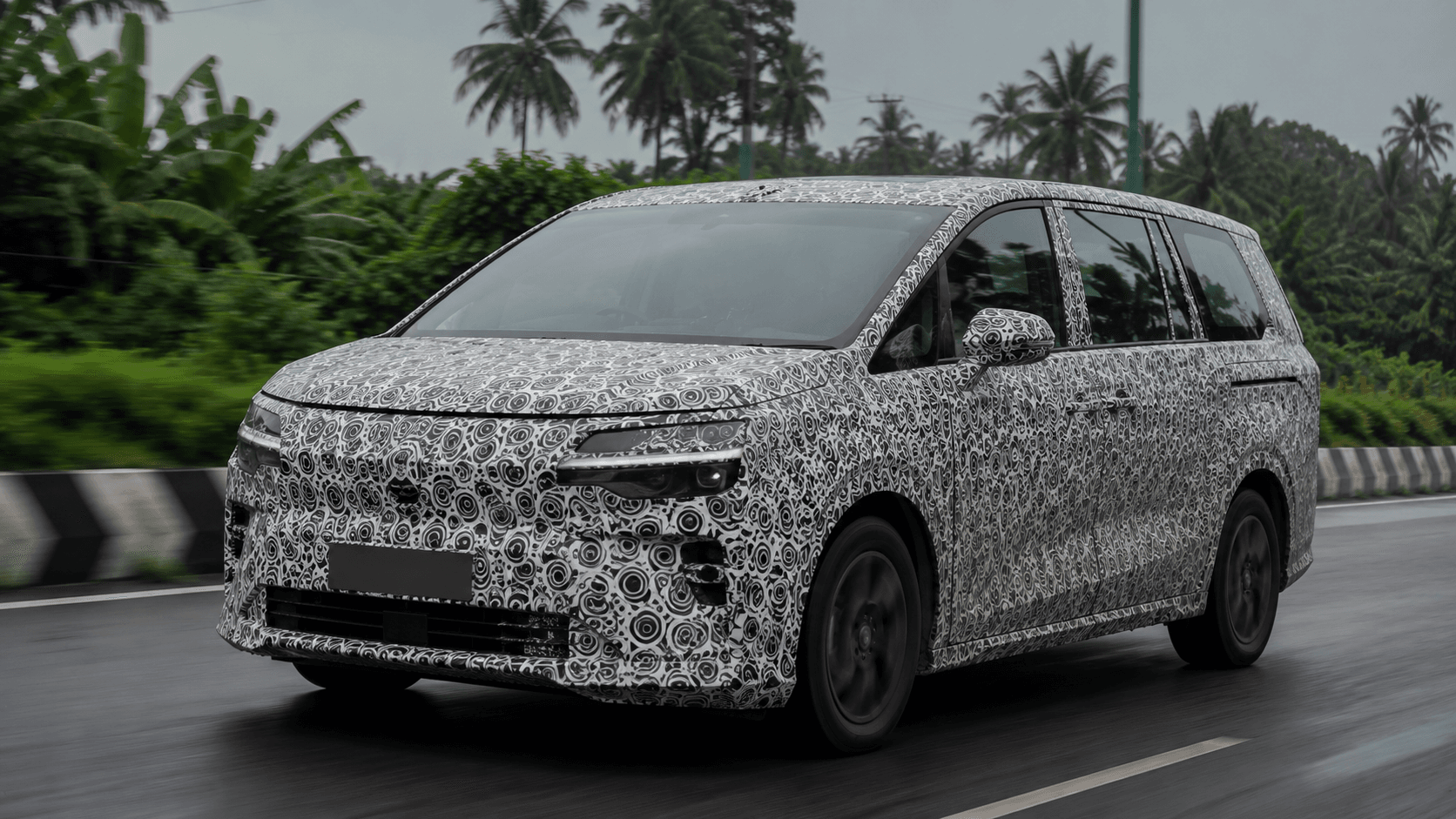
The Toyota Innova Hycross has been spotted testing in India for the first time in facelifted form — a heavily camouflaged mule caught in Kerala, showing a revised front fascia, redesigned bumpers and new lighting elements front and rear. Reports point to a 2027 launch. But the most useful thing to understand about this update isn’t what’s changing; it’s what almost certainly isn’t. The Hycross’s strong-hybrid powertrain is the reason it succeeds, it’s expected to carry over unchanged, and that single fact should shape how any prospective buyer reads this news.
What the Spy Shots Actually Show
Precision matters here, because this is a first sighting of a comprehensively camouflaged test vehicle, and almost everything circulating is inference rather than fact.
What’s genuinely visible: the camouflage is concentrated around the front and rear, indicating those areas see the most change. The grille appears squarer than the current car’s, the headlights look sleeker with new projector units, and the front bumper appears redesigned. There are revised lighting elements at the rear. The profile shows no visible changes, and the alloy wheels appear similar to the existing design.
What’s expectation, not observation: the interior hasn’t been spied at all. Suggestions of a larger touchscreen, a fully digital instrument cluster, new upholstery and added features are reasonable inferences from Toyota’s typical facelift approach, but nobody has seen them. A flex-fuel variant — a prototype of which Toyota has shown previously — could join the lineup, but that too is speculation.
On timing, Toyota hasn’t confirmed anything. The current Hycross launched in December 2022, and Toyota typically introduces a mid-cycle facelift around the four-year mark, which points to 2027. Some reports suggest late 2026 as a possibility. Treat 2027 as the reasonable expectation and nothing more.
The Powertrain Is Expected to Carry Over — and That’s the Point
The Hycross is expected to retain its current powertrain lineup: a 2.0-litre naturally-aspirated petrol producing around 172-173hp paired with a CVT, and a 2.0-litre strong hybrid making 184hp with an e-CVT, using Toyota’s fifth-generation hybrid system.
Some will read “no powertrain changes” as a disappointment. It isn’t — it’s a signal of confidence, and understanding why requires looking at how the Hycross earned its position.
When it launched in late 2022, the Hycross was genuinely controversial. It abandoned nearly everything that had defined the Innova nameplate for two decades: the ladder-frame chassis gave way to a monocoque, rear-wheel drive became front-wheel drive, and the beloved diesel engine disappeared entirely. For a nameplate built on rugged, durable, fleet-friendly toughness, that looked like heresy, and plenty of long-time Innova buyers said so.
It succeeded anyway. Sales data shows it won not by being a better traditional Innova, but by being a different and genuinely excellent vehicle. The strong hybrid delivered fuel economy that a large three-row diesel MPV simply couldn’t match in city driving, the monocoque platform gave it car-like refinement and ride comfort, and the cabin offered space and quality that made it feel appropriately premium. Toyota effectively created a new proposition and found a large audience for it, while continuing to sell the ladder-frame Innova Crysta alongside for buyers who wanted the old formula.
That hybrid powertrain is the moat. It’s the specific thing rivals struggle to match and the specific reason buyers choose a Hycross over the alternatives. Toyota changing it in a mid-cycle facelift would be solving a problem that doesn’t exist.
The Real Risk Is Competitive, Not Product
If the Hycross’s product fundamentals are sound, where’s the pressure? It’s coming from the segment reshaping around it.
Research shows the premium three-row space is electrifying and diversifying quickly. The Kia Sorento Hybrid is expected to arrive, bringing a direct hybrid competitor into a space where Toyota has enjoyed relatively little like-for-like competition. Electric MPVs including the Mahindra XEV 9S and BYD eMax 7 are entering, offering a different value proposition around running costs. Established rivals like the Kia Carnival, Hyundai Alcazar, Mahindra XUV 7XO, Tata Safari and MG Hector Plus continue to compete on space, features and price. The Hycross’s rebadged sibling, the Maruti Invicto, is expected to be updated alongside it.
This is the meaningful context for the facelift. The Hycross doesn’t need to fix itself; it needs to stay visually current and feature-competitive while rivals crowd in. A styling refresh and feature upgrades are exactly the right response to competitive pressure of that kind — you don’t re-engineer a winning powertrain because new competitors arrived, you make sure the package around it doesn’t look dated next to them.
The genuine question for Toyota is pricing. The current Hycross spans roughly ₹18.33 lakh to ₹31.30 lakh, and a modest increase is expected with the facelift. In a segment where electric MPVs are competing hard on running-cost arguments and the Sorento Hybrid will offer a credible alternative, how aggressively Toyota prices the updated car will matter more than any styling decision.
What Buyers Should Do
Here’s the practical guidance, and it’s refreshingly clear-cut.
If you need a premium three-row MPV now, buy now. A 2027 launch is a long way off, the current Hycross remains an excellent vehicle, and — critically — the component that makes it excellent is expected to carry over unchanged into the facelift. You would be waiting a year or more for revised bumpers, updated lighting and some feature additions, while the powertrain, packaging, ride quality and hybrid efficiency you’re actually buying the car for stay the same. That’s rarely a good trade.
If you’re not in a hurry and want the latest styling, waiting is reasonable, but understand the trade-off honestly: you’re deferring a purchase by roughly a year for cosmetic and feature updates, and paying a likely price increase for them. According to industry analysts, experts generally caution against waiting for mid-cycle facelifts precisely for this reason, since they rarely change what a vehicle fundamentally is.
One genuinely legitimate reason to wait: if a flex-fuel variant matters to you and it materialises, that would be a substantive addition rather than a cosmetic one. But it remains unconfirmed, so it isn’t something to plan around.
The Bottom Line
The Innova Hycross facelift is real and testing has begun, but it’s early — one camouflaged sighting, a 2027 expectation, and a great deal of reasonable inference standing in for confirmed detail. What’s clear is the shape of it: Toyota is refreshing the styling and equipment of a product whose core proposition is working, while leaving the strong-hybrid powertrain that anchors its appeal alone. That’s the correct call. For buyers, it means there’s little reason to wait — the important part of the car isn’t changing.
FAQs
When will the Toyota Innova Hycross facelift launch in India?
Toyota hasn’t confirmed a date. Given the current model launched in December 2022 and Toyota’s typical four-year mid-cycle refresh cadence, a 2027 launch is expected, though some reports suggest late 2026 is possible.
What will change on the Innova Hycross facelift?
Spy shots show a revised front fascia with a squarer grille, sleeker headlights with new projector units, redesigned bumpers and new lighting elements at the rear. Interior changes haven’t been seen but feature and trim upgrades are expected.
Will the Innova Hycross facelift get a new engine?
It’s expected to retain the current powertrains — a 2.0-litre petrol (around 172-173hp) with a CVT, and a 2.0-litre strong hybrid (184hp) with an e-CVT. A flex-fuel variant could potentially join, but this is unconfirmed.
How much does the Toyota Innova Hycross cost?
The current model is priced from roughly ₹18.33 lakh to ₹31.30 lakh (ex-showroom). A minor price increase is expected with the facelift, though nothing has been announced.
What does the Innova Hycross compete against?
Rivals include the Kia Carnival, Hyundai Alcazar, Mahindra XUV 7XO, Tata Safari and MG Hector Plus, along with electric MPVs like the Mahindra XEV 9S and BYD eMax 7. A Kia Sorento Hybrid is expected to become a direct competitor.
Should I wait for the facelift or buy the current Hycross?
If you need the vehicle now, buying makes sense — the hybrid powertrain that defines the car is expected to carry over unchanged, so waiting a year or more gains you mainly cosmetic and feature updates at a likely higher price.