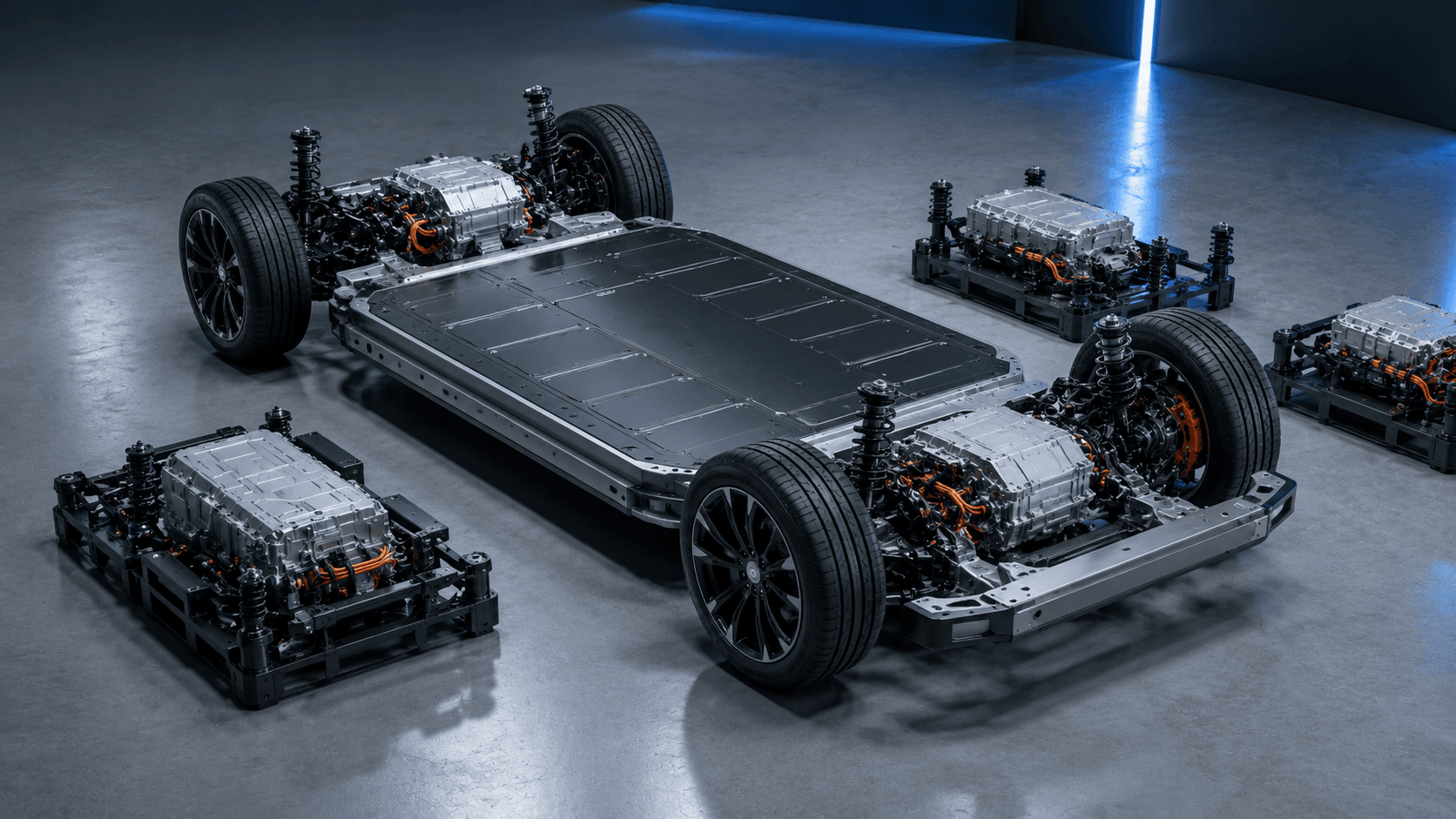
JSW MG Motor India has unveiled MG ADAPT, a modular vehicle architecture that can underpin a pure electric vehicle, a strong hybrid, a plug-in hybrid, or a range-extender EV from the same engineering base. The company is positioning it as India’s first multi-new-energy-vehicle platform. Strip away the acronym and the launch language, and what MG has actually done is industrialise a hedge — it has built the engineering answer to a market that stubbornly refuses to pick one powertrain. On the evidence of how Indians actually buy cars, that’s a shrewd call.
What Was Actually Announced
MG ADAPT stands for Advance Drive Architecture Platform Technology, and it was unveiled in Gurugram on 16 July 2026. It’s a single modular base designed to support four distinct propulsion types: battery electric vehicles (EVs), strong hybrids (HEVs), plug-in hybrids (PHEVs), and range-extender electric vehicles (REEVs), where a petrol engine acts purely as a generator to recharge the battery and never drives the wheels directly.
MG’s stated benefits are the ones you’d expect from a modular architecture: faster product development, greater design flexibility, and improvements to driving range, fast-charging capability, efficiency, performance, safety and refinement. At its core sits what MG describes as a 10-in-1 intelligent electric drive unit, combining multiple functions into a single compact system for better efficiency and packaging, with the ability to switch automatically between operating modes depending on conditions.
Crucially, MG has confirmed a product timeline: the first two vehicles built on ADAPT — one EV and one PHEV — are due to debut in FY2026-27. Reports suggest the first could be a plug-in hybrid version of the Hector, though that specific model attribution should be treated as reported rather than confirmed.
One clarification worth making, because the naming genuinely invites confusion: this is JSW MG Motor India, the JSW–MG joint venture. It is a separate entity from JSW Motors, the group’s other new-energy venture built on Chery platforms. Two different JSW-linked automotive businesses, two different partners, two different product pipelines.
Why a Multi-Powertrain Platform Is the Right Engineering Bet Here
Conventional vehicle platforms are built around a single powertrain type. An EV-native architecture optimises the floor for a big flat battery; a combustion platform is designed around an engine bay, transmission tunnel and fuel system. Building a hybrid on an EV platform, or an EV on a combustion one, always involves compromise — which is why manufacturers historically maintained separate architectures and absorbed the cost.
A multi-powertrain platform accepts a small amount of that compromise in exchange for enormous flexibility. Instead of committing capital to guess which powertrain wins, MG can build whichever the market asks for from a common base, and change the mix as demand shifts.
For India specifically, this matters more than it might elsewhere, because the Indian market has stubbornly refused to consolidate around one answer. According to real sales data rather than forecasts, the picture is clear: when Kia disclosed the cumulative powertrain split for its Carens family after crossing three lakh sales, it broke down as roughly 60% petrol, 30% diesel and 10% electric. That is not a market mid-transition to a single destination. That’s a market where three or four powertrains coexist, each serving buyers with genuinely different priorities on upfront cost, running cost, charging access and driving pattern.
MG ADAPT is the engineering expression of that reality. Rather than betting on electrification arriving faster than it has, or hedging by keeping combustion products alive on separate old platforms, it lets one architecture serve the petrol-hybrid buyer, the plug-in buyer, the pure-EV buyer and the range-anxious buyer simultaneously.
The REEV Inclusion Is the Interesting Part
Of the four supported powertrains, the range-extender is the one worth flagging, because it signals a specific reading of Indian buyer psychology.
A REEV drives like an electric car — the wheels are always turned by an electric motor — but carries a small petrol engine purely as an onboard generator to top up the battery on long journeys. It offers the electric experience for daily use while removing the long-trip range anxiety that still deters mainstream buyers in a market where charging infrastructure remains uneven outside major cities.
This isn’t a uniquely Indian insight; data shows it reflects a broader shift. Even EV-native manufacturers have concluded that a meaningful slice of family and long-distance buyers aren’t ready to commit fully to pure electric, which is why range-extender architecture has been gaining ground on large family vehicles elsewhere. MG building REEV capability into its India platform from the start suggests it expects that middle path to matter here too — and given India’s charging reality and long average trip distances, that’s a defensible read.
The Honest Caveat: A Platform Is Not a Product
Here’s where enthusiasm should be tempered. MG ADAPT is an enabler, not something anyone can buy. No vehicle is on sale on this architecture today, and the first two products aren’t due until FY2026-27. Platform announcements are, by their nature, statements of intent — they tell you what a manufacturer is capable of building, not what it will actually deliver, at what price, or how well.
Industry experts consistently caution that research shows the gap between a platform’s theoretical capability and a finished vehicle’s real-world merit is where products succeed or fail. A flexible architecture doesn’t guarantee competitive pricing, good ride quality, reliable software, or adequate service support. Those are product-level and company-level outcomes, and they’ll only be judged when actual cars arrive.
So the appropriate response for a buyer is interest, not anticipation. Note that MG intends to offer more powertrain choice within its model lines. Then judge the individual cars on their merits when they launch.
What This Means for Buyers
Assuming MG executes, the practical consequence is greater choice within a single model line. Rather than choosing between different MG models to get a different powertrain, buyers could increasingly pick a model they like and then select how it’s powered — petrol-hybrid for someone without home charging, plug-in for a short-commute buyer with a charger, full EV for a city user, range-extender for a family that does regular long highway runs.
That’s a genuinely useful development in a market as heterogeneous as India’s, where the right powertrain depends heavily on individual circumstances rather than on any general trend. It also puts pressure on rivals: manufacturers running single-powertrain platforms will find it harder and slower to respond as demand shifts between fuel types.
The competitive question for MG, though, isn’t architecture. It’s whether the resulting cars are priced sharply, supported well, and backed by a service network buyers trust — the same fundamentals that determine success for every manufacturer regardless of how clever the underlying engineering is.
The Bottom Line
MG ADAPT is a sensible, well-reasoned response to a specific market truth: Indian buyers haven’t converged on one powertrain, and probably won’t for years. Building one flexible architecture that can serve EV, hybrid, plug-in and range-extender demand simultaneously is a better strategy than betting on any single outcome. But a platform is a promise, not a product. The first ADAPT-based EV and PHEV arrive in FY2026-27, and only then will there be anything to actually evaluate.
FAQs
What is MG ADAPT?
MG ADAPT (Advance Drive Architecture Platform Technology) is a modular vehicle platform unveiled by JSW MG Motor India on 16 July 2026, designed to support electric vehicles, strong hybrids, plug-in hybrids and range-extender EVs from a single common architecture.
When will the first MG ADAPT cars launch in India?
MG has confirmed that the first two products based on ADAPT — one EV and one plug-in hybrid — are due to debut in FY2026-27. No specific models or prices have been officially confirmed.
What is a range-extender EV (REEV)?
A range-extender EV is always driven by its electric motor, with a small petrol engine acting purely as an onboard generator to recharge the battery on longer journeys. It offers an electric driving experience without full dependence on charging infrastructure.
Is JSW MG Motor the same as JSW Motors?
No. JSW MG Motor India is the JSW–MG joint venture. JSW Motors is a separate new-energy vehicle venture from the JSW Group built on Chery platforms, with its own distinct product pipeline.
Why does a multi-powertrain platform matter in India?
Indian buyers remain split across petrol, diesel, hybrid and electric powertrains rather than converging on one. A flexible platform lets a manufacturer serve all of them from a common base and adjust the mix as demand shifts, instead of betting on a single outcome.
Can I buy a car based on MG ADAPT today?
No. ADAPT is a platform announcement, not a product launch. No vehicle currently on sale uses it, and the first models are expected in FY2026-27.