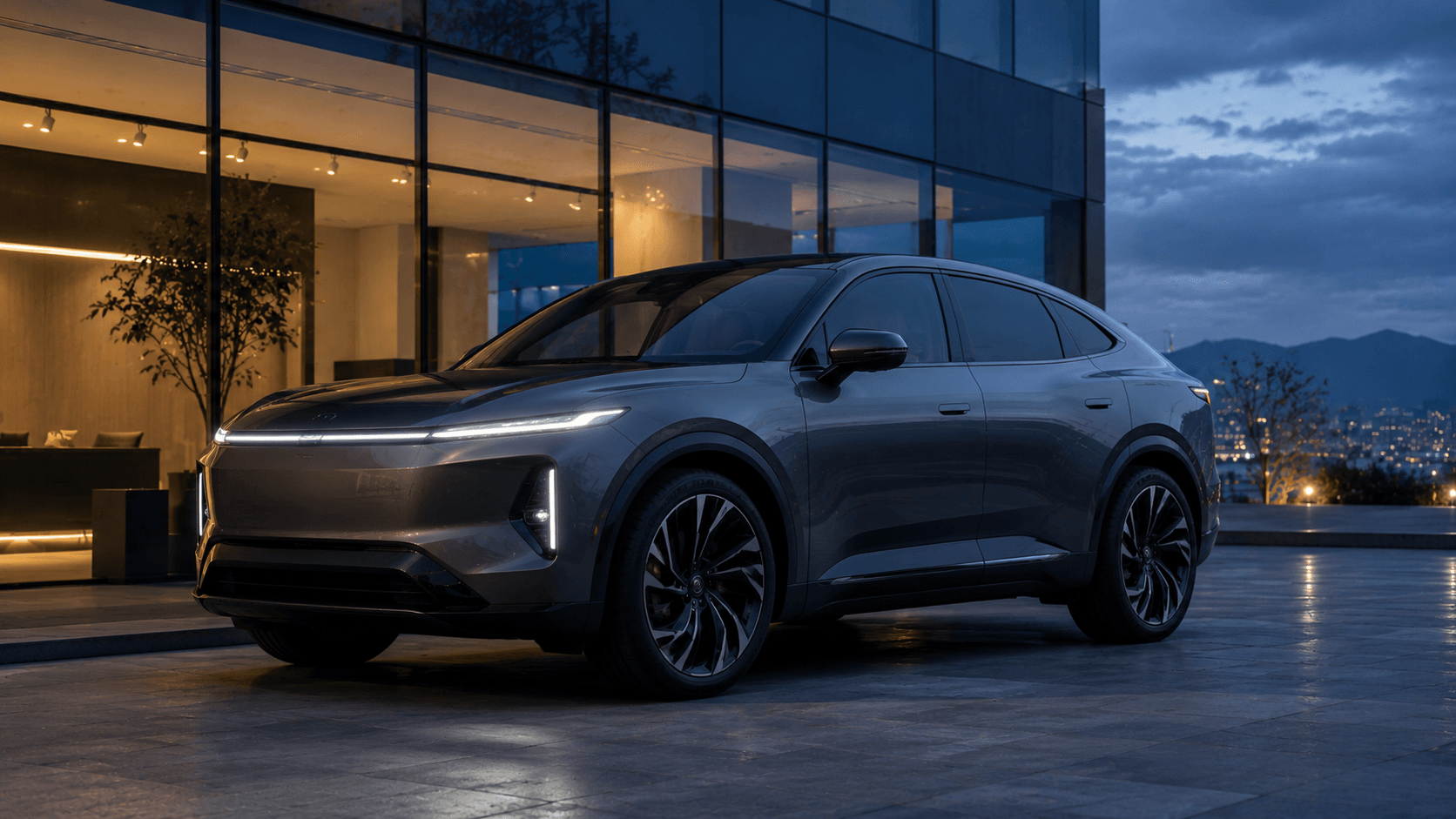
Honda’s ZR-V e:HEV has been on sale in India since its May 2026 launch, with deliveries running since mid-July, and it arrives as the most expensive Honda you can buy in the country. At roughly ₹40 lakh, brought in as a limited fully-imported model, it sits in a bracket where buyers have far bigger, plusher, more badge-heavy options to choose from. So the interesting question isn’t what the ZR-V is — it’s who it’s genuinely for, and whether Honda’s deliberately cautious way of bringing it here is smart strategy or a self-imposed ceiling. The answer comes down to one number on the spec sheet, and it isn’t the price.
What Honda Actually Launched
The ZR-V is a premium five-seat hybrid SUV that sits above the Honda Elevate on an entirely different platform, positioned as Honda’s new flagship for India. It launched in May 2026 alongside the 2026 Honda City facelift, and it represents the sharp end of Honda’s biggest India product push in years — a strategy now centred firmly on hybrids, premium positioning, and technology, after a relatively quiet stretch for the brand in this market.
Crucially, the ZR-V comes to India as a Completely Built Unit (CBU) — a full import rather than a locally-assembled car. Honda is using a government provision that allows a manufacturer to import up to 2,500 units of a model per year without going through the local homologation process. That single decision shapes almost everything about the ZR-V’s positioning: it’s a limited-volume, high-price offering by design, and understanding why is central to understanding the car.
The CBU Strategy: Low Risk, High Price
Here’s what the fully-imported route actually means, and why Honda chose it.
Bringing a car in as a CBU under the homologation-exemption cap lets Honda test the premium-hybrid waters without committing the enormous capital required to localise production. There’s no new assembly line, no supplier localisation, no long-term volume commitment — Honda imports a modest number of finished cars and sees how the market responds. For a brand that’s been cautious in India recently, that’s a sensibly low-risk way to field a flagship and signal technological intent.
The trade-off is unavoidable, though, and it’s the reason the ZR-V costs what it does. A fully-imported vehicle attracts steep import duties, which is precisely why a car that might look mid-size on paper carries a roughly ₹40 lakh price tag. The CBU route keeps Honda’s risk low but forces the price high and caps availability at a couple of thousand units a year. It’s a halo-and-test-the-water play, not a volume play — and buyers should read it as exactly that.
One honest caveat on the number itself: pricing reports vary. The credible auto outlets cluster around ₹40 lakh and up (ex-showroom) for this premium CBU, and that’s the figure to work with, but final on-road cost depends on variant and city, so treat the headline price as indicative rather than a single settled figure and confirm locally.
The Efficiency Is the Whole Point
If the price is the ZR-V’s problem, its powertrain is its answer — and the specific thing that justifies its existence.
The ZR-V uses Honda’s 2.0-litre e:HEV strong-hybrid system: an Atkinson-cycle petrol engine working primarily as a generator, with electric motors driving the front wheels, for a combined 184hp and 315Nm through an e-CVT. In most city driving it effectively operates as an electric car, with the petrol engine stepping in as needed. The result is a claimed efficiency of around 22.8 kmpl.
That figure is the ZR-V’s real differentiator, and it’s worth putting in context. According to figures cited for its natural rivals, research shows petrol-powered premium SUVs like the Skoda Kodiaq and Volkswagen Tiguan return substantially lower real-world efficiency — in the region of 12-15 kmpl. A hybrid SUV claiming nearly 23 kmpl in this class isn’t a marginal improvement; it’s a different category of running cost. For a buyer covering serious annual mileage, that gap compounds into real money over years of ownership, and it’s the single strongest argument for the car.
This mirrors a pattern worth noting across the current premium market: the hybrid powertrain is increasingly the moat that separates one SUV from another, rather than raw size or power. The ZR-V leans entirely into that logic.
The Honest Value Problem
Now the difficult part, stated plainly. At around ₹40 lakh, the ZR-V is priced into a bracket where buyers have access to larger, more prestigious, and in some cases more feature-laden alternatives. Data shows this price band in India is fiercely contested — European SUVs like the Kodiaq and Tiguan, and depending on exact pricing even entry-luxury options from premium German brands, all compete for the same money. Several of those offer more size, more perceived prestige, or a stronger badge than a Honda, however well-engineered.
The ZR-V also carries some structural limitations for the money. It’s a five-seater, not a seven-seat family hauler, despite a price that overlaps with three-row options. It’s front-wheel drive only, with no all-wheel-drive option for buyers who want it, and there’s no diesel. Feature and even airbag counts vary slightly across sources, so the exact specification is worth confirming variant-by-variant at the dealership rather than assuming.
So who actually buys it? The honest answer: the specific buyer who genuinely wants what Honda does best — class-leading hybrid efficiency, Honda’s reliability reputation, a comprehensive Level 2 ADAS safety suite, and a well-made, tech-rich cabin — and who values those things over outright size, all-wheel drive, or badge prestige. For that person, the ZR-V is a genuinely appealing and rational choice. For the buyer chasing space, status, or value-for-money in the traditional sense, it isn’t, and no amount of efficiency changes that. It’s a niche premium purchase, not a value proposition, and it’s most honestly recommended as exactly that.
What the ZR-V Does Offer
For the buyer it does suit, the equipment is genuinely strong. Expect full-LED lighting, 18-inch alloys, a panoramic sunroof on the top variant, a 9-inch touchscreen, a 10.2-inch digital instrument cluster, a premium audio system, wireless charging, a powered tailgate, dual-zone climate control, powered and heated front seats, and a quality leatherette-trimmed cabin. On safety, it brings eight airbags (per higher-spec listings), Honda’s Sensing Level 2 ADAS suite, a 360-degree camera, hill descent control, and stability and traction control. This is a properly equipped, comfortable, safety-focused premium SUV — the package around that efficient powertrain is not an afterthought.
Buyer Guidance
If the ZR-V’s specific strengths match your priorities, there’s a practical wrinkle: because it’s a CBU limited to a small annual import volume, availability is genuinely constrained. A buyer who has decided it’s the right car should act relatively early rather than assume stock will be freely available later in the year, since the homologation-exemption cap limits how many Honda can bring in.
But that urgency only applies if you’ve honestly concluded it fits. The sensible process is to weigh what you actually value: if it’s hybrid efficiency, reliability, safety tech and Honda engineering, test-drive it and take the limited availability seriously. If it’s space, all-wheel drive, badge prestige, or maximising features-per-rupee, the alternatives in this price band deserve a serious look first, and there’s no reason to rush.
The Bottom Line
The Honda ZR-V e:HEV is a well-engineered, efficient, safety-rich premium hybrid SUV that’s on sale now as a deliberately limited import. Its ~₹40 lakh CBU pricing is the direct consequence of a low-risk strategy that lets Honda field a flagship without committing to local production — smart for Honda, but it places the car in a demanding price bracket where its five-seat, front-wheel-drive package faces bigger and more prestigious rivals. Its class-leading hybrid efficiency is the genuine reason to buy it, and for the specific buyer who prizes that above all else, it’s a rational and appealing choice. Just go in understanding it for what it is: a niche, efficiency-led premium purchase, not a value or space play.
FAQs
Has the Honda ZR-V launched in India?
Yes. The Honda ZR-V e:HEV launched in India in May 2026, with customer deliveries beginning in mid-July 2026. It’s on sale now.
How much does the Honda ZR-V cost?
It’s priced at approximately ₹40 lakh (ex-showroom) as a premium fully-imported model, with reports placing it in the ₹40-50 lakh range. Final on-road pricing depends on variant and city, so confirm locally.
Why is the Honda ZR-V so expensive?
It’s brought to India as a Completely Built Unit (CBU) — a full import — using a government rule allowing up to 2,500 units a year without local homologation. Import duties on a fully-built car push the price up, and the route intentionally keeps it a limited-volume offering.
What is the Honda ZR-V’s mileage?
Honda claims around 22.8 kmpl (ARAI) from its 2.0-litre e:HEV strong-hybrid system — substantially more efficient than petrol rivals like the Skoda Kodiaq and Volkswagen Tiguan.
What engine does the Honda ZR-V use?
It uses a 2.0-litre Atkinson-cycle petrol engine paired with Honda’s e:HEV twin-motor strong-hybrid system, producing a combined 184hp and 315Nm through an e-CVT, driving the front wheels.
What does the Honda ZR-V compete against?
At its price point it competes with premium SUVs such as the Skoda Kodiaq and Volkswagen Tiguan, and depending on final pricing may be cross-shopped against entry-luxury options. Its main draw over these is hybrid efficiency.
Is the Honda ZR-V a 7-seater?
No. The ZR-V is a five-seat SUV, front-wheel drive only, with no diesel or all-wheel-drive option.