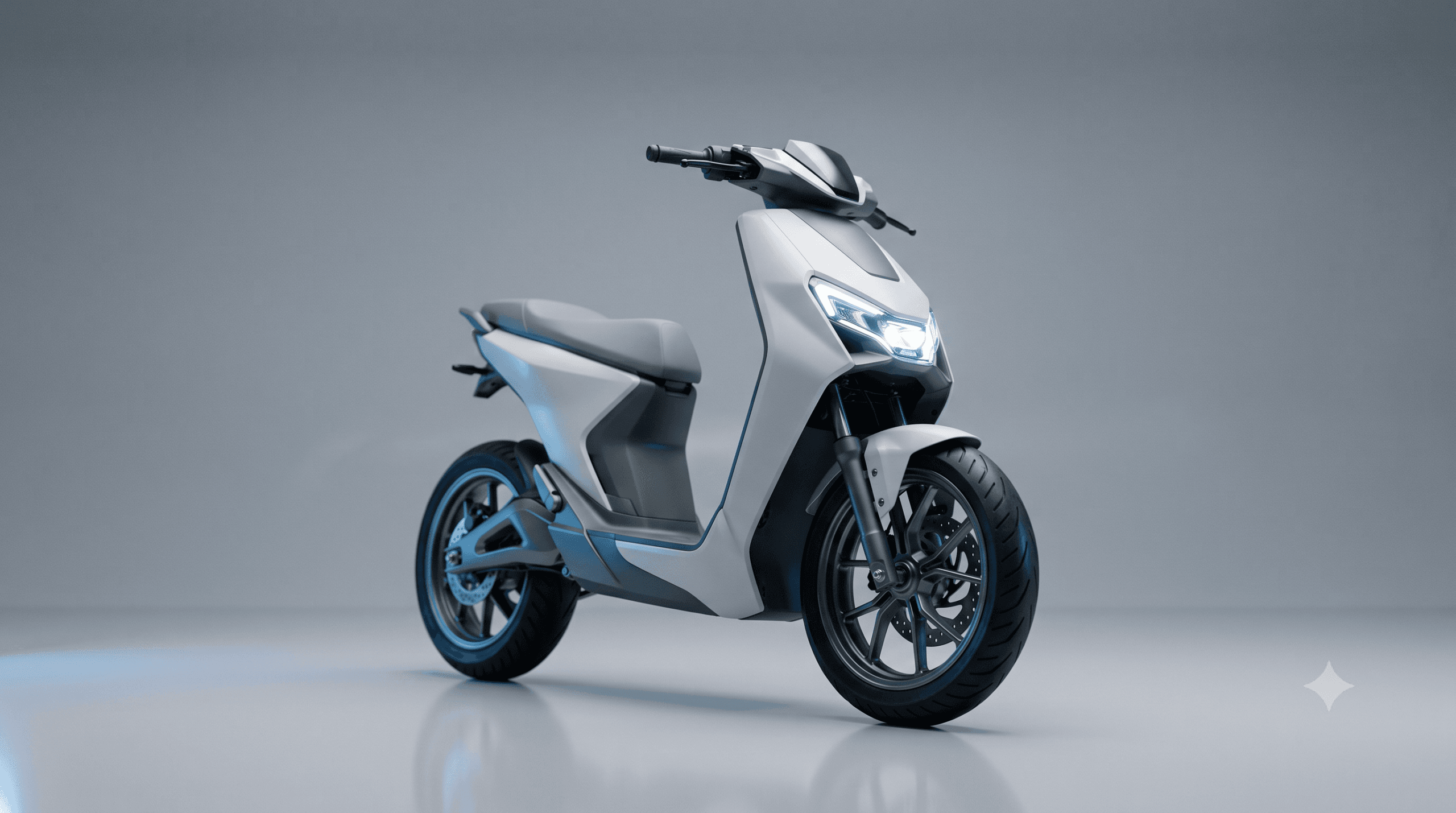
A Japanese design registration has revealed a new, production-looking Yamaha electric scooter with an unusual centrally-mounted motor, belt drive, and an under-seat battery that may be swappable. It’s a genuinely intriguing glimpse — but before anyone gets excited, the single most important fact is this: it’s a patent filing, nothing more. Yamaha has announced no specifications, no production plans, and no India timeline. So this is worth examining for what it hints about Yamaha’s thinking, not as a product to anticipate. With that caveat firmly in place, the design is interesting enough to unpack.
What the Registration Actually Shows
Design registrations reveal appearance and layout, not confirmed mechanicals, so everything here should be read as “shown in the filing” rather than “specified by Yamaha.” With that understood, the drawings reveal a scooter whose overall silhouette draws inspiration from Yamaha’s Ray ZR 125, but with several notable departures from convention.
The standout detail is the drivetrain. Unlike the Yamaha Aerox-E, which uses a swingarm-mounted motor, this scooter appears to use a centrally-mounted motor that drives the rear wheel via a belt — a layout closer to Yamaha’s EC-06. The battery is housed beneath the seat, and the design suggests it could be swappable, though that isn’t confirmed. The rear suspension is unusual too, with twin shock absorbers mounted much further forward on the swingarm than normal, straddling the under-seat battery compartment.
Elsewhere, the filing shows disc brakes at both ends, a telescopic front fork, and a long single-piece seat. There’s a distinctive headlight with two rectangular LED units flanking a central V-shaped daytime running lamp, a sharp angular tail-light, storage pockets inside the front apron, and a small TFT display. The absence of a visible keyhole hints at keyless ignition and seat access. Based on its proportions, the scooter looks like it could be a 125cc-equivalent model — a size that would suit the Indian market well.
The Interesting Engineering Question
If this layout reaches production, it represents a meaningfully different packaging philosophy from Yamaha’s current electric offerings — and the two most interesting elements are the belt drive and the possibly-swappable battery.
The centrally-mounted motor with belt drive is a design choice with real trade-offs. It can allow for a cleaner, better-balanced packaging of the drivetrain and potentially smoother power delivery, differing from the hub or swingarm-mounted motors common on many electric scooters. It’s a more considered approach than simply bolting a motor to the wheel.
The under-seat, potentially swappable battery is the more strategically significant hint. According to industry analysts, battery swapping — where a depleted pack is exchanged for a charged one at a station rather than waiting to recharge — is one of the genuinely contested questions in India’s electric two-wheeler market. It promises to eliminate charging downtime, which matters enormously for high-utilisation riders like delivery and gig-economy workers, but it requires a dense swapping-station network and standardisation to work. If Yamaha is genuinely designing for swappability, it suggests the company is thinking seriously about that model rather than defaulting to fixed batteries. But “the design suggests it could be swappable” is a long way from a confirmed swappable-battery product, and that gap is worth respecting.
Why This Matters for Yamaha in India
Here’s the strategic context that makes even a patent filing worth noting. Yamaha has been a relatively minor player in India’s electric two-wheeler space while rivals have scaled aggressively. Data shows the market is fiercely competitive and dominated by focused electric players — Ather, Ola Electric, TVS, Bajaj and Hero are all fighting hard for share in a price-sensitive segment that has grown rapidly. Yamaha’s current electric line-up is limited: globally it offers the compact Neo’s commuter in Europe, and in India it fields the EC-06 (based on the River Indie) alongside its in-house Aerox-E.
A credible 125cc-equivalent electric scooter — a mainstream, practical commuter size rather than a niche performance or premium product — could be the vehicle that finally gives Yamaha a genuine foothold in India’s electric commuter market, which is where the real volume is. The proportions shown in this filing point in exactly that direction. So while a design registration is far from a product, it’s a plausible early indicator that Yamaha may be preparing a more serious India-relevant electric play than its current line-up suggests.
The important caveat, though, is Yamaha’s pace. The company has been comparatively slow to commit to India’s electric two-wheeler market while competitors built scale and brand loyalty. A patent filing doesn’t change that track record, and there’s no guarantee this design reaches production, reaches India, or arrives in time to matter in a market that isn’t waiting for it.
How It Fits the Battery-Swap Debate
It’s worth dwelling on the swappable-battery hint, because it sits at the centre of one of the most consequential strategic questions in India’s electric two-wheeler market. Research shows the industry is split between two philosophies: fixed batteries that the owner charges at home or work, and swappable batteries exchanged at dedicated stations. Each has a genuine constituency. Fixed batteries are simpler, cheaper to implement, and fine for the typical private owner with predictable daily mileage and access to a charging point. Swappable batteries eliminate charging downtime entirely, which is transformative for high-utilisation riders — delivery fleets, gig-economy workers, and anyone who can’t afford to have a scooter parked and charging for hours.
The catch with swapping is infrastructure: it only works if there’s a dense enough network of swap stations, and if battery formats are standardised enough for that network to be viable. Several Indian players have invested heavily in swap ecosystems, while others have bet firmly on fixed batteries. If Yamaha’s filing genuinely points to a swappable design, it would place the company on one side of that divide — but a patent drawing showing an under-seat pack that “could be” swappable is not a strategic commitment, and it would be a mistake to read too much into it. It’s a hint about how Yamaha might be thinking, not a declaration of which side it has chosen.
What Buyers Should Do
Nothing — and that’s the honest answer. This is a design registration, not a product. There’s nothing to buy, nothing to wait for, and no timeline to plan around. Yamaha has confirmed none of it, and design patents frequently never reach production at all, or reach it in substantially altered form.
For a prospective electric scooter buyer in India today, this filing should have zero bearing on a current purchase decision. The market already offers a wide range of capable, on-sale electric scooters from established players, and there’s no sense deferring a purchase for a Yamaha that exists only as patent drawings. The appropriate posture is mild interest: note that Yamaha may be developing something India-relevant, and revisit if and when the company actually confirms a product. Until then, treat it as an early signal, not news to act on.
The Bottom Line
The leaked Yamaha electric scooter design is genuinely interesting — a centrally-mounted belt-drive motor, an under-seat possibly-swappable battery, and 125cc-equivalent proportions that would suit India well. It hints that Yamaha may be thinking more seriously about a mainstream electric commuter than its current thin line-up suggests. But it’s a patent filing and nothing more: no specs, no confirmation, no timeline. Read it as a small window into Yamaha’s possible direction, keep expectations firmly in check, and don’t let it influence any real-world buying decision. It’s one to watch quietly, not to wait for.
FAQs
Has Yamaha confirmed this new electric scooter?
No. The scooter has only surfaced through a Japanese design registration. Yamaha has not announced any specifications, production plans, or launch timeline, and design patents don’t always lead to production models.
What’s unusual about the new Yamaha electric scooter’s design?
It features a centrally-mounted motor driving the rear wheel via a belt (rather than a swingarm-mounted motor), an under-seat battery that may be swappable, and an unusual rear suspension layout with forward-mounted twin shocks straddling the battery compartment.
Will the new Yamaha electric scooter come to India?
There’s no confirmation. However, its proportions suggest a 125cc-equivalent model, a size well suited to the Indian market, so it’s plausible — but Yamaha has announced nothing about India availability.
Does the new Yamaha scooter have a swappable battery?
The design registration suggests the under-seat battery could be swappable, but this hasn’t been confirmed by Yamaha.
What electric scooters does Yamaha currently sell in India?
Yamaha currently offers the EC-06 (based on the River Indie) and its in-house-developed Aerox-E in India. Its global electric line-up remains relatively limited.
Should I wait for this Yamaha scooter before buying an electric scooter?
No. It’s only a design registration with no confirmed specs or timeline. India’s electric scooter market already offers many capable on-sale options, and there’s no reason to defer a purchase for a product that may never reach production.