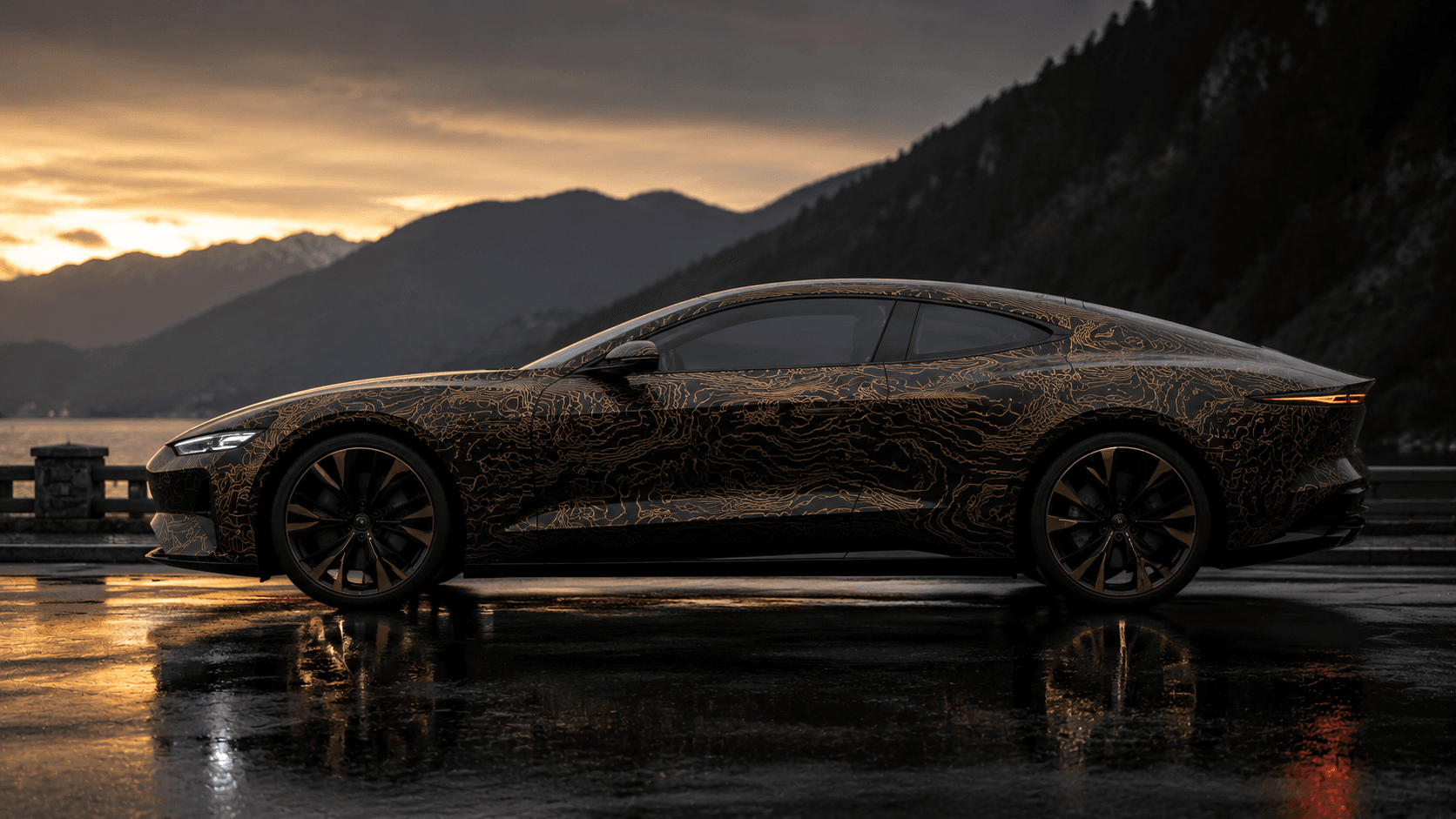
Range Rover has revealed the GT, an all-electric grand tourer that is longer than a standard-wheelbase Range Rover and — remarkably — sits lower than a Porsche Macan. It’s the first wholly new addition to the Range Rover family since the Velar in 2017, and it abandons the tall-SUV formula the brand effectively invented. That alone makes it interesting. But there’s a second detail worth noticing: the GT is built on JLR’s EMA platform, the very architecture Tata Motors recently walked away from for its own Avinya premium EV brand. Put those two facts side by side and you get a genuinely revealing picture of how JLR is allocating its electric future.
What Range Rover Actually Revealed
The GT was shown as a camouflaged prototype, with a global testing fleet now running. Even under an elaborate gold-on-black wrap — a topographic pattern inspired by the landscape around Gaydon, home to Range Rover’s design and engineering teams — the shape is unmistakable: long, low and almost coupe-like, with a roofline that seems to stretch on and on.
The proportions are the headline. Range Rover says the GT is longer than the standard-wheelbase Range Rover and is the lowest Range Rover yet, sitting lower than a Porsche Macan while stretching beyond a Range Rover Sport. The wheelbase appears to be comfortably over three metres. It still drives all four wheels, but the stance reads as a fast, long-legged cruiser rather than a go-anywhere SUV.
Refinement is central to the pitch. Martin Limpert, Managing Director of Range Rover, has called it the quietest Range Rover yet, with a claimed 7dB improvement over the ICE Range Rover — a substantial gap in acoustic terms, since decibels are a logarithmic scale. Initially the GT will be a pure battery-electric vehicle, with a hybrid option planned later in its lifecycle. It’s built at Halewood alongside ICE and hybrid models.
Why the Platform Choice Actually Matters
Here’s where the engineering gets genuinely interesting, and it explains why “born-electric” platforms aren’t just marketing language.
The GT marks a clean break from the MLA architecture used by the Range Rover and Range Rover Sport Electrics. MLA is shared with combustion powertrains, which means every packaging decision is a compromise between what an EV wants and what an engine and transmission need. The GT instead uses JLR’s EMA — the Electrified Modular Architecture — designed from the ground up for electric power only.
The benefits show up in concrete, physical ways rather than abstract claims. The battery uses longer cells arranged in a single layer rather than a double-stacked configuration, which means the floor doesn’t have to be raised to accommodate the pack. That’s why a car this low can still offer headroom for six-footers in both rows, helped by a fixed panoramic glass roof — the largest Range Rover has fitted — that adds 40mm of headroom on its own. There’s also a frunk, which the MLA-based Range Rover Electrics don’t get, because a combustion-derived platform has an engine bay full of other things.
Data shows this is the clearest illustration of why dedicated EV architectures beat adapted ones: the same battery capacity packaged differently unlocks an entirely different shape of car. A low grand tourer simply isn’t possible on a platform designed around an engine.
The EMA Question Worth Asking
Now the juxtaposition. EMA is JLR’s own born-electric architecture, and it’s clearly capable enough to underpin the most radical new Range Rover in years. Yet Tata Motors — which owns Jaguar Land Rover — recently confirmed that its Avinya premium EV brand will not use EMA as originally planned, and will instead be built on the Chery-JLR Freelander platform (E0X) developed in China.
That’s worth sitting with, though it’s worth being careful about what it does and doesn’t mean. The straightforward reading isn’t that EMA is deficient — the GT is evidence to the contrary. According to reporting around the Avinya switch, the likelier explanation is that JLR shelved the relevant India-specific EV platform plans, leaving Tata without the base it had counted on, and EMA capacity and priority sat with JLR’s own products. Faced with that, Tata took the faster available route.
Still, the outcome is striking: JLR’s in-house electric architecture is good enough for a radical new Range Rover, while its parent company builds its premium EV halo brand on a Chinese platform. That says less about engineering quality than about how capital, capacity and priority get allocated inside a global group — and about the speed advantage Chinese EV platforms currently offer to anyone who needs a car on the road quickly.
Inside: Reductive, Lounge-Like, and Light on Buttons
The cabin follows Range Rover’s reductive design language but pushes it in a more architectural direction. Strong horizontal lines dominate, with a single central OLED screen paired with a compact driver display in place of a conventional instrument cluster. That smaller display isn’t purely stylistic — the stated intent is to cut clutter and reduce how much information the driver has to process.
A concealed air vent runs the full width of the dash, creating a clean horizontal graphic, and the dashboard is wrapped in a woven textile that conceals the speakers within its form. Second-row legroom is claimed to be class-leading, which the stretched body and EMA packaging make plausible — this is clearly a car meant to be enjoyed from the back seat as much as the front.
One honest note: there are very few physical buttons. Range Rover says the controls have been simplified for usability, but buyers who prefer tactile switchgear may find the approach frustrating, and that’s a legitimate preference rather than mere conservatism.
What Isn’t Known
Rigour matters here, because a camouflaged prototype reveal is not a launch. No hard figures have been released — no battery capacity, no range, no power outputs, no performance claims. The wheelbase and EMA’s capabilities suggest a sizeable pack and serious long-distance ability, but that’s inference, not specification.
For Indian readers specifically, there’s a further gap: no India launch, timeline or pricing has been announced for the GT. Range Rover does sell in India, where the standard Range Rover sits in the ₹2.40-3.50 crore bracket, so a flagship electric GT would clearly be a rarefied proposition here if it arrives at all. Treat India availability as entirely open.
What It Signals
Beyond the specifics, the GT reflects a broader shift worth tracking. For two decades the default answer to “what should a luxury flagship be?” was a tall SUV. The GT suggests that as luxury brands move to dedicated electric platforms, some are rediscovering the low, long grand tourer — a shape that electric packaging actually suits better than combustion ever did, since there’s no engine to sit above and no transmission tunnel to design around.
According to industry analysts, dedicated EV architectures are increasingly enabling body styles that were impractical or compromised on adapted platforms. The Range Rover GT is a conspicuous example: a brand that built its identity on height and command driving position using electric packaging freedom to go the other way entirely.
The Bottom Line
The Range Rover GT is the most conceptually adventurous thing the brand has done in years — an all-electric grand tourer, lower than a Macan, on a born-electric platform that makes its proportions possible. The engineering story is genuinely interesting, and the EMA choice is a useful counterpoint to Tata’s decision to build Avinya on a Chinese architecture instead. But it remains a camouflaged prototype with no confirmed figures and no India plans, so treat it as a signal of where luxury EVs are heading rather than a car to anticipate.
FAQs
What is the Range Rover GT?
It’s an all-electric grand tourer and the first wholly new addition to the Range Rover family since the Velar in 2017. It abandons the traditional tall-SUV shape for a long, low, coupe-like silhouette while retaining all-wheel drive.
How big is the Range Rover GT?
Range Rover says it’s longer than the standard-wheelbase Range Rover and stretches beyond a Range Rover Sport, with a wheelbase appearing to exceed three metres. It’s the lowest Range Rover yet, sitting lower than a Porsche Macan.
What platform does the Range Rover GT use?
It uses JLR’s EMA (Electrified Modular Architecture), a born-electric platform, marking a break from the MLA architecture used by the Range Rover and Range Rover Sport Electrics, which is shared with combustion powertrains.
What is the Range Rover GT’s range and battery size?
No hard figures have been released. Range Rover hasn’t disclosed battery capacity, range, or power outputs at this prototype stage.
Will the Range Rover GT come to India?
No India launch, timeline or pricing has been announced. Range Rover does sell in India, where the standard Range Rover is priced from around ₹2.40 crore, but GT availability here remains unconfirmed.
Will the Range Rover GT be available as a hybrid?
It launches as a pure battery-electric vehicle, with a hybrid option planned later in its lifecycle.