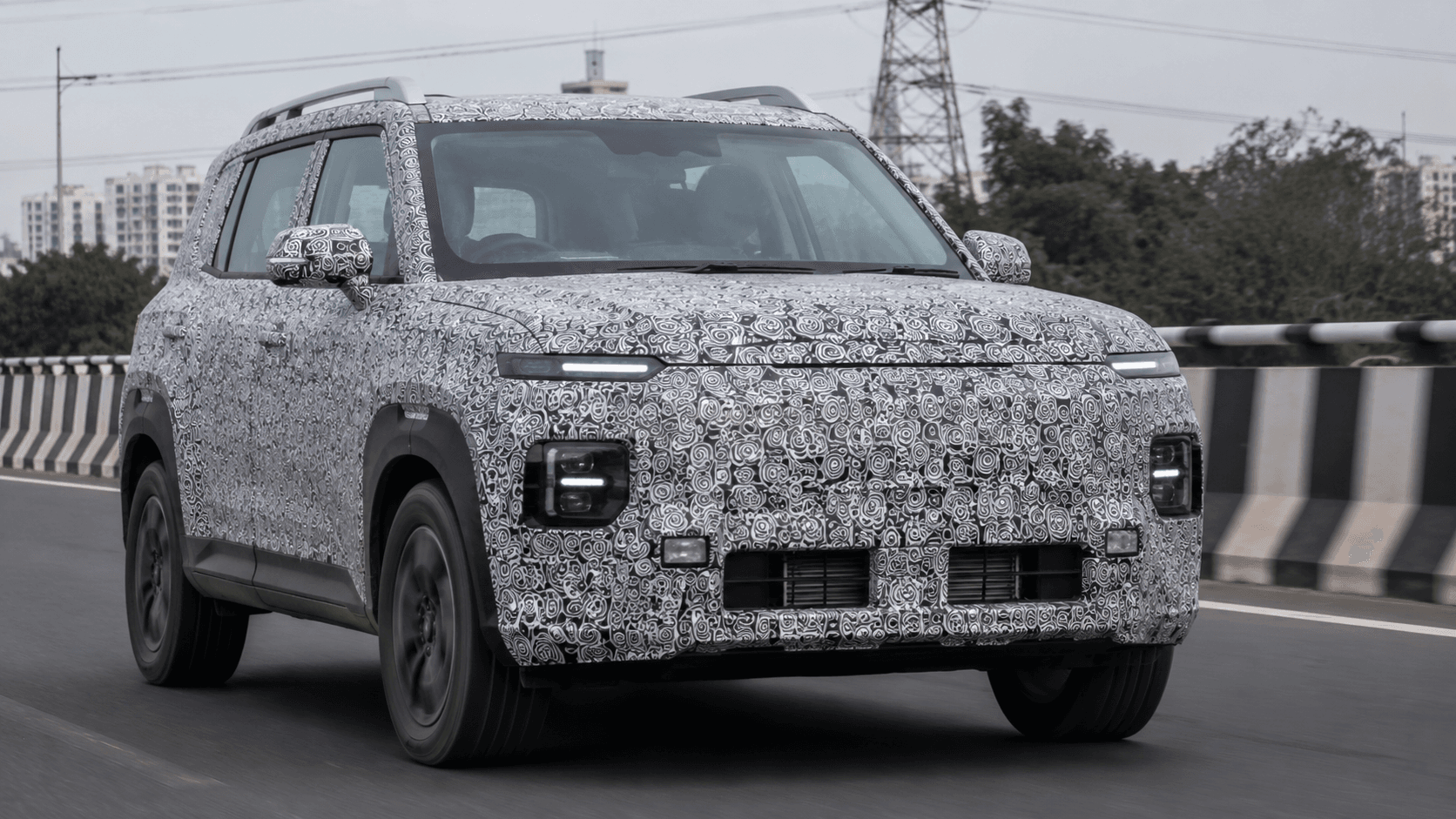
For a while, Hyundai’s upcoming Bayon-based SUV was widely reported as a sub-four-metre crossover built to take on the Maruti Fronx. That’s no longer the understanding. Reporting now indicates the car — codenamed Bc4i — measures around 4.18 metres and is being positioned as Hyundai’s second midsize SUV, sitting alongside the Creta rather than below the Venue. Crossing the four-metre line isn’t a minor spec revision. In the Indian market it changes the tax treatment, the price band, the rival set and the entire buyer profile. That shift, not the spy shots, is what’s worth understanding.
Why Four Metres Is the Most Important Number in Indian Car Design
To grasp why this repositioning matters, you need to understand the single most influential constraint in Indian vehicle packaging: the sub-four-metre threshold.
India’s tax structure has long treated vehicles under four metres in length (with engine capacity limits) more favourably than larger ones. The practical effect is that manufacturers engineer cars to that boundary — designers work backwards from 3,995mm, compressing overhangs and packaging to squeeze maximum cabin space into a length dictated by a tax rule rather than by design logic. It’s why India has an unusually large population of sub-four-metre SUVs and compact sedans that exist nowhere else in the world in quite the same form.
So when a car crosses four metres, it exits that favourable bracket and lands in a different cost structure. That decision is never accidental. It means the manufacturer has judged that the extra size, presence and cabin space will justify a higher price to buyers — a genuinely different commercial bet. A 4.18-metre Bayon-based SUV is therefore not a slightly bigger Fronx rival; it’s a different product aimed at a different customer.
The Maruti Playbook Hyundai Appears to Be Copying
The comparison drawn in reporting is instructive: Hyundai’s approach looks similar to Maruti’s with the Grand Vitara and Victoris — two midsize SUVs from the same manufacturer, sold in parallel rather than one replacing the other.
According to industry analysts, the logic behind running twin models in one segment is sound. India’s midsize SUV space is enormous and internally varied: some buyers want rugged upright styling, others want sleeker crossover proportions; some prioritise features, others value. A single model has to compromise across all of that. Two models let a manufacturer cover more of the segment’s breadth, capture buyers who’d otherwise defect to a rival, and hedge if one design language falls out of favour.
There’s a specific timing logic for Hyundai too. The next-generation Creta is expected around March 2027 and is reported to be moving further upmarket. That creates a gap immediately beneath it — buyers who found the outgoing Creta about right but may find the new one too expensive. A 4.18-metre Bayon-based SUV would slot precisely into that space. Seen this way, the repositioning looks less like indecision and more like Hyundai adjusting a product to fill a hole its own flagship is about to create.
Where the Reporting Genuinely Disagrees
Being straight about uncertainty matters here, because this story has moved and sources don’t fully align.
On size and positioning: earlier reports described a sub-four-metre Fronx rival; more recent reporting describes a roughly 4.18-4.2 metre second midsize SUV positioned alongside the Creta. The more recent framing appears better sourced, but Hyundai hasn’t officially confirmed the car’s dimensions or positioning.
On engines: this is the least settled area. Some reporting suggests a naturally-aspirated petrol with a CNG option likely. Other reporting points to a new 1.2-litre turbo-petrol — potentially with hybrid assistance — offering more power than Hyundai’s current 1.0-litre turbo and better efficiency than the 1.5-litre turbo, with lower trims possibly retaining the 1.0-litre turbo. Hyundai has publicly signalled plans for multiple hybrid models in India by 2030, which makes an electrified option plausible, but nothing is confirmed and it would be premature to assume a hybrid arrives at launch.
On price: estimates naturally follow the positioning assumption. If it’s a sub-four-metre Fronx rival, figures around ₹8-15.65 lakh have been cited; if it’s a Creta-adjacent midsize SUV, roughly ₹10-17 lakh. That spread exists because the underlying question of what the car is hasn’t been officially answered.
On timing: expectations cluster around the second quarter of FY2027 — roughly July to September 2026 — with some reports suggesting a festive-season launch. Also unconfirmed.
What the Spy Shots Show
Camouflaged test mules have revealed a split-headlamp arrangement similar to the Venue, slim LED daytime running lights, and split tail-lights. There’s black cladding, silver roof rails, a reverse camera and parking sensors, and a radar sensor that hints at ADAS. Notably, the India-spec mules wear alloy wheels with a piston-shaped design that differs from the international Bayon’s 16-inch rims.
The styling direction is worth flagging: the India-bound car appears to be moving away from the rounded, car-like crossover character of the European Bayon toward a more upright, conventional SUV look. That’s consistent with Indian buyer preference, where upright SUV proportions carry more appeal than crossover silhouettes. The interior hasn’t been spied, though dual 10.25-inch displays and Hyundai’s newer connected-car software have been mentioned in reporting — again, unconfirmed.
What This Means for Buyers
The practical guidance depends entirely on what you’re shopping for, and this is where the repositioning has real consequences.
If you’re looking at sub-four-metre SUVs — the Fronx, Taisor, Kiger, Magnite bracket — this car may no longer be your competitor. If the 4.18-metre framing holds, it will be priced above that segment, and you shouldn’t defer a purchase waiting for it.
If you’re shopping midsize SUVs — Creta, Grand Vitara, Victoris territory — it becomes more relevant, and there’s a reasonable case for waiting a beat. A launch window of roughly July to September 2026 is close, and a new entrant can affect both your choice and the discounting on existing models. That said, “close” is not “confirmed,” so don’t hold indefinitely.
The broader point for any buyer: Hyundai’s own Creta is expected to move upmarket in 2027. If you like where the Creta sits today on size and price, this new SUV may end up being the closer match to that position than the next Creta itself.
The Bottom Line
Data shows the four-metre threshold has shaped Indian car design more than almost any other single factor, which is why a car crossing it is genuinely significant news rather than a footnote. Hyundai’s Bayon-based SUV appears to have moved from sub-four-metre Fronx rival to a second midsize SUV positioned alongside the Creta — a shift that changes its price, rivals and buyer entirely. Research shows twin-model strategies in a single segment have worked for rivals, and the timing fits neatly with the Creta’s expected move upmarket. But size, engines, price and launch date all remain officially unconfirmed, so treat the details as informed expectation rather than fact until Hyundai says otherwise.
FAQs
What is the Hyundai Bayon-based SUV?
It’s an upcoming Hyundai SUV for India, codenamed Bc4i, based on the global Bayon sold in Europe, the Middle East and North Africa. Recent reporting positions it as Hyundai’s second midsize SUV, alongside the Creta.
Is the Hyundai Bayon a sub-4m SUV?
Reportedly not. It was earlier described as a sub-four-metre Fronx rival, but more recent reporting indicates it measures around 4.18 metres, placing it above that tax bracket and into midsize SUV territory. Hyundai hasn’t officially confirmed dimensions.
When will the Hyundai Bayon-based SUV launch in India?
It’s expected in the second quarter of FY2027 — roughly July to September 2026 — with some reports suggesting a festive-season launch. No official date has been announced.
What engine will it get?
This is unconfirmed and sources disagree. Some reporting suggests a naturally-aspirated petrol with a possible CNG option; other reporting points to a new 1.2-litre turbo-petrol, potentially with hybrid assistance, with lower trims possibly using the existing 1.0-litre turbo.
How much will the Hyundai Bayon-based SUV cost?
No official pricing exists. Estimates range from roughly ₹8-15.65 lakh if it’s a sub-four-metre model to around ₹10-17 lakh if it launches as a midsize SUV — the spread reflects the unresolved positioning question.
What will it compete against?
That depends on final positioning. As a midsize SUV it would rival the Maruti Victoris, Grand Vitara and Creta-adjacent models; as a sub-four-metre model it would have faced the Fronx, Taisor, Kiger and Magnite.