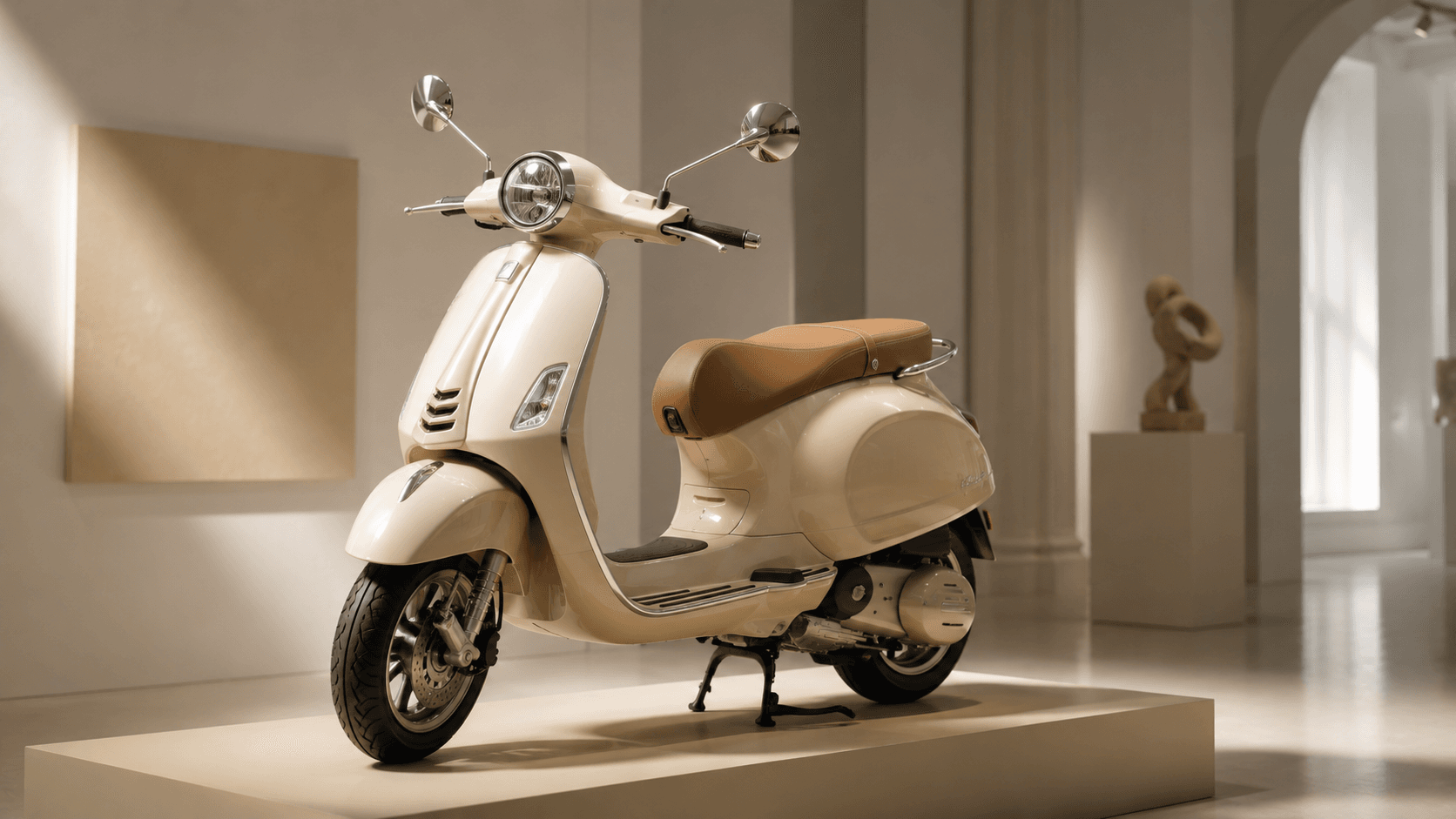
Vespa has revealed a special edition of its Primavera 125 priced at €12,000 — roughly ₹10.8 lakh. That’s a 125cc scooter costing more than most cars sold in India, and somewhere between five and nine times what a standard Vespa costs here. It isn’t coming to India, and mechanically it’s an ordinary Primavera underneath. So the interesting question isn’t what it has; it’s what a brand needs to have earned before it can ask car money for a scooter and expect anyone to say yes. Vespa is one of the very few two-wheeler makers on earth that can even attempt this, and understanding why says something useful about how the brand operates in India too.
What Was Actually Announced
The Primavera 125 x Gigi is a limited-run collaboration between Vespa and Gigi, an upscale Italian restaurant group — a hospitality partner rather than a fashion house, which is itself a slightly unusual choice. Priced at €12,000, it’s positioned explicitly as a luxury lifestyle accessory rather than a means of transport, and coverage of the launch noted the price places it in a category of its own, far beyond any standard 125cc scooter sold anywhere in the world.
Preorders are open exclusively through Vespa’s European website. There are no announced plans for an Indian or US release. As an exclusivity flourish, just two examples will be displayed at the Gigi restaurant in Saint-Tropez during the summer of 2026.
Mechanically, nothing has fundamentally changed. Underneath the collaboration finish and detailing sits a Primavera 125 — a competent, well-made, entirely conventional small-capacity scooter. The price is not buying performance, technology or capability. It’s buying the object.
The Question That Actually Matters
Plenty of manufacturers would like to charge luxury prices. Very few can. So what does Vespa have that makes this even plausible?
The answer is roughly eighty years of accumulated cultural meaning. Vespa launched in 1946 under the Italian conglomerate Piaggio, making it one of the oldest two-wheeler brands in the world, and it became something a scooter almost never becomes: a design icon with genuine cultural weight, embedded in postwar Italian identity and decades of film and photography. Piaggio marked the brand’s 80th anniversary with a celebration in Rome in June 2026 — the kind of milestone that reinforces heritage rather than merely commemorating it.
That matters commercially because it changes what the product is in a buyer’s mind. A scooter is transport, and transport is judged on cost-per-kilometre, practicality and running costs. A design object is judged on desirability, provenance and how it makes the owner feel — criteria with no natural ceiling. Vespa’s silhouette is recognisable in outline alone, which is a rare asset in an industry where most products are visually interchangeable. Once a brand has crossed that threshold, extreme-priced limited editions become possible, because the buyer isn’t comparing it to other scooters at all.
The honest counterpoint is that this is a very small game. A handful of buyers globally will pay €12,000 for a 125cc scooter, and Vespa knows it. The point isn’t volume — it’s a demonstration of pricing power, and a reminder to the market of where the brand sits.
Monetising Credibility vs. Buying It
It’s worth setting this against another collaboration in the news recently: MG’s Couture Editions of the Cyberster and M9, created with couturier Gaurav Gupta and limited to 50 units each. Superficially these look like the same manoeuvre — a car or scooter brand partnering with a lifestyle name to make an ultra-limited collector’s piece.
But the strategic direction is opposite, and that’s the genuinely useful distinction. MG is a brand with mass-market origins in India working to establish premium credibility it doesn’t yet fully possess; the fashion collaboration is a way of borrowing cultural cachet to accelerate that repositioning. Vespa isn’t borrowing anything. It already holds the cultural equity, accumulated over eight decades, and the Gigi edition simply monetises credibility that’s already banked.
That difference determines what each collaboration has to achieve. MG’s has to persuade — it needs to shift perception. Vespa’s only has to exist; it confirms a status the market already grants. Both are legitimate uses of the same tool, but a brand buying credibility faces a much harder task than one cashing it in.
The Limits of the Strategy
It’s worth being clear-eyed about what this kind of pricing can and can’t do, because heritage isn’t an unlimited licence. According to marketing analysts, brand equity of this magnitude takes decades to build and can be eroded relatively quickly if a manufacturer overextends it — flooding the market with expensive limited editions tends to dilute exactly the scarcity that makes them work. The discipline in Vespa’s approach is that these extreme editions remain genuinely rare and are kept separate from the volume business, which continues to sell conventionally-priced scooters on their merits.
There’s also a generational question worth acknowledging. Vespa’s cultural equity rests substantially on mid-twentieth-century associations, and research shows that heritage-based brand appeal has to be actively renewed for younger buyers who have no lived connection to the era that created it. Collaborations with contemporary partners — restaurants, designers, fashion names — are partly an attempt to do exactly that: keep an eighty-year-old brand culturally current rather than merely historic. Whether that succeeds over the long run is a genuine open question, and it applies as much to Vespa’s mainstream business in India as to a €12,000 collector’s piece in Europe.
Why This Is Relevant to Indian Readers
The Gigi edition isn’t coming to India, so its direct relevance is nil. Its indirect relevance is a clearer view of how Vespa actually competes here.
Vespa’s Indian history is longer than most buyers realise: Piaggio licensed the design to Bajaj in the 1960s, later partnered with LML until 1999, and formally relaunched the Vespa brand in India at the 2012 Auto Expo. Today it retails through a few hundred dealerships across the country, with prices running from roughly ₹1.13 lakh to around ₹2 lakh depending on model — a substantial premium over mass-market scooters that offer comparable or better practicality and running costs.
Vespa sustains that premium in India using a diluted version of exactly the logic behind the Gigi edition: it doesn’t compete on value, features-per-rupee or efficiency, because it would lose. It competes on design, heritage and the desire to own something distinctive. According to industry observers, brand equity of this kind is one of the few durable defences against pure price competition in commoditised categories — and two-wheelers in India are about as price-competitive as any market gets.
So an Indian buyer weighing a Vespa against a mainstream scooter is really answering the same question the €12,000 edition poses in extreme form: how much is design and identity worth to you, over and above transport? There’s no wrong answer, but it’s worth recognising that’s the actual trade-off rather than pretending the comparison is about specifications.
The Bottom Line
A ₹10.8 lakh 125cc scooter sounds absurd stated plainly, and in transport terms it is. But it isn’t sold as transport — it’s sold as a design object, and Vespa is among the very few two-wheeler brands with the eight decades of cultural equity required to make that pitch credibly. Research shows the ability to escape category price ceilings is one of the clearest markers of genuine brand strength, and this edition is a demonstration of it. Indian buyers won’t be able to buy this one, but they encounter a milder version of the same proposition every time they consider a Vespa over a cheaper, more practical scooter.
FAQs
How much does the Vespa Primavera 125 x Gigi cost?
It’s priced at €12,000, roughly ₹10.8 lakh — far above any standard 125cc scooter sold anywhere in the world.
Is the Vespa Primavera x Gigi coming to India?
No. Preorders are open exclusively through Vespa’s European website, and no Indian or US release has been announced.
What makes the Gigi edition different from a standard Primavera?
It’s a limited-run collaboration with Gigi, an upscale Italian restaurant group, featuring bespoke finishes and detailing. Mechanically it remains a standard Primavera 125 — the price reflects exclusivity and collaboration, not performance or technology.
Why is a 125cc scooter priced this high?
It’s positioned as a luxury lifestyle accessory rather than transport. Vespa’s roughly 80 years of design heritage and cultural status allow it to price certain limited editions as design objects rather than as scooters.
How much do Vespa scooters cost in India?
Vespa’s India range runs from roughly ₹1.13 lakh to around ₹2 lakh depending on model and source, a significant premium over mainstream Indian scooters.
How long has Vespa been in India?
Piaggio licensed Vespa production to Bajaj in the 1960s and later partnered with LML until 1999. Piaggio officially relaunched the Vespa brand in India at the 2012 Auto Expo.