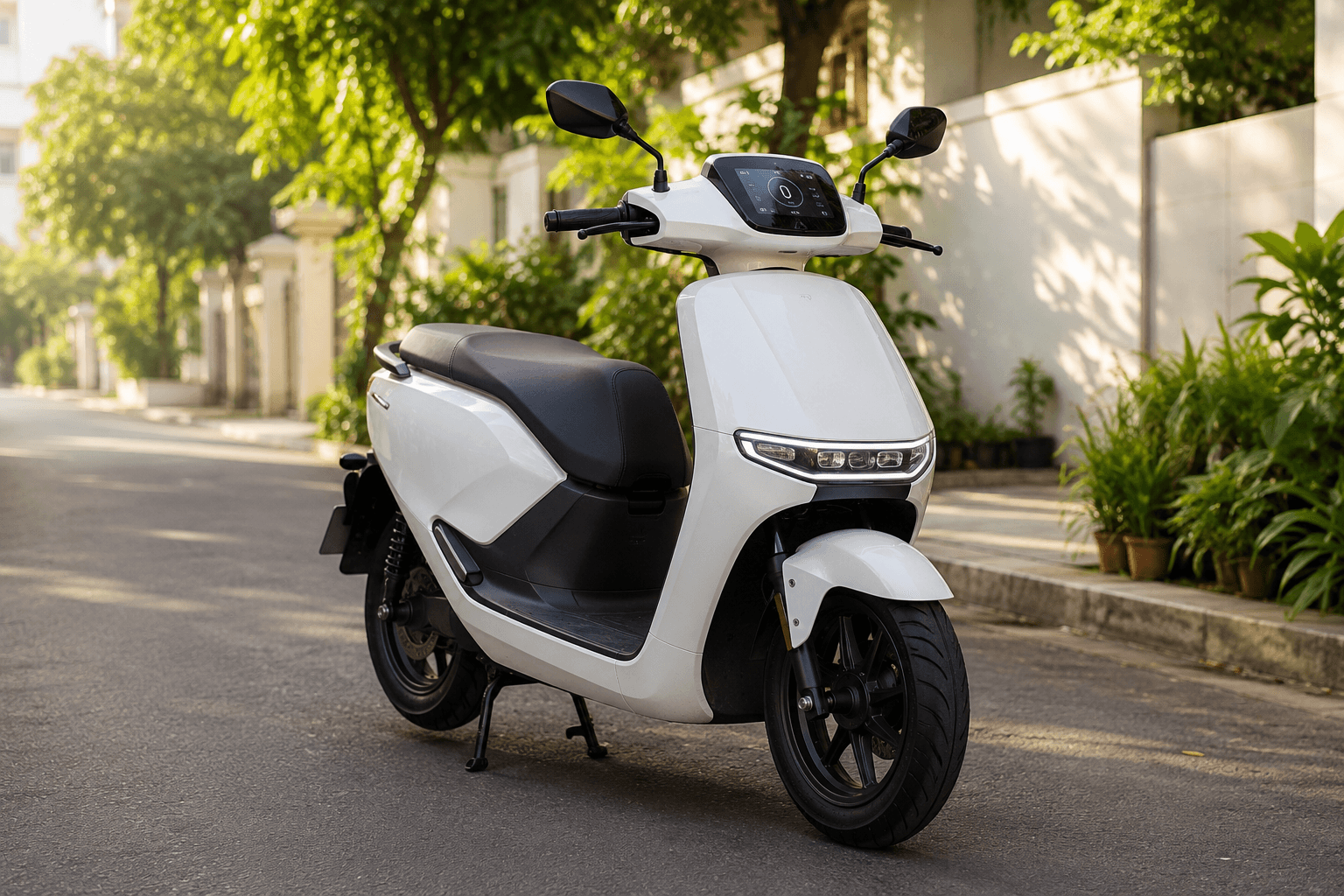
The Honda Activa e is the electric version of India’s most trusted scooter name, and it is also one of the most expensive mainstream electric scooters you can buy, priced from around Rs 1.17 lakh to Rs 1.52 lakh (ex-showroom). It runs on a swappable-battery system rather than a fixed pack, claims a 102km range, and is currently sold in only three cities. The question that hangs over it is simple: does the Honda badge and the swap-battery convenience justify a price that sits well above much of the competition? Here is a clear-eyed assessment.
What you get for the money
According to specifications reported by BikeWale and Autocar India, the Activa e uses two swappable 1.5kWh batteries, badged Honda Mobile Power Pack e:, for a combined 3kWh capacity. These feed a 6kW permanent-magnet synchronous motor making 22Nm, good for a claimed top speed of 80kmph and a 0-60kmph time of 7.3 seconds. There are three riding modes: Econ, Standard and Sport. The claimed range is 102km on a full charge.
On features, the Activa e is well-equipped: a large 7-inch TFT screen, Honda RoadSync Duo connectivity on the top variant, turn-by-turn navigation, a reverse mode, LED lighting, alloy wheels and telescopic front suspension. The base variant, however, drops the RoadSync Duo connectivity, so the smart features are reserved for the pricier trim.
The swappable-battery idea: clever, but conditional
The defining feature is what Honda has built the Activa e around: battery swapping. Instead of plugging in and waiting, riders pull the two power packs and exchange them at a Honda swap station for freshly charged ones, developed and maintained by Honda Power Pack Energy India. In theory, this eliminates charging downtime entirely, which is a genuinely attractive proposition for high-usage urban riders and delivery use cases.
But the model comes with two hard conditions. First, according to the product details, the Activa e is available only in Bengaluru, Mumbai and Delhi in its initial phase, because the swap network only exists in those cities. Second, and this is the big one, there is no home-charging option. If you cannot reach a swap station, you cannot refuel the scooter. That is the opposite of how most electric scooters work, where a home socket is the fallback.
My analysis: swappable batteries are a brilliant solution to charging anxiety, but only if the swap network is dense enough. In the three launch cities, for a rider who lives or commutes near swap stations, it works beautifully. Outside that footprint, or for someone who would have relied on charging at home overnight, the Activa e simply does not fit their life yet. The technology is ahead of its own infrastructure, and that gap is the single biggest thing a buyer must honestly assess before purchase.
The performance and range reality
On paper, the numbers are commuter-appropriate rather than exciting. An 80kmph top speed and 7.3-second 0-60kmph time are fine for city use, matching the everyday-scooter brief the Activa nameplate has always served. The 102km claimed range covers roughly three days of typical urban commuting between swaps.
The honest caveat is that owner feedback flags real-world usage requiring frequent swapping for higher-mileage riders, meaning the effective range in daily use can feel shorter than the claim, as with most EVs. For a light-usage commuter, this is a non-issue. For someone covering long daily distances, the swap frequency becomes part of the ownership routine.
The elephant in the room: the price
The Activa e’s biggest challenge is its own price tag. At roughly Rs 1.17 lakh to Rs 1.52 lakh, it is significantly costlier than the petrol Activa and pricier than several capable electric-scooter rivals. For a segment where buyers count every thousand rupees against their EMI, that is a steep ask, and it is why the “most expensive e-scooter” label sticks.
Honda’s counter-argument rests on brand trust, build quality and the swap convenience. The Activa is arguably the most trusted scooter name in India, with a reputation for reliability and low-stress ownership built over two decades, and that goodwill has real value for a first-time EV buyer nervous about switching. The running-cost savings are also meaningful: electric running costs a fraction of petrol per kilometre, so over years of ownership the higher purchase price is partly offset.
But I would be direct with a prospective buyer: you are paying a premium for the Honda badge and the swap ecosystem, not for class-leading specs. The range, performance and even storage (the boot is notably small) are not standout numbers. If those fundamentals matter more to you than the badge and the swap network, rivals offer more scooter for the money.
Who should buy it, and who should not
Buy the Activa e if you live in Bengaluru, Mumbai or Delhi, ride close to Honda’s swap stations, value the brand’s reliability above all, and want to skip charging waits entirely. For that specific rider, it is a smart, low-hassle way into electric scootering.
Look elsewhere if you need home charging, live outside the three launch cities, do high daily mileage, need generous under-seat storage, or are shopping primarily on value. The Activa e’s premium and its infrastructure dependence make it the wrong fit for those needs today.
How it compares within the segment
To put the Activa e in context, it competes in a fast-crowding premium electric-scooter space that includes established rivals such as the Ather Rizta, TVS iQube and Bajaj Chetak, most of which use conventional fixed batteries with home charging. According to owner feedback captured across listings, buyers consistently praise the Activa e’s build quality and Honda’s reputation for low-stress after-sales service, while flagging the price, limited storage and swap-network dependence as the main drawbacks.
My analysis: this tells you exactly what kind of product the Activa e is. It is not trying to win a spec-sheet shootout on range or storage. It is selling trust, refinement and a charging-free ownership model to a buyer who values those things over raw numbers. Whether that is worth the premium is a personal call, but it is an honest, coherent proposition rather than a confused one.
The bigger picture: Honda’s cautious EV bet
It is also worth reading the Activa e as a statement about Honda’s EV strategy. According to how the product is positioned, Honda has chosen swappable batteries and a phased, city-by-city rollout rather than a nationwide fixed-battery launch. That is a deliberately cautious approach: it lets Honda control the ownership experience tightly in a few markets and build out swap infrastructure before scaling.
The trade-off is reach. By tying the Activa e to a swap network that exists in only three cities, Honda has limited its own addressable market in exchange for a cleaner, charging-free experience where the network is dense. As that network expands, the Activa e should become relevant to far more buyers. For now, it is best understood as a carefully controlled first step rather than a mass-market product, and judged on that basis, it makes more sense than the price tag alone suggests.
The bottom line
The Honda Activa e is a well-built, feature-rich electric scooter wrapped around a genuinely clever swappable-battery idea and India’s most trusted scooter badge. But it is also expensive, available in just three cities, offers no home charging, and delivers only average range and storage. It is an excellent choice for a narrow, well-served urban buyer, and a poor one for everyone whose life does not line up with its swap network. As Honda expands that network, the value equation should improve, but as it stands today, buy it for the convenience and the badge, not for the spec sheet.
FAQs
What is the price of the Honda Activa e?
The Honda Activa e is priced from around Rs 1.17 lakh (Standard) to Rs 1.52 lakh (RoadSync Duo variant), ex-showroom, making it one of the most expensive mainstream electric scooters in India.
What is the range of the Honda Activa e?
Honda claims a range of 102km on a full charge, powered by two swappable 1.5kWh batteries with a combined 3kWh capacity. Real-world range varies with riding conditions and can require more frequent swapping for high-mileage riders.
Does the Honda Activa e support home charging?
No. The Activa e uses only Honda’s swappable-battery system and does not offer a home-charging option. Riders must exchange batteries at Honda swap stations, currently available in Bengaluru, Mumbai and Delhi.
How fast is the Honda Activa e?
It uses a 6kW motor making 22Nm, with a claimed top speed of 80kmph and a 0-60kmph time of 7.3 seconds, across three riding modes: Econ, Standard and Sport. These are typical city-commuter figures.
Is the Honda Activa e worth buying?
It suits riders in its three launch cities who live near swap stations and value Honda’s reliability and charging-free convenience. Buyers who need home charging, longer range, more storage or better value will find rivals more suitable.