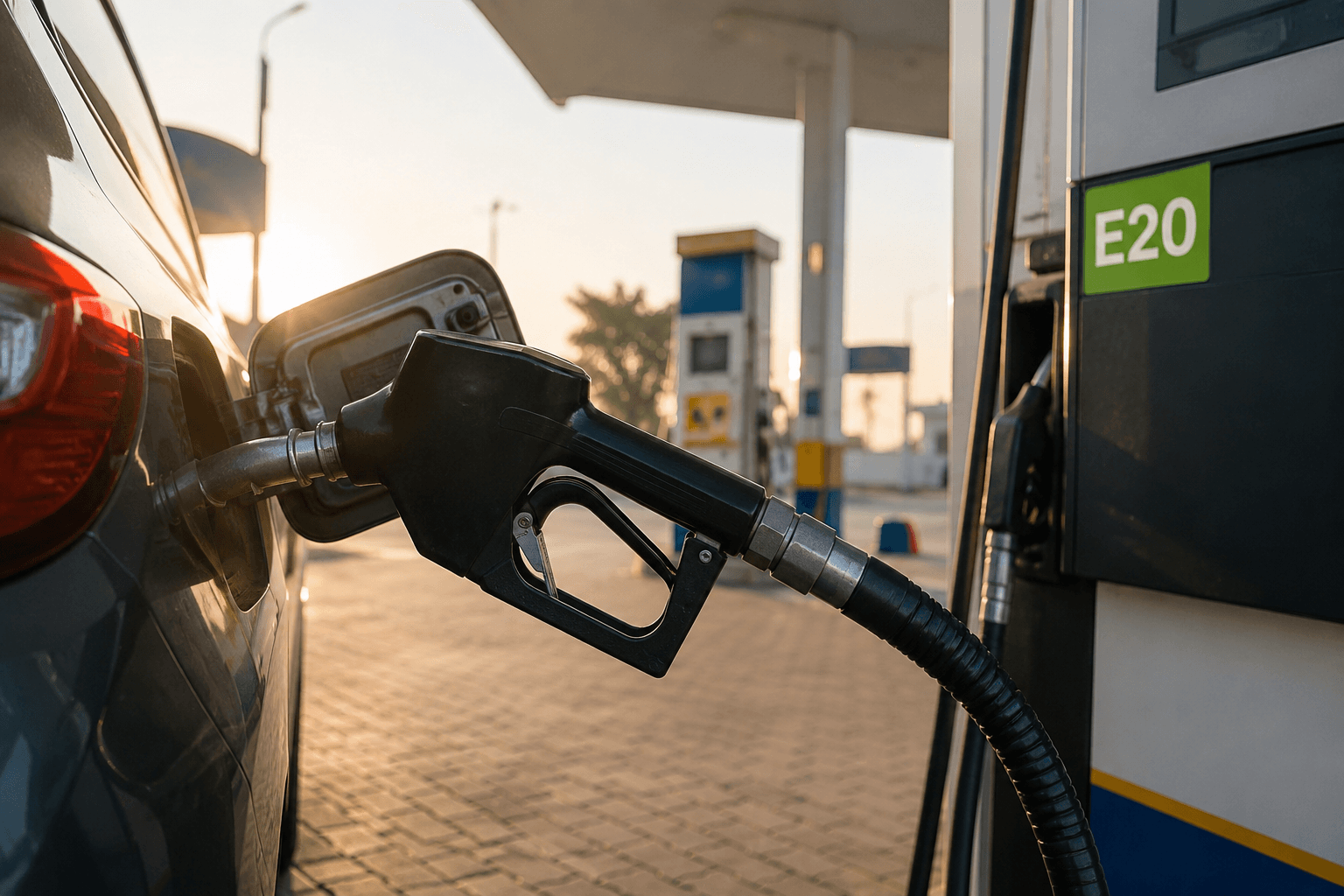
On 5 August 2026, the Society of Indian Automobile Manufacturers pulled back a letter it had sent barely a week earlier to the Ministry of Petroleum and Natural Gas. That letter — dated 28 July and addressed to Petroleum Secretary Neeraj Mittal — flagged serious concerns about the quality of E20 petrol being dispensed across India, and connected it to a rising tide of expensive engine-component failures. Within twenty-four hours of the contents becoming public, the industry body said the numbers “need authentication” and withdrew the communication. The government said fresh quality checks are already in place. And the story became political almost overnight.
For anyone whose car runs on the E20 blend now sold at most fuel outlets in the country — which, at this point, is nearly every petrol-powered vehicle on Indian roads — the withdrawal itself is not the story. The story is what SIAM’s members were seeing in the first place, what the technical data actually claims, and what a reasonable owner should do about it while the industry, the OMCs and the ministry work out who is right.
What the withdrawn letter actually said
According to reporting by Business Standard, Business Today, CarToq and Autocar India, and to statements SIAM itself issued the following night, the 28 July communication made three concrete claims.
Component failures are rising. According to the Business Standard account of the letter, SIAM’s OEM members told the industry body they had seen a “huge increase” in replacements of fuel injectors, fuel pumps, exhaust gas recirculation (EGR) valves, and other components that come into direct contact with fuel or engine emissions. This isn’t an abstract concern about long-term wear — these are parts being changed under warranty and out of warranty in service bays right now.
Chloride contamination is the leading suspect. Field investigations into failed parts pointed to corrosion and wear caused by high chloride content. Fuel samples pulled directly from affected vehicles showed chloride at up to 500 parts per million. Samples pulled from retail outlets showed up to 350 ppm. Against that, SIAM proposed a BIS specification limit of less than 1 mg/kg (or ppm) for commercial E20 and E85, and less than 3 mg/kg for the anhydrous ethanol that gets blended into petrol upstream. In other words, the samples were hundreds of times above the limit that would make chloride a controlled parameter.
Moisture is the second problem. Samples exceeded 10,000 mg/kg of moisture — over 1% — versus the current permitted limit of 3,000 mg/kg. Ethanol is hygroscopic, meaning it pulls water out of the air. Above roughly 1%, water content triggers “phase separation”: the ethanol-water fraction settles out from the petrol, and the vehicle can be immobilised almost immediately after refuelling. SIAM warned of exactly this outcome.
Ageing underground storage tanks and pipelines at older retail outlets, particularly in monsoon and coastal conditions, were flagged as a likely contamination pathway. The concerns were reportedly concentrated in “certain pockets” of the country, especially in the north — not a uniform nationwide problem.
None of this appeared out of thin air. Weeks earlier, Mercedes-Benz India had independently raised fuel-contamination concerns and pushed for stricter quality checks after linking component damage in some vehicles to fuel quality. SIAM’s letter formalised what individual OEMs had been flagging separately.
What SIAM said when it withdrew the letter
In a statement issued the night of 5 August, SIAM described the 28 July communication as part of “routine and ongoing technical deliberations” between industry bodies, oil marketing companies, OEMs and testing agencies — the kind of technical back-and-forth that happens all the time and isn’t meant to be a public position. The industry body said media coverage had selectively focused on chloride and sulphur content, and that “some numbers quoted in the communication need authentication through collection of elaborate data from various regions across the country followed by a comprehensive consultation with our member OEMs.”
Two things stand out in that statement. First, SIAM did not disavow the phenomenon its members are reporting — the component-failure trend was not retracted. It disavowed the specific numerical claims (the 500 ppm chloride, the 10,000+ mg/kg moisture) pending broader data. Second, the withdrawal was accompanied by a reaffirmation of “full support for the government’s E20 programme” — a political line as much as a technical one.
The Ministry of Petroleum and Natural Gas, for its part, has already introduced a 3 ppm guideline for chloride and sulphur in ethanol blended into petrol, and says OMCs have strengthened quality checks across the supply chain. SIAM’s Aug 5 statement acknowledged those steps as “fully meeting the needs of the automobile industry.”
The political layer arrived within hours. AAP national convenor Arvind Kejriwal alleged at a press conference that the Centre had forced SIAM to withdraw the letter. Neither SIAM nor the Centre responded to that specific allegation at the time of reporting. Whether the withdrawal was scientific caution or something else, that question is now part of the public record.
Reading between the lines: what has actually changed
Strip out the political heat, and here is what looks concretely true after 5 August.
Something is happening in the field. OEM service bays are seeing more fuel-system component failures than they used to. That trend was not part of the withdrawal. It sits alongside Mercedes-Benz India’s separate concerns, and it is precisely the kind of signal you would expect if fuel-quality parameters that were adequate for E10 have become inadequate for E20 in some geographies.
The specific numbers — the 500 ppm chloride, the 1% moisture — are officially “pending verification.” That does not mean they are wrong. It means they came from an unspecified sample size and geography, and a national fuel-quality specification cannot be rewritten on that basis alone. Independent sampling by BIS, oil companies and OEMs together will need to establish what typical contamination levels really look like, and where the worst outliers are.
The regulatory ask is still on the table. SIAM has proposed adding chloride as a mandatory BIS-tested parameter in ethanol-blended petrol. The ministry’s 3 ppm guideline is a start. Whether that becomes an enforceable BIS specification, and how quickly, is what will actually change conditions on the ground.
The E20 rollout is not being paused. Every stakeholder — SIAM, the ministry, the OMCs — has signalled that the ethanol-blending programme continues. This is a story about product quality, not about ethanol policy.
What owners should actually do
For most people driving petrol-engined cars sold in the past two to three years, panic is not warranted. Vehicles built to be E20-compliant were engineered assuming ethanol content up to that level, with fuel-line materials, seals and injectors chosen accordingly. The failures SIAM has reported are, on the evidence available, tied to fuel that is out of specification — not to a design mismatch between compliant hardware and compliant fuel.
That said, a few practical steps are worth considering while the industry sorts this out.
Buy fuel from high-turnover, better-maintained outlets. Contamination linked to ageing underground tanks is most likely where fuel sits in older infrastructure. Busy urban outlets from major OMCs, with newer tank systems, are lower risk than isolated rural pumps that see slower stock rotation.
Be cautious with fuel that has been standing. If a vehicle has been parked with a partially full tank for weeks — a common situation for second cars, monsoon-parked bikes, or vehicles in humid coastal cities — the ethanol fraction has had more time to absorb moisture. Topping up rather than driving a stale tank down to empty is the safer default.
Keep records if you have unexplained fuel-system trouble. If a modern petrol vehicle shows sudden misfires, stalling right after refuelling, or premature injector or pump replacement, note the outlet, the date, and the odometer reading. Warranty conversations get much easier with data attached.
Do not rush to aftermarket “E20 protection” products. Fuel additives making blanket anti-corrosion claims are neither validated by OEMs nor, according to fuel-system engineering experts working with modern high-pressure direct injection systems, guaranteed to be compatible with them. If your vehicle is under warranty, unapproved additives can complicate a claim.
Watch for BIS updates. If chloride becomes a mandatory tested parameter under BIS 2796 (the petrol specification), that will be the meaningful policy change — not any single letter or press conference. Fuel quality visible to consumers improves only when the specification and the enforcement mechanism both move.
The bigger picture: why fuel-quality specifications are lagging fuel policy
E20 was rolled out nationwide faster than almost any regulator or industry body publicly forecast even three years ago. The blending target that was originally set for 2030 was achieved by 2025-26, driven by farm-income politics, oil-import considerations, and refiner incentives. Whether the physical fuel-quality-control system — the tank cleaning schedules, the retail-outlet audit cycles, the BIS test parameter list — kept pace with that speed is the underlying question this whole episode raises.
SIAM’s letter was, in effect, an OEM lobby telling a fuel ministry that the pipeline delivering E20 is not as clean as the fuel that leaves the refinery. That is a technically specific complaint and it deserves a technically specific answer — publicly disclosed sampling data, published limits, enforceable audits. The withdrawal has muddied that conversation, but it has not made the underlying question go away.
For consumers, the practical takeaway is unglamorous but true: the fuel you buy today is very likely fine for a modern E20-compliant vehicle. The failures being reported are real but not universal. And the fastest route to certainty is a mandatory BIS chloride specification with published audit results — which is exactly what SIAM asked for, and what the ministry has partially begun to answer. The rest of that answer is what to watch for over the next few months.
FAQs
What is E20 petrol, and is my car compatible with it? E20 is petrol blended with 20% ethanol by volume. Every new petrol-engined car sold in India is required to be E20-compliant, and most vehicles built from 2023 onwards were engineered for the blend. Cars sold before that can typically run E20 without immediate problems, but manufacturers have generally not certified older vehicles for extended use of higher-ethanol blends. Check your owner’s manual for the maximum ethanol content approved for your model.
Did SIAM say E20 damages cars? No. SIAM’s 28 July letter said that contaminated E20 — specifically, fuel with excessive chloride and moisture beyond the intended specification — was linked to a rise in failures of injectors, fuel pumps, EGR valves and exhaust components. The complaint was about fuel quality control at the retail level, not about ethanol as a fuel additive. SIAM has since withdrawn the specific figures pending further verification but reaffirmed its support for the E20 programme.
Can contaminated fuel actually strand my car? Yes, in the specific case of severe moisture contamination. Ethanol pulls water out of the air, and above roughly 1% water content, the ethanol-water fraction can separate from the petrol — a process called phase separation. SIAM warned that this can immobilise a vehicle immediately after refuelling. In practice, this is a rare, geography-dependent event most likely at retail outlets with poorly maintained underground storage tanks, not a common occurrence at high-volume urban pumps.
Is there a way to know if my fuel is contaminated? Not visually or easily. Chloride contamination is invisible and only detectable in a lab. Moisture-driven phase separation, if severe, produces visibly cloudy or two-layer fuel in a clear container, but by the time it is visible in a tank sample, the vehicle is usually already misbehaving. The realistic strategy is to buy from high-turnover outlets and monitor your vehicle for unusual symptoms rather than to test fuel yourself.
Should I switch to premium fuel or avoid E20 outlets? Premium (higher-octane) petrol from the same OMC comes from the same supply chain and is not automatically ethanol-free. Some premium grades in some geographies have lower ethanol content, but this varies. The larger factor for contamination risk is retail-outlet hygiene, not fuel grade. There is currently no comprehensive nationwide list of E20 vs non-E20 pumps, and the government’s stated goal is uniform E20 availability.
What happens next in the SIAM–ministry conversation? Watch two things. First, whether BIS updates its petrol specification (BIS 2796) to include a mandatory chloride limit and a stricter moisture limit for retail-dispensed E20. Second, whether OMCs publish audit data from retail outlets showing chloride and moisture ranges in the field. Both would move this from a controversy into a controlled parameter. Until then, the fastest signal for consumers is watching whether OEMs quietly extend warranty coverage on fuel-system components — that is what actually happens when manufacturers see risk they cannot yet make public.