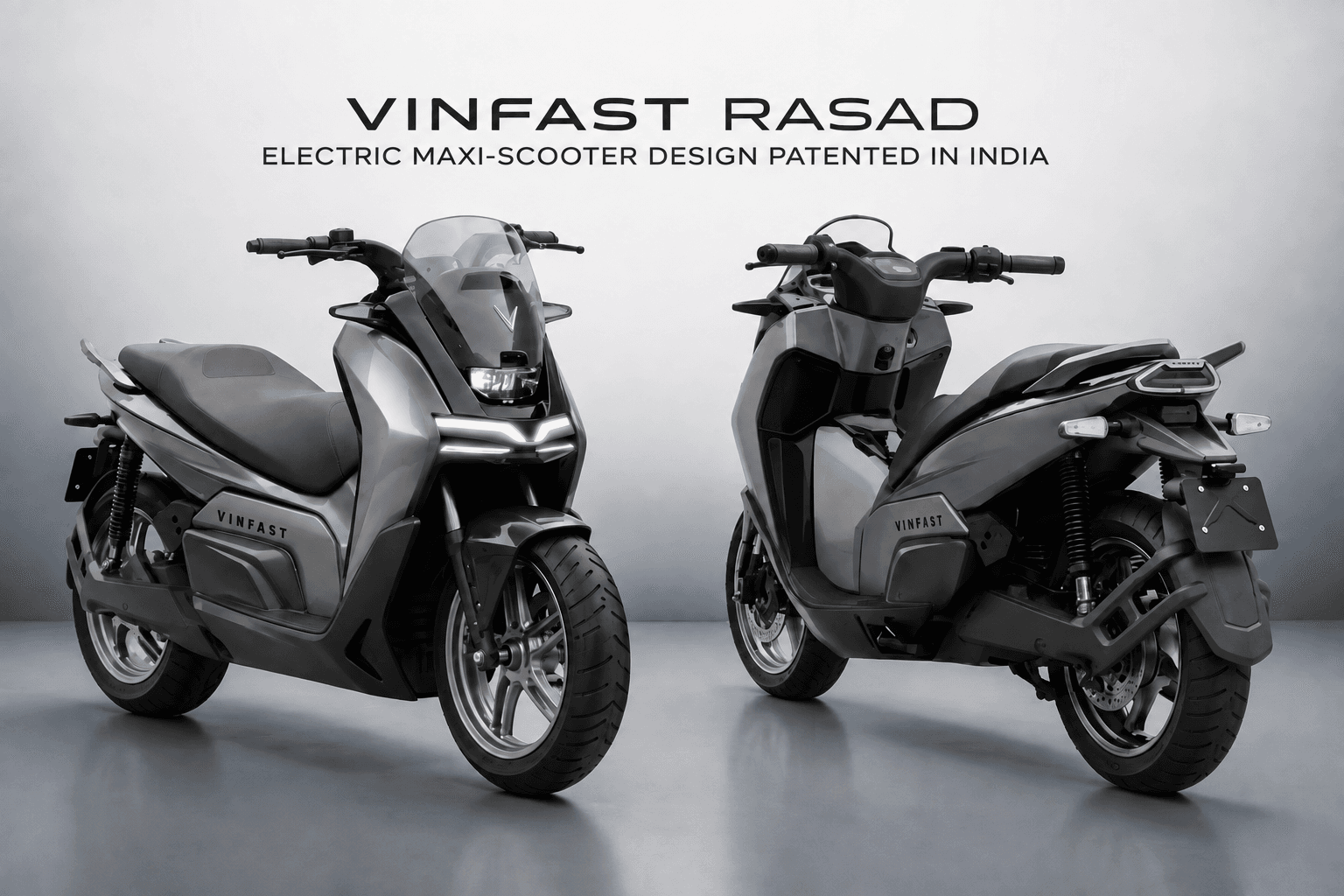
VinFast Rasad Design Patent Filed in India, a premium electric maxi-scooter it unveiled in Vietnam earlier this year. This is the third VinFast two-wheeler patented locally in as many months, and it signals that the Vietnamese carmaker isn’t coming to India with just a mass-market commuter scooter — it’s bringing an entire ladder.
The Rasad joins the Viper (a mid-size scooter) and a motorcycle believed to be based on the Sulad sport concept, both patented in India a few weeks earlier, as reported by Autocar India. A patent filing is not a launch confirmation. But three in ninety days, from a brand that has publicly committed to a two-wheeler line-up here, isn’t a coincidence either.
What the patent actually shows
The design filing reveals a familiar maxi-scooter silhouette — the same body language you see on the Yamaha Aerox, the recently unveiled Honda ADV160, and, at the higher end, the Aprilia SXR 160. Chunky tyres. An underbone chassis instead of a floorboard-first commuter layout. A tall windscreen. A stepped, spacious seat. Disc brakes at both ends, telescopic forks up front, and a pair of rear shock absorbers.
None of this is exotic. What’s interesting is the positioning. India’s maxi-scooter niche has been slow but steadily growing, and it has almost no dedicated electric competitor. Ather, Bajaj, TVS, Ola, Hero Vida — none of them build a maxi-scooter today. If VinFast actually lands the Rasad here, it won’t be arriving in a crowded room.
VinFast has not officially confirmed specifications. According to Vietnam News, the scooter is expected to use a centrally mounted motor producing around 7.1 kW of peak power, with a claimed top speed of 100 kph. Battery capacity, real-world range, and charging details are still unpublished. According to the same source, VinFast is targeting a global launch in the fourth quarter of 2026.
Why three patents in a row change the story
Back in January, according to an interview VinFast Asia CEO Pham Sanh Chau gave to Autocar Professional, the company was studying local usage patterns, infrastructure, commute distances, and price sensitivity — the kind of language that usually points to an affordable, high-volume urban scooter, not a 100 kph maxi.
The three patents suggest a wider brief.
- The Viper is a sportily styled scooter positioned around a 3 kW motor and a 1.5 kWh removable battery, per BikeWale and carbike360. That’s squarely aimed at the TVS iQube / Bajaj Chetak / Ather Rizta / Ola S1 space.
- The Sulad-derived motorcycle would sit in a segment that barely exists in India today — a premium electric two-wheeler with sportbike styling.
- The Rasad takes on the premium maxi-scooter category.
Put together, these three products cover mass-market, premium scooter, and premium sport. That aligns with what VinFast’s Vietnamese business itself announced in January — a portfolio “structured into three segments: mass-market, premium and sport” with seven new models across the top two tiers, per a statement to Vietnam News. The Indian filings look like a compressed replay of that same strategy.
What this means for the Indian electric two-wheeler market
For buyers, most of this is still 12–18 months away. For competitors, the picture is more immediate.
VinFast has committed capital to a Thoothukudi (Tamil Nadu) plant, and per Autocar Professional, the company has publicly stated a long-term two-wheeler capacity target of one million units annually, with a dedicated production line at that facility. Even a partial build-out would put it on par with Ola Electric’s early ambitions and ahead of most Indian two-wheeler start-ups.
The pricing question is the one that will settle it. The Viper, if launched close to its Vietnamese specification, could land in the ₹1.10 lakh to ₹1.30 lakh window. That is right in the Ather Rizta / TVS iQube / Bajaj Chetak crosshairs. The Rasad, being a maxi-scooter with a 100 kph target and a bigger battery than any Vietnam-market VinFast today, would almost certainly sit north of ₹1.80 lakh — closer to Aprilia SXR 160 (petrol) or an aspirational e-mobility statement piece than a commuter.
That last part matters. India’s ₹2 lakh+ scooter market is small but growing, and it’s where brand aspiration is built. If VinFast wants Indian buyers to take its EV sedan and SUV plans seriously, it helps to have a visible, halo-adjacent two-wheeler doing the rounds in metro cities. The Rasad plays that role well.
The catch: patents ≠ launches
It’s worth being clear-eyed here. Design patents protect the appearance of a product — they don’t commit the manufacturer to importing, homologating, or selling it. Two-wheeler makers routinely file patents for models they never launch in a given market, either because the business case shifts, or the type-approval work turns out expensive, or the competitive landscape moves faster than expected.
So: yes, the Rasad is now on the paperwork trail in India. No, that does not mean a showroom launch is imminent. The signal, though, is what matters. Read together with Chau’s public statements, the manufacturing investment, and the two earlier filings, the Rasad patent suggests VinFast is planning a portfolio play — not a single-product test — for the second-largest two-wheeler market on the planet.
For legacy players, the strategic question is straightforward: when a foreign brand with car-scale capital walks into a segment they’ve been ignoring (premium electric maxi-scooters), do they respond, or do they let VinFast own the category by default? Ather’s Konarc — spotted testing recently, per Autocar India — hints that at least one Indian rival has read the memo.
FAQs
Is the VinFast Rasad launched in India? No. As of August 2026, VinFast has filed a design patent for the Rasad in India but has not officially launched it. The company is targeting a global launch in Q4 2026 (as reported by Vietnam News), and there is no confirmed Indian on-sale date yet.
How much will the VinFast Rasad cost in India? VinFast has not disclosed pricing. Based on the Rasad’s premium maxi-scooter positioning and expected specifications, an Indian sticker price is likely to fall well above ₹1.80 lakh (ex-showroom) if the model is eventually launched — this is an editorial estimate, not a company figure.
What is the top speed and power of the VinFast Rasad? Per Vietnam News, the Rasad is expected to use a centrally mounted motor rated at 7.1 kW (peak) and a claimed top speed of 100 kph. VinFast has not officially confirmed these figures.
Which scooters will the VinFast Rasad compete with in India? If launched, the Rasad would target the premium maxi-scooter segment — a niche currently occupied by petrol models like the Aprilia SXR 160 and the newly unveiled Honda ADV160. There is no direct electric maxi-scooter rival on sale in India today.
When will VinFast start selling electric scooters in India? VinFast has publicly said it plans to enter the Indian two-wheeler market in the second half of 2026, per Autocar Professional, with production planned at its Tamil Nadu plant. The Rasad is not confirmed to be part of the first launch wave; the Viper and two other Vietnam-market scooters are the more likely opening acts.