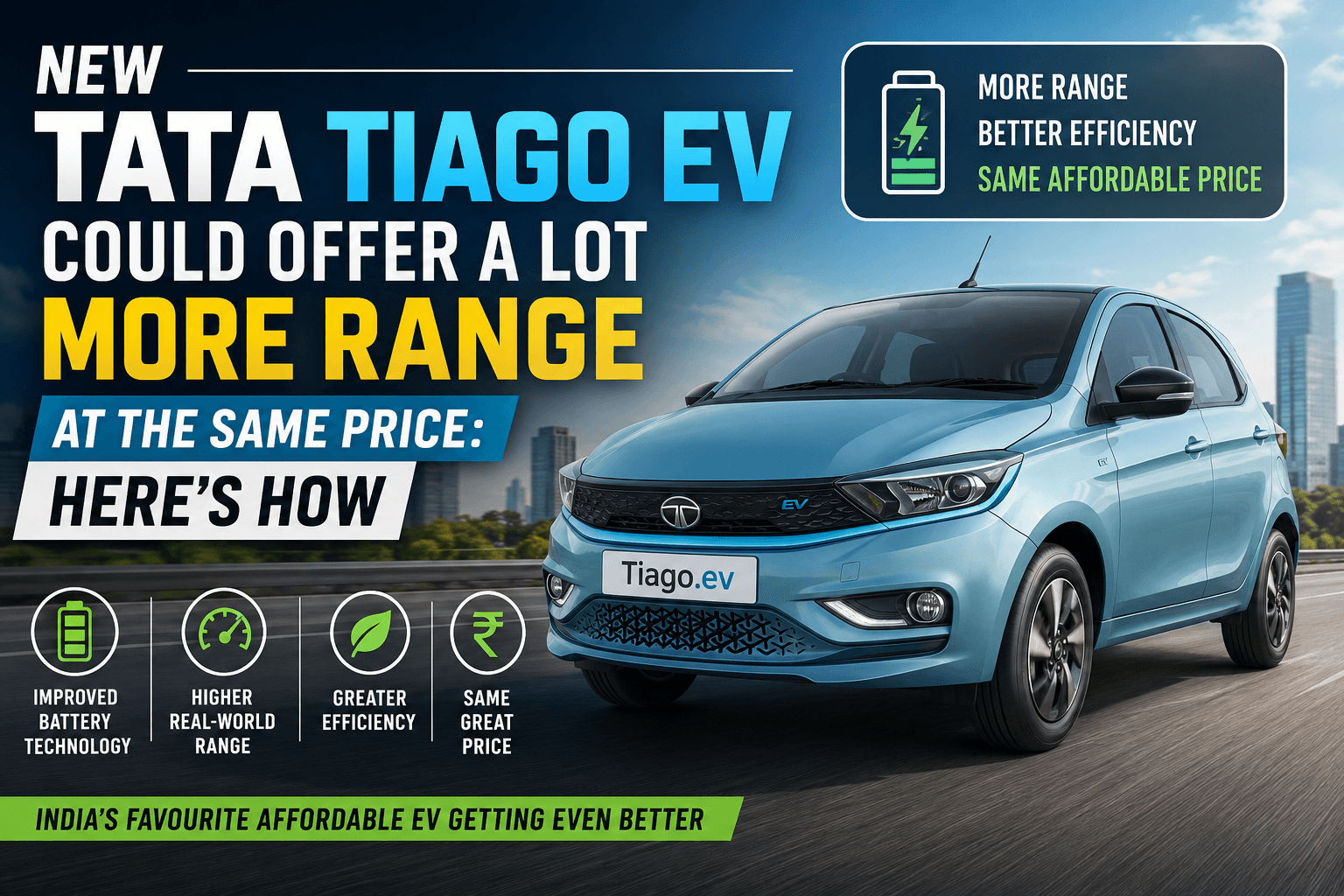
The electric vehicle market in India is evolving rapidly, and Tata Motors continues to dominate the affordable EV segment with products like the Tata Nexon EV, Punch EV, and Tiago EV. Among these, the 2026 Tata Tiago EV has become one of the most accessible electric cars for Indian buyers thanks to its attractive pricing, practical design, and low running costs.
Now, fresh developments suggest that the upcoming 2026 Tata Tiago EV update could deliver significantly more driving range without a substantial increase in price. If Tata manages to pull this off, the Tiago EV could become an even stronger value proposition for city commuters and first-time EV buyers.
But how exactly can Tata increase range while maintaining affordability? The answer lies in battery technology improvements, smarter packaging, software optimization, and platform sharing.
Let’s take a closer look at how the next 2026 Tata Tiago EV could become one of India’s smartest affordable electric cars.
Tata Is Preparing a Major Tiago EV Update
Tata Motors has aggressively expanded its EV lineup over the last few years, and the Tiago EV has played a crucial role in bringing electric mobility to budget-conscious buyers.
The current Tiago EV already offers:
- Competitive pricing
- Multiple battery options
- Compact city-friendly dimensions
- Low maintenance costs
- Decent real-world usability
However, competition in India’s affordable EV segment is increasing quickly. Buyers now expect:
- Longer range
- Faster charging
- Better technology
- Improved cabin experience
To stay ahead, Tata is expected to introduce meaningful upgrades to the Tiago EV, potentially borrowing technology from newer-generation EVs like the Punch EV.
Why Range Matters More Than Ever in India
For Indian EV buyers, driving range remains one of the biggest deciding factors.
Even though charging infrastructure is improving steadily across metro cities and highways, range anxiety still affects purchasing decisions. Most buyers want an EV that can comfortably handle:
- Daily office commutes
- Weekend drives
- Intercity travel
- Unexpected traffic conditions
A higher range also reduces charging frequency, making ownership more convenient.
Currently, the Tiago EV is offered with:
- A 19.2kWh battery pack
- A larger 24kWh battery pack
The larger version delivers a claimed MIDC range of around 315km, while real-world figures are typically lower depending on driving conditions.
If Tata can increase efficiency and usable battery capacity without drastically increasing costs, the Tiago EV could become significantly more practical for Indian roads.
How Tata Could Increase Range Without Raising Prices
Improved Battery Energy Density
One of the biggest advancements in EV technology is improved battery energy density.
Modern battery cells can now store more energy within the same physical space. This means Tata may not need a significantly larger battery pack to improve range.
By using newer-generation cells:
- Energy storage increases
- Efficiency improves
- Weight can remain controlled
- Costs stay manageable through scale production
This approach allows manufacturers to offer more kilometers per charge without dramatically increasing vehicle prices.
Better Battery Packaging
Battery packaging technology has evolved quickly in recent years.
Instead of increasing battery size physically, Tata could optimize:
- Cell arrangement
- Thermal management
- Structural integration
This helps maximize usable capacity while improving cooling and efficiency.
The newer Punch EV already showcases Tata’s advancements in battery architecture, and some of those learnings could trickle down to the Tiago EV.
Software and Regenerative Braking Optimizations
Software plays a massive role in EV efficiency.
Tata could improve the Tiago EV’s range through:
- Smarter energy management systems
- Enhanced regenerative braking
- Optimized motor calibration
- Better battery usage algorithms
Even small efficiency gains can translate into noticeable range improvements in real-world conditions.
For city driving especially, stronger regenerative braking can recover more energy during stop-and-go traffic.
Lightweight Components and Efficiency Tweaks
Weight reduction remains one of the easiest ways to improve EV range.
Tata could introduce:
- Lighter alloy materials
- More efficient tires
- Aerodynamic enhancements
- Reduced rolling resistance
Combined together, these upgrades can improve overall efficiency without increasing battery costs.
Could Tata Borrow Technology from the Punch EV?
The Tata Punch EV introduced several important upgrades to Tata’s EV ecosystem.
Some of the key improvements included:
- More advanced battery architecture
- Better software integration
- Improved charging management
- Enhanced thermal systems
If Tata integrates even part of this technology into the Tiago EV, buyers could benefit from:
- Improved efficiency
- Better charging consistency
- More real-world range
- Smoother performance
Platform sharing also helps Tata reduce manufacturing costs, which is essential for maintaining aggressive pricing.
Expected Battery Options and Claimed Range
While Tata has not officially confirmed the final specifications, industry expectations suggest:
- The smaller battery pack may remain unchanged
- The larger battery version could receive efficiency improvements
- Real-world range may increase substantially
Potential estimates include:
- 250km to 280km real-world range for the larger battery
- Better highway efficiency
- Improved consistency in extreme weather conditions
If Tata introduces higher-density battery cells, the Tiago EV may even challenge larger and more expensive EVs in practical usability.
Design and Feature Updates Expected
The upcoming Tiago EV update may not be limited to battery improvements alone.
Expected exterior updates include:
- Revised front grille design
- New LED lighting elements
- Updated alloy wheels
- Fresh color options
Inside the cabin, Tata could introduce:
- Larger touchscreen infotainment
- Updated digital instrument cluster
- Wireless smartphone connectivity
- Improved materials and finish
Safety features may also improve with:
- Additional airbags
- Enhanced electronic stability systems
- Better connected-car technology
These updates would help the Tiago EV remain competitive against newer rivals entering the market.
Why the Tiago EV Could Become India’s Best Affordable EV Again
The Tiago EV already offers one of the lowest entry points into electric mobility in India.
Its strengths include:
- Affordable pricing
- Compact dimensions
- Easy urban usability
- Low charging costs
- Tata’s expanding EV service network
If Tata successfully improves range while keeping pricing competitive, the Tiago EV could become even more attractive for:
- Daily commuters
- First-time EV buyers
- Young professionals
- Fleet operators
- City-based families
The running cost advantage remains significant compared to petrol hatchbacks, especially with rising fuel prices.
2026 Tata Tiago EV vs Rivals
MG Comet EV
The MG Comet focuses heavily on urban mobility but lacks the practicality and highway confidence offered by the Tiago EV.
Citroen eC3
The Citroen eC3 provides decent practicality but struggles to match Tata’s charging ecosystem and widespread service support.
Tata Punch EV
The Punch EV offers more premium features and stronger performance, but it also costs considerably more.
The Tiago EV continues to occupy a sweet spot between affordability and practicality.
Should Buyers Wait for the New Tata Tiago EV?
If you are considering purchasing an affordable EV in India, waiting for the updated Tiago EV may be a smart decision.
The expected benefits could include:
- Better range
- Improved efficiency
- More modern features
- Enhanced technology
- Potentially better resale value
However, buyers needing an EV immediately may still find the current Tiago EV to be an excellent value-for-money option.
The upcoming version is likely to appeal most to buyers prioritizing:
- Longer daily commutes
- Reduced charging frequency
- Better highway flexibility
Final Verdict
The 2026 Tata Tiago EV has already proven that affordable electric mobility can work in India. Now, Tata appears ready to take the formula further by potentially offering substantially better range without pushing prices higher.
If the company successfully combines:
- Better battery technology
- Improved efficiency
- Smarter software
- Shared EV platform advantages
the updated Tiago EV could become one of the most compelling budget electric cars in the country.
For Indian car enthusiasts and EV buyers alike, the next chapter of the Tiago EV looks extremely promising.
What is the expected range of the new 2026 Tata Tiago EV?
The updated 2026 Tata Tiago EV could potentially deliver around 250km to 280km of real-world driving range depending on battery configuration and driving conditions.
Will the 2026 Tata Tiago EV get a bigger battery?
Tata may not necessarily increase battery size physically. Instead, it could use higher energy-density battery cells and efficiency improvements to increase range.
What will be the expected price of the updated Tata Tiago EV?
Tata is expected to maintain aggressive pricing to keep the Tiago EV competitive in India’s affordable EV market.
Is the Tata Tiago EV good for long drives?
The current Tiago EV is mainly optimized for urban usage, but improved range in the updated version could make occasional highway trips more practical.
Which Tata EV offers the best value currently?
The Tiago EV remains one of Tata’s best-value electric vehicles for budget-conscious buyers, while the Punch EV offers a more premium experience.