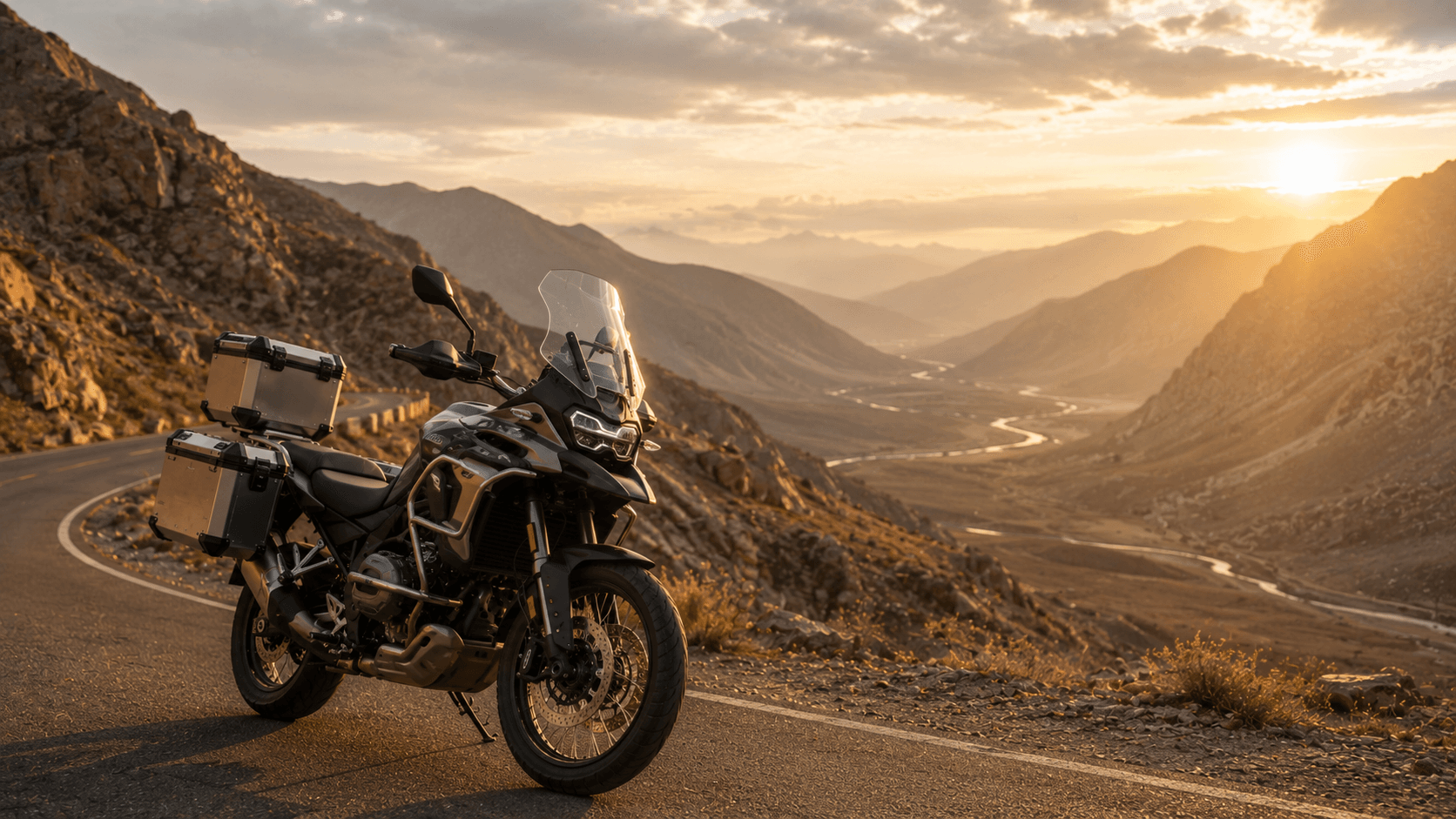
Royal Enfield’s Himalayan 750 has been spied testing in India repeatedly, its world premiere is confirmed for EICMA 2026, and an India launch is expected within roughly the next year. But the accumulated evidence from those spy shots points to something worth flagging before anyone builds expectations: this is shaping up to be a road-biased touring motorcycle carrying a nameplate built on rugged, genuinely off-road-capable credentials. That’s not a criticism of the engineering — it’s a sound trade-off — but it does mean buyers expecting a bigger Himalayan 450 may be surprised by what actually arrives.
What’s Confirmed and What Isn’t
Let’s separate these carefully, because almost everything circulating about this motorcycle is estimation rather than specification.
Confirmed: Royal Enfield showed the Himalayan 750 in concept form at EICMA 2025, and CEO B Govindarajan stated the concept needed further testing before entering production. The world premiere is confirmed for EICMA 2026 in Italy later this year. Production-ready prototypes have been spotted testing in India on multiple occasions, including load-testing with panniers fitted.
Not confirmed: essentially everything else. Reports place the India launch somewhere between late 2026 and March 2027 — the motorcycle is described as one of several all-new Royal Enfield models earmarked for FY27, but sources disagree on timing. Expected pricing clusters around ₹4.00-4.50 lakh, which is an estimate, not a figure Royal Enfield has stated. Power outputs vary meaningfully across reports too, ranging from roughly 50bhp to around 60bhp with torque estimates between 60 and 65Nm. Treat all of it as informed speculation until the EICMA reveal.
The Hardware Story
The Himalayan 750 is expected to use a new 750cc air/oil-cooled parallel-twin, most likely a bored-out development of the 648cc twin that powers Royal Enfield’s 650 range (which produces 47hp and 52Nm). That engine is also expected to appear in the next-generation Interceptor and Continental GT, making this a platform investment rather than a one-model motor. It’s paired to a six-speed gearbox, partially retuned for the heavier machine, possibly with a slipper clutch.
The chassis package looks genuinely premium by Royal Enfield standards: a new frame and subframe, upside-down front forks, and a rear monoshock — notably the first twin-cylinder Royal Enfield to use one. Braking moves to twin front discs with Bybre callipers plus a single rear disc and dual-channel ABS, expected to be switchable. Wheels are 19-inch front and 17-inch rear, and prototypes have appeared with both wire-spoke and alloy setups, suggesting more than one variant. Features should include the circular TFT display seen on the Himalayan 450 and Bear 650, with Google Maps navigation and smartphone connectivity, and possibly traction control and riding modes. A larger fuel tank and an upswept exhaust round out the touring-oriented package.
Why This Is a Tourer, Not a Bigger Himalayan 450
Here’s the positioning tension, and the physics behind it. Three pieces of evidence point the same direction.
First, the wheel sizes. A 19-inch front wheel paired with a 17-inch rear is a road-biased combination. Data shows serious adventure motorcycles built for genuine off-road work typically use a 21-inch front wheel, which rolls over obstacles better and handles rough terrain more capably. The Himalayan 450 is a properly off-road-capable machine; the 750’s wheel specification signals a different intent.
Second, the weight. A twin-cylinder 750cc platform is substantially heavier than the single-cylinder 450, and that weight fundamentally changes what a motorcycle can do off-road. According to riders and reviewers with experience on large-capacity adventure machines, heavy adventure bikes are demanding and tiring to ride on genuinely difficult terrain regardless of how capable their suspension is. Coverage of the spy shots has noted directly that the twin-cylinder platform’s weight makes it impractical for serious off-road use — this is a physical constraint, not a design oversight.
Third, the accessories and variants. Prototypes have been spotted with hard panniers that appear to fit the tail section properly, plus a headlight guard, suggesting an official touring accessories package. And the appearance of an alloy-wheel variant alongside the wire-spoke version points to a road-touring configuration sitting alongside a more trail-friendly one.
None of this is a failure. Building a comfortable, torquey, twin-cylinder highway tourer with mild off-road ability is a completely legitimate and commercially sensible product — it’s arguably the segment where most adventure-bike buyers actually spend their riding time. The engineering trade-off is correct for what this motorcycle is meant to do.
The Expectation-Management Risk
The genuine risk is the name. According to long-time followers of the brand, “Himalayan” carries specific meaning for Indian riders, built over years through the 411 and the 450: accessible, rugged, unpretentious, and genuinely capable when the tarmac ends. That reputation was earned in exactly the conditions the name evokes.
A 750cc twin-cylinder road-biased tourer is a different motorcycle serving a different rider. If buyers approach it expecting a scaled-up Himalayan 450 — same go-anywhere attitude, more power — some will be disappointed when they discover a heavier machine that’s happiest covering highway distance rather than tackling difficult trails. Conversely, riders who specifically want a comfortable, characterful twin-cylinder tourer for long-distance road journeys with occasional light trail work should be very well served indeed.
How Royal Enfield positions and communicates this at the EICMA reveal will matter as much as the specifications. Framed honestly as a touring-focused adventure motorcycle, it’s a strong proposition. Marketed on the Himalayan’s hardcore off-road heritage, it risks setting up expectations the product isn’t designed to meet.
Where It Would Sit, and What It Competes With
Royal Enfield’s current adventure lineup consists of the Himalayan 450 (around ₹2.98 lakh) and the Scram 440, so a ₹4-4.5 lakh twin-cylinder machine would sit meaningfully above both as the brand’s adventure-touring flagship. At that estimated price it enters genuinely competitive territory, cross-shopped against the KTM 390 Adventure and a range of middleweight touring-capable machines depending on final pricing.
Royal Enfield’s traditional advantages apply here: strong value for the hardware offered, an extensive service network, and a distinctive character that has won the brand a loyal following. Its challenge in this bracket is that buyers spending ₹4 lakh-plus have access to established touring machines from manufacturers with long track records in the segment, so the 750 will need to deliver genuine refinement and highway composure rather than relying on brand affection alone.
What Buyers Should Do
Nothing yet — and that’s the honest answer. With the world premiere still ahead at EICMA 2026 and an India launch expected somewhere between late 2026 and March 2027, this is a motorcycle to track rather than plan around. Final specifications, confirmed power outputs, actual weight, variant lineup, and pricing are all still unknown, and the weight figure in particular will tell you a great deal about how this bike will actually ride.
Riders who want a Royal Enfield adventure motorcycle today have the Himalayan 450, which is a genuinely capable and well-regarded machine at a much lower price. Riders specifically waiting for a twin-cylinder touring Royal Enfield should watch the EICMA reveal for confirmed specifications and then, critically, wait for real-world ride reviews — because for a heavy touring machine, how it actually feels over distance matters far more than any number on a spec sheet.
FAQs
When will the Royal Enfield Himalayan 750 launch in India?
No official date has been confirmed. The world premiere is confirmed for EICMA 2026, with reports placing the India launch somewhere between late 2026 and March 2027.
What engine will the Himalayan 750 use?
It’s expected to use a new 750cc air/oil-cooled parallel-twin, likely a bored-out development of the 648cc twin from Royal Enfield’s 650 range, paired with a six-speed gearbox. Output estimates vary from roughly 50bhp to 60bhp, with around 60-65Nm of torque — all unconfirmed.
How much will the Royal Enfield Himalayan 750 cost?
Royal Enfield hasn’t announced pricing. Estimates cluster around ₹4.00-4.50 lakh (ex-showroom), but this is speculation until launch.
Will the Himalayan 750 be as off-road capable as the Himalayan 450?
Probably not. Its 19-inch front wheel (versus the 21-inch typical of serious off-road machines) and the substantially heavier twin-cylinder platform suggest a road-biased tourer with mild off-road ability, rather than a dedicated off-roader like the 450.
What features will the Himalayan 750 have?
Expected features include a circular TFT display with Google Maps navigation and smartphone connectivity, upside-down front forks, a rear monoshock, twin front discs with dual-channel ABS, and possibly traction control and riding modes.
What will the Himalayan 750 compete against?
At its estimated price it would sit above Royal Enfield’s own Himalayan 450 and compete in middleweight adventure-touring territory against machines like the KTM 390 Adventure and other touring-capable rivals, depending on final pricing.