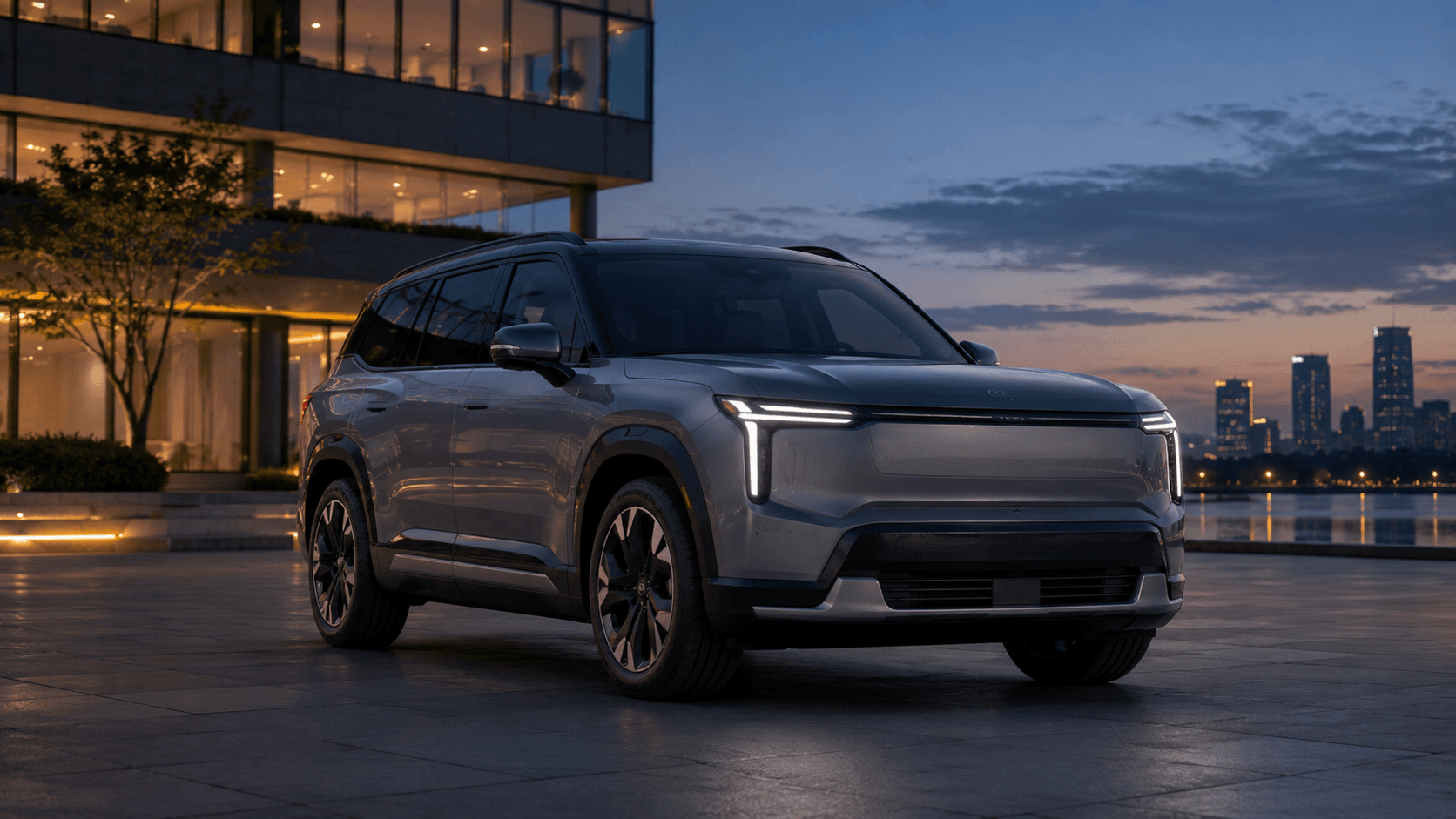
Skoda has unveiled the Peaq, its largest and most advanced electric SUV yet, with a claimed range of up to 647 km, seven-seat practicality and a genuinely premium technology package. Skoda Auto India has confirmed the model is being evaluated for the Indian market. But before anyone starts planning a purchase, here’s the detail that matters most: credible price estimates for an India-spec Peaq currently range from around ₹65 lakh to well over ₹1 crore. That’s a spread of roughly 2x, and the reason for it — not the range figure — is the most useful thing to understand about this car’s India prospects.
What Skoda Actually Revealed
The Peaq is the production evolution of Skoda’s Vision 7S concept, built on the Volkswagen Group’s dedicated MEB electric architecture and measuring over 4.8 metres — making it larger than the Kodiaq and positioning it as the flagship of Skoda’s electric range. Globally it targets the premium full-size electric SUV segment occupied by the Kia EV9, Hyundai Ioniq 9, and Volvo EX90.
Three variants are offered internationally. The entry-level Peaq 60 pairs a 63kWh battery with a single rear-mounted motor producing 204hp for a claimed WLTP range of 459 km and a 0-100kph time of 8.6 seconds. The Peaq 90 steps up to a 91kWh battery with a 286hp rear motor, delivering the headline 647 km claimed range and 7.1 seconds to 100kph. The top Peaq 90x uses the same 91kWh pack with a dual-motor all-wheel-drive setup producing 299hp — quickest at 6.7 seconds, with a slightly reduced 613 km claimed range. Charging is competitive: the 91kWh pack manages 10-80% in a claimed 28 minutes on a 199kW DC charger.
Practicality is a genuine strength. The Peaq is offered in both five- and seven-seat configurations, with 299 litres of luggage space behind the third row expanding to 935 litres with that row folded — claimed to be the largest of any Skoda — plus a 37-litre front compartment. Inside, there’s a 13.6-inch touchscreen, a 10-inch digital driver’s display, a 16-speaker Sonos system, dual wireless chargers, a panoramic sunroof, and USB ports across all three rows. Sensibly, Skoda has retained some physical controls on a split centre console rather than burying everything in the touchscreen. An optional Relax Package adds AGR-certified massaging seats with leg rests and fold-out tables.
Why the India Price Is Genuinely Unknowable Right Now
Skoda India has been clear that the Peaq is under evaluation, not confirmed — and reporting suggests that if it does arrive, it would come via the completely built unit (CBU) import route rather than local assembly. That single detail is what makes the price so hard to pin down, and it’s why published estimates diverge so wildly.
A CBU import lands in India’s steepest duty bracket. According to industry analysts, import duties on a large, expensive, fully-imported electric SUV can add enormously to the landed cost — which is precisely why some outlets estimate around ₹65 lakh while others project ₹1-1.3 crore with a 2027 arrival. Both numbers are defensible depending on what you assume about duty treatment, variant selection, and whether any trade-agreement relief applies. Neither is a forecast you should plan around.
Local assembly, which would sidestep most of that duty burden, is unlikely for a product like this. Data shows that local assembly only becomes economically viable at volumes a flagship electric SUV in this price bracket simply won’t generate in India. So the CBU route — and its duty consequences — is the realistic scenario.
The Trade-Agreement Angle, and an Important Caution
Some coverage has suggested the Peaq could benefit from a future India-EU trade agreement, which would reduce duties on European-built vehicles and improve its pricing. That’s plausible in principle — India’s recently-implemented trade agreement with the UK demonstrated that trade deals genuinely can move luxury vehicle pricing, cutting duties on qualifying imports substantially.
But there’s a critical caveat worth applying here, drawn directly from that UK precedent: electric and hybrid vehicles were excluded from the initial duty reductions for the first five years, with relief only beginning later and on a slower schedule. If an eventual India-EU agreement follows a similar structure — and there’s no guarantee either way — an imported electric SUV like the Peaq might see far less near-term benefit than headlines about trade deals would imply. Anyone assuming a trade agreement will make this car meaningfully affordable soon should treat that as a hopeful scenario rather than a likely one.
Where It Would Sit in India
If the Peaq arrives, it would become Skoda’s most premium electric offering in India by a wide margin and slot into the small but growing three-row premium EV space. Its most direct reference point in the Indian market would be the Kia EV9, which occupies similar territory. The Peaq’s competitive strengths on paper are clear — a strong claimed range at the top of the lineup, genuine seven-seat usability, class-competitive charging speeds, and a well-equipped cabin.
Its challenge is equally clear: research shows that at CBU pricing, it enters a bracket where buyers have access to established luxury marques with deeper service networks and stronger resale precedent in the premium segment. Skoda has been working to build its India presence, but a six-figure-rupee-per-lakh flagship import is a different proposition from the Kushaq and Slavia volume products the brand is better known for here.
What Buyers Should Actually Do
The honest guidance is straightforward. The Peaq is not a purchase decision today — it’s an “evaluated for India” product with no confirmed launch, no confirmed pricing, and reporting pointing to a 2027 arrival at the earliest if it happens at all. There’s no sensible way to plan a purchase around a vehicle whose potential price spans a 2x range.
For anyone genuinely shopping for a three-row electric SUV in India in the near term, the practical move is to evaluate what’s actually on sale or imminently arriving, rather than waiting on an import that may or may not materialise. The Peaq is worth tracking as a signal of Skoda’s premium electric ambitions and as evidence that global manufacturers increasingly consider India for flagship EVs — but treat it as a 2027-at-earliest, low-volume halo product rather than something to hold a budget for.
The Bottom Line
The Skoda Peaq is a genuinely impressive flagship electric SUV: long claimed range, real seven-seat practicality, strong charging, and a premium, thoughtfully-designed cabin. Skoda India confirming it’s under evaluation is meaningful, because it signals the brand’s intent to bring more global products here. But “evaluated” is not “confirmed,” CBU import economics are punishing for a vehicle this size and price, and the trade-agreement relief some are counting on may exclude EVs for years based on recent precedent. Enjoy the specifications; hold the expectations.
FAQs
What is the range of the Skoda Peaq?
The Peaq 90 offers the highest claimed range at 647 km (WLTP) from a 91kWh battery. The Peaq 60 claims 459 km from a 63kWh pack, and the all-wheel-drive Peaq 90x claims 613 km.
Is the Skoda Peaq coming to India?
Skoda Auto India has confirmed the Peaq is being evaluated for the Indian market, but no launch has been officially confirmed or dated. Reporting suggests a CBU import route and a 2027 arrival at the earliest if it proceeds.
How much will the Skoda Peaq cost in India?
There is no official pricing. Published estimates vary widely — from around ₹65 lakh to over ₹1 crore — largely depending on assumptions about import duties, since the model would likely arrive as a fully-imported CBU.
How many seats does the Skoda Peaq have?
It’s offered in both five-seat and seven-seat configurations, with 299 litres of boot space behind the third row, expanding to 935 litres with that row folded.
How fast does the Skoda Peaq charge?
Skoda claims the 91kWh battery charges from 10-80% in about 28 minutes using a 199kW DC fast charger, while the 63kWh pack does the same in about 27 minutes on a 160kW charger.
What does the Skoda Peaq compete against?
Globally it targets the Kia EV9, Hyundai Ioniq 9, and Volvo EX90. In India, the Kia EV9 would be its closest reference point if it launches.