The Centre has reportedly waived roughly ₹2,700 crore in penalties levied on passenger vehicle manufacturers for missing fuel-efficiency targets under CAFE-2, and the automotive industry has treated it as a significant financial reprieve. But the more consequential question isn’t the money — it’s what the waiver does to the credibility of a regulation designed to push India’s carmakers toward cleaner fleets. Experts are genuinely split on this, and both readings have merit. For buyers, meanwhile, the quieter story is how the accompanying rule changes may shape which cars actually get built and priced in India over the next several years.
What CAFE Actually Is (and Why SUV-Heavy Brands Got Caught)
CAFE stands for Corporate Average Fuel Efficiency, and the crucial thing to understand is that it works at the fleet level, not the model level. A manufacturer isn’t judged on whether any individual car meets a fuel-consumption or CO₂ target; it’s judged on the weighted average across everything it sells. That structure is deliberate — it lets a company sell some thirsty, heavy vehicles as long as efficient ones elsewhere in the portfolio pull the average back down. Small petrol cars, hybrids, CNG vehicles, and EVs all help offset large SUVs and premium models.
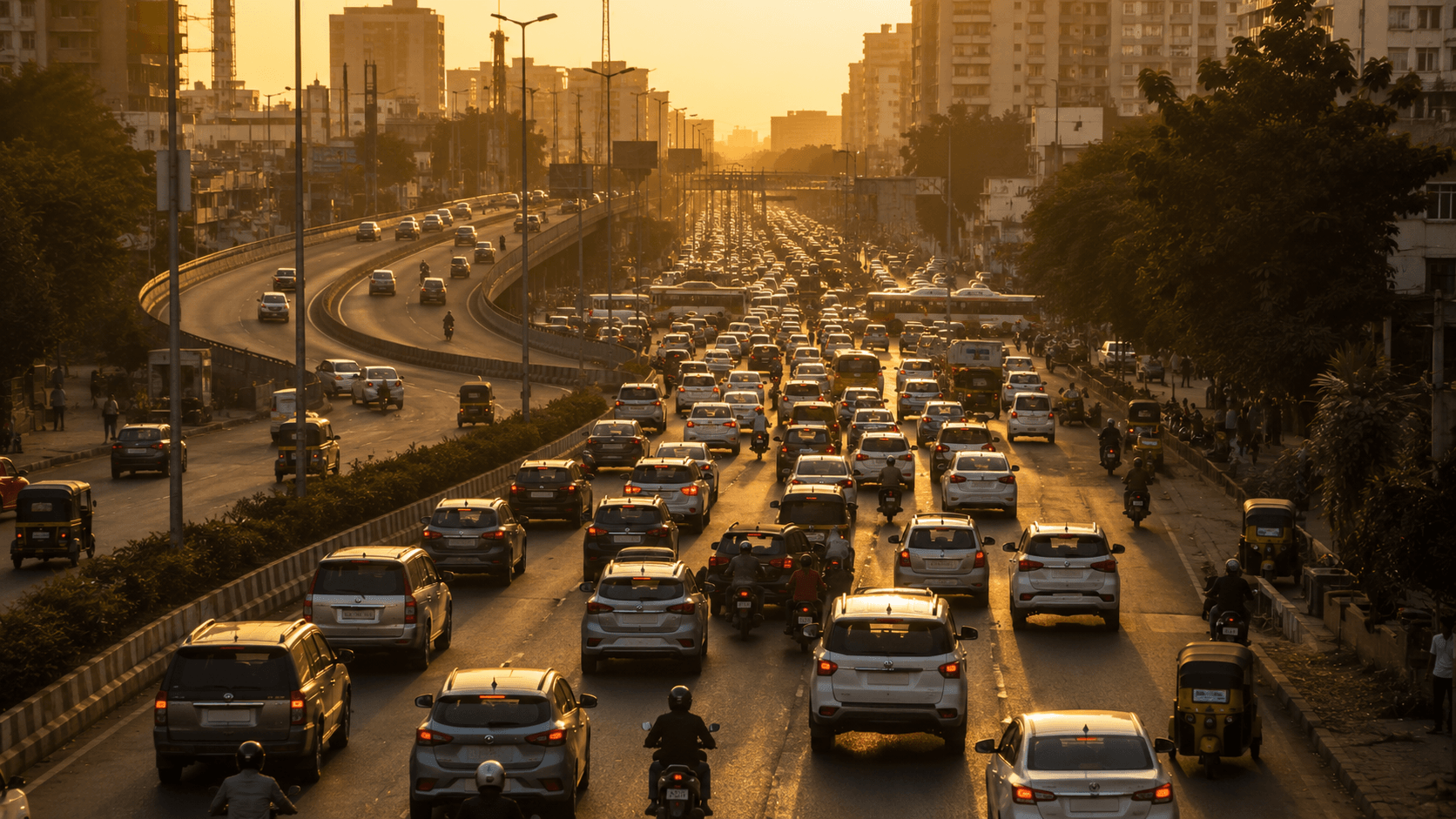
That design explains precisely why several manufacturers ended up non-compliant during the CAFE-2 period. Indian buyers shifted decisively toward SUVs over the past few years, and SUVs are heavier and generally less fuel-efficient than the hatchbacks and small sedans they displaced. At the same time, small-car demand — the very segment that used to drag fleet averages down — slowed considerably. Manufacturers whose sales mix tilted hardest toward SUVs found their fleet averages drifting above target through no single product’s fault. Add the simultaneous cost of BS6 Phase-2 compliance, EV platform development, hybrid technology, safety upgrades, and connected-car features, and the industry was absorbing several expensive mandates at once.
The Numbers, and How They Moved
It’s worth being precise here, because the figures have shifted more than once and reporting varies slightly. The penalties relate to non-compliance across roughly FY23 to FY25. Data shows early estimates put the total liability near ₹7,800 crore across the affected manufacturers. That was subsequently revised down to about ₹2,728 crore covering nine carmakers, following a change in how penalties were calculated — moving from per-vehicle charges scaled to the degree of deviation, to a fixed standard penalty per manufacturer for part of the period. The reported waiver is of roughly that ₹2,700 crore figure. Manufacturers reported to be among the beneficiaries include Hyundai, Kia, and Mahindra.
Alongside the waiver, the government is reportedly establishing a credit-debit registry for each manufacturer, with the Ministry of Power outlining the plan to the Prime Minister’s Office. Under this system, manufacturers can offset efficiency deficits using surplus credits generated within a compliance block period — initially three years. That’s a structural shift: instead of a monetary penalty falling due every reporting cycle, compliance becomes something manufacturers can manage and trade across time, closer to how several global markets operate.
The Case That This Is a Sensible Reset
The argument in favour runs roughly like this. A ₹2,700-crore-plus liability landing on manufacturers already committing enormous capital to electrification, hybrid development, and safety compliance would have hit margins, product planning, and investment allocation at an awkward moment — potentially slowing the very clean-technology investment the norms exist to encourage. If the original penalty calculation was methodologically flawed (and the substantial downward revision from ₹7,800 crore suggests the government itself concluded it was), then correcting it isn’t leniency so much as fixing a miscalculation.
There’s also a forward-looking logic. CAFE-3 is scheduled to follow, bringing a sharper emissions trajectory alongside a more flexible compliance architecture built around credits. Clearing legacy disputes from a contested CAFE-2 calculation before that framework begins lets everyone start the next phase on defensible footing rather than litigating the last one. On this reading, the waiver is a one-time reset accompanying a genuine system upgrade, not a signal that targets are optional.
The Case That This Damages Credibility
The counter-argument is equally serious, and it comes from experts who study this closely. According to policy analysts tracking India’s fuel-efficiency regime, CAFE norms aren’t an accounting exercise — they exist to reduce fuel consumption, cut oil imports, and lower transport emissions, and the penalty is the mechanism that gives the target teeth. If penalties are recalculated, diluted, and then waived, manufacturers may reasonably conclude that future non-compliance is a negotiation rather than a liability. One expert quoted in coverage of the decision argued directly that waiving penalties weakens the effectiveness and credibility of future CAFE norms, and an official familiar with the matter acknowledged a credibility concern exists.
The worry is straightforward: a regulation that has never actually been enforced with financial consequence teaches the regulated party that it need not be feared. That matters most precisely when the next phase is meant to be stricter — because the deterrent effect of CAFE-3 depends partly on manufacturers believing that missing it will genuinely cost them.
Reasonable people land differently on this, and it’s worth being honest that this is a contested policy judgement rather than a question with a clean answer. Whether the waiver reads as pragmatic correction or regulatory capitulation depends heavily on whether the credit-registry system that replaces it is enforced with more rigour than the penalty regime it succeeds.
What This Means for Buyers
Here’s the part most coverage skips, and it’s the part that eventually reaches showrooms. Two structural details deserve attention.
First, CAFE targets remain weight-based, and reporting around the newer norms indicates that smaller cars no longer enjoy the same relative compliance advantage they once did — SUVs are comparatively less disadvantaged than under earlier versions. That’s significant, because fleet-efficiency regulation has historically been one of the forces nudging manufacturers to keep small, efficient cars in their lineups. Weaken that pull, and the commercial logic tilts further toward the SUVs buyers are already choosing, in a market where small-car demand is already soft.
Second, a credit-trading system changes the compliance calculus. Rather than being pushed to make every part of the portfolio more efficient, a manufacturer can concentrate on generating surplus credits in one area — typically EVs and hybrids — and use them to cover heavier vehicles elsewhere. That can be efficient, and it does reward electrification. But it also means fleet-average compliance can be achieved without broad-based efficiency improvement across mainstream petrol and diesel models, which is where the large majority of Indian buyers still shop.
The practical upshot for a car buyer is that neither outcome shows up as a price change tomorrow. But over a product cycle, regulation shapes what manufacturers choose to engineer and sell. A framework that pressures small-car efficiency less, and lets EV credits offset heavier vehicles, points toward a market with more SUVs, more electrified halo products, and comparatively less investment in making ordinary combustion cars meaningfully more efficient.
What to Watch Next
The waiver isn’t the end of this story — the finalisation of CAFE-3 is. The questions worth tracking are whether the credit-debit registry is actually implemented with real enforcement teeth, how strict the CAFE-3 trajectory ends up being once industry consultation concludes, and whether the framework restores some structural advantage to smaller, lighter vehicles or continues to accommodate the market’s SUV tilt. Those decisions will do far more to shape India’s vehicle fleet over the next decade than a one-time waiver of past penalties.
FAQs
What are CAFE norms?
CAFE stands for Corporate Average Fuel Efficiency. The norms require each manufacturer to meet a fleet-level average fuel consumption and CO₂ emission target across everything it sells, rather than requiring every individual model to comply.
How much did the government waive in CAFE-2 penalties?
Reports indicate roughly ₹2,700 crore was waived. The figure had earlier been revised down to about ₹2,728 crore across nine carmakers, from an initial estimate of around ₹7,800 crore, after a change in the penalty calculation method.
Which automakers benefit from the CAFE-2 waiver?
Manufacturers reported to be among the beneficiaries include Hyundai, Kia, and Mahindra, among the nine carmakers covered by the revised penalty assessment.
Why did carmakers miss the CAFE-2 targets?
The Indian market shifted strongly toward heavier, less fuel-efficient SUVs while small-car demand slowed, pushing manufacturers’ fleet averages above target — even as they simultaneously funded BS6 Phase-2, EV, hybrid, and safety investments.
What is the CAFE credit-debit registry?
It’s a proposed system under which each manufacturer’s compliance and non-compliance is tracked, allowing surplus efficiency credits to offset deficits within a compliance block period (initially three years) instead of triggering an immediate monetary penalty each cycle.
When do CAFE-3 norms take effect?
CAFE-2 applies across roughly FY23 to FY27, with CAFE-3 scheduled to follow (reported as FY28-FY32, with some coverage citing application from April 2027). Its final trajectory is still being determined.