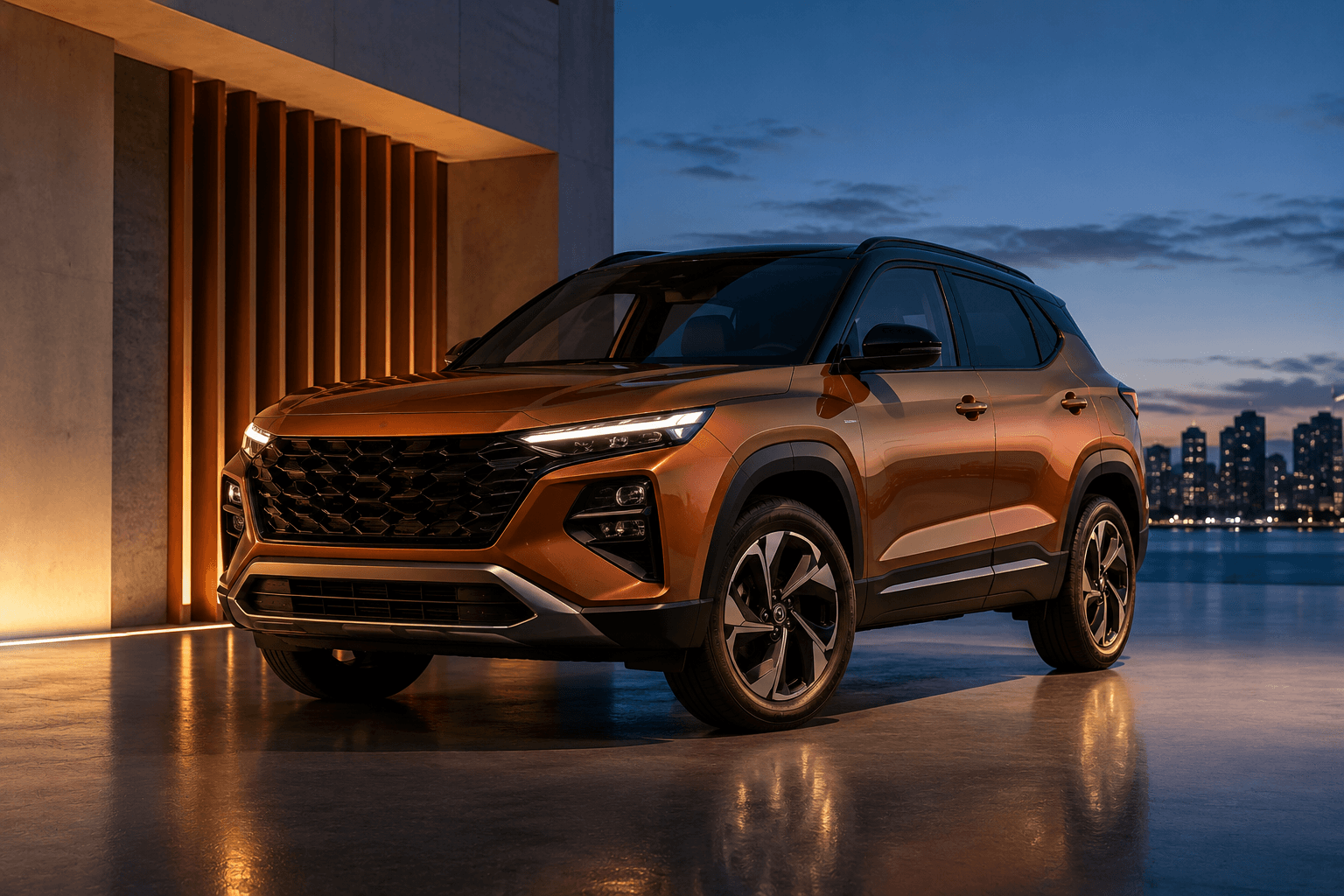
Maruti Suzuki launched the 2026 Brezza on the evening of 24 July 2026 with a headline that reads like a price cut: a starting price of ₹7.40 lakh (ex-showroom Delhi), roughly ₹86,000 lower than the outgoing model’s entry point. It is not a price cut. According to the full 19-variant list Maruti has since put on its official site — spanning ₹7.40 lakh to ₹13.71 lakh — and a far more deliberate pricing strategy emerges: Maruti has widened the bottom of the range with a new turbo-manual base variant, quietly nudged the top automatics upmarket, and engineered the line-up so that anyone who wants a fully loaded manual Brezza must now buy the turbo engine. For India’s best-selling compact SUV nameplate, that is not tinkering. It is a re-architecture of how the Brezza captures buyers.
The short version, stated up front for anyone comparing prices: the 2026 Brezza’s ₹7.40 lakh starting price is lower only because a brand-new 1.0-litre turbo-petrol manual now sits at the base of the range. According to variant-wise comparisons, like-for-like against the outgoing variants that used the same powertrains prices actually shift anywhere from about ₹17,900 cheaper to ₹69,200 more expensive depending on the trim. The number in the headline and the number you pay for the Brezza you actually want are two different things.
What’s genuinely new under the skin
The biggest change is mechanical. Maruti has added its 1.0-litre Boosterjet direct-injection turbo-petrol engine to the Brezza, producing 110hp and 170Nm. That is significant beyond the Brezza itself: direct-injection turbo power has largely been the preserve of pricier or more premium models, and putting it into a mass-market sub-4-metre SUV at a sub-₹8-lakh entry point is Maruti answering a years-old criticism that the Brezza’s 1.5-litre naturally aspirated motor felt lazy on the highway.
The 1.5-litre K15C naturally aspirated petrol continues, and it remains the only way to get an automatic gearbox — a 6-speed torque converter. Every powertrain now pairs with a new 6-speed manual as standard, replacing the old 5-speed unit. The CNG option gets a meaningful upgrade too: an underbody dual-cylinder setup, similar in principle to the arrangement seen on newer Maruti models, which frees up boot space that the old single-tank CNG cars sacrificed.
Cosmetically, the update is light: a redesigned grille with a dark-chrome panel connecting the headlamps, a mildly reworked bumper and faux skid plate, fog lamps repositioned into new triangular housings, fresh dual-tone door cladding and new 16-inch alloy wheels. The L-shaped LED daytime running lamps carry over. Inside, the notable additions are ventilated front seats, an air purifier and a larger 10.1-inch touchscreen replacing the previous 9-inch unit. One cost-saving carries across the whole range regardless of variant: you get only a puncture repair kit, not a spare wheel. The Brezza also carries a 5-star Bharat NCAP rating.
The pricing map: where Maruti moved the goalposts
This is where the strategy lives, and it rewards reading the variant map rather than the headline.
Maruti has effectively divided the manual petrol range into two price bands — a turbo band and a naturally aspirated band — rather than running one continuous ladder. Two variants in particular sit at a psychologically important spot just below ₹10 lakh: the turbo ZXi dual-tone and the VXi CNG. That sub-₹10-lakh line matters in the compact-SUV segment because it is a common mental ceiling for buyers cross-shopping the class, and Maruti has deliberately parked two of its most appealing configurations right underneath it.
At the top, the automatic range — available only with the 1.5-litre engine — begins with the VXi AT at ₹10.61 lakh and climbs to ₹13.71 lakh for the ZXi+ dual-tone automatic. That ceiling is higher than before. So the net effect is a range that has been stretched at both ends: cheaper to get into on paper via the turbo-manual base, but more expensive to fully load, especially in automatic form.
The most consequential structural decision is subtle: a buyer who wants the fully loaded manual Brezza no longer has the naturally aspirated option at the top of the manual ladder — the top manual trims belong to the turbo engine. Maruti has, in effect, used the variant structure to funnel the most engaged, feature-hungry manual buyers toward its new, higher-margin turbo powertrain. That is deliberate product-ladder design, not accident.
The original read: this is a segmentation play, not a discount
Here is the analysis that the variant tables alone don’t spell out. Maruti is doing three things simultaneously, and they only make sense together.
It is democratising turbo to reset the Brezza’s image. By making the ₹7.40 lakh headline a turbo car, Maruti attaches “turbo” to the Brezza’s most-quoted, most-advertised number. Even buyers who ultimately choose the 1.5-litre now perceive the Brezza as a car that offers direct-injection turbo performance — a halo effect achieved through pricing placement rather than through the product most people will actually buy.
It is laddering buyers upward without appearing to raise prices. A lower headline number reduces the psychological barrier to walking into the showroom, while the real margin sits in the mid and upper trims that carry the genuine year-on-year increases of up to ₹69,200. This is classic price anchoring: advertise the floor, monetise the middle.
It is defending a wider slice of the segment at once. With three powertrains — turbo petrol, naturally aspirated petrol and CNG — spread across a ₹7.40-13.71 lakh band, the new Brezza now overlaps performance-minded buyers, conventional family buyers and cost-per-kilometre CNG buyers in a single showroom queue. That breadth is a direct response to a segment where the Tata Nexon, Hyundai Venue, Kia Sonet, Mahindra XUV 3XO, Skoda Kylaq and Kia Syros each attack a different buyer motivation. The Brezza is trying to have an answer for all of them rather than ceding any single sub-segment.
For context on why this matters commercially: sales data shows the Brezza has crossed roughly 14 lakh cumulative sales since it first arrived in 2016, and this is the most substantial update to the second-generation car since 2022. When a nameplate that dependable gets re-priced this deliberately, the pricing itself is a product decision.
Who wins and who loses on the new list
The clear winner is the value-focused enthusiast: getting a direct-injection turbo, a 6-speed manual and updated safety at a sub-₹8-lakh starting point is genuinely strong, provided the base LXi’s equipment is acceptable to you.
The buyer who loses a little is the one who wanted a fully loaded manual on the calmer, cheaper-to-service naturally aspirated engine — that combination has effectively been removed, pushing them to either the turbo (more money, more complexity) or an automatic (more money again).
The CNG buyer largely wins, gaining the underbody twin-cylinder layout and its boot-space benefit, with the VXi CNG landing at that appealing just-under-₹10-lakh mark.
Bottom line
The 2026 Brezza is a better car — turbo option, better gearbox, more features, smarter CNG, strong safety rating. But the ₹7.40 lakh figure doing the rounds is a marketing entry point, not a reflection of what the popular variants now cost. Cross-shop by the specific variant you intend to buy, compare it against the same-powertrain 2025 price and against the Nexon and Venue turbo trims, and treat the headline as what it is: the opening move in a well-designed pricing ladder rather than a discount.
Related reading and sources
- Maruti Suzuki Brezza official price and variant page — for the confirmed, city-wise variant list
- TechJugaad: compact SUV comparisons and Nexon/Venue coverage — internal link placeholder for the cross-shopping context above
FAQs
What is the 2026 Maruti Brezza’s on-road price and starting price?
The 2026 Brezza starts at ₹7.40 lakh (ex-showroom Delhi) for the base 1.0-litre turbo-petrol manual and runs to ₹13.71 lakh for the top ZXi+ dual-tone automatic. On-road prices will be higher after registration, insurance and other charges, and vary by city, so use a city-specific on-road calculator for your exact figure.
Is the 2026 Maruti Brezza cheaper than the old model?
Only at the entry point, and not on a like-for-like basis. The ₹7.40 lakh start is about ₹86,000 lower than before because a new turbo-manual variant now sits at the base. Comparing the same powertrains as the outgoing car, prices actually range from roughly ₹17,900 lower to ₹69,200 higher depending on the variant.
What engine options does the 2026 Brezza get?
Three: a new 1.0-litre Boosterjet direct-injection turbo-petrol making 110hp and 170Nm, the continuing 1.5-litre naturally aspirated petrol, and a factory-fitted S-CNG with a new underbody dual-cylinder tank. All get a new 6-speed manual as standard; only the 1.5-litre petrol offers a 6-speed automatic.
Which 2026 Brezza variant offers the best value?
For most buyers, the turbo variants sitting just below ₹10 lakh — particularly the turbo ZXi dual-tone — hit the strongest balance of performance, features and price. CNG buyers get strong value from the VXi CNG, also just under ₹10 lakh. The right pick depends on whether you prioritise performance, running cost or an automatic gearbox, since the automatic is 1.5-litre only.
Does the 2026 Maruti Brezza have a spare wheel?
No. Across all variants, the 2026 Brezza is supplied with only a puncture repair kit rather than a spare wheel. Buyers who regularly drive long distances or on poor roads should factor in an aftermarket spare or a tyre-protection plan.