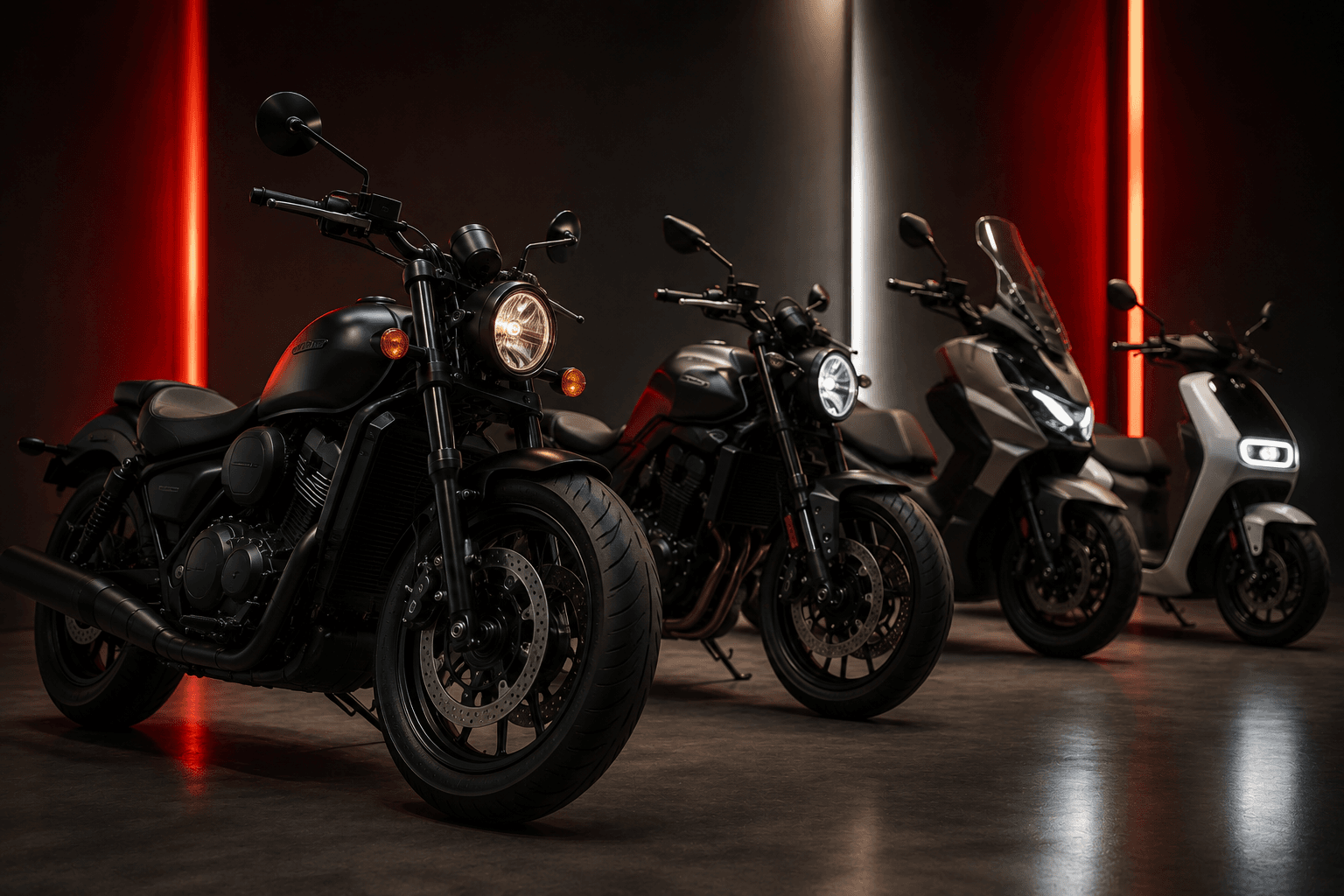
Honda Motorcycle & Scooter India (HMSI) unveiled ten two-wheelers in a single showcase on 24 July 2026 — seven all-new models plus three refreshed CB350 variants — and the headline everyone will repeat is the number. The more important story is what the number is admitting: after a decade of watching Royal Enfield, Bajaj-Triumph, Hero-Harley and TVS build the profitable premium end of the Indian market, Honda has finally decided to fight for it on every front at once. This is not a product launch. It is a statement of strategy, and it comes with one large asterisk.
That asterisk is pricing. HMSI has been explicit that this was an unveiling, not a simultaneous market launch. According to reports from multiple outlets including RushLane and Autopunditz, the ten models will reach showrooms in phases, with prices, launch dates and availability announced closer to each arrival. For a company whose India reputation in the premium space has repeatedly been dented by aspirational products landing at aspirational prices, that silence on cost is the single biggest variable separating this from being a genuine market shift versus another well-received reveal that under-delivers on volume.
What Honda actually showed — and the segments it is finally entering
The seven new models are spread deliberately across body styles Honda has historically under-served in India. Grouping them by intent tells you more than a flat list.
The cruisers: Rebel 300 and Rebel 500
The Rebel twins are the emotional centre of the reveal. The Rebel 300 uses a 286cc liquid-cooled single producing roughly 30bhp in a low-slung bobber stance, while the Rebel 500 steps up to a 471cc parallel-twin making 45.5bhp. Both will be offered in a standard form and in a version fitted with Honda’s automated E-Clutch, which lets a rider shift without operating the clutch lever — a genuinely differentiating piece of tech at this price point in India. This is Honda walking straight into Royal Enfield’s living room. The Meteor 350, the Classic 350 and the 650 twins have owned the accessible-cruiser and mid-capacity retro space almost unchallenged. A liquid-cooled, tech-forward Rebel is a very different proposition from an air-cooled RE, and that difference cuts both ways: it is more modern, but it also risks being priced above the segment’s psychological comfort zone.
The roadster: CB500
The all-new CB500 is arguably the most commercially significant model in the room, precisely because it is the most conventional. A 501cc single-cylinder air-cooled engine with an oil cooler, offered in alloy and spoke-wheel variants, positions it as a heritage-flavoured roadster built in India. If Honda prices it to sit near the Royal Enfield Interceptor 650 rather than above it, the CB500 could do real damage in the 350-650cc retro roadster space that has become the industry’s most fashionable battleground. If it lands as a CKD-priced curiosity, it becomes a halo product with a thin order book. The engineering says mass-market intent; the price will confirm or deny it.
The adventure duo: XR300L and XR300 Rally
The XR300L brings a 293.5cc air-cooled single making 26.9bhp in a lightweight dual-purpose package, with the XR300 Rally building on it with rally fairings and extended-range touring hardware. India’s mid-capacity adventure segment has exploded around the Royal Enfield Himalayan and the KTM/Husqvarna 390 platform. Honda has been conspicuously absent with a true dual-sport at this displacement. The XR300 pair plugs a hole that has existed in the lineup for years.
The scooters: ADV160 and QC3
The ADV160 is a 156.9cc water-cooled “City Adventure” scooter making around 15.8bhp, and it carries the reveal’s most quietly important claim: Honda says it is India’s first flex-fuel scooter, capable of running on ethanol blends up to E85 through its FlexTech system. Given the government’s aggressive ethanol-blending trajectory, being first to a flex-fuel scooter is a policy hedge as much as a product.
The QC3 is Honda’s electric play, and notably its third attempt at an India EV scooter. It packs a 3.0kWh battery, roughly 32 litres of under-seat storage, a Smart Key, and a TFT display with Honda RoadSync connectivity and turn-by-turn navigation, aimed squarely at the family commuter. According to RushLane, one small but telling detail stands out: Honda’s main press release quotes an IDC range of 151km while the QC3’s own product brochure states 145km. A six-kilometre discrepancy on an unlaunched product is a reminder that homologation is not finalised — and a useful signal that “unveiling” here really does mean early.
Completing the ten are the refreshed CB350, CB350C and CB350RS, which get new colour options rather than mechanical changes. They are lineup housekeeping, not news.
The real story: “multi-pathway” is a hedge, not a slogan
Honda framed the reveal around a “multi-pathway” strategy spanning internal combustion, electric and alternative fuels. It is easy to dismiss that as corporate language, but read as strategy it is coherent and, frankly, defensive.
Here is the synthesis that does not appear verbatim in any single source article: Honda is deliberately refusing to place a single bet on how India’s premium and commuter two-wheeler market evolves over the next five years. It does not know whether the profitable growth comes from mid-capacity ICE motorcycles (the RE/Triumph thesis), from flex-fuel scooters riding the ethanol policy wave, or from electric family scooters. So it has funded a product in each lane simultaneously and will let the market — and pricing power — decide which ones scale. A company confident in one pathway concentrates. A company covering ICE, E85 and EV in the same showcase is buying optionality. That is a rational response to genuine uncertainty, but optionality is expensive, and it only pays off if the individual products are priced to actually sell rather than merely to exist.
The timing supports an aggressive read. India’s two-wheeler market is running hot: according to FADA retail data, domestic two-wheeler sales in June 2026 reached roughly 18.5 lakh units, an increase of around 18.6% year on year. Launching a broad premium push into a rising market is textbook. The festive-season window that follows is when Indian two-wheeler buying peaks, and a phased rollout lets Honda meter these launches into that demand rather than dumping ten SKUs at once.
What could go wrong
Three risks deserve honest weighting rather than optimism.
First, pricing. This is the recurring Honda-in-India problem. Products like the CB350 range and past premium experiments have often been well-engineered but positioned a notch above where the volume sits. If the Rebel 500 or CB500 arrive as premium-CKD-flavoured pricing, they become respected niche products, not RE-fighters.
Second, dealer and service reach in the premium segment. Royal Enfield’s moat is not just product; it is service familiarity and community. Honda’s BigWing premium network is still expanding. Selling a 471cc E-Clutch cruiser requires a different showroom experience than selling an Activa.
Third, the EV question. The QC3 is Honda’s third India EV attempt, and the earlier ones did not move the needle. A 3.0kWh family scooter enters a segment where Ather, TVS iQube, Bajaj Chetak and Ola already have scale, brand and charging familiarity. Being late here is not fatal, but it means the QC3 has to win on trust and total cost, not novelty.
Bottom line for buyers
If you are shopping now, nothing here changes your decision this month — prices and dates are unknown, and buying on an unveiling is buying on faith. If you are a mid-capacity motorcycle buyer with a 6-12 month horizon, the Rebel twins, CB500 and XR300 pair are worth waiting to price-check against the Royal Enfield and KTM equivalents before you commit. If you are a scooter buyer, the ADV160’s flex-fuel capability and the QC3’s connected-EV package are both worth watching, but neither is a reason to delay a purchase you need today.
The reveal is genuinely significant: Honda has, on paper, closed several of the biggest gaps in its India two-wheeler lineup in a single afternoon. Whether it becomes a market share story or a showcase story will be decided entirely by the prices Honda has, so far, declined to name.
Related reading and sources
- Honda’s official India two-wheeler range — for confirmed specs and prices as each model launches
- TechJugaad: Royal Enfield and mid-capacity motorcycle coverage — internal link placeholder for the competitive context referenced above
FAQs
How many new bikes did Honda launch in India in July 2026?
Honda did not launch ten bikes — it unveiled them. On 24 July 2026, HMSI revealed ten two-wheelers: seven all-new models (ADV160, CB500, Rebel 300, Rebel 500, XR300L, XR300 Rally and the QC3 electric scooter) plus three refreshed CB350 variants with new colours. Prices and launch dates will be announced in phases closer to each model’s arrival.
What is the Honda QC3 electric scooter’s range?
Honda has cited an IDC-certified range for the QC3 of 151km in its press release and 145km in the product brochure, using a 3.0kWh battery. Charging from 0 to 80% takes about two hours 40 minutes. Because the model is only unveiled and not yet on sale, the final homologated range figure should be treated as provisional until launch.
Is the Honda ADV160 really India’s first flex-fuel scooter?
Honda has positioned the ADV160 as India’s first flex-fuel scooter, saying it can run on ethanol blends up to E85 through its FlexTech system. It uses a 156.9cc water-cooled engine. That capability is as much a bet on India’s rising ethanol-blending policy as it is a performance feature.
Will the Honda Rebel and CB500 compete with Royal Enfield?
Yes, directly. The Rebel 300 and Rebel 500 target Royal Enfield’s cruiser space (Meteor, Classic and the 650 twins), while the CB500 roadster squares up against retro roadsters like the RE Interceptor 650. The competitive outcome will hinge on Honda’s pricing, since RE’s advantage rests heavily on accessible pricing, service reach and community.
When will the new Honda bikes go on sale in India?
Honda has confirmed a phased rollout but has not announced specific launch dates or prices for any of the ten models. Given the market’s festive-season peak in the second half of the year, expect the launches to be metered into that demand window, with each model’s pricing revealed closer to its individual on-sale date.