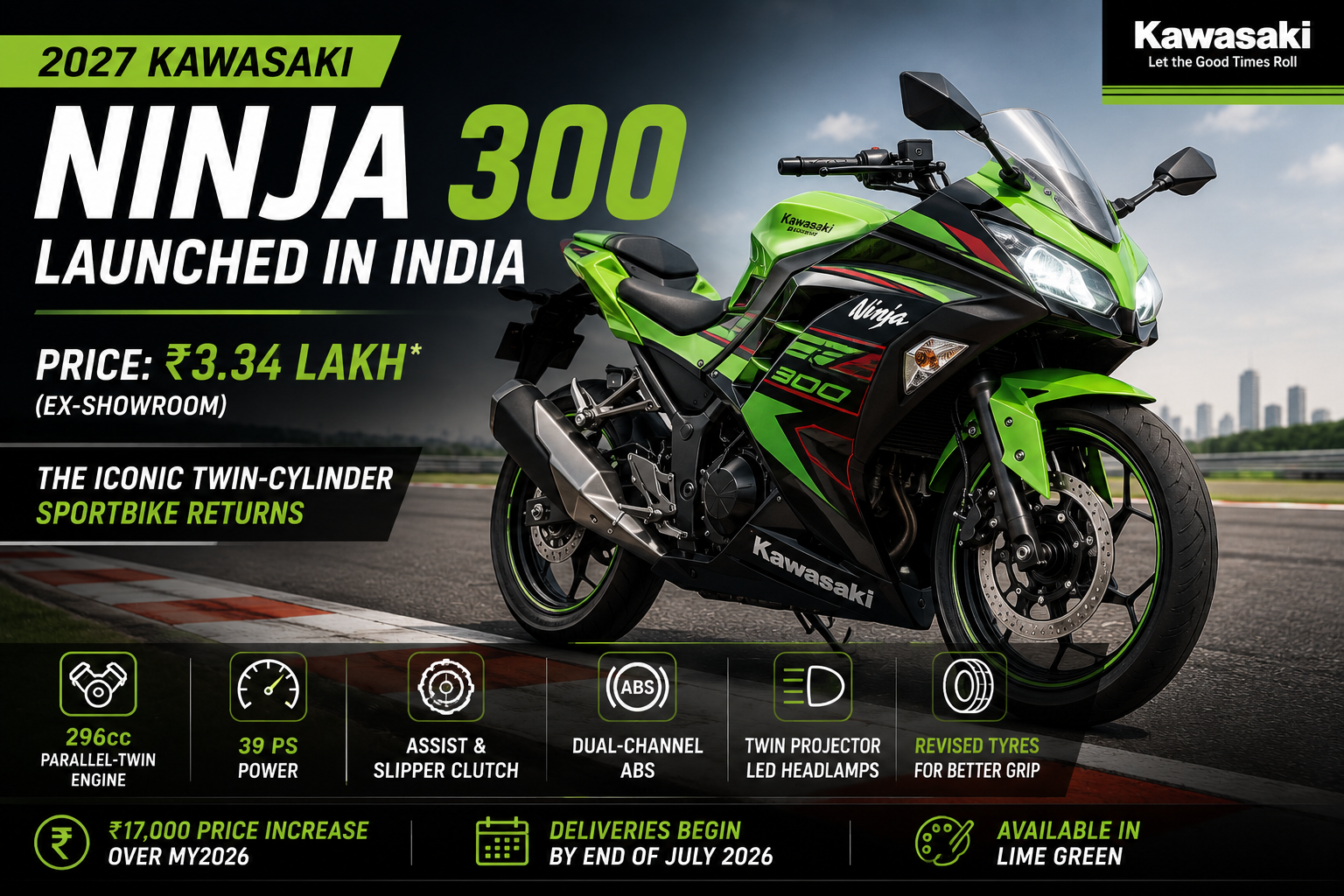
Kawasaki has introduced the 2027 Ninja 300 in India with an ex-showroom price of ₹3.34 lakh, marking another model-year update for one of the country’s longest-running entry-level twin-cylinder sport motorcycles. While the MY2027 model carries a ₹17,000 price increase over its predecessor, the motorcycle remains mechanically unchanged and continues to target riders seeking an affordable multi-cylinder supersport experience.
Although the update is relatively minor, the Ninja 300 continues to occupy a unique position in the Indian market. At a time when many manufacturers are introducing larger-capacity motorcycles or electric alternatives, Kawasaki has chosen to retain the familiar 296cc parallel-twin platform that has earned a loyal following among enthusiasts.
For buyers considering their first twin-cylinder sportbike, the Ninja 300 remains one of the most recognisable names in the segment.
Key Highlights
- 2027 Kawasaki Ninja 300 launched in India
- Priced at ₹3.34 lakh (ex-showroom)
- ₹17,000 more expensive than the MY2026 model
- No engine or mechanical changes
- Continues with the 296cc parallel-twin engine
- Produces 39 PS and 26.1 Nm
- Available in Lime Green
- Deliveries begin by the end of July 2026
A Familiar Formula Returns for Another Model Year
The Ninja 300 has been on sale globally for well over a decade and continues to hold its place as Kawasaki’s accessible twin-cylinder sport motorcycle in India.
Rather than redesigning the motorcycle for 2027, Kawasaki has carried forward the existing platform with minimal revisions. The most noticeable change is the updated pricing, while the motorcycle’s styling, chassis, engine and feature list remain largely identical to the outgoing model.
For many enthusiasts, this continuity is part of the Ninja 300’s appeal.
Its predictable handling, smooth parallel-twin engine and everyday usability have helped it remain relevant despite increasing competition from newer motorcycles.
No Mechanical Changes Under the Fairing
Power continues to come from Kawasaki’s proven 296cc liquid-cooled, parallel-twin, DOHC engine.
The engine produces:
- 39 PS
- 26.1 Nm of torque
- Six-speed gearbox
- Assist and slipper clutch
Unlike many single-cylinder motorcycles in the same price bracket, the Ninja 300’s parallel-twin engine delivers smoother power delivery, refined highway cruising and a distinctive exhaust note that continues to attract enthusiasts.
The assist-and-slipper clutch also reduces clutch effort while helping minimise rear-wheel hop during aggressive downshifts, improving rider confidence during spirited riding.
Chassis and Suspension Continue Unchanged
The MY2027 Ninja 300 retains its well-known chassis package.
Key hardware includes:
- Tubular diamond steel frame
- 37 mm telescopic front forks
- Uni-Trak rear monoshock with preload adjustment
- Front and rear disc brakes
- Dual-channel ABS
- 17-inch alloy wheels
The motorcycle continues to balance sporty handling with everyday ride comfort, making it equally suitable for city commuting and weekend touring.
Although newer rivals offer upside-down forks and more advanced electronics, Kawasaki’s chassis setup remains predictable and approachable for newer riders.
Styling Still Looks Modern
Despite its age, the Ninja 300 continues to wear styling inspired by Kawasaki’s larger Ninja family.
Design highlights include:
- Full aerodynamic fairing
- Twin projector LED headlights
- Floating windscreen
- Split-style seat
- Sporty graphics
- Sharp tail section
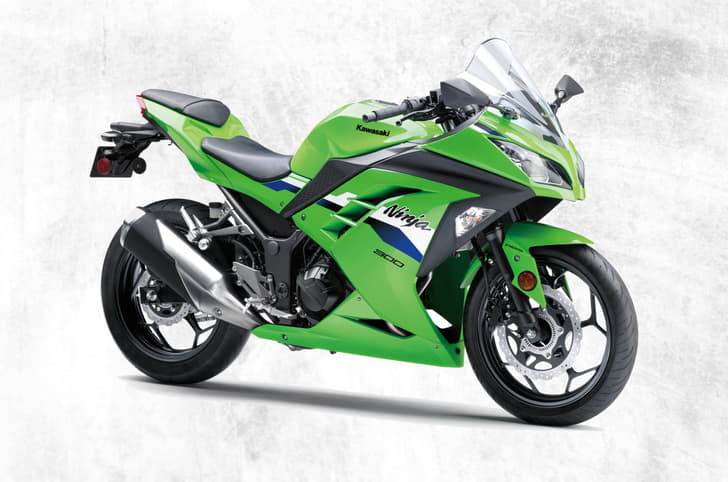
For the 2027 model year, Kawasaki continues offering the motorcycle in its signature Lime Green colour scheme.
The overall design remains instantly recognisable and continues to appeal to riders looking for a traditional fully-faired Japanese sportbike.
Revised Tyres Improve Everyday Confidence
While the motorcycle is mechanically unchanged, Kawasaki has equipped the MY2027 Ninja 300 with revised tyres, intended to provide improved grip and rider confidence in everyday conditions.
Although the company has not positioned this as a major update, better tyre performance can positively influence:
- Cornering confidence
- Wet-weather traction
- Braking stability
- Daily commuting
For riders who regularly use the Ninja 300 on public roads, this subtle change may prove more meaningful than cosmetic updates.
Why the Ninja 300 Still Matters
The Indian motorcycle market has evolved significantly since the Ninja 300 first arrived.
Today, buyers can choose from:
- KTM RC 390
- Yamaha R3
- Aprilia RS 457
- Honda CBR650R
- Kawasaki Ninja 500
Yet the Ninja 300 continues to occupy a niche of its own.
Its combination of:
- Japanese reliability
- Refined twin-cylinder engine
- Comfortable ergonomics
- Proven mechanical package
- Strong resale value
continues to attract enthusiasts who prioritise refinement over outright performance.
Unlike many high-performance single-cylinder motorcycles, the Ninja 300 emphasises smoothness and long-distance usability, making it a compelling option for riders seeking their first multi-cylinder sportbike.
Features Remain Simple but Rider-Focused
Unlike many modern sport motorcycles that are packed with electronic rider aids, the 2027 Kawasaki Ninja 300 continues with a straightforward equipment list.
The motorcycle includes:
- Dual-channel ABS
- Assist and slipper clutch
- Twin projector LED headlamps
- LED tail lamp
- Taller windscreen
- Analogue tachometer with digital LCD display
- Hazard warning switch
Notably absent are features such as:
- Traction control
- Riding modes
- TFT colour display
- Smartphone connectivity
- Quickshifter
While this may seem like a disadvantage on paper, Kawasaki has deliberately retained the Ninja 300’s traditional approach, focusing on mechanical refinement rather than electronic complexity.
Everyday Practicality Still Sets It Apart
One of the reasons the Ninja 300 has remained popular despite its age is its balance between sporty performance and daily usability.
Compared with more aggressive supersport motorcycles, it offers:
- Smooth parallel-twin engine characteristics
- Predictable throttle response
- Comfortable riding position
- Manageable seat height
- Good highway cruising ability
- Proven long-distance reliability
These qualities make it suitable not only for weekend rides but also for everyday commuting and touring.
For riders upgrading from a 150cc–250cc motorcycle, the Ninja 300 provides a relatively friendly introduction to twin-cylinder performance without feeling intimidating.
Is the Price Increase Justified?
The most significant change for the MY2027 model is the revised pricing.
At ₹3.34 lakh (ex-showroom, Delhi), the motorcycle now costs ₹17,000 more than the previous model despite receiving no mechanical or feature upgrades.
Whether this increase is justified depends on buyer priorities.
Reasons to consider the Ninja 300:
- Proven Japanese reliability
- Refined twin-cylinder engine
- Strong resale value
- Comfortable for everyday riding
- Mature and dependable platform
Reasons some buyers may look elsewhere:
- Rivals offer more modern technology
- No TFT display or smartphone connectivity
- Conventional telescopic forks
- No traction control or riding modes
- Premium pricing for an ageing platform
For enthusiasts who value engine refinement over feature lists, the Ninja 300 still holds considerable appeal.
Competition
The Ninja 300 competes in India’s entry-level performance motorcycle segment.
Its primary rivals include:
| Motorcycle | Approx. Price (Ex-showroom) | Key Strength |
|---|---|---|
| KTM RC 390 | ₹3.32 lakh | Higher performance, advanced electronics |
| TVS Apache RR 310 | ₹2.62–2.78 lakh | Rich feature list and value |
| Aprilia RS 457 | Higher price segment | More power and modern chassis |
| Yamaha R3 | Premium pricing | Japanese refinement and twin-cylinder engine |
| Kawasaki Ninja 500 | Higher segment | More performance and newer platform |
While several competitors deliver higher power outputs or more advanced technology, the Ninja 300 distinguishes itself with its smooth parallel-twin engine, predictable handling and long-established reliability.
Who Should Buy the 2027 Ninja 300?
The MY2027 Ninja 300 is best suited for riders who:
- Want their first twin-cylinder sport motorcycle
- Prioritise engine smoothness over electronic features
- Frequently ride on highways
- Value long-term reliability and resale
- Prefer a comfortable fully-faired motorcycle for touring
It may be less suitable for buyers seeking the latest technology or the highest performance per rupee, as newer rivals offer more equipment and stronger performance in similar price brackets.
Expert Analysis
The 2027 Kawasaki Ninja 300 demonstrates Kawasaki’s confidence in a platform that has remained relevant through consistent engineering rather than frequent redesigns.
Although the MY2027 update introduces little beyond a price increase, the motorcycle continues to occupy a niche that few rivals match.
Its 296cc parallel-twin engine remains one of the smoothest in the segment, and its approachable ergonomics make it equally comfortable for commuting, weekend rides and light touring.
That said, the competitive landscape has changed significantly. Motorcycles such as the KTM RC 390, Aprilia RS 457 and Yamaha R3 offer more contemporary features, stronger performance or newer platforms.
Ultimately, the Ninja 300 is no longer the segment’s technology leader—but it remains a dependable choice for riders who value refinement, reliability and the distinctive character of a Japanese twin-cylinder sportbike.
Frequently Asked Questions (FAQ)
What is the price of the 2027 Kawasaki Ninja 300 in India?
The 2027 Kawasaki Ninja 300 is priced at ₹3.34 lakh (ex-showroom, Delhi).
Has the 2027 Ninja 300 received any mechanical updates?
No. Kawasaki has carried forward the existing 296cc parallel-twin engine, chassis and feature set without mechanical changes.
How much power does the Ninja 300 produce?
The liquid-cooled 296cc parallel-twin engine develops 39 PS and 26.1 Nm, paired with a six-speed gearbox and an assist-and-slipper clutch.
Does the 2027 Ninja 300 have traction control?
No. The motorcycle continues with dual-channel ABS but does not offer traction control, riding modes or other electronic rider aids.
Which motorcycles compete with the Ninja 300?
Key rivals include the KTM RC 390, TVS Apache RR 310, Yamaha R3, Aprilia RS 457 and Kawasaki Ninja 500.
Conclusion
The 2027 Kawasaki Ninja 300 is an evolutionary update rather than a revolutionary one.
Despite its ₹17,000 price increase, Kawasaki has chosen to retain the motorcycle’s proven mechanical package, highlighting the company’s confidence in a platform that has earned a loyal following over the years.
The combination of a refined 296cc parallel-twin engine, comfortable ergonomics, assist-and-slipper clutch and dependable handling continues to make the Ninja 300 an attractive option for riders entering the world of multi-cylinder sport motorcycles.
However, the market has become far more competitive. Buyers now have access to motorcycles offering more power, advanced electronics and newer platforms at comparable prices.
For riders who prioritise proven engineering, smooth performance and Japanese reliability over the latest technology, the MY2027 Ninja 300 remains a compelling choice. Those seeking cutting-edge features or maximum performance per rupee may find stronger alternatives elsewhere.