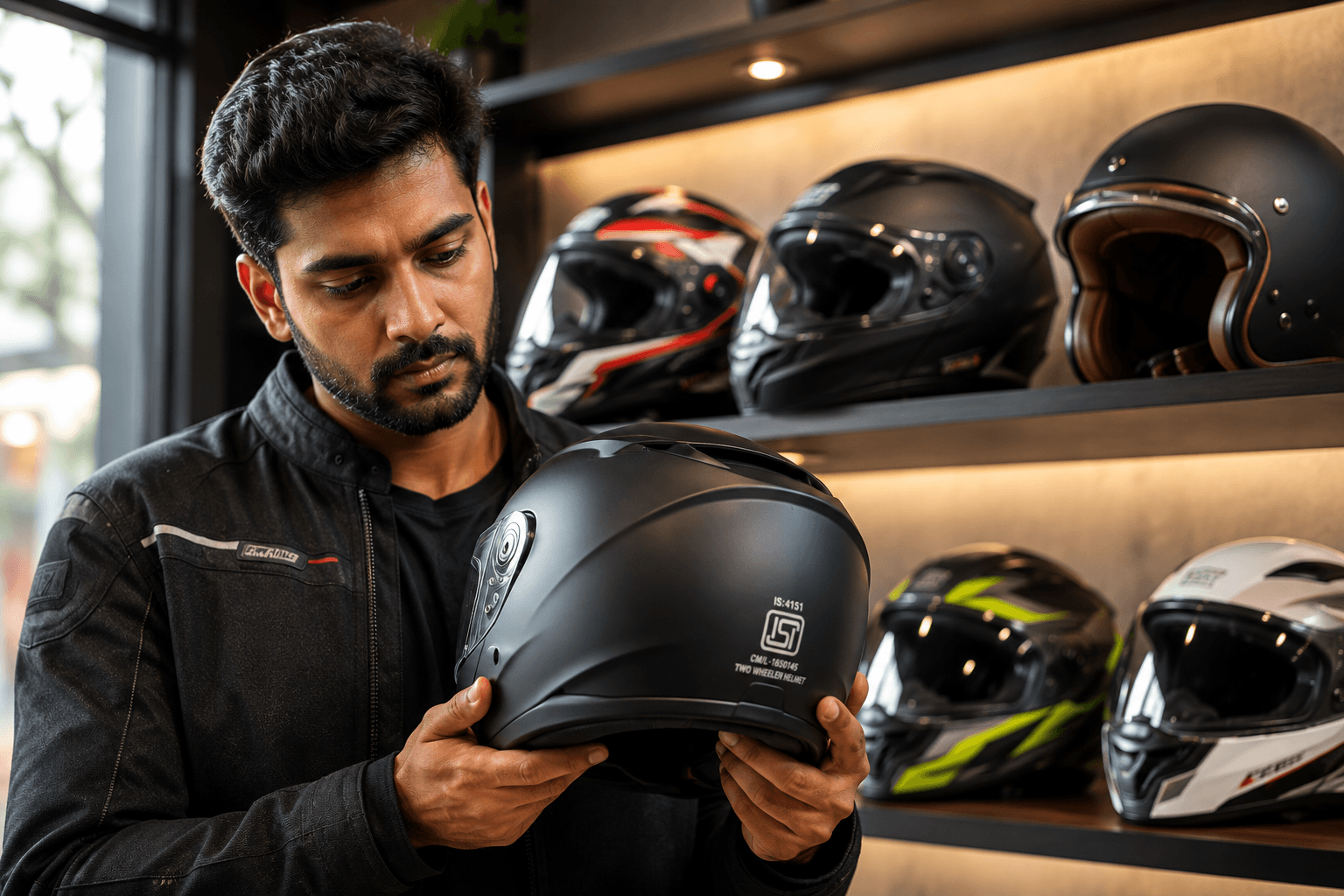
How to Choose a Helmet in India: To choose a helmet in India in 2026, buy an ISI-certified full-face model that meets IS 4151:2015 under the Bureau of Indian Standards (BIS), fits your head circumference measured 2 cm above the eyebrows, sits snug against your cheeks with no side-to-side wobble, weighs under 1.5 kg, ideally carries an ECE 22.06 dual certification if you tour, and costs at least ₹2,500. From 1 January 2026, dealers must supply two BIS-certified helmets – one for the rider, one for the pillion – with every new two-wheeler sold in India. Riding without an ISI helmet attracts a fine of ₹1,000 under Section 194D of the Motor Vehicles Act, 1988.
In this guide
- Why 2026 is different for helmet buyers in India
- What certifications does a helmet need to be legal in India?
- Which helmet type should you buy?
- How to measure your head for the correct helmet size
- How to check helmet fit in the shop — the four tests
- Head shape: round, intermediate oval, long oval
- What material should the helmet shell be made of?
- Which features actually matter — Pinlock, MIPS, sun visor, ventilation, Bluetooth
- How much should you spend on a helmet in India?
- Which helmet brands are worth trusting in India in 2026?
- How to spot a fake ISI helmet
- When should you replace your helmet?
- Buying online vs offline: which is safer?
- Frequently asked questions
- How we tested and researched this guide
- Sources and references
Why 2026 is different for helmet buyers in India
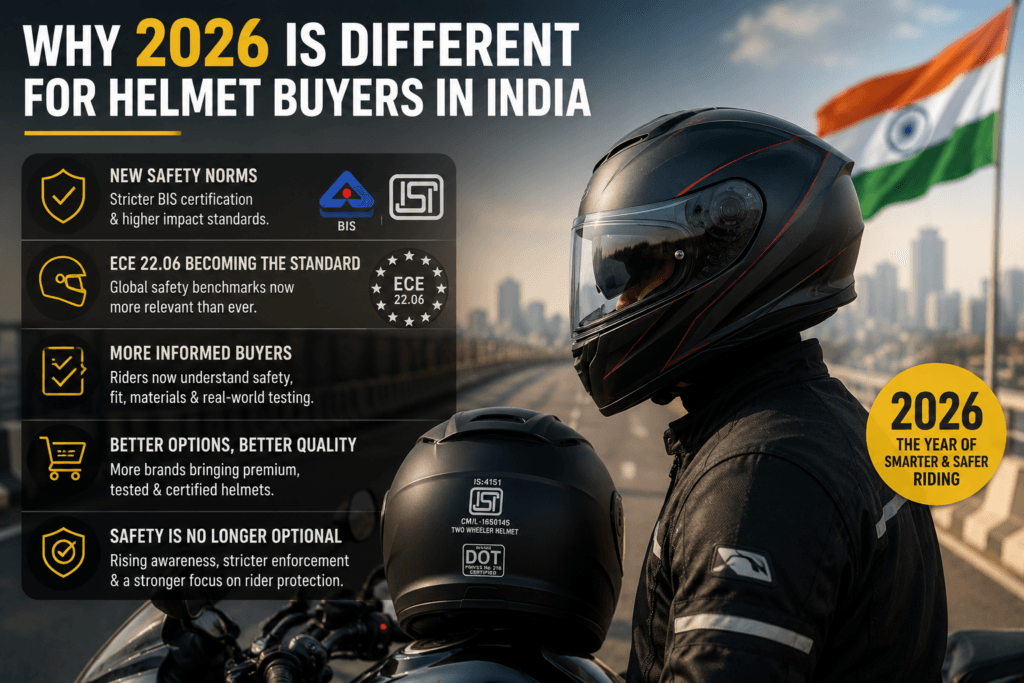
Two things changed the helmet market in India this year.
First, from 1 January 2026, the government made it mandatory for every two-wheeler dealer to include two BIS-certified helmets with the sale of a new motorcycle or scooter — one for the rider and one for the pillion. The rule was notified by the Ministry of Road Transport and Highways in late 2025 and applies pan-India, with non-compliance risking dealer licence action.
Second, enforcement of the 2020 Quality Control Order — which already made it illegal to manufacture, import, sell or use a non-ISI helmet — has sharpened. The Department of Consumer Affairs and BIS have run multiple market seizure drives through 2025 and 2026, and thousands of non-compliant helmets have been pulled off shelves and e-commerce marketplaces.
The buyer’s job is now less about “should I wear a helmet” and more about “am I sure the helmet I’m about to buy is real, correctly certified, and correctly sized.” That is what this guide is built for.
What certifications does a helmet need to be legal in India?
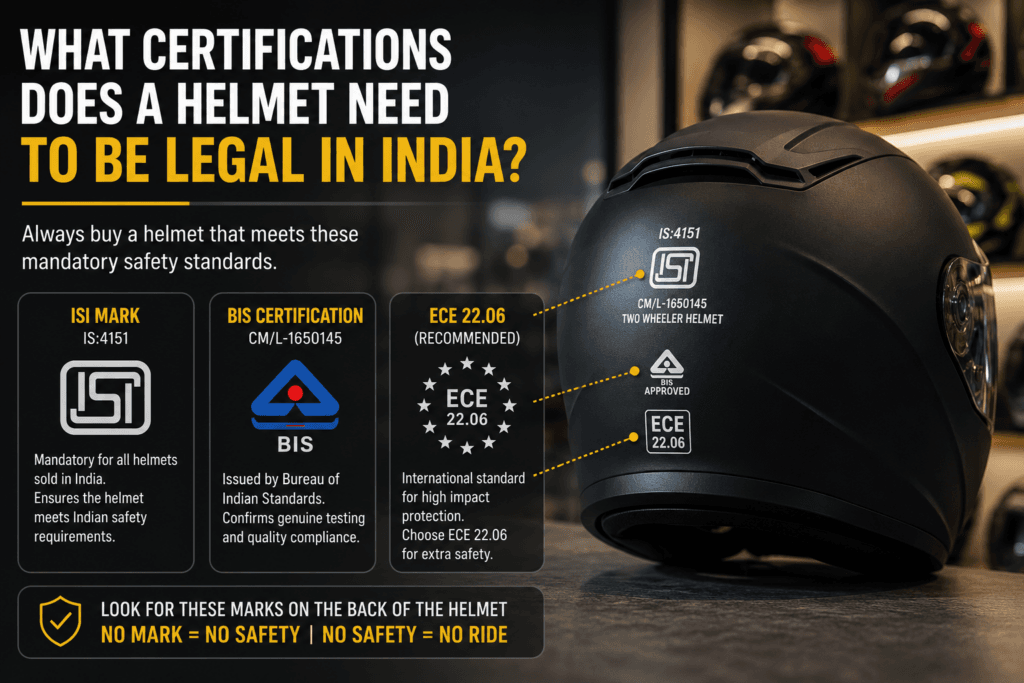
Only an ISI-marked helmet certified against IS 4151:2015 by the Bureau of Indian Standards (BIS) is legal on Indian roads. A DOT-only, ECE-only, or SNELL-only helmet — even if it is a ₹40,000 imported lid — is not road-legal in India unless it also carries the ISI mark. Dual-certified helmets (ISI + ECE 22.06, or ISI + DOT) are legal because the ISI mark is present.
The certifications explained
| Standard | Region | Legal in India? | What it tests |
|---|---|---|---|
| ISI / BIS (IS 4151:2015) | India (mandatory) | Yes — required by law | Impact absorption, penetration resistance, chin-strap retention, shell thickness, flame resistance, visor clarity |
| ECE 22.06 | Europe (2024+ replacement for 22.05) | Only if dual-certified with ISI | Multi-impact linear + rotational testing, chin bar (P) and open-face (J) homologation, visor tests |
| DOT FMVSS 218 | United States | Only if dual-certified with ISI | Impact attenuation, penetration, retention system, peripheral vision |
| SNELL M2020D/R | Voluntary global (racing) | Only if dual-certified with ISI | Highest test loads; multi-hit impact; used in motorsport |
| SHARP | UK (rating, not certification) | Rating, not a legal standard | 5-star crash rating of ECE-certified helmets |
What IS 4151:2015 actually requires
The Indian standard is not weak. It requires the helmet to withstand a drop onto a flat and a hemispherical steel anvil, resist penetration by a striker from a defined height, keep the retention system intact after fatigue testing, and self-extinguish if the shell catches fire. The certified shell is typically 22–25 mm thick, and finished helmet weight is capped at approximately 1.2–1.5 kg depending on size and type.
The Jan 2026 two-helmet rule in one paragraph
Every new two-wheeler sold in India from 1 January 2026 must be delivered with two BIS-certified helmets — one rider, one pillion — as part of the on-road price. The rule sits alongside the earlier mandate that all new two-wheelers, regardless of engine capacity, must be fitted with an Anti-Lock Braking System (ABS). Both are aimed at cutting the roughly 60,000+ two-wheeler fatalities India records every year, of which head injury is the leading cause.
Fines for non-compliance
Riding without a helmet — or wearing an unstrapped helmet — attracts a fine of ₹1,000 under Section 194D of the Motor Vehicles Act, 1988, along with disqualification from holding a driving licence for up to three months. The fine applies equally to the rider and the pillion. State enforcement varies slightly, but the central figure is the anchor.
Which helmet type should you buy?
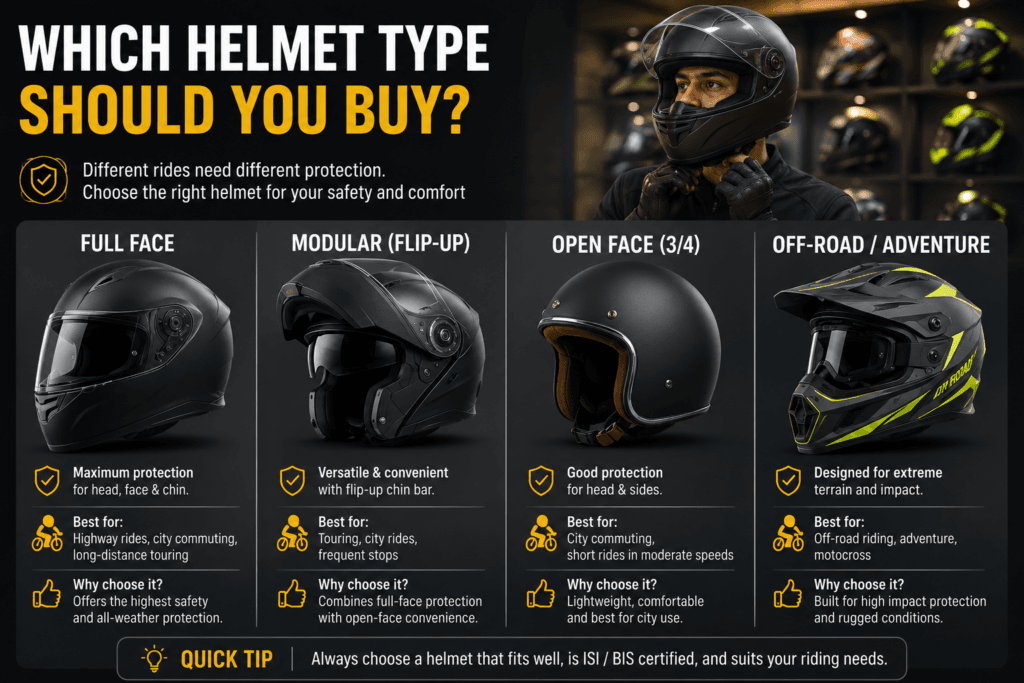
For 90% of Indian riders, a full-face helmet is the correct choice. It offers the highest crash protection, blocks dust and rain, and is the safest option for both city and highway use. Modular (flip-up) helmets suit long-distance tourers; open-face helmets suit low-speed scooter commuters who prioritise ventilation; half helmets are legal only if ISI-certified but offer the least protection.
The six helmet types you will see in Indian stores
| Type | Best for | Protection | Price range | Weight |
|---|---|---|---|---|
| Full-face | Highway, city commute, sport, all-weather | Highest (chin bar covers jaw) | ₹1,500–₹40,000 | 1.2–1.6 kg |
| Modular / Flip-up | Long-distance touring, riders who stop often | High when closed, moderate when flipped | ₹4,000–₹22,000 | 1.5–1.8 kg |
| Open-face / Jet | Low-speed scooter commutes, cruiser aesthetic | Moderate (no chin bar) | ₹1,200–₹6,000 | 0.9–1.3 kg |
| Half / Skull cap | Legally allowed only if ISI-certified — not recommended | Lowest | ₹800–₹3,000 | 0.6–1.0 kg |
| Off-road / Motocross | Dirt, trails, motocross tracks | High for off-road impacts; needs goggles | ₹3,500–₹25,000 | 1.2–1.5 kg |
| Dual-sport / ADV | Adventure touring, Himalaya, Rann, mixed terrain | High; combines full-face with peak visor | ₹6,000–₹45,000 | 1.4–1.7 kg |
How to choose between the top three
- Choose full-face if you ride on any road with traffic above 40 kmph, in monsoon, or on highways. This is the default for most Indian riders.
- Choose modular if you tour, stop frequently for photos, water or tolls, wear glasses, or want the option to talk without removing the helmet. Confirm the model is dual-homologated to both P (chin bar closed) and J (chin bar open) under ECE 22.06 if you plan to ride with it flipped up. Most modulars are meant to be closed while moving.
- Choose open-face only if you ride an under-125cc scooter within a city, at speeds below 50 kmph, and understand you are accepting significantly higher facial injury risk in a crash.
How to measure your head for the correct helmet size
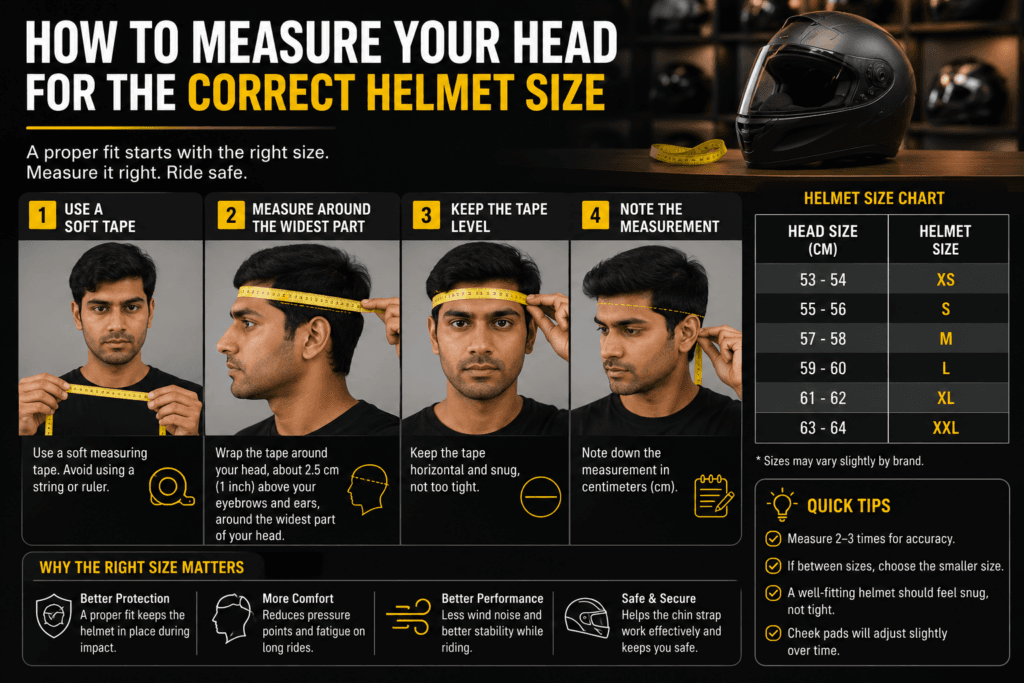
Wrap a soft cloth measuring tape around your head roughly 2 cm above the eyebrows and above the ears — the widest part of your head — and note the circumference in centimetres. Measure three times and take the average. Match this to the specific brand’s size chart, because sizes are not standardised across brands.
Step-by-step (HowTo)
- Use a soft cloth tape measure — a metal tailor’s ruler will not curve correctly.
- Position the tape roughly 2 cm above your eyebrows in front, and just above your ears on the sides — the widest circumference of your skull.
- Pull the tape snug but not tight.
- Record the measurement in centimetres.
- Repeat twice more and take the average.
- Cross-check against the specific brand’s size chart — an M in Studds is not the same fit as an M in AGV.
Indicative adult helmet size chart (India)
| Size | Head circumference (cm) | Head circumference (inches) |
|---|---|---|
| XS | 53–54 | 20.9–21.3 |
| S | 55–56 | 21.7–22.0 |
| M | 57–58 | 22.4–22.8 |
| L | 59–60 | 23.2–23.6 |
| XL | 61–62 | 24.0–24.4 |
| XXL | 63–64 | 24.8–25.2 |
If your measurement lands between two sizes, size down — not up. The EPS liner and cheek pads will compress by roughly 5–10% within the first 15–20 hours of use. A helmet that is slightly loose on day one will be dangerously loose in a month.
How to check helmet fit in the shop — the four tests
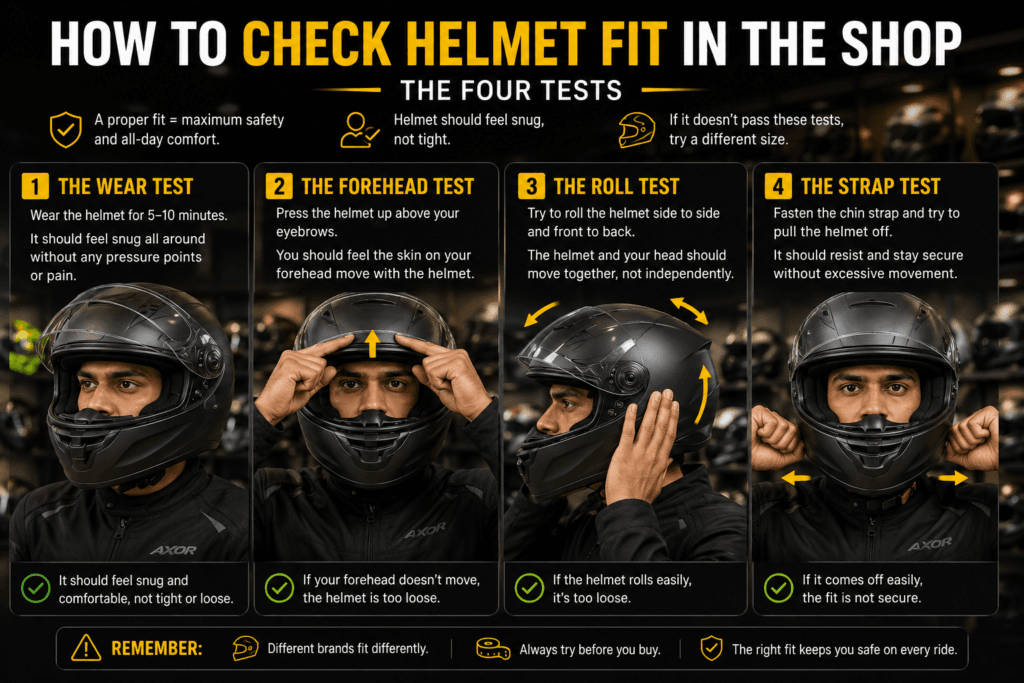
A correctly fitted helmet touches your forehead, cheeks and back of the head with even pressure, does not rotate when you shake your head, does not slide off when you push it up from the rear rim, and lets you fit only two fingers between the strap and your throat when buckled.
The four in-store tests (HowTo)
- The wear test. Pull the helmet on with the chin bar (or opening) spread apart using both hands. It should take a small effort to slide it onto your head. If it slides on effortlessly, it is too large.
- The forehead test. Look up at the ceiling. The brow pad should sit against your forehead with light, even pressure. No gap, no pinch. A gap means the shell is too big or the wrong shape for your head.
- The roll test. With the chin strap buckled tight, grip the chin bar (or front rim) and try to roll the helmet forward off your head. If it comes off, the helmet is too big. If it rotates but does not come off, the fit is borderline. If it stays put, the fit is correct.
- The strap test. With the strap buckled, you should be able to slide only two fingers, stacked flat, between the strap and your throat. Anything more is too loose.
Wear the helmet for a minimum of 15 minutes in the shop before you buy. Pressure points that feel neutral for two minutes can turn into a headache after fifteen. That is the signal the shell shape is wrong for your head — not the size.
Head shape: round, intermediate oval, long oval
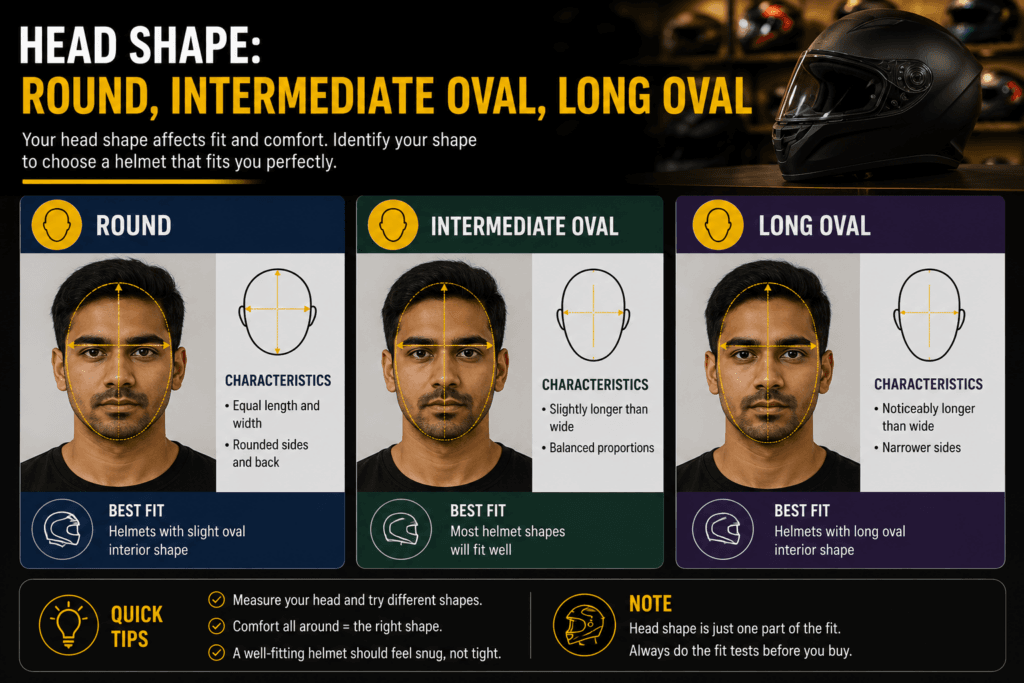
Head shape matters as much as head size. Two people with the same 58 cm circumference may need different helmet models because their heads are shaped differently. Most Indian riders have an intermediate oval or round head shape.
The three broad head shapes:
- Round oval — front-to-back and side-to-side measurements are nearly identical. A round-oval head in an intermediate-oval helmet feels tight at the temples.
- Intermediate oval — slightly longer front-to-back than side-to-side. This is the most common shape and what most mid-market Indian helmets are moulded for.
- Long oval — noticeably longer front-to-back than side-to-side. A long-oval head in a round-oval helmet feels tight at the forehead and back.
Ask your dealer which shape a specific helmet is designed for. Premium brands (AGV, Shoei, Arai, Bell, HJC) publish their shell shape openly. Most Indian brands mould to intermediate oval by default.
What material should the helmet shell be made of?
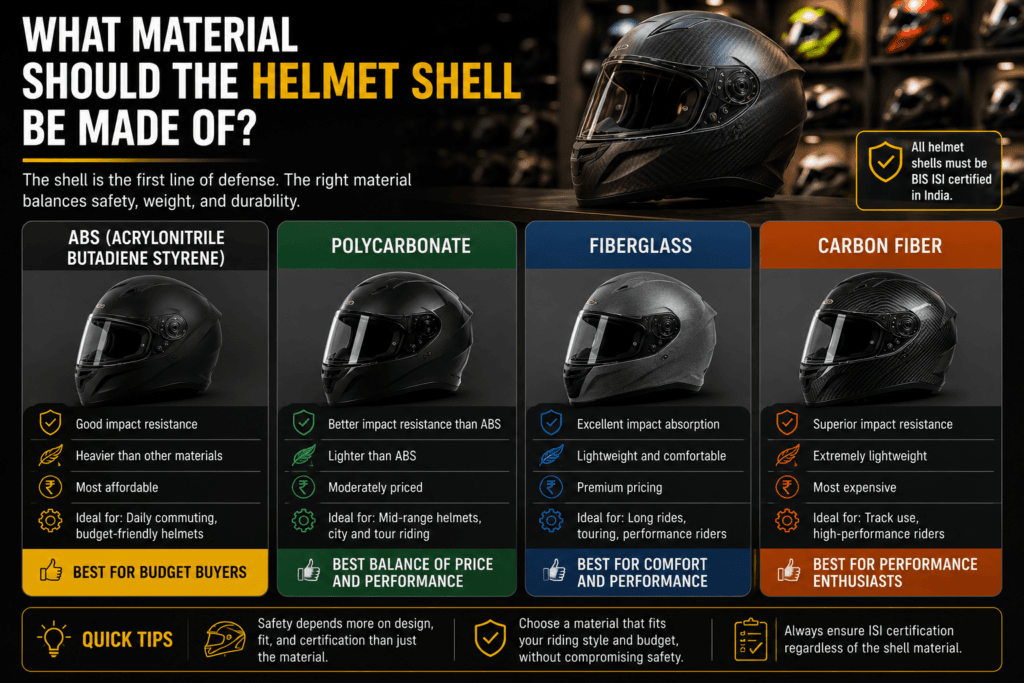
In 2026, ABS and polycarbonate are the standard shell materials for Indian helmets under ₹8,000. Fiberglass composite starts around ₹8,000–₹15,000. Carbon fibre appears above ₹15,000 and shaves 200–400 g off the weight. All four materials, when ISI-certified, pass the same IS 4151:2015 impact tests.
The four shell materials, compared
| Material | Weight | Strength-to-weight | Price segment | What it feels like |
|---|---|---|---|---|
| ABS (Acrylonitrile Butadiene Styrene) | Heaviest | Adequate | Entry (₹1,500–4,000) | Solid, dense, workhorse plastic |
| Polycarbonate / Kinetic Polymer Alloy | Medium | Good | Mid (₹3,000–10,000) | Lighter than ABS, flexes marginally more |
| Fiberglass composite (multi-layer) | Light | Excellent | Premium (₹8,000–20,000) | Rigid, cracks progressively to absorb energy |
| Carbon fibre | Lightest | Highest | Flagship (₹18,000–45,000+) | Feather-light, tightly grained finish |
What actually matters inside the helmet
The shell distributes impact energy across a larger area. The EPS (Expanded Polystyrene) liner underneath the shell absorbs that energy by crushing on impact — this is what actually protects your brain. A better shell means a lighter helmet at the same protection level. It does not mean the helmet is more protective than a cheaper certified one against a single crash.
The comfort padding (the fabric-covered foam you feel against your face and scalp) is separate from the EPS and does not provide crash protection. It only positions your head and manages sweat.
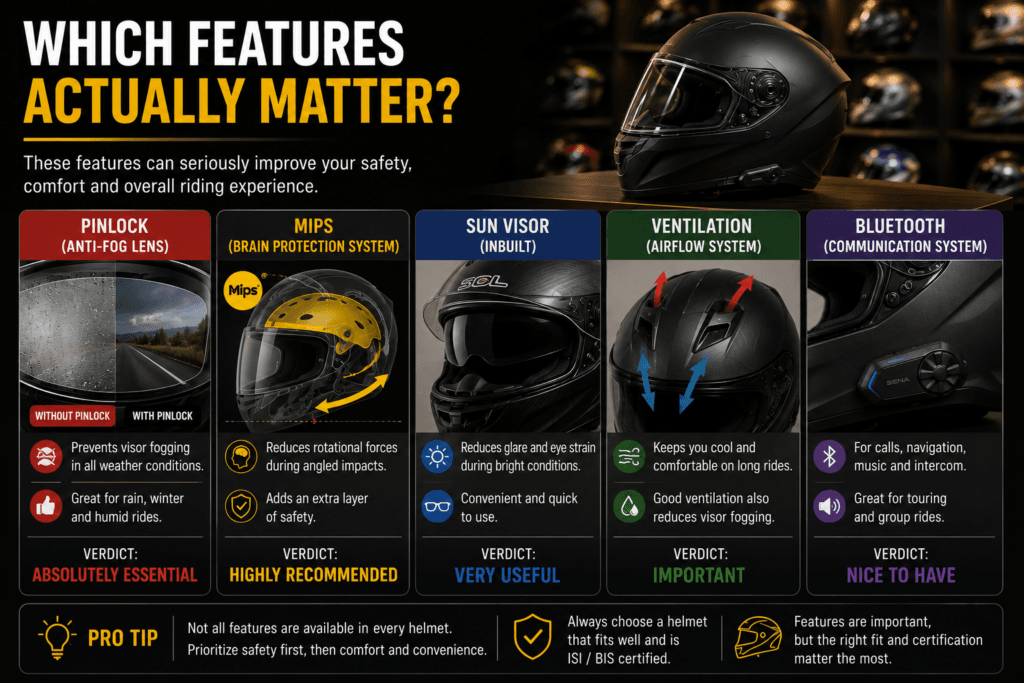
Which features actually matter — Pinlock, MIPS, sun visor, ventilation, Bluetooth?
The features that matter most in Indian conditions are a Pinlock-ready visor for monsoon defogging, an internal drop-down sun visor for daytime glare, and a well-designed vent system that flows air even at 30 kmph. Bluetooth integration is convenient but should never come at the cost of certification or fit. MIPS is a proven rotational-impact technology but is still uncommon in motorcycle helmets sold in India in 2026.
Feature-by-feature reality check
- Pinlock anti-fog insert. A secondary lens that clips onto the inside of the visor and creates a sealed air layer, preventing fog. Essential for monsoon and early-morning winter rides. Look for the term “Pinlock-ready” or “Pinlock-prepared” — the insert may come bundled or cost ₹800–₹1,500 extra.
- Internal drop-down sun visor. A tinted secondary visor that drops from inside the shell. Replaces the need for sunglasses, adjusts in a second, and works with prescription glasses underneath. Non-negotiable for Indian summer commutes.
- Ventilation. More vents is not automatically better — airflow channel design matters. Look for at least one chin vent, two forehead vents, and rear exhaust vents. Test them by opening and closing while wearing the helmet; you should feel the difference.
- Weight. Under 1.5 kg for a full-face is comfortable for long rides. Above 1.7 kg starts to fatigue the neck.
- Chin strap buckle. Micrometric ratchet buckles are faster and easier for daily use. Double-D ring straps are marginally more secure and are required for track use. Both are safe when correctly used.
- Bluetooth. Built-in Bluetooth 5.2/5.3 helmets from HeadFox, Steelbird, Vega Cruze Pro and others offer calls, music, GPS prompts and rider-to-rider intercom, typically with 12–48 hour battery life. Prefer add-on units (Cardo, Sena) if you plan to switch helmets, or built-in if you want a clean single-purchase solution. Verify the base helmet is ISI-certified before caring about the electronics.
- MIPS (Multi-directional Impact Protection System). A low-friction liner inside the shell that lets the head rotate ~10–15 mm during an angled impact, reducing rotational brain injury risk. Widely adopted in cycling helmets and premium motorcycle helmets in Europe and the US. In India, MIPS motorcycle helmets are largely limited to imported flagships. Nice to have if the budget allows, not a legal or common requirement.
- Photochromic (auto-tinting) visors and integrated LED brake lights. Emerging in the ₹8,000+ smart-helmet segment. Genuinely useful, but treat them as extras — not selection criteria.
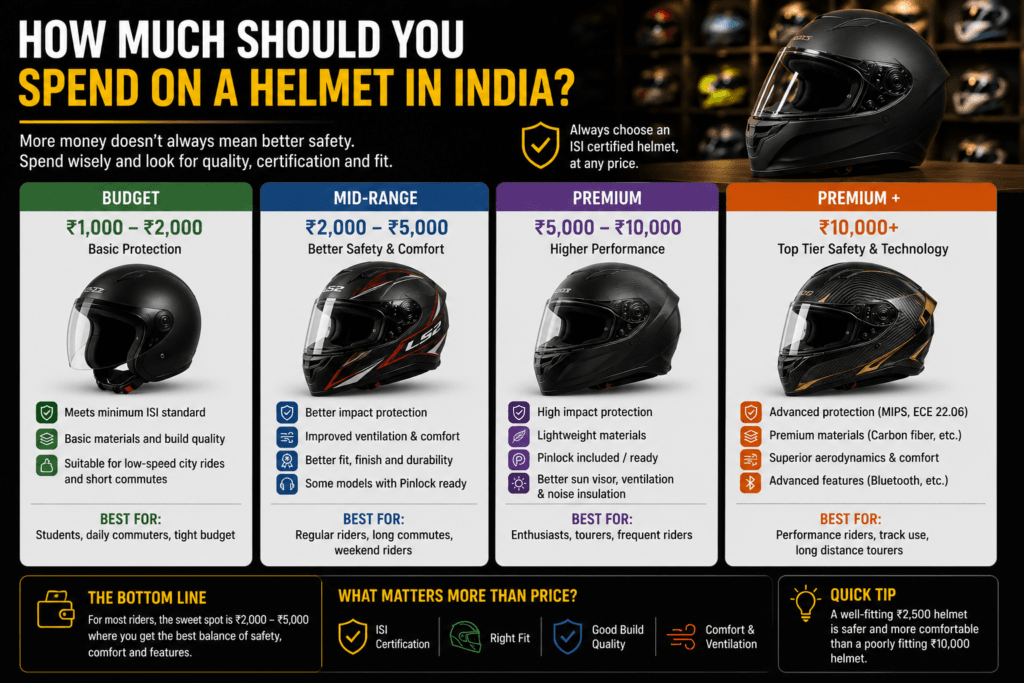
How much should you spend on a helmet in India?
A safe, certified, comfortable full-face helmet in India starts at around ₹2,500 in 2026. Below ₹1,500, you are almost certainly buying a compromised or counterfeit product. Between ₹3,000 and ₹8,000 is the sweet spot for daily commuters. Above ₹15,000, you are paying for lower weight, better ventilation, quieter cabins and premium materials.
Price-tier decode
| Budget | What you get | Who it suits |
|---|---|---|
| Under ₹1,500 | Barely-legal ISI helmet, heavy ABS shell, poor visor, basic strap. Fake-ISI risk is high in this range. | Avoid. |
| ₹1,500–₹3,000 | Genuine ISI-certified full-face, ABS or polycarbonate shell, functional ventilation, plain visor. | Occasional short-distance riders. |
| ₹3,000–₹6,000 | Sweet spot: better fit, drop-down sun visor, Pinlock-ready on many models, quieter, lighter. | Daily commuters, most Indian riders. |
| ₹6,000–₹12,000 | Improved comfort padding, refined ventilation, dual certification (ISI + ECE), lighter shell, quality visor mechanism. | Weekend riders, tourers, sport commuters. |
| ₹12,000–₹25,000 | Fibreglass or composite shell, premium Pinlock included, refined aerodynamics, top-tier interiors. | Regular tourers, sport-riding enthusiasts. |
| Above ₹25,000 | Carbon fibre or hand-laid composite shell, race-grade construction, race homologation, lowest weight. | Track riders, serious long-distance tourers, discerning buyers. |
The single biggest jump in real-world quality happens between ₹1,500 and ₹4,000. The gains between ₹15,000 and ₹40,000 are meaningful but incremental — mostly weight, noise, and refinement, not fundamentally more crash protection.
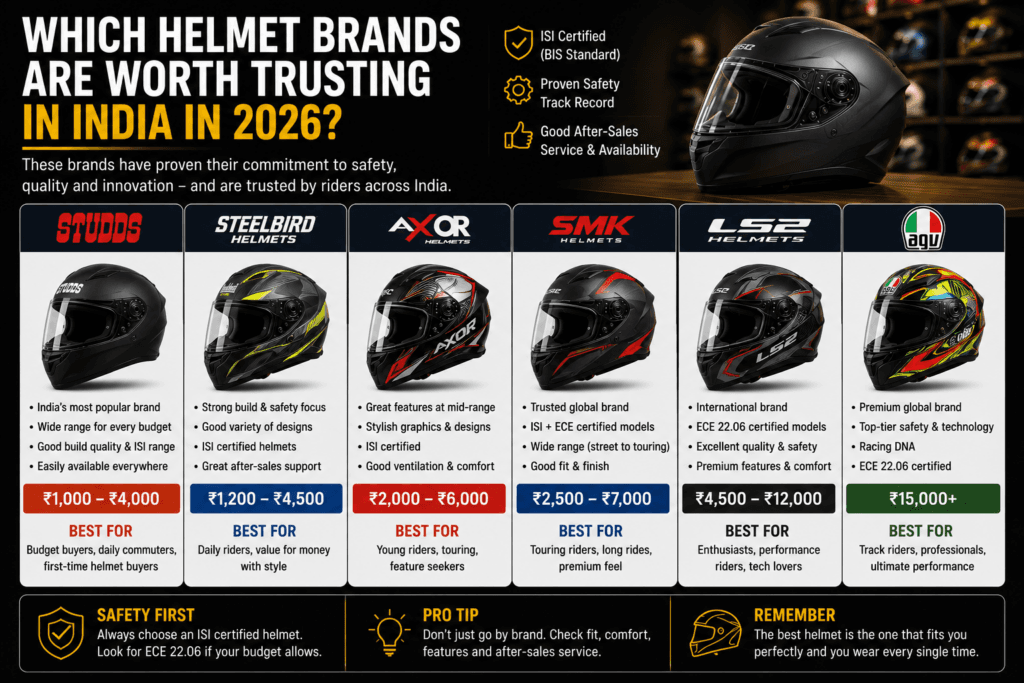
Which helmet brands are worth trusting in India in 2026?
The Indian helmet market in 2026 splits cleanly into three tiers: mainstream Indian brands (Studds, Steelbird, Vega, SMK, Axor, Ignyte) that dominate the sub-₹8,000 segment; mid-premium global brands (LS2, MT Helmets, HJC) in the ₹6,000–₹25,000 band; and flagship globals (AGV, Shoei, Arai, Bell, SHARK) above ₹25,000.
Indian brands — mainstream, ISI-certified, widely available
- Studds — the largest Indian helmet brand by volume, with the widest distribution and consistent ISI compliance. Models like the Chrome Elite, Ninja and Thunder are staples of the sub-₹3,000 full-face segment.
- Steelbird — offers Steelbird, Steelbird Air, Ares and Ignyte sub-brands. Popular for aggressive graphics, dual-visor SBA and SBH series, and mid-priced Bluetooth-integrated models.
- Vega — a Karnataka-based veteran, especially strong in open-face and mid-range full-face; the Cruze Pro is a DOT + ISI dual-certified option with Bluetooth.
- SMK — a premium sub-brand under Studds, sold in 38+ countries. Pinlock anti-fog, in-helmet sun shades, and European design cues at Indian prices.
- Axor — mid-premium Indian brand known for lightweight fibreglass composite full-face helmets with strong graphics and ECE-style aesthetics.
- Ignyte — Steelbird’s premium sub-brand, offers ISI + ECE dual-certified models at competitive prices; a strong choice in the ₹4,000–₹8,000 range.
Global brands — mid-premium, imported or assembled in India
- LS2 — arguably the best value-for-money in the imported segment. Kinetic Polymer Alloy shells, Pinlock-ready visors, ECE 22.06 certification, and prices from ₹6,000 to ₹25,000. FF800 Storm and Vector II are popular touring models.
- MT Helmets — Spanish brand delivering ECE-certified helmets in the ₹5,000–₹15,000 range. Well-regarded ventilation.
- HJC — Korean giant, one of the world’s largest helmet manufacturers, dominates independent ventilation tests. The RPHA series is a common touring choice.
- Tiivra — Indian premium brand offering composite and carbon options at 25–40% below imported flagship prices.
Global flagships — premium and race
- AGV — Italian brand favoured by MotoGP racers. Pista GP RR and K6 S are the marquee models. Priced from ₹35,000 to ₹1,20,000+.
- Shoei — Japanese benchmark for build quality, quietness and finish. GT-Air II and X-15 are the touring and sport picks.
- Arai — Japanese hand-built helmets with the strongest reputation for consistent shell integrity. Long history in racing.
- Bell — American brand with strong retro and off-road ranges. Bullitt and Moto-9 are recognisable choices.
- SHARK — French brand strong in noise reduction and touring.
None of the flagship globals is road-legal in India on their own — they must carry an ISI mark alongside their home certification. Ask specifically before you buy.
Buying strategy by segment
- Daily city commuter, budget < ₹4,000: Studds, Steelbird, Vega.
- Weekend rider / touring commuter, ₹4,000–₹10,000: SMK, Axor, Ignyte, LS2, MT.
- Serious tourer, ₹10,000–₹25,000: LS2, MT, HJC, SMK Typhoon.
- Track, sport, flagship touring, ₹25,000+: AGV, Shoei, Arai, Bell, SHARK.
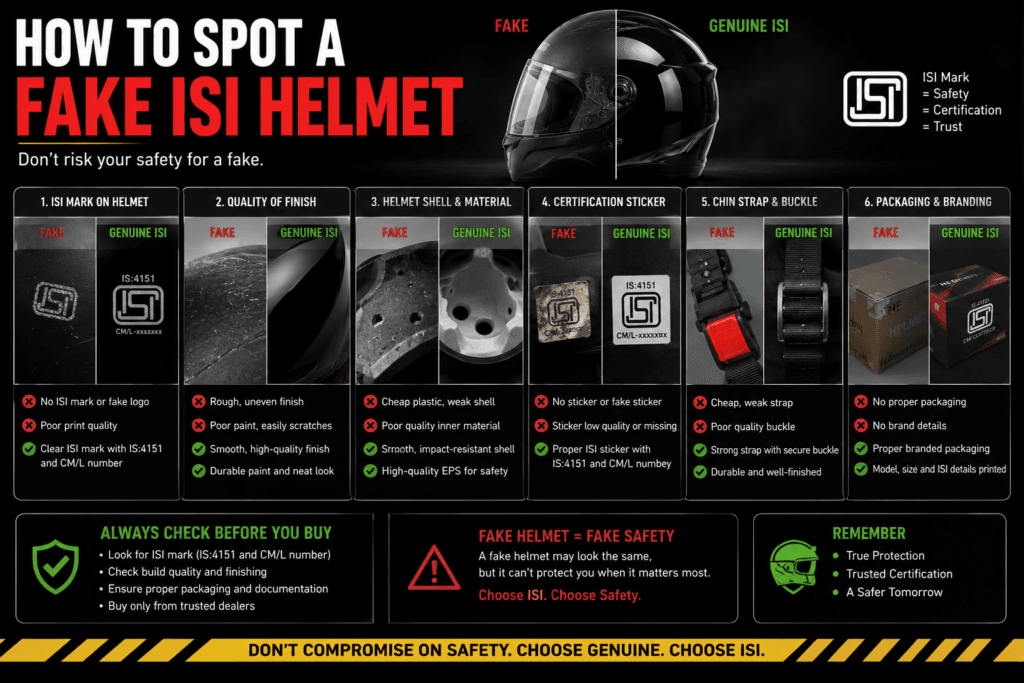
How to spot a fake ISI helmet
A genuine ISI-certified helmet carries an embossed (not stickered) ISI mark, a printed BIS licence number (CM/L format), a legible IS 4151:2015 marking, and can be verified by entering the licence number in the free BIS Care app or on bis.gov.in. If any of these are missing, or the ISI mark is a peel-off sticker, the helmet is a fake.
The five checks (HowTo)
- The ISI mark should be embossed or moulded into the rear of the helmet or on the retention strap tag — not a peel-off sticker. Real ISI markings are permanent.
- A BIS licence number (format: CM/L-1234567) must be printed near the mark. Every genuine helmet carries a unique one.
- The words “IS 4151:2015” should appear near the mark. This is the standard the helmet is certified against.
- Verify the licence number using the BIS Care app (Android and iOS, free, published by the Bureau of Indian Standards) or by searching the number at bis.gov.in. A valid, active licence will show the manufacturer’s name and product details.
- Inspect physical build. The strap should be evenly stitched, the buckle should click firmly, the shell should have no visible seams or resin bleed, the EPS liner should be uniform, and the total weight should feel substantial — not featherlight in a suspicious way.
Fakes are most common on roadside stalls and unbranded e-commerce listings under ₹500–₹1,000. Buy from authorised retailers or the brand’s own online store.
When should you replace your helmet?
Replace a motorcycle helmet every 3–5 years from date of first use, or immediately after any crash, drop from more than one metre, or visible shell damage — even if no external damage is obvious. The EPS liner degrades from UV exposure, heat, sweat and vibration long before the shell cracks.
Additional triggers that warrant replacement:
- The interior padding no longer holds the helmet snug (the roll test now fails).
- The visor mechanism is loose or the seal has hardened.
- The strap fabric shows fraying or the buckle is inconsistent.
- The helmet has been left in direct sunlight or in a hot car boot for extended periods across seasons.
The 3–5 year benchmark comes from the fact that EPS foam hardens slowly and stops absorbing impact energy as designed. Manufacturers stamp a date-of-production sticker inside most helmets — track from that date if the helmet was shelved before purchase.
Buying online vs offline: which is safer?
Both channels can be safe — the risk is not the channel but the seller. Buy offline from a large authorised multi-brand retailer if you are unsure of your size, want to physically test fit, or are buying above ₹8,000. Buy online only from the brand’s official store, Amazon “Sold by Cloudtail/Appario” style verified listings, or Flipkart’s Retail account — and check the return window before confirming.
Advantages of buying offline
- Physical fit testing (irreplaceable for first-time buyers).
- Immediate identification of counterfeits.
- Face-to-face after-sales support.
- Ability to negotiate on Bluetooth accessories, visors and Pinlock inserts.
Advantages of buying online
- Wider model and colour selection.
- Better prices, especially on Amazon and Flipkart Big Sale events.
- Verified reviews at scale.
- Doorstep delivery.
The safe online buying checklist
- Prefer the brand’s official website (Studds.com, Steelbird.com, Vegaauto.com, LS2helmets.in).
- On Amazon and Flipkart, confirm the seller is the brand’s own account or a top-rated retailer with 4.3+ rating.
- Check that the listing explicitly mentions “ISI Certified” and “IS 4151:2015”.
- Read the return policy — a 7-day fit-based return window is standard from reputable sellers.
- Skip listings priced 40%+ below MRP on unfamiliar sellers. That price is not a deal; it is a fake.
Frequently asked questions
Is a DOT or ECE-only helmet legal in India in 2026?
No. A helmet sold or used on Indian roads must carry the ISI mark under IS 4151:2015. A DOT, ECE 22.06, or SNELL-only helmet — no matter how expensive — is not road-legal unless it also has ISI certification. Dual-certified helmets (ISI + ECE, or ISI + DOT) are legal because the ISI mark is present.
What is the minimum price for a genuine ISI helmet in India?
A safe, comfortable, genuinely ISI-certified full-face helmet in India starts at around ₹2,500 in 2026. Prices below ₹1,500 correlate strongly with either poor build quality or counterfeit ISI marks. Independent seizure reports have found that a large share of sub-₹500 helmets on the roadside market carry fake ISI stickers.
Is Bluetooth in helmets legal in India?
Yes. Bluetooth intercom, calls and music via a helmet-integrated system are legal, provided the helmet itself is ISI-certified. What is not legal is using handheld phones or earphones while riding — helmet-integrated Bluetooth is the compliant alternative.
Does insurance get affected if I ride without a helmet?
Yes, indirectly. Personal accident cover under most two-wheeler insurance policies can be reduced or denied if the insured was not wearing an ISI-certified helmet at the time of the accident. The vehicle’s own-damage claim is typically not affected, but the health and personal-injury payout is at risk.
Do I need to buy helmets separately if I bought a new two-wheeler after 1 January 2026?
No. From 1 January 2026, dealers are required to supply two BIS-certified helmets — one for the rider, one for the pillion — with every new two-wheeler sold in India. Verify that the helmets you receive carry a genuine embossed ISI mark and a valid BIS licence number before leaving the showroom.
Are the free helmets from dealers of good quality?
They meet the legal minimum — ISI certification and IS 4151:2015 compliance. They are usually entry-level ABS-shell open-face or full-face helmets from mainstream Indian brands. They are legal, safe for short-distance urban use, but not necessarily the best fit or the most comfortable helmet for long rides. Many buyers upgrade within 6–12 months, keeping the dealer helmet as a spare or pillion helmet.
How do I know if my helmet’s ISI mark is real?
Check that the mark is embossed or moulded into the shell or strap tag (not a sticker), that a BIS licence number in the CM/L format is printed alongside, and that the words IS 4151:2015 appear near it. Then enter the licence number in the free BIS Care app or on bis.gov.in — a genuine licence returns the manufacturer’s name and product details.
Which is safer: full-face or modular?
A full-face helmet is marginally safer than a modular in a frontal crash because the chin bar is a single continuous piece. A modular’s flip-up hinge introduces a mechanical joint that, while strong, is not identical to a solid chin bar. In real-world crash data, both are dramatically safer than open-face or half helmets. Modulars certified to ECE 22.06 with P/J dual homologation are engineered to be safely ridden in either position.
Can I share my helmet with someone else?
Not ideally. Sweat, hair oils and head shape gradually mould the interior padding to the original user. A shared helmet loses its precise fit, which is central to protection. Head lice and scalp infections are also transferred through shared helmets. For an occasional pillion, it is safe. For daily shared use, buy separate helmets.
How do I clean my helmet?
Remove the interior padding (most modern helmets have removable liners) and wash it with mild soap in lukewarm water. Wipe the EPS liner with a slightly damp cloth — never soak it. Clean the visor with a microfibre cloth and plain water; avoid alcohol-based cleaners that damage the anti-fog coating. Air-dry the padding fully before reinstalling. Do this once every 2–4 weeks in Indian conditions.
What is the best helmet colour for safety?
Bright colours (white, yellow, hi-viz orange, fluorescent) are consistently associated with lower crash rates in visibility studies. Matte black looks aggressive but is the least visible in low light. If safety is the priority, choose light or fluorescent shades — or add reflective stickers to darker helmets.
How long does a good helmet last with daily use in India?
3–5 years, depending on storage and use. Indian heat, monsoon humidity and UV exposure accelerate EPS degradation and comfort-padding wear. Regular users who ride 30+ km daily and store helmets in enclosed cabinets (not on bike hooks) tend to hit the 4–5 year mark. Occasional users still hit the 5-year cap because the foam degrades regardless of use.
Sources and references
SNELL M2020 — Snell Memorial Foundation motorcycle helmet standard.
Bureau of Indian Standards — IS 4151:2015 standard for protective helmets for two-wheeler riders. bis.gov.in
Ministry of Road Transport and Highways — notification on the two-helmet supply mandate effective 1 January 2026.
Motor Vehicles Act, 1988 — Section 129 (mandatory helmet), Section 194D (penalty for non-compliance).
Quality Control Order, 2020 — prohibits manufacture, import, sale and use of non-BIS-certified helmets.
BIS Care app — official Bureau of Indian Standards verification app, available on Android and iOS.
ECE Regulation 22.06 — United Nations Economic Commission for Europe motorcycle helmet standard, replacing 22.05.
DOT FMVSS 218 — United States Federal Motor Vehicle Safety Standard for motorcycle helmets.
Related buying guides
- ISI, BIS and IS 4151:2015 explained — what the mark on your helmet actually means
- India’s new two-helmet rule (Jan 2026): what buyers, riders and dealers need to know
- How to verify an ISI-certified helmet using the BIS Care app (step-by-step)
- Helmet size chart India — how to measure your head correctly
- Full-face vs modular vs open-face vs half: which one should you buy?
- Best helmet brands in India 2026: ranked by category
- Best helmets under ₹3,000 in India
- Best helmets under ₹10,000 in India
- Best Bluetooth helmets in India 2026
- How to spot a fake ISI helmet: 9 signs of a counterfeit