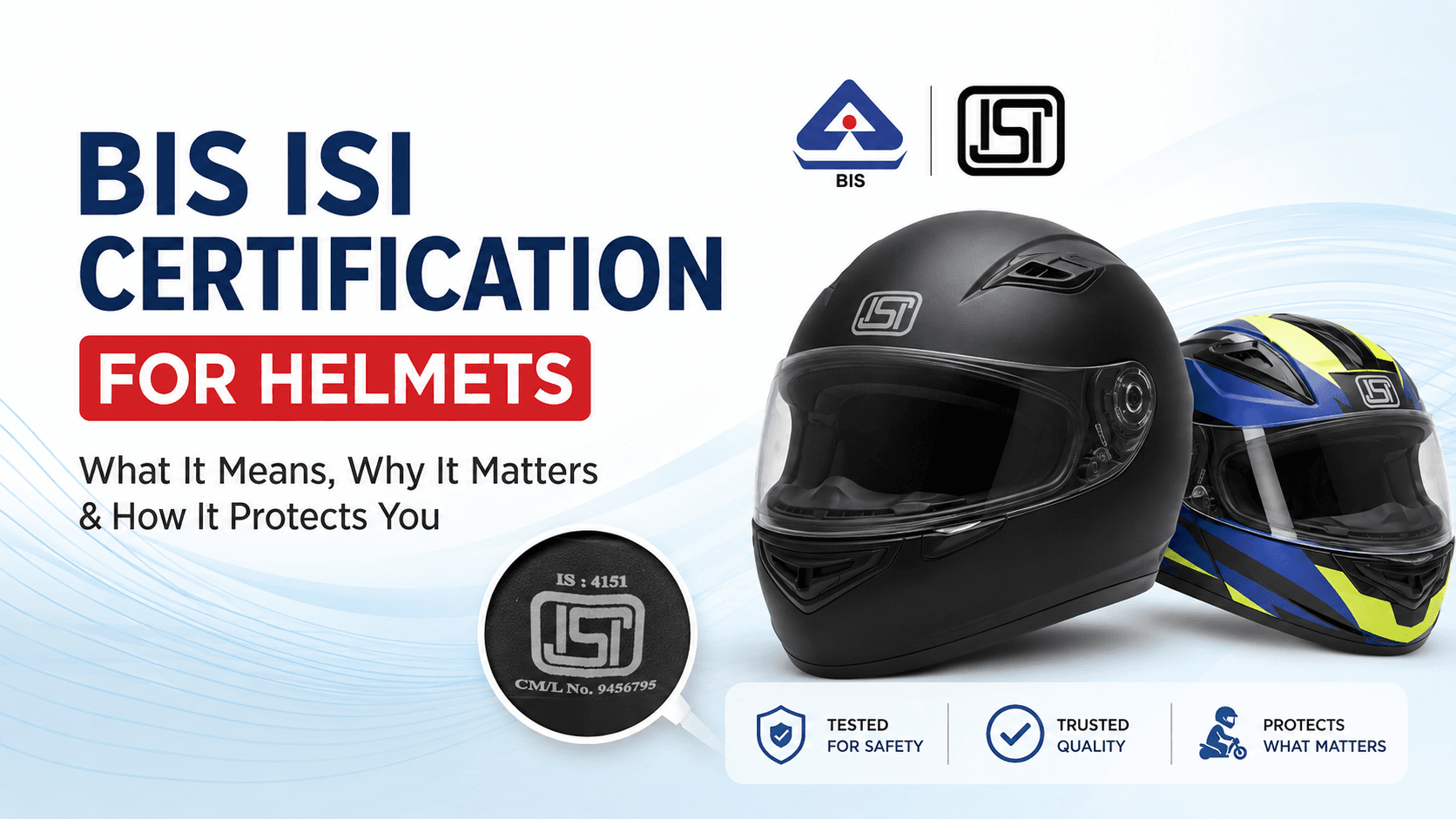
An ISI-marked helmet is one certified by the Bureau of Indian Standards (BIS) to meet the IS 4151:2015 protective helmet standard for two-wheeler riders. Under the Helmet for Riders of Two Wheeler Motor Vehicles (Quality Control) Order, 2020, this certification has been legally mandatory for every helmet manufactured, imported, sold or used in India since 1 June 2021. A genuine ISI mark is embossed — not stickered — and is printed alongside a unique BIS licence number in the CM/L format, which can be verified free on the BIS Care app or at bis.gov.in. As of June 2025, only 176 manufacturers hold valid BIS licences for helmets, and BIS seized over 3,000 non-compliant helmets in FY 2024–25 alone.
In this guide
- What is BIS and why does it regulate helmets in India?
- What is IS 4151:2015 and what does it actually test?
- What is the ISI mark and where do you find it on a helmet?
- What is the Quality Control Order 2020, and what did it change?
- What is the Jan 2026 two-helmet rule?
- How is a helmet actually certified? The BIS licensing process
- How to verify an ISI mark using the BIS Care app (step-by-step)
- How to spot a fake ISI mark on a helmet
- What is BIS doing about fake helmets? Enforcement in 2024–2026
- How IS 4151:2015 compares to ECE 22.06, DOT and SNELL
- What are the penalties for making, selling or wearing a non-ISI helmet?
- Frequently asked questions
- Sources and references
What is BIS and why does it regulate helmets in India?
The Bureau of Indian Standards (BIS) is India’s National Standards Body, established under the BIS Act, 2016. It sets, publishes and enforces mandatory quality standards for products where consumer safety is at risk — protective helmets being one of them. BIS operates under the Ministry of Consumer Affairs, Food & Public Distribution.
BIS traces its origins to 1947 as the Indian Standards Institution (ISI) — which is where the “ISI” in the ISI mark comes from. It was reconstituted as the Bureau of Indian Standards in 1986 and further strengthened by the BIS Act, 2016, which gave it explicit powers of search, seizure and prosecution under Sections 17 and 28. As of 2025, BIS has published over 20,000 Indian Standards, of which 358+ products carry mandatory (compulsory) certification. Two-wheeler helmets have been on that mandatory list since 2021.
For helmets specifically, BIS is the licensing authority. No factory in India — Indian-owned or foreign — can legally manufacture a two-wheeler helmet without a valid BIS licence. No importer can bring a helmet into the country for sale without ISI certification. No retailer can sell one. And no rider can legally wear one.
What is IS 4151:2015 and what does it actually test?
IS 4151:2015 — full title “Protective Helmet for Two Wheeler Riders — Specification (Fourth Revision)” — is the current Indian Standard that defines what a two-wheeler helmet in India must be made of, how it must be built, and what safety tests it must pass. Published in 2015 and reaffirmed in 2020, it is administered by the CED 22 technical committee. It sets a maximum finished helmet mass of 1500 grams and specifies eight standard head-form sizes: 500, 520, 540, 560, 570, 580, 600 and 620 mm.
Brief history of the standard
IS 4151 has been through four revisions:
- IS 4151:1962 — the original standard (protective helmets for scooter and motorcycle riders).
- IS 4151:1972 — first revision.
- IS 4151:1988 — second revision.
- IS 4151:1993 — third revision, with amendments issued in 1998 and 1999. This was the version in force for over two decades.
- IS 4151:2015 — fourth revision (current). Reaffirmed 2020. Introduced ventilation allowances, updated test methods, added side-impact considerations, and aligned certain parameters with international practice.
The performance tests that IS 4151:2015 requires
Every helmet model going through BIS certification is subjected to a battery of physical tests at a BIS-recognised laboratory, on a sample of 8 helmets per variety. The core tests include:
- Impact absorption test — the helmet is dropped from a specified height onto flat and hemispherical (kerbstone) steel anvils. The peak acceleration transmitted to the head form must remain below the standard’s threshold, on both first and second impacts at the same site.
- Penetration resistance test — a striker is dropped from a specified height to check that a sharp object cannot pierce through to the head form.
- Rigidity test — the helmet is compressed longitudinally and transversely; deformation and residual deformation must stay within limits.
- Retention system test (dynamic and static) — the chin strap and buckle must resist a jerked mass without stretching beyond a threshold and must not break under a static load.
- Peripheral vision test — the helmet must allow a minimum horizontal field of view so the rider can see traffic to the sides.
- Projections and surface friction — external projections above 5 mm must be smooth and rounded, and the shell must not catch on a road surface in a slide.
- Visor tests — optical clarity, luminous transmittance (typically at least 85% for a clear visor), and resistance to impact by a steel ball.
- Flammability resistance — shell and interior padding must self-extinguish within a specified time when exposed to a flame.
- Heat, cold and water resistance — samples are conditioned at high temperature, low temperature, and after water immersion, then re-tested for impact — the shell and liner must still perform.
- Corrosion resistance of metal parts — buckles, rivets and D-rings are salt-spray tested.
Clause references in the standard: sizes fall under Clause 5, constructional requirements under Clauses 6.1–6.6, peripheral vision under Clause 6.7, workmanship and finish under Clause 6.8, mass under Clause 6.9, and dynamic retention testing under Clause 7.5.
What the standard specifies for construction
- Shell materials — typically thermoplastics (ABS, polycarbonate) or thermoset composites (fibreglass, carbon composite); IS 4151:2015 sets material acceptance criteria rather than mandating a specific material.
- Protective padding — expanded polystyrene (EPS) or equivalent energy-absorbing foam covering the entire area above a defined AA plane on the head.
- Comfort padding — the fabric-covered inner lining is a comfort element, not a crash-protection element.
- Retention system — typically a Y-strap chin retention with a Double-D ring or micrometric quick-release buckle.
- Visor — optional, but if fitted must meet optical and impact requirements.
- Ventilation — permitted (a change from earlier revisions), subject to structural strength being retained.
Important clarification: IS 4151:2015 caps total helmet mass at 1500 g. This is the finished helmet weight — shell, EPS, padding, retention system and visor combined. Genuine ISI helmets almost always weigh between 1100 g and 1500 g depending on type and size.
What is the ISI mark and where do you find it on a helmet?
The ISI mark is the visible symbol that a product has been certified by BIS against a specific Indian Standard. On a helmet, it appears alongside “IS 4151:2015” (the standard) and a unique BIS licence number in the CM/L-XXXXXXX format. The mark is a stylised “ISI” letterform inside a rectangular border, and on a genuine helmet it is embossed, moulded or permanently printed — never a peel-off sticker.
Where to look for it on the helmet
- On the rear of the shell, near the base — often moulded or stamped into the shell itself or into the strap-anchor plate.
- On the retention strap tag — a permanent fabric or plastic tag stitched onto the chin strap.
- Inside the shell, near the neck opening — on some models, printed on a certification label bonded to the EPS.
- On the packaging box — including the BIS licence number, manufacturer name and address, and the IS 4151:2015 reference.
If any of these are missing — no licence number, no IS 4151:2015 reference, or a sticker-style ISI mark that peels off — treat the helmet as suspect and verify (or skip the purchase entirely).
What is the Quality Control Order 2020, and what did it change?
The Helmet for Riders of Two Wheeler Motor Vehicles (Quality Control) Order, 2020 — issued by the Ministry of Road Transport and Highways via S.O. 4252(E) dated 26 November 2020 — brought two-wheeler helmets under BIS’s compulsory certification scheme. From 1 June 2021, no helmet without a valid BIS licence and ISI mark can be manufactured, imported, stored, sold or distributed for use in India. Selling non-certified helmets is a punishable offence under the BIS Act, 2016.
The context for the QCO was stark. At the time of notification, the government stated that an estimated 60–70% of helmets sold in India did not conform to BIS norms. Two-wheelers accounted for roughly a third of all road fatalities in India, and head injuries were the single leading cause of death in those crashes. Ministry of Road Transport data cited 30,148 rider deaths and 14,516 pillion deaths in 2019 alone attributable to non-use of helmets.
What the QCO changed in practical terms:
- Manufacturing helmets without a BIS licence became illegal.
- Importing non-ISI helmets for sale in India became illegal.
- Retail sale of non-ISI helmets became illegal.
- Roadside vendors selling counterfeit helmets became targets of BIS enforcement action.
- Legal enforcement moved from being only a Motor Vehicles Act issue (fines on riders) to also being a BIS Act issue (criminal action on manufacturers and sellers).
What is the Jan 2026 two-helmet rule?
From 1 January 2026, every new two-wheeler sold in India must be delivered with two BIS-certified helmets — one for the rider and one for the pillion — as part of the on-road transaction. The rule was proposed in a draft notification dated 23 June 2025 as an amendment to the Central Motor Vehicles Rules, 1989, and took effect in January 2026 alongside a parallel rule making Anti-Lock Braking Systems (ABS) mandatory on all new two-wheelers regardless of engine capacity.
Before this rule, dealerships were only required to supply a single BIS-certified helmet with a new two-wheeler purchase — leaving pillion riders (a majority in India’s crash-death data) unprotected on the very first day of ownership. The new rule directly addresses pillion safety, which official crash data has repeatedly flagged as under-protected.
Key details buyers should know:
- Both helmets must carry a genuine embossed ISI mark, a valid BIS licence number and reference to IS 4151:2015.
- The rule applies to all new two-wheelers regardless of engine capacity — including sub-125cc scooters that were previously exempt from many safety mandates.
- An exemption exists under Section 129 of the Motor Vehicles Act, 1988, for riders who fall under legally recognised categories (for example, Sikh riders wearing a turban) — the two-helmet delivery obligation on the dealer, however, is not waived by this exemption in most implementations.
- Non-compliance risks dealer licence action and potential driving-licence-related consequences for those distributing non-certified helmets under the guise of the rule.
A caution for new buyers: the free helmets you receive with your new two-wheeler meet the legal minimum — they are ISI-certified and safe for use — but they are typically entry-level open-face or basic full-face models. Many buyers upgrade the primary rider’s helmet within 6–12 months and keep the dealer helmet as a spare or pillion helmet.
How is a helmet actually certified? The BIS licensing process
A helmet manufacturer obtains BIS certification by applying via the BIS online portal, submitting product samples (8 helmets per variety) for testing at a BIS-recognised laboratory, undergoing a factory inspection to verify manufacturing capacity and quality control, and — on successful completion — receiving a BIS licence with a unique CM/L number. The licence is typically valid for one or two years, subject to periodic surveillance testing and renewal.
The certification workflow, in six steps
- Application. The manufacturer files an application on the BIS portal (manakonline.in), attaches product specifications and manufacturing details, and pays the applicable government fee.
- Sample submission. Eight helmets per variety are submitted to a BIS-recognised testing laboratory. The sample must reflect actual production, not a hand-built prototype.
- Laboratory testing. The laboratory runs the full IS 4151:2015 test battery — impact, penetration, retention, rigidity, peripheral vision, visor, flammability, corrosion, and environmental conditioning. Results are uploaded via the Laboratory Information Management System (LIMS).
- Factory audit. BIS officers visit the manufacturing facility to verify machinery, quality control processes, raw material sourcing and record-keeping.
- Licence grant. If both the test report and audit are satisfactory, BIS grants a licence and issues a unique CM/L number. The manufacturer can now use the ISI mark on the specific helmet varieties covered under the scope of the licence.
- Surveillance. BIS conducts periodic market and factory surveillance testing throughout the licence period. Non-conforming samples can trigger a stop-marking notice, cancellation of the licence and market seizure.
Cost and timeline: total certification cost depends on the number of models, testing complexity, and factory location. Manufacturers commonly report end-to-end timelines of 60–90 days for a standard model. Renewal is a lighter process, subject to satisfactory surveillance.
How to verify an ISI mark using the BIS Care app (step-by-step)
The BIS Care app is the official Bureau of Indian Standards verification tool, free to download on Android and iOS in English and Hindi. To verify a helmet, enter the CM/L licence number printed on the helmet or its strap tag under the “Verify Licence Details” option. The app returns the manufacturer’s name and address, the licence validity, the varieties and brands covered, and the current status of the licence.
Verification steps
- Download BIS Care. Get the app from the Google Play Store (Android) or Apple App Store (iOS). It is published by the Bureau of Indian Standards, is free, and does not require a login for verification.
- Open the app and choose “Verify Licence Details” (ISI Mark). This is the option for products under Scheme I — which is what helmets are certified under. Do not use “Verify R-Number under CRS” (that is for electronics) or “Verify HUID” (that is for hallmarked jewellery).
- Enter the CM/L number. The format is CM/L followed by a hyphen and a seven-digit number, for example CM/L-1234567. Find it printed on the helmet’s rear shell, on the strap tag or on the packaging.
- Review the returned details. A genuine, active licence will display the manufacturer’s registered name and address, licence issue and validity dates, the list of helmet models covered under the licence, the brand names permitted, and the licence’s current status (active / expired / cancelled).
- Cross-check against the helmet. The manufacturer name on the app should match the name printed on the helmet or its box. The model in your hand should fall within the “varieties covered” list. If the licence is marked expired or cancelled, do not buy the helmet — even if the ISI mark on it looks genuine, the manufacturer has lost the right to use it.
- If something is off, report it. Use the app’s “Complaints” feature to report a fake mark, misuse of the ISI mark, or a substandard product.
Alternate verification: you can also verify a CM/L number by visiting bis.gov.in and searching under “Manak Online” — the same records that power the BIS Care app.
How to spot a fake ISI mark on a helmet
A genuine ISI mark is embossed, moulded or permanently printed onto the helmet shell or the strap tag. It is accompanied by a valid CM/L licence number, a reference to “IS 4151:2015”, and can be verified through the BIS Care app. A fake ISI mark is typically a peel-off sticker, has no licence number or an invented one that fails verification, misspells the standard reference, or appears on a helmet with obvious build-quality defects.
The nine tell-tale signs of a fake ISI helmet
- The ISI mark is on a stickered label that peels off. Genuine marks are embossed or permanently printed.
- There is no CM/L licence number visible on the helmet, strap tag or packaging.
- The CM/L number, when entered in the BIS Care app, returns no result or a mismatched manufacturer name.
- The standard reference is misspelt or vague — “IS-4151” without the year, or “As per IS 4151” without a licence number.
- The manufacturer name and address are absent, generic (“Made in India”), or missing from the packaging.
- The shell has visible seams, resin bleed, uneven paint, or a hollow feel when tapped.
- The chin strap stitching is uneven or the buckle feels flimsy.
- The helmet weighs conspicuously less than 1000 g — genuine ISI helmets rarely fall below this.
- The price is dramatically below market rates — anything sub-₹500 for a helmet is a strong counterfeit signal.
Roadside vendors, street-corner traffic-signal sellers and unbranded e-commerce listings are the most common sources of counterfeit ISI helmets. Buy only from authorised retailers, brand-owned online stores, or verified accounts on major marketplaces.
What is BIS doing about fake helmets? Enforcement in 2024–2026
BIS enforcement against fake and non-compliant helmets has intensified through 2024, 2025 and into 2026. In FY 2024–25, BIS conducted over 30 search-and-seizure operations, tested more than 500 helmet samples, and seized around 3,000 non-compliant helmets across the country. Enforcement has extended to e-commerce marketplaces, roadside retail, and manufacturers operating on expired or cancelled licences.
Documented enforcement actions
- November 2020: Ministry of Road Transport and Highways notifies the Helmet Quality Control Order (S.O. 4252(E)).
- June 2021: QCO comes into force — non-ISI helmets become illegal to manufacture or sell in India.
- March 2025: BIS conducts a 15+ hour search-and-seizure operation at Amazon Sellers Pvt Ltd warehouses in Delhi, seizing over 3,500 products worth approximately ₹70 lakh — including items with counterfeit ISI marks. A parallel raid at Instakart Services Pvt Ltd (a Flipkart subsidiary) uncovers stock packaged for dispatch without required ISI markings.
- FY 2024–25 (aggregate): 30+ search-and-seizure operations, 500+ helmet samples tested, 3,000+ non-compliant helmets seized. A single Delhi operation confiscated over 2,500 helmets from 9 manufacturers operating on expired or cancelled licences. Another sweep across 17 retail and roadside locations seized approximately 500 more.
- December 2024 – June 2025: Traffic authorities reportedly issued over 10.5 million helmet-related challans across India — a signal of parallel Motor Vehicles Act enforcement alongside BIS Act enforcement.
- July 2025: Department of Consumer Affairs publicly appeals to consumers to use only BIS-certified helmets. As of June 2025, only 176 manufacturers hold valid BIS licences for two-wheeler helmets.
- May 2026: BIS Coimbatore Branch Office conducts a search-and-seizure operation at M/s. IP Auto World, Saibaba Colony, Mettupalayam Road, Coimbatore, under Section 28 of the BIS Act, 2016 — seizing protective helmets sold without the ISI mark.
The enforcement message is unambiguous: BIS is no longer treating fake ISI helmets as a passive problem. It is actively raiding manufacturers, e-commerce warehouses and roadside retail — and prosecuting under the BIS Act, 2016 rather than just the Motor Vehicles Act.
How IS 4151:2015 compares to ECE 22.06, DOT and SNELL
IS 4151:2015 is the Indian standard; ECE 22.06 is the European standard (in force from 2024, replacing 22.05); DOT FMVSS 218 is the US federal standard; SNELL M2020 is a voluntary racing-grade standard. Only ISI-marked helmets are legal on Indian roads, regardless of what other certifications they carry. A helmet bearing DOT or ECE certification alone — no matter how expensive — is not road-legal in India unless it also carries the ISI mark.
| Standard | Region | Legal in India | Key characteristics |
| IS 4151:2015 | India | Yes — required by law | Impact absorption on flat and hemispherical anvils; penetration resistance; retention system dynamic and static tests; peripheral vision; visor optical clarity; flammability; corrosion; heat, cold and water conditioning; maximum finished weight 1500 g. |
| ECE 22.06 | Europe (UNECE) | Only if dual-certified with ISI | Replaced 22.05 in 2024. Introduces multi-impact testing at higher and lower velocities; rotational (angled) impact testing; homologation for chin bar (P) and open-face (J); expanded visor and accessory tests. |
| DOT FMVSS 218 | United States | Only if dual-certified with ISI | Impact attenuation; penetration resistance; retention system strength; peripheral vision (105° minimum each side). Self-certified by the manufacturer, subject to spot-check by NHTSA. |
| SNELL M2020 | Voluntary (global, racing) | Only if dual-certified with ISI | Higher impact energy levels than ECE or DOT; multi-hit impact on the same site; strict penetration; commonly used in motorsport. |
| SHARP | United Kingdom (rating) | Rating only, not a legal standard | A 1–5 star crash rating of ECE-certified helmets published by the UK Department for Transport. Useful comparative data, not a certification. |
The practical takeaway for Indian riders
- For legal road use in India, ISI certification is non-negotiable. Every other standard is either supplementary or advisory.
- Dual-certified helmets (ISI + ECE 22.06, or ISI + DOT) offer the best of both worlds — Indian legality with additional international test coverage.
- The gap between IS 4151:2015 and ECE 22.06 in real-world protection is narrower than online forum debates often suggest. Both standards deliver a genuinely protective helmet when the manufacturer builds honestly to spec. The differences are meaningful mostly at the margins — rotational impact, multi-hit performance and cold-weather behaviour.
- A cheap ISI-certified helmet from a licensed manufacturer will outperform an expensive imported ECE-only helmet in the one metric that matters most on Indian roads: legal admissibility and insurance protection.
What are the penalties for making, selling or wearing a non-ISI helmet?
Riding without an ISI-certified helmet in India attracts a fine of ₹1,000 under Section 194D of the Motor Vehicles Act, 1988, along with disqualification from holding a driving licence for up to three months. Manufacturing, importing or selling non-ISI helmets attracts far heavier penalties under the BIS Act, 2016 — including fines up to ₹5 lakh, imprisonment up to two years, and seizure of stock.
For riders and pillion passengers
- Fine of ₹1,000 for riding without a helmet or with an unstrapped helmet, under Section 194D of the Motor Vehicles Act, 1988.
- Disqualification from holding or obtaining a driving licence for up to three months.
- Personal-accident insurance payouts may be reduced or denied for policyholders who were not wearing an ISI-certified helmet at the time of the crash.
- Applies equally to the rider and to the pillion passenger.
For manufacturers, importers and sellers
- Under Section 17 and Section 29 of the BIS Act, 2016: penalties can include fines up to ₹5 lakh (or 10 times the value of the goods, whichever is higher), imprisonment up to two years, or both.
- Seizure of stock under Section 28 during a search-and-seizure operation.
- Cancellation of any existing BIS licence, blacklisting from future applications for a defined period.
- Removal of listings from e-commerce marketplaces — Amazon and Flipkart have been directly implicated in enforcement actions in 2025.
- Criminal prosecution for repeat offenders and for large-scale counterfeiting operations.
Frequently asked questions
What does the ISI mark on a helmet actually mean?
The ISI mark on a helmet means the model has been certified by the Bureau of Indian Standards to meet IS 4151:2015 — India’s protective helmet standard for two-wheeler riders. It confirms that the helmet has passed impact absorption, penetration resistance, retention system, peripheral vision, visor optical clarity and environmental conditioning tests at a BIS-recognised laboratory, and that the manufacturer holds a valid BIS licence to use the mark.
Is IS 4151:2015 the same as IS 4151:1993?
No. IS 4151:1993 was the third revision of the standard, in force for over two decades. IS 4151:2015 is the fourth (current) revision, published in 2015 and reaffirmed in 2020. The 2015 revision updated test methods, allowed ventilation openings in the shell, and refined dimensional and material specifications. Any helmet certified today is certified against IS 4151:2015, not the older 1993 version.
Are ECE 22.06 or DOT-only helmets legal to use in India?
No. A helmet must carry an ISI mark under IS 4151:2015 to be road-legal in India. An ECE 22.06-only or DOT-only imported helmet — even a premium ₹40,000 lid — is not legal unless it also has the ISI mark. Dual-certified helmets (ISI + ECE, or ISI + DOT) are legal because the ISI mark is present.
Can I check if my helmet is ISI-certified without physically going anywhere?
Yes. Download the free BIS Care app (Android and iOS), tap “Verify Licence Details”, and enter the CM/L licence number printed on the helmet or its strap tag. The app instantly returns the manufacturer name, licence validity and covered models. Alternatively, verify the same CM/L number on bis.gov.in under Manak Online.
What does CM/L in the licence number stand for?
CM/L stands for “Certification Mark Licence” — the format BIS uses for licences issued under Scheme I, which is the mandatory certification scheme that covers products like helmets. Every BIS-licensed manufacturer receives a unique CM/L number that identifies the licence, the manufacturer, and the scope of certified products.
How many manufacturers actually hold valid BIS helmet licences?
As of June 2025, only 176 manufacturers across India held valid BIS licences for two-wheeler protective helmets. This is a smaller number than the market suggests, and it is why counterfeit ISI markings are widespread — the number of helmets on sale far exceeds what 176 licensed manufacturers can legally produce.
What is the two-helmet rule that came into effect in January 2026?
From 1 January 2026, dealers must supply two BIS-certified helmets — one for the rider and one for the pillion — with every new two-wheeler sold in India. The rule sits alongside a parallel mandate making Anti-Lock Braking Systems (ABS) standard on all new two-wheelers, regardless of engine capacity.
Are the free helmets that come with a new two-wheeler good enough?
They meet the legal minimum — they are ISI-certified and safe for daily use — but they are typically entry-level ABS-shell open-face or basic full-face models. They are adequate for short urban commutes, especially as a spare or pillion helmet, but most regular riders upgrade the primary helmet within 6–12 months for better fit, comfort and features.
What is the maximum weight of an ISI-certified helmet under IS 4151:2015?
IS 4151:2015 caps the total mass of a finished helmet at 1500 grams. In practice, genuine ISI-certified helmets weigh between 1100 g and 1500 g depending on type, size and shell material. A helmet weighing far below 1000 g is a strong counterfeit signal.
Can I be fined for wearing a helmet that is ISI-certified but not strapped?
Yes. Section 194D of the Motor Vehicles Act, 1988 requires that the helmet be worn “properly” — which the enforcement interpretation consistently reads as strapped and fastened. A ₹1,000 fine and possible three-month driving-licence disqualification apply for wearing an unstrapped helmet just as they do for wearing no helmet at all.
What should I do if I bought a helmet and discover it has a fake ISI mark?
Do not use it. Contact the seller for a refund. Report the counterfeit through the BIS Care app under the “Complaints” feature or on bis.gov.in with photographs of the helmet and the mark, your purchase invoice, and the seller’s details. BIS actively pursues counterfeiting cases under Section 28 of the BIS Act, 2016. Complaints are free to file.
How this guide was researched
This guide is based on the text of IS 4151:2015 (Bureau of Indian Standards, CED 22 committee), the Helmet for Riders of Two Wheeler Motor Vehicles (Quality Control) Order, 2020 (Ministry of Road Transport and Highways, S.O. 4252(E) dated 26 November 2020), the BIS product manual for IS 4151, official Press Information Bureau releases on BIS enforcement activity in FY 2024–25, verified news coverage of the Central Motor Vehicles Rules amendment on the two-helmet mandate, and hands-on verification of live CM/L licence numbers through the BIS Care app. Prices, enforcement figures and manufacturer counts are as reported by the government up to July 2026.
Sources and references
- Bureau of Indian Standards. IS 4151:2015 — Protective Helmet for Two Wheeler Riders — Specification (Fourth Revision). Reaffirmed 2020. Committee: CED 22. Available at bis.gov.in.
- Bureau of Indian Standards. Product Manual for IS 4151. Available at bis.gov.in/wp-content/uploads/IS-4151-Product-Manual.pdf.
- Ministry of Road Transport and Highways. Helmet for Riders of Two Wheeler Motor Vehicles (Quality Control) Order, 2020. S.O. 4252(E), dated 26 November 2020.
- Ministry of Road Transport and Highways. Draft notification amending the Central Motor Vehicles Rules, 1989 — two-helmet and ABS mandate, dated 23 June 2025.
- Motor Vehicles Act, 1988. Section 129 (mandatory helmet use) and Section 194D (penalty for non-compliance).
- BIS Act, 2016. Sections 17, 28, and 29 (enforcement, search and seizure, penalties).
- Press Information Bureau. “Helmet — More Than Just a Shell” — Government of India release on BIS enforcement actions in FY 2024–25.
- BIS Care app. Bureau of Indian Standards. Available free on Google Play Store and Apple App Store.
- UNECE. ECE Regulation 22.06 — motorcycle helmet standard, in force from 2024.
- NHTSA. FMVSS 218 — Motorcycle Helmet Standard, United States Federal Motor Vehicle Safety Standard.
- Snell Memorial Foundation. M2020 — Standard for Protective Headgear for Use With Motorcycles.
Related buying guides
- How to Choose a Helmet in India — The 2026 Buyer’s Guide
- India’s New Two-Helmet Rule (Jan 2026): What Buyers, Riders and Dealers Need to Know
- How to Verify an ISI-Certified Helmet Using the BIS Care App (Step-by-Step)
- Fake vs Real ISI Helmets: 9 Signs of a Counterfeit and Where Fakes Are Sold
- ISI vs DOT vs ECE 22.06 vs SNELL — Which Certification Actually Matters in India?
- Helmet Fines in India 2026: State-Wise Penalty Chart Under Section 194D