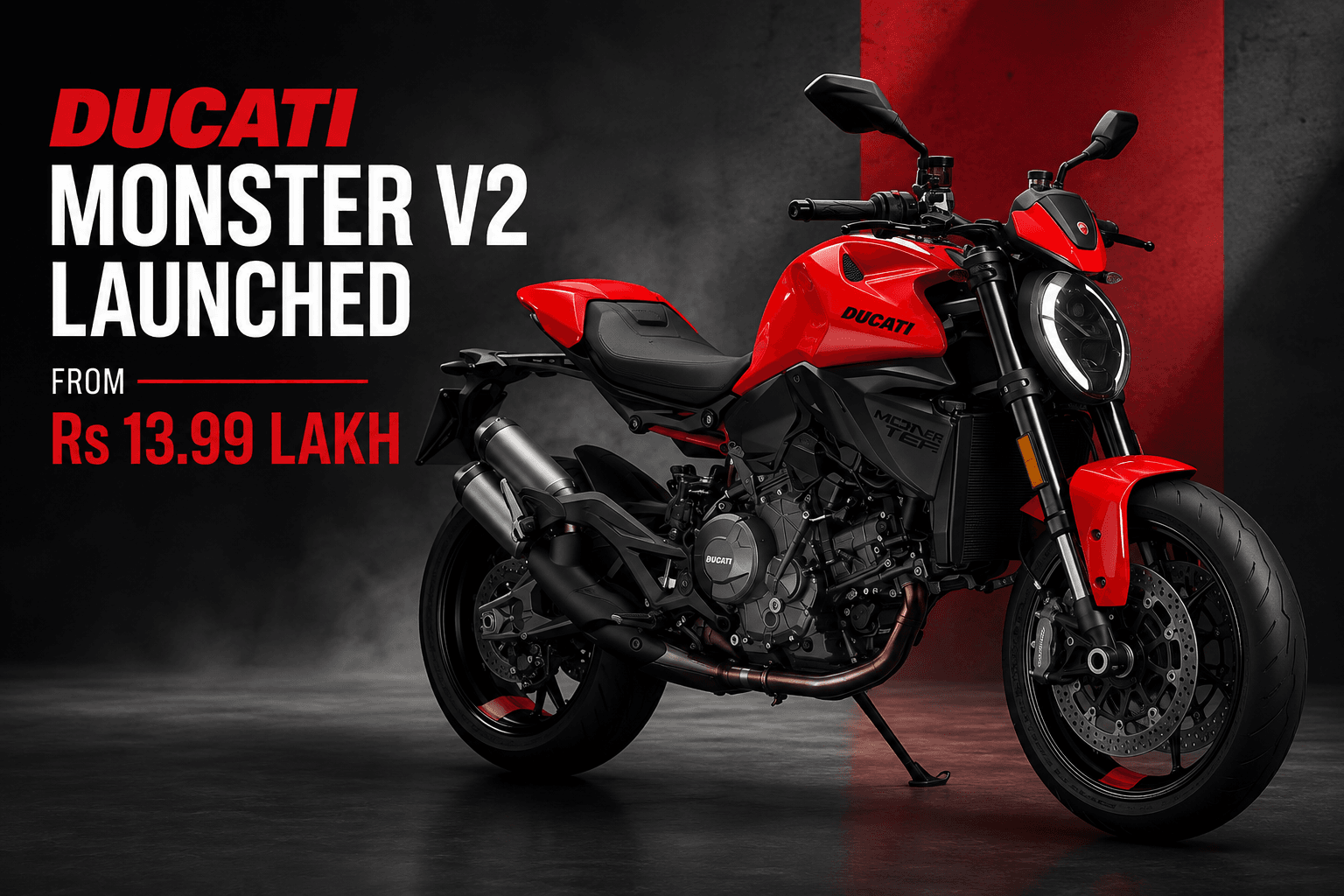
Ducati Monster V2 Launched in India at ₹13.99 Lakh: Ducati India has launched the fifth-generation Monster and Monster+ in India, priced from ₹13.99 lakh (ex-showroom), a modest ₹15,000 hike over the outgoing model. On paper that reads like a small update. Look under the tank, and it’s a much bigger story: the Monster now uses the same 890cc V2 engine Ducati has quietly spread across the Panigale V2, Streetfighter V2 and Multistrada V2, and it comes with a service interval that reshapes the ownership cost equation for a Ducati in India.
What’s new on the 2026 Monster
The headline change is the engine. Out goes the old 937cc Testastretta 11°. In comes a new 890cc V-twin with Intake Variable Timing (IVT), mounted as a stressed member of a new aluminium monocoque chassis — the same architecture Ducati borrows from its sportbike lineup. According to Ducati India, the switch drops around 5 kg from the bike, taking dry weight to 175 kg.
Peak power stays at 111 hp, now arriving at 9,000 rpm — 250 rpm earlier than before. Torque is 91.1 Nm at 7,250 rpm, a 2 Nm drop on paper. But the meaningful number is this: over 80 percent of that peak torque is now available between 4,000 rpm and 9,000 rpm. Translation — the new bike is more usable in the everyday riding band, even if the peak headline number moves slightly.
Ducati is offering the Monster and Monster+ in three colours: Ducati Red, Iceberg White and Sport Livery. Ducati Red anchors the pricing at ₹13.99 lakh; the two premium colours cost ₹14.23 lakh. The Monster+ starts at ₹14.34 lakh and tops out at ₹14.45 lakh. Mechanically, the two variants are identical. The Monster+ adds a headlight cowl (flyscreen) and a rear passenger seat cover for a cleaner, sportier profile.
The buried headline: 45,000 km valve check interval
If you own or are thinking of owning a Ducati in India, this is the number that actually matters.
Valve clearance inspections on Ducati L-twins have historically been the item that scared prospective buyers into rival Japanese and British bikes. On the older 937cc Monster, that inspection was due at 30,000 km. On the new 890cc V2, thanks to IVT, that interval has been stretched to 45,000 km. Ducati India recommends the bike be serviced once a year or every 15,000 km, whichever comes first, with a standard two-year unlimited-mileage warranty.
For a rider clocking 12,000–15,000 km a year (typical for a used-often big bike in the metros), that means a serious valve service now falls outside the standard warranty period, but the interval between checks nearly triples the previous industry-typical figures for a V-twin performance engine. Ducati is also offering an optional Ducati Protect Periodic Maintenance Contract for buyers wanting predictable service costs from day one.
Combined, these two changes — lower purchase price hike, dramatically extended valve interval — are the single biggest change to Ducati’s Indian value proposition in years.
Chassis, brakes, electronics — same premium formula, better foundation
The mechanical package is exactly what a Monster-shopper expects at this price:
- Suspension: 43 mm Showa upside-down fork up front, monoshock at the rear.
- Brakes: Brembo, 320 mm dual discs at the front, 245 mm at the rear.
- Tyres: Pirelli Diablo Rosso IV — 120/70 R17 front, 180/55 R17 rear.
- Electronics: Ride and power modes, cornering ABS, traction control, wheelie control, engine brake control, bi-directional quickshifter, full LED lighting and a 5-inch TFT dash.
Ergonomics get a genuine India-friendly rethink. Standard seat height is 815 mm, but Ducati offers a 795 mm accessory seat and a further 775 mm low-seat option (the latter needs a matching lower suspension kit). For a large chunk of Indian riders, especially those coming off KTM Dukes or Triumph Street Triples, that lower option is what makes a Monster feasible day-to-day.
Buyers can also spec cruise control, TPMS, heated grips and turn-by-turn navigation via the Ducati accessory catalogue. Bookings are open on the Ducati India website.
Where the Monster V2 sits in India’s mid-weight naked market
According to specification sheets available on both manufacturer websites, the direct rival is, as it has been for a decade, the Triumph Street Triple 765 RS — currently retailing between roughly ₹12–13 lakh, ex-showroom. On raw power, according to Triumph’s India spec sheet, the Street Triple pulls ahead: 128 hp (from 130 hp in some markets) against Ducati’s 111 hp. On character, they diverge sharply.
The 765cc inline-triple in the Street Triple is a rev-happy, Moto2-adjacent engine that rewards a rider who works the gearbox. Ducati’s 890 V2 is a low-and-mid-range torque engine that trades top-end scream for grunt from 4,000 rpm. In city traffic and on Indian B-roads, that shifts the balance meaningfully toward Ducati.
There’s also the Ducati Streetfighter V2 — same engine, more aggressive styling and ergonomics — but at roughly ₹17 lakh–plus, ex-showroom, it sits in a different pricing conversation.
Ducati is quietly consolidating its mid-tier around this 890cc V2 engine — the same powertrain now sits inside the Panigale V2, Multistrada V2, Streetfighter V2, and Monster. For dealers, that simplifies parts and service. Every 890cc V2 sold now feeds the same platform-improvement cycle — scale that matters for Ducati in India, where volumes are still small compared to Triumph.
Should you buy the 2026 Ducati Monster?
If you were considering the outgoing 937cc Monster, the ₹15,000 hike is functionally invisible for a fundamentally new bike with lower weight, a modern chassis, and the longer service interval.
If you’re cross-shopping the Triumph Street Triple 765 RS, the question is character, not spec sheet. The Triumph is sharper, lighter-feeling and faster on paper. The Ducati is easier to live with in India — lower seat option, tractable engine, and now, a service story that no longer punishes you for daily use.
FAQs
What is the on-road price of the 2026 Ducati Monster in India? Ex-showroom prices start at ₹13.99 lakh (Ducati Red) and go up to ₹14.45 lakh (Monster+ in Iceberg White or Sport Livery). On-road prices vary by city — expect roughly 12–15 percent above ex-showroom in most metros, once RTO and insurance are added.
What engine does the 2026 Ducati Monster use? A new 890cc V-twin that Ducati also uses in the Panigale V2, Streetfighter V2 and Multistrada V2. It produces 111 hp at 9,000 rpm and 91.1 Nm at 7,250 rpm, with Intake Variable Timing.
How is the 2026 Monster different from the outgoing 937cc model? Smaller-displacement but similarly powerful engine, a new aluminium monocoque chassis, 5 kg lower weight, a 45,000 km valve inspection interval versus 30,000 km previously, and revised styling with a bison-back fuel tank. Price is up only ₹15,000.
What is the Monster+ variant? The Monster+ is mechanically identical to the standard Monster but adds a small flyscreen and a rear passenger seat cover. It’s a cosmetic package, not a performance one.
Which bikes does the Ducati Monster V2 compete with in India? Its primary rival is the Triumph Street Triple 765 RS. Cross-shoppers may also consider the Ducati Streetfighter V2 (at a significantly higher price) and, from a distance, the Kawasaki Z900 and BMW F 900 R.