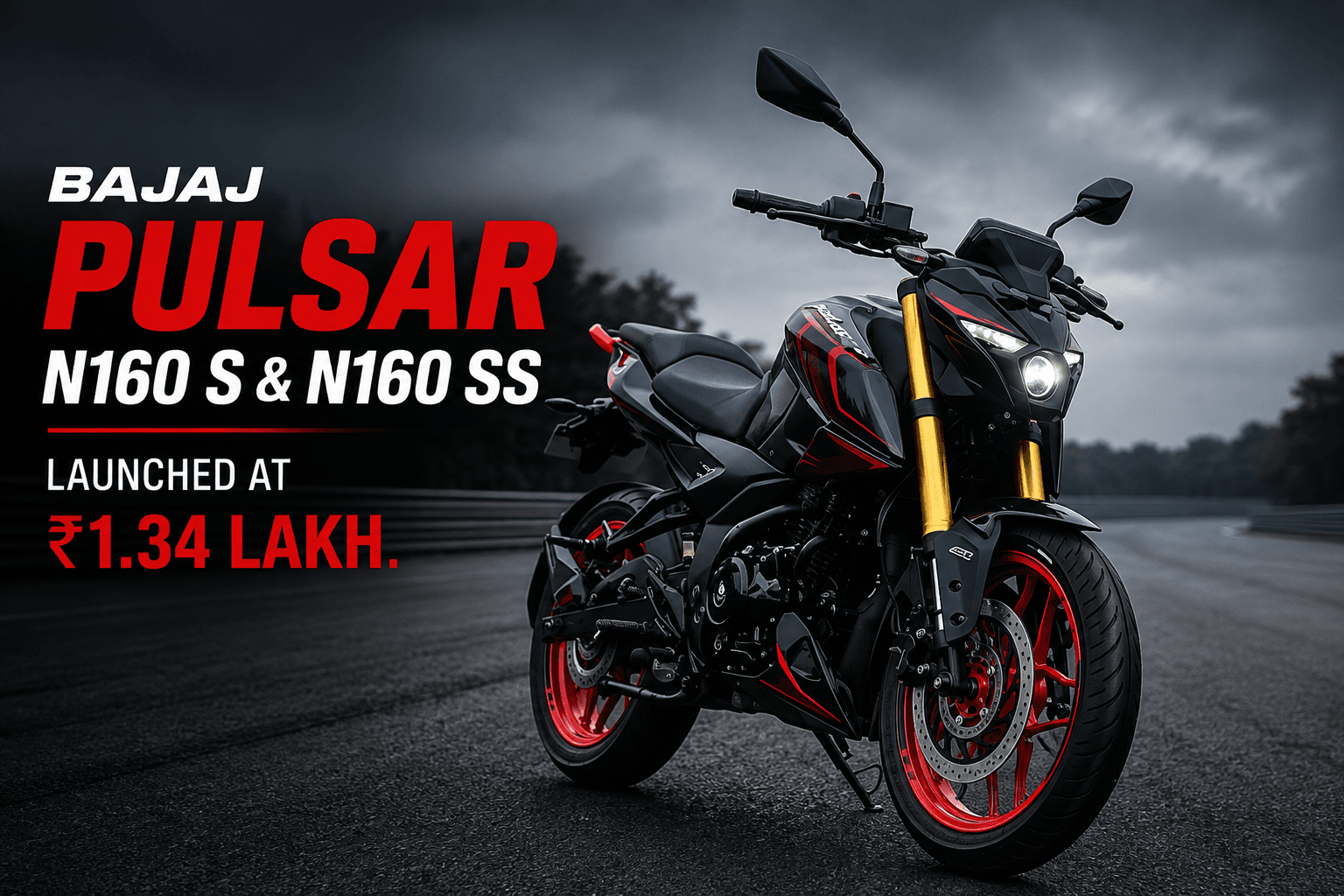
Bajaj Pulsar N160 S and N160 SS Launched at ₹1.34 Lakh: Bajaj Auto has expanded the Pulsar N160 family with two new variants — the N160 S at ₹1,33,511 and the flagship N160 SS at ₹1,42,585 (ex-showroom, Delhi). The two-valve N160 stays on sale as the entry model. The bigger story isn’t just a price. It’s that Bajaj has crossed a technology line the 160cc segment has never seen: ride-by-wire throttle, four ride modes, traction control, crawl assist and a TFT dash with Google Maps mirroring, all under ₹1.50 lakh. Whether it’s a bargain depends on what you were about to spend anyway.
What’s new — the engine, first
The N160 S and N160 SS share a new 164.5cc single-cylinder, oil-cooled, four-valve engine that makes 18.5 PS at 9,500 rpm and 14.4 Nm at 8,000 rpm. Compared to the outgoing two-valve motor’s 16 PS and 14.65 Nm, that’s a 2.5 PS bump for a 0.25 Nm dip in torque. According to Bajaj’s own claims, the bike will hit 0–60 km/h in 4.5 seconds — which, if independent tests hold it up, would make this the quickest bike in the 160cc segment.
The 5-speed gearbox carries over. The bigger change is under the throttle: the older cable-operated setup is gone, replaced with a ride-by-wire electronic throttle body, which Bajaj is branding “Intelligent Throttle (ETB).” That single component is what unlocks everything else on the spec sheet.
Ride modes, traction control, crawl — segment-first territory
The electronic throttle enables four riding modes across both variants: Road, Rain, Sport and Off-road. Each recalibrates throttle response, not just the digital display — so a Rain-mode roll-on genuinely delivers softer power at typical urban-monsoon speeds rather than just changing the theme colour on the dash.
Both bikes also get Crawl Technology — a lift from the KTM 390-family playbook — that lets the motorcycle inch forward in higher gears with almost no clutch feathering. If you commute through Bengaluru or Mumbai traffic on a manual bike, that feature alone is likely to make a meaningful difference to left-forearm fatigue.
The flagship N160 SS adds Responsive Traction Control, which Bajaj is claiming as a first for a 160cc sports motorcycle in India. Because it runs off the same ride-by-wire throttle, it can pull power smoothly during a rear-wheel slip rather than just cutting ignition. On paper that’s meaningful. In practice, on a 18.5 PS bike, it’ll matter most on wet roads, oil patches, and gravelly turn-ins — not corner-exit hero moments.
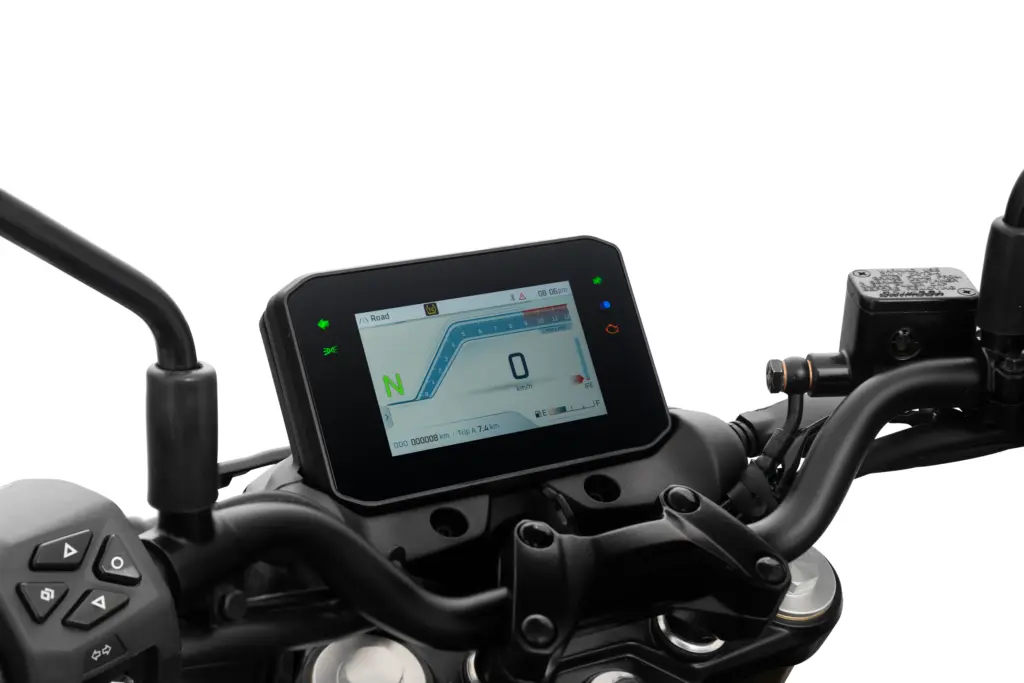
The SS also becomes the first Bajaj motorcycle to get a 5-inch TFT display with Google Maps mirroring, along with Bluetooth and Wi-Fi connectivity and adjustable brake and clutch levers. The N160 S continues with an LCD console.
Chassis and hardware — modest but real
The frame, wheelbase (1,348 mm), fuel tank (14 L), ground clearance (165 mm), seat height (795 mm) and 151 kg kerb weight are unchanged. But the hardware around them has been genuinely upgraded:
- Front forks: 37 mm upside-down units, up from 33 mm.
- Front disc: 300 mm, up from 280 mm.
- N160 SS: gets dual-channel ABS and a radial rear tyre (130/70-17).
- N160 S: single-channel ABS.
Available colours across both variants: Atlantic Blue, Pearl Metallic White, and Brooklyn Black.
The price question — is a ₹1.42 lakh Pulsar N160 fair?
Here’s where the analysis gets interesting.
- Bajaj Pulsar N160 (2V, entry): from ~₹1.16 lakh
- Bajaj Pulsar N160 S (new): ₹1,33,511
- Bajaj Pulsar N160 SS (new): ₹1,42,585
- TVS Apache RTR 160 4V (top): from ~₹1.19 lakh
- Hero Xtreme 160R 4V: from ~₹1.33 lakh
Prices sourced from manufacturer sites and BikeWale listings, current at the time of this launch.
On a straight ex-showroom comparison, the N160 SS is roughly ₹23,000 more expensive than the Apache RTR 160 4V. That’s not a small delta in this segment. Bajaj is asking buyers to pay it in return for traction control, a TFT with maps, ride-by-wire, and crawl — a real feature stack no rival offers today, but also one that most first-time 160cc buyers won’t use fully.
The N160 S at ₹1.33 lakh is arguably the sharper buy. You get the new engine, USD forks, ride modes, and crawl — the substantive changes — without paying the SS premium for the TFT and traction control.
If you’re coming from a 125cc or older 150cc bike, the S is enough. If you already ride a KTM Duke 200 or a Yamaha MT-15, and you were going to spend ₹1.60 lakh–plus anyway, the SS is a genuinely rational move for a lot less money.
What this launch tells us about Bajaj’s strategy
According to Bajaj Auto’s own commentary at launch, the N160 range grew roughly 60 percent in the first six months of the calendar year. That growth was on a bike that, feature-for-feature, was starting to look thin against Apache and Hero rivals.
Rather than cut prices to defend, Bajaj has moved in the opposite direction — loading premium tech onto a mainstream commuter platform, then pricing above the segment average. This is the same play we saw with the Pulsar NS400Z at the top of the range: use segment-leading electronics as a moat, then let the volume Pulsars (P125, N125, Neon 150) hold the value end.
For the wider Indian 160cc segment, this launch effectively resets the expected tech ceiling. TVS and Hero will now be pushed to either match the traction control-plus-TFT stack or accept a positioning where they’re the value option and Bajaj is the “premium 160cc”. Neither response is trivial for a segment that used to compete almost entirely on refinement and mileage.
FAQs
What is the ex-showroom price of the Bajaj Pulsar N160 S and N160 SS? The Pulsar N160 S is priced at ₹1,33,511 and the N160 SS at ₹1,42,585, both ex-showroom Delhi. Bajaj typically publishes these as “₹1.34 lakh” and “₹1.43 lakh” in its communication.
What engine does the new Pulsar N160 use? Both the N160 S and N160 SS use a new 164.5cc single-cylinder, oil-cooled, four-valve engine producing 18.5 PS at 9,500 rpm and 14.4 Nm at 8,000 rpm, paired with a 5-speed gearbox and ride-by-wire (Intelligent Throttle) throttle body.
What is the difference between the Pulsar N160 S and N160 SS? Both share the same new engine, ride modes, USD forks and Crawl Technology. The N160 SS adds Responsive Traction Control, a 5-inch TFT display with Google Maps mirroring, Bluetooth/Wi-Fi connectivity, adjustable levers, dual-channel ABS and a radial rear tyre.
Is the Pulsar N160 SS the first 160cc bike in India with traction control? According to Bajaj’s official launch statement, the N160 SS is the first sports motorcycle in the 160cc category in India to offer Responsive Traction Control. No rival 160cc bike currently on sale in India offers this feature.
Should I buy the N160 S or the N160 SS? For most everyday riders coming up from a smaller commuter, the N160 S offers the majority of the mechanical upgrades — new engine, USD forks, ride modes, crawl — at a ₹9,000 lower price. The SS makes sense if you specifically want traction control, a TFT dash with Google Maps and premium levers.