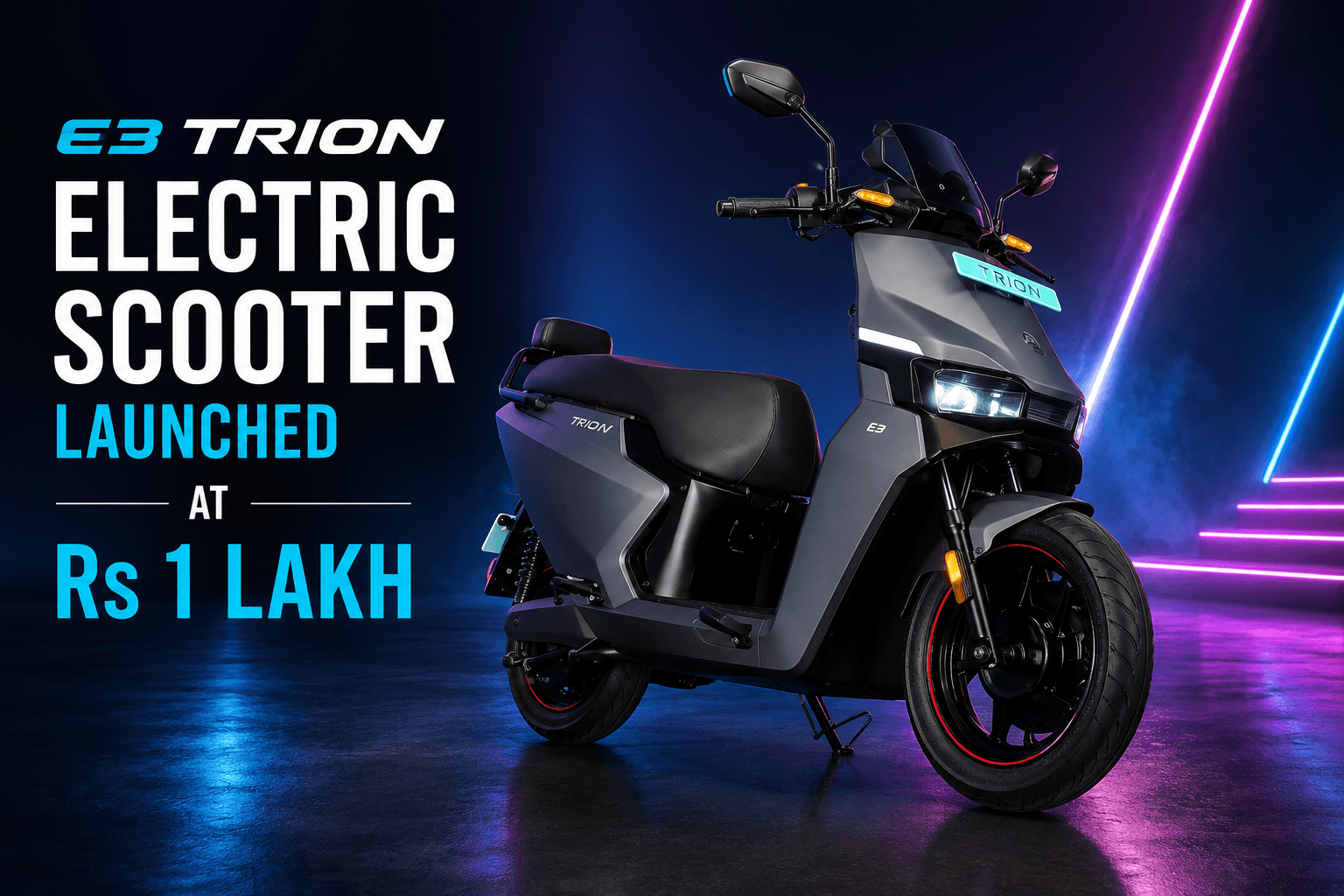
E3 Trion Electric Scooter Launched at ₹99,999: A Bengaluru deeptech startup just launched an electric scooter and called it, without much hesitation, “India’s first AI-powered intelligent electric scooter.” That’s a big claim in a market where Ather has spent a decade building software credibility and TVS has an entire connected-vehicle ecosystem behind the iQube. The question worth asking isn’t whether E3 Electric.AI’s marketing language is bold — it clearly is — but whether the E3 Trion’s actual spec sheet backs it up, and whether ₹99,999 buys something genuinely different or just another commuter scooter with a chatty app.
What the Trion actually offers
E3 Electric.AI, founded in 2024 by Sanjeev P., has launched the Trion in three trims: C1, C1x and C2, priced at ₹99,999, ₹1.10 lakh and ₹1.20 lakh respectively (ex-showroom, Bengaluru, introductory pricing), according to the company’s own launch statement.
The entry C1 runs a removable 2.3 kWh LFP battery — good for home charging without a dedicated wall box. The C1x and C2 step up to a fixed 3 kWh LFP pack. E3 claims an IDC-certified range of 165 km for the C1x; the C1’s range figure hasn’t been published yet, which is an odd gap for a company leaning this hard on transparency as a brand pillar.
The C2, the range-topper, claims an 82 kph top speed and 0–40 kph in 6 seconds — reasonable numbers for the category, not segment-leading. All three variants use a PMSM hub motor, but E3 hasn’t disclosed power output figures for any of them. For a company positioning itself on data and precision, withholding motor wattage is a curious omission, and one every prospective buyer should ask about directly before booking.
The AI pitch: substance or software polish?
Here’s where E3 is trying to differentiate. According to the company, its connected suite is built around what E3 calls the E3 CommandCenter — a vehicle-and-cloud data system meant to deliver predictive diagnostics and service alerts before a fault becomes a breakdown. A companion feature, AI HealthScan, claims to run a full vehicle diagnostic in 10 seconds. The battery pack itself gets an AI Digital Twin, which is supposed to model degradation and flag issues in real time.
None of this is unprecedented — Ather’s software stack already does OTA updates and ride analytics, and TVS’s SmartXonnect platform offers geofencing and diagnostics too. What’s different is the framing: E3 is betting that predictive maintenance, not top speed or torque, is the actual pain point stopping more Indian families from going electric. That’s a reasonable hypothesis. Range anxiety and unpredictable service costs are genuinely the two most common objections raised by first-time EV buyers in India, ahead of raw performance.
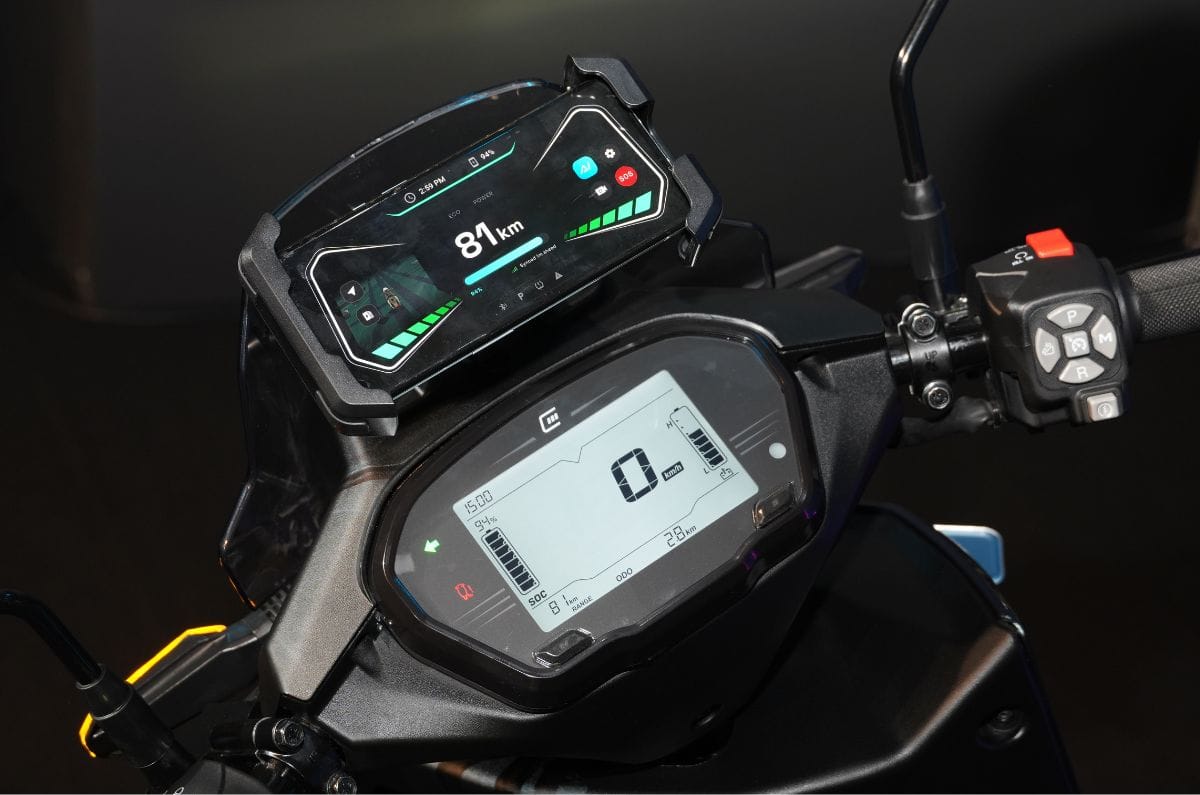
The rider-facing layer, TripSense, turns your phone into a secondary display for navigation, trip planning with charger locations, remote battery monitoring, geofencing, SOS assistance and even a dashcam function. A 5-inch LCD (not a TFT) handles the primary dash. Add dual-projector LED headlights, IP67 weather sealing, and 52 litres of combined storage — a genuinely useful number if the underseat compartment alone accounts for a meaningful share of it, though E3 hasn’t broken that figure down separately.
Where the Trion sits against Ather, TVS, Bajaj and Ola
This is the section that matters most for a buyer with ₹1 lakh to spend.
- Ather Rizta: ₹1.21–1.32 lakh, ~140 km real-world range, disc brakes, Ather Grid fast-charging network, the most polished software ecosystem in the category.
- TVS iQube: ₹1.13–1.15 lakh at entry, up to 160–170 km on the ST 5.3 kWh variant, Battery-as-a-Service option to lower upfront cost.
- Bajaj Chetak: from ~₹87,100 at the very base, steel body construction, IP67 protection, reverse assist, ~120 km range on the 3501 variant.
- Ola S1 X Plus: ~₹1.20 lakh.
- E3 Trion: ₹99,999–1.20 lakh, 165 km claimed (IDC, C1x only), unproven service network.
On price, the Trion C1 undercuts every established rival at entry level. On range, the C1x’s 165 km claim is competitive with, though not superior to, the TVS iQube ST’s real-world numbers. On brand trust, E3 is starting from zero. Ather, TVS and Bajaj all have thousands of service touchpoints and years of failure-mode data. E3 has Bengaluru pre-bookings and a promise of “more markets to follow.”
That last point is the real risk for early buyers. An 8-year, 1-lakh-km extended warranty sounds generous — according to manufacturer comparisons, it’s longer than most rivals offer — but a warranty is only as good as the company’s ability to still be operating, and staffed with technicians, when you need to invoke it. India’s electric two-wheeler space has already seen well-funded start-ups struggle with service quality once volumes scale past their home city. E3 hasn’t been tested at that scale yet.
The honest read for a first-time buyer
If you’re in Bengaluru, comfortable being an early adopter of a new brand, and the AI-diagnostics pitch genuinely appeals to you, the Trion C1 at ₹99,999 is a legitimate consideration — especially if predictive service alerts save you from an unexpected roadside battery failure even once.
If you’re outside Bengaluru, or you want the reassurance of a proven service network and resale value, the smarter move right now is Bajaj Chetak (lowest entry cost, strongest build reputation) or TVS iQube (best range-to-price ratio with the BaaS option). Ather remains the software leader if that ecosystem matters more to you than raw price.
E3’s real test isn’t the Trion’s spec sheet — it’s whether the company can execute service delivery at scale over the next 18 months. That’s not something any press release can answer.
FAQs
What is the price of the E3 Trion electric scooter? The E3 Trion is priced at ₹99,999 for the C1, ₹1.10 lakh for the C1x, and ₹1.20 lakh for the C2 — all introductory, ex-showroom Bengaluru prices.
What is the range of the E3 Trion? E3 claims an IDC-certified range of 165 km for the C1x variant, powered by a 3 kWh LFP battery. Range figures for the C1 and C2 have not been officially disclosed.
What makes the E3 Trion an “AI-powered” scooter? E3’s AI features include the CommandCenter for predictive diagnostics and service alerts, an AI HealthScan claiming 10-second vehicle diagnostics, and an AI Digital Twin for real-time battery monitoring — all delivered through the company’s TripSense connected app.
Is the E3 Trion available outside Bengaluru? Not yet. Pre-bookings have opened only in Bengaluru as of August 2026, with E3 saying other markets will follow, though no confirmed timeline has been announced.
How does the E3 Trion compare with the Ather Rizta or TVS iQube? The Trion undercuts both on entry price and matches the TVS iQube’s range claims on paper, but it lacks the proven service network, years of reliability data, and established resale value that Ather and TVS currently offer Indian buyers.