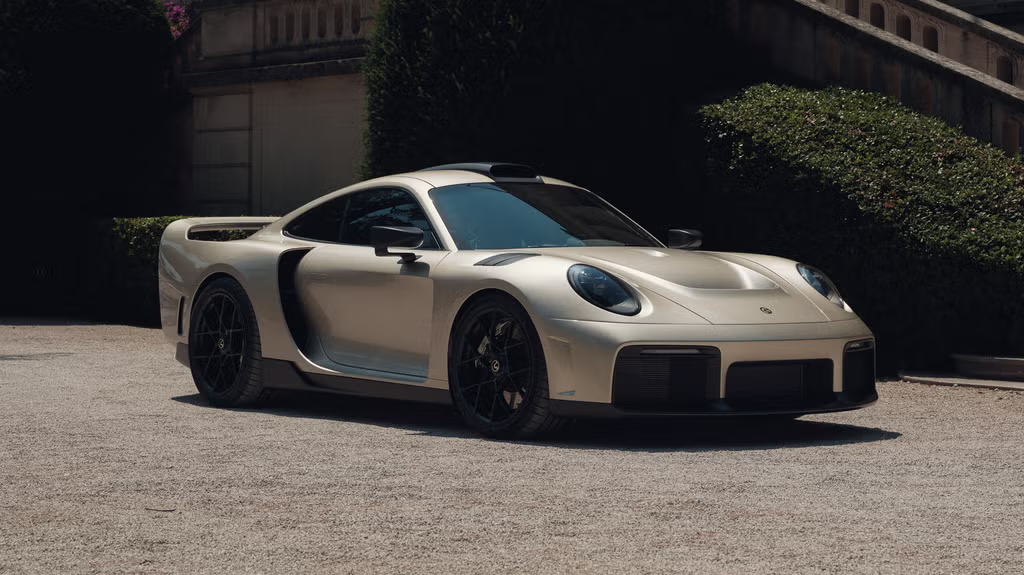
Marc Philipp Gemballa Marsien GT Revealed: Marc Philipp Gemballa has revealed the Marsien GT, a road-focused, 830-horsepower reinterpretation of the Porsche 911 Turbo S that trades the original Marsien’s dune-bashing suspension for a serious road-going chassis, ahead of its global premiere at the Pebble Beach Concours d’Elegance on August 13, 2026. It’s the second model in what has quickly become one of the more compelling stories in the bespoke supercar world — a small German outfit turning Porsche’s most capable production 911 into something that visually channels one of the marque’s most legendary cars, the 959, while charging nearly five times what the donor car costs.
Who is actually building this, and why the name is confusing
Before getting into the car itself, the naming needs untangling, because it trips up almost every first-time reader. Marc Philipp Gemballa GmbH is the company founded by Marc Philipp Gemballa, son of Uwe Gemballa, who founded the original Gemballa tuning company back in 1981. The two companies are explicitly, legally separate — Marc Philipp Gemballa GmbH states clearly that it is “not associated in any form with Gemballa, GmbH,” the older firm that still exists under different ownership. It’s a genuinely awkward situation for a small coachbuilder to navigate, but the RUF Automobile relationship — which built the engines for both the original Marsien and now the GT — traces back decades through the Gemballa family, giving Marc Philipp Gemballa’s operation real technical pedigree even as it works to establish its own separate identity.
The first Marsien launched in 2021 as a desert-focused, off-road-capable 911 conversion, limited to 40 units, with customer cars now delivered across more than 16 countries. The Marsien GT is the follow-up: a 30-unit run that keeps the visual DNA but abandons the rally-inspired long-travel suspension for something built purely for tarmac. Combined, the two models will total exactly 70 cars — a number chosen deliberately to mark what would have been Uwe Gemballa’s 70th birthday.
What the Marsien GT actually is, underneath the bodywork
Every Marsien GT starts life as a Porsche 911 (992-generation) Turbo or Turbo S before roughly 1,500 bespoke components go into the transformation — everything from the fully carbon-fibre body to the suspension, exhaust, wiring, lighting, aerodynamics and interior. That’s not a wide-body kit and a new bumper; it’s closer to a ground-up remanufacture built around a donor car’s core structure and drivetrain.
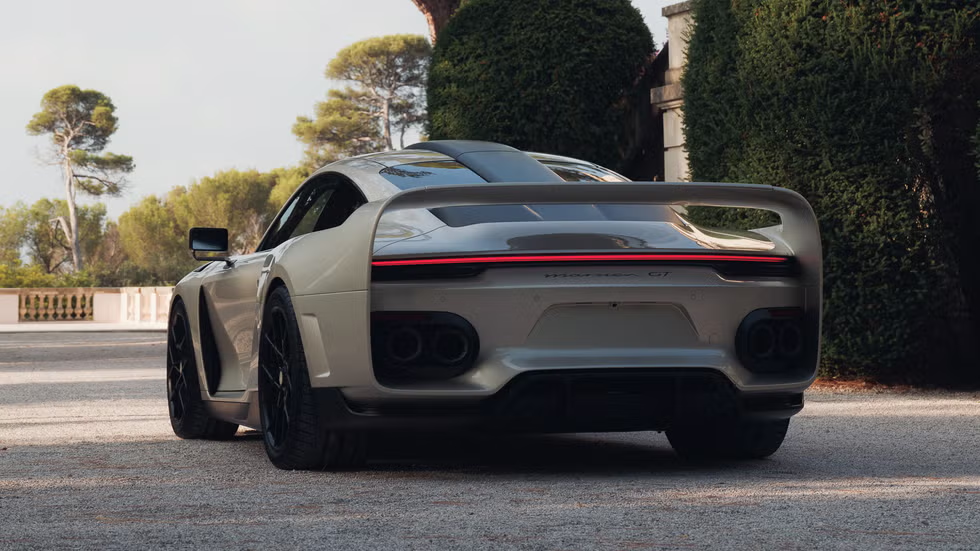
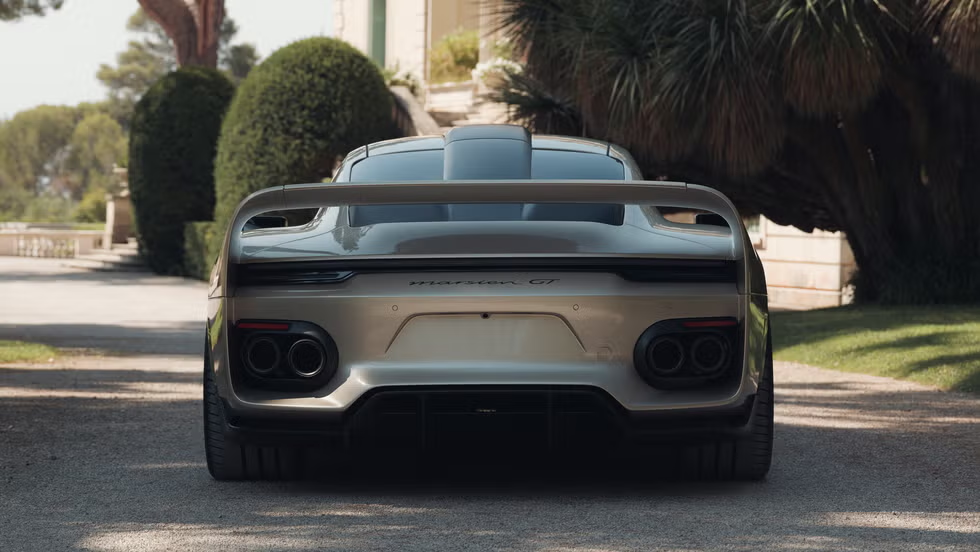
The exterior design, credited to French automotive designer Alan Derosier, leans unmistakably into the Porsche 959 at the rear — a deliberate homage that becomes obvious the moment you see the car’s tail treatment and roofline. At the front, the influence shifts toward the road-going Porsche GT1, and a roof-mounted scoop feeds air directly to the engine’s intercoolers, a genuinely functional element rather than styling flourish. Notably, Marc Philipp Gemballa says nearly every exterior panel on the GT is freshly designed compared to the original off-road Marsien — only the doors and the roof structure carry over, and even the roof gains that new scoop.
Aerodynamically, the GT adds active louvers on the front fenders that bleed off high-pressure air, a central hood-mounted fuel filler, and a large active rear wing. Unusually, the active aero components are actuated pneumatically rather than by electric motors — a choice the company says allows faster, more instantaneous response than motor-driven systems typically achieve, delivering higher stability, more downforce, and even a degree of air braking under hard deceleration.
The engine: RUF-built, 830 horsepower, more available
Under the rear deck sits a six-cylinder boxer engine developed with RUF Automobile, continuing a relationship between RUF and the Gemballa family stretching back decades. According to the company’s own performance claims, twin VTG (variable-turbine-geometry) turbochargers, revised ECU mapping, and transmission tuning push output beyond 830 horsepower and 930 Nm (roughly 687 lb-ft) of torque. Marc Philipp Gemballa has also confirmed, in its official announcement, an optional second-stage engine package targeting more than 900 horsepower for buyers who want even more headroom. A bespoke titanium quad exhaust system from Akrapovič handles the sound, engineered specifically to give the Marsien GT what the company calls a “distinct visual and acoustic signature” rather than simply amplifying the stock Porsche note.
Performance figures back up the hardware: according to the manufacturer’s claimed figures, a 0–60 mph time of 2.4 seconds and a top speed of around 205 mph (330 kph). The car retains the Porsche 911 Turbo S’s all-wheel-drive system, but the suspension is entirely bespoke — Marc Philipp Gemballa partnered with KW Automotive to develop a new double-wishbone front setup specifically for the GT, using KW’s DDC V5 electronically controlled damping technology. These dampers can adjust compression and rebound in real time, responding to changing road surfaces in as little as 20 milliseconds — a genuinely quick reaction time that’s intended to deliver precise handling without sacrificing the ride comfort expected of a car pitched as a grand tourer rather than a track weapon. Weight savings are modest but real: reports place the GT somewhere between 150 and 165 pounds (roughly 68–75 kg) lighter than a standard Turbo S, achieved through the carbon body, a carbon undertray, and other lightweight components — figures that vary slightly between outlets but consistently point to a genuine, if not dramatic, reduction.
Inside the cabin
The interior carries the same bespoke ambition as the exterior. A raised centre console houses an aluminium gear lever directly inspired by the Porsche Carrera GT, with optional exposed-carbon or mahogany shift knobs available depending on the buyer’s taste. Alcantara trims the cabin as standard, with optional full carbon-fibre interior packages for buyers wanting a more motorsport-focused look, and an optional clubsport-style roll bar that can be finished in paint, leather, Alcantara, or bare exposed carbon fibre. Every single car carries a numbered plaque on the centre console — a small but deliberate reminder of the car’s extreme exclusivity.
The launch example revealed at Pebble Beach pairs dark grey Alcantara with carbon-fibre bucket seats and champagne-coloured stitching, seatbelts and instrument detailing, all matched to a bespoke four-layer “Anniversary Liquid Champagne Gold” paint finish created specifically to mark Uwe Gemballa’s 70th birthday — tying the car’s most visible design choice directly back to the reason the entire 70-unit production run exists.
Pricing, production, and where it lands in the market
Production is strictly limited to 30 units, priced at €770,000 (approximately $840,000) before taxes, duties, shipping, and — critically — before the cost of the donor 911 Turbo or Turbo S itself, which owners must separately provide or purchase. All-in, buyers should expect a total cost well north of $900,000 once the base car and applicable taxes are factored in, positioning the Marsien GT firmly in hypercar territory despite its Porsche 911 underpinnings.
The Marsien GT will make its world premiere and North American debut across several stops during Monterey Car Week 2026, according to the company’s published schedule, including appearances at the 18th Lawn at Pebble Beach, The Quail, A Motorsports Gathering, and the Pebble Beach Concours d’Elegance Concept Lawn itself on August 13. Marc Philipp Gemballa has not announced a firm production start date, but first customer deliveries are expected toward the end of 2027 — a lead time that reflects just how much custom fabrication goes into each of the roughly 1,500 bespoke components per car.
Why this matters beyond the ultra-wealthy collector set
For most people, a $840,000-plus 911 conversion is pure spectacle, the same way the Bugatti Destrier or a Rolls-Royce coachbuilt commission is spectacle — genuinely unreachable, and not really meant to be reached by ordinary buyers. But the Marsien GT is worth understanding for what it represents in the broader restomod and bespoke-coachbuilding economy: a small, independent operation with deep technical roots in the Porsche tuning world (via its RUF relationship) building genuinely engineered, not merely cosmetic, transformations of an already extreme donor car, and finding enough demand across 16-plus countries to justify a second 30-unit production run within five years of its debut. That’s a meaningful signal about how much appetite exists at the very top of the automotive market for cars that are provably rare, mechanically serious, and visually tied to genuine automotive history rather than just a fresh paint job on a stock platform.
FAQs
How much does the Marc Philipp Gemballa Marsien GT cost? The Marsien GT is priced at €770,000 (approximately $840,000) before taxes, duties, shipping, and the cost of the donor Porsche 911 Turbo or Turbo S, which buyers must separately supply.
How many Marsien GT units will be produced? Production is limited to 30 units of the Marsien GT, adding to the 40 units of the original off-road Marsien, for a combined total of 70 cars — a number chosen to honour what would have been Uwe Gemballa’s 70th birthday.
What engine does the Marsien GT use? A RUF-developed twin-turbocharged flat-six boxer engine producing more than 830 horsepower and 930 Nm (687 lb-ft) of torque, with an optional second-stage package targeting over 900 horsepower.
What car is the Marsien GT based on? The Marsien GT is based on the Porsche 911 (992-generation) Turbo or Turbo S, reworked with approximately 1,500 bespoke components including a full carbon-fibre body, custom suspension, and a Ruf-tuned powertrain.
When will the Marsien GT be delivered to customers? The Marsien GT makes its public debut at Pebble Beach on August 13, 2026, with first customer deliveries expected toward the end of 2027.