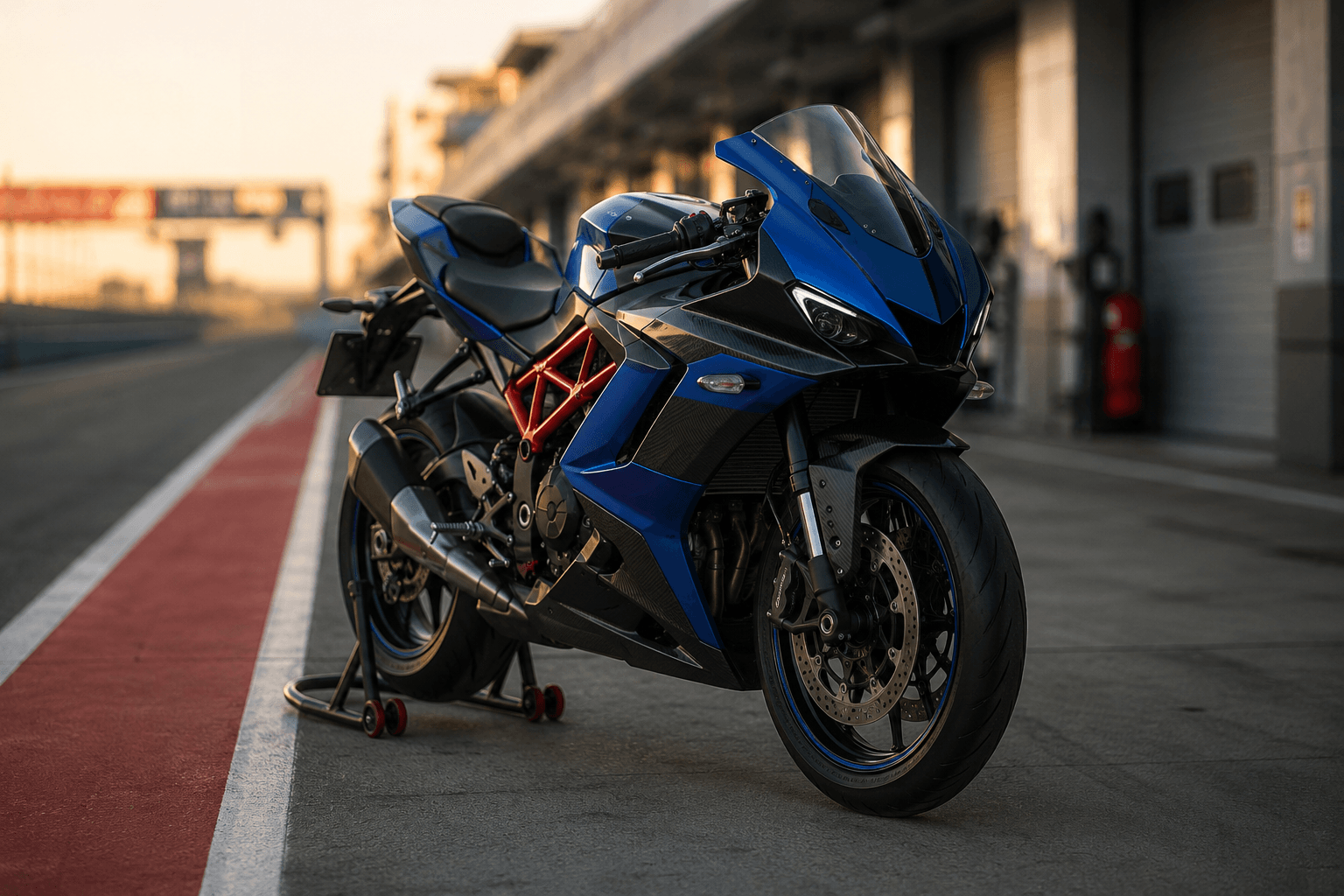
Yamaha India will launch the YZF-R2 on 27 August 2026, filling a decade-old gap in its fully-faired sportbike lineup between the 155cc R15 and the twin-cylinder R3. Media invites for the event have already gone out, and pre-bookings are expected to open the same day, with deliveries lined up for the festive season. If Yamaha prices it in the widely reported Rs 2.10-2.40 lakh window, the R2 will land directly on top of the KTM RC 200, Bajaj Pulsar RS200 and Hero Karizma XMR 210 — the three bikes that currently define the sub-Rs 2.5 lakh entry-supersport segment.
Here is a complete breakdown of what the R2 is, why Yamaha is launching it now, and how it changes the buying decision for anyone shopping in the entry-level sportbike segment.
The launch date is confirmed. Here’s why August 27 matters
Yamaha Motor India has sent media invites for an event on 27 August 2026. Multiple independent trade publications, including Autocar India, ZigWheels, BikeWale and RushLane, have identified this as the R2 launch date. The name YZF-R2 was trademarked in India by Yamaha Motor Co. in late 2025, and the bike is internally referred to by the development codename 070.
Two things make the timing strategically deliberate:
First, festive season sales in India (August to Diwali) account for roughly 30-35% of annual two-wheeler volumes. Launching a debut product two months before Diwali gives Yamaha time to build media coverage, open bookings, prime dealers and start deliveries before the peak buying window closes.
Second, the launch precedes the anticipated updates to key rivals. Hero MotoCorp is expected to launch the Karizma XMR 250, KTM has not refreshed the RC 200 in several years, and Bajaj’s Pulsar RS lineup is due for a generational rethink. Yamaha is moving into a segment where the incumbent products are aging — a classic first-mover window.
What the R2 actually is: the R15’s platform, upsized
Yamaha has taken the pragmatic route with the R2. Rather than developing an all-new architecture, industry reports converge on the R2 using an evolution of the 155cc single-cylinder liquid-cooled engine that powers the R15, MT-15 and XSR 155 — bored out to approximately 200cc.
Expected mechanical specification, based on trade reporting:
- Engine: Approx 200cc, single-cylinder, liquid-cooled, four-valve SOHC
- Fuel delivery: Electronic fuel injection
- VVA: Yamaha’s Variable Valve Actuation carried over from the R15 platform
- Peak output: Roughly 23-25 PS and 18-20 Nm of torque
- Transmission: 6-speed with assist & slipper clutch, possibly a bi-directional quickshifter
- Frame: Deltabox chassis, shared conceptually with the R15
- Suspension: Upside-down front forks and a linked rear monoshock
- Wheels: 17-inch alloys, disc brakes both ends, dual-channel ABS
The strategic logic here is important. According to Autocar India, the R2 has been designed and developed in India and will be manufactured at Yamaha’s Chennai facility. Using a bored-out variant of an existing engine cuts tooling investment, shortens the homologation cycle, and — critically — lets Yamaha keep the price under Rs 2.5 lakh. A ground-up 200cc engine would have pushed the R2 closer to the R3’s Rs 3.5-lakh territory and defeated the entire purpose of the launch.
For riders, the trade-off is honest: the R2 is not going to be a 40-horsepower rocket. It is a bigger, more highway-capable R15, tuned for the buyer who has outgrown the 155cc but does not want to jump to a twin-cylinder CBU.
Features and technology: what to expect on the equipment list
Yamaha’s R-series in India has moved sharply upmarket on features over the past three years. The R15 V4 already offers a colour TFT display, Y-Connect Bluetooth connectivity, traction control (on the M variant) and a quickshifter. The R2, positioned above the R15, needs to offer at least the same and preferably more to justify its price.
Reasonable expectations, based on Yamaha’s segment behaviour and reporting from BikeDekho and DriveSpark:
- Full-colour TFT instrument cluster with smartphone connectivity
- Yamaha Y-Connect integration for notifications, ride analytics, maintenance reminders
- Turn-by-turn navigation
- Multiple ride modes
- Traction control
- Bi-directional quickshifter (highly likely on the top variant)
- Full LED lighting with sportier DRL signature
- Possibly cruise control on the top spec
If Yamaha holds back the quickshifter or traction control for a higher “M” variant, it opens up an easy price stack — a base R2 in the Rs 2.15 lakh range and a fully-loaded R2 M around Rs 2.40 lakh, matching how the R15 range is structured today.
The segment analysis: who the R2 competes with, and what it can steal
The 200-250cc entry-supersport segment in India is smaller than most people assume — but it is high-margin, brand-defining and dominated by exactly three bikes at the moment.
KTM RC 200 (Rs 2.24 lakh, ex-showroom Delhi): 199.5cc single-cylinder producing 25 PS and 19.2 Nm. Known for track-focused ergonomics and racy character, but interior finish and Bluetooth-era features have not aged well. This is the R2’s most direct rival on specifications.
Bajaj Pulsar RS200 (approx Rs 1.79 lakh): 199.5cc single, 24.5 PS and 18.7 Nm. The most affordable option, but the platform is over a decade old and the design language is now firmly last-generation.
Hero Karizma XMR 210 (Rs 1.84-1.86 lakh): 210cc, 25 PS and 20.4 Nm. Newer platform (relaunched 2023), reasonably well-equipped, but Hero is still building sportbike credibility with premium buyers.
Suzuki Gixxer SF 250 (approx Rs 2 lakh): 249cc air-oil-cooled single, 26 PS and 22.2 Nm. More displacement but oil-cooled, semi-faired styling and simpler electronics compared to a modern super-sport.
If the R2 lands with a Bluetooth TFT, quickshifter, VVA-assisted low-end and Yamaha’s refinement DNA — and prices below Rs 2.25 lakh — the RC 200 is the most vulnerable rival. KTM riders who prioritize dealer network, resale value and daily-usability tend to lean Yamaha anyway.
The R2 is unlikely to seriously threaten the Karizma XMR at its lower price point, or the Gixxer SF 250 buyers who specifically want more displacement. The realistic target is the RC 200 defector and the R15 owner who is upgrading in-brand.
What this means for the R15
An important clarification: Yamaha has confirmed to trade press that the R15 is not being discontinued. The R2 will co-exist with the R15 V4 and R15 M, sold through the same dealer network.
This dual-model strategy is deliberate. The R15 remains India’s top-selling premium sportbike in the 150cc class with a devoted community and race-school following. Killing it to make room for the R2 would surrender that base to Bajaj’s Pulsar N160 and the Hero Xtreme 200S. Instead, Yamaha now gets a natural in-brand upgrade path — first bike an R15 at Rs 1.75 lakh, second bike an R2 at Rs 2.20 lakh, aspirational bike an R3 or MT-03 at over Rs 3.5 lakh.
For the buyer, this simplifies the decision. If the primary use is city commuting with occasional weekend rides, the R15 remains the right pick. If highway cruising, longer touring, or a more grown-up ride position matters, the R2 is the natural step up without leaving the R-series.
Realistic price expectation and what to watch for on August 27
The strongest price signal comes from Autocar India’s positioning analysis, which places the R2 between the top-spec R15 M (Rs 1.98 lakh) and the KTM RC 200 (Rs 2.24 lakh). Multiple outlets converge on Rs 2.10-2.40 lakh (ex-showroom, introductory).
If Yamaha prices the base R2 aggressively — say Rs 2.10-2.15 lakh — it undercuts the RC 200 and puts direct pressure on KTM. If the base variant lands at Rs 2.25 lakh or higher, Yamaha is banking on brand pull and feature parity rather than pricing pressure, which historically works for Yamaha but leaves the door open for Hero to counter with a Karizma XMR variant refresh.
Three specific things to watch when Yamaha reveals the R2 on August 27:
- The engine’s actual output figure — anything above 25 PS is a positive surprise, anything at or below 22 PS is a red flag against the RC 200.
- Whether the quickshifter is standard or restricted to a top variant — this signals how Yamaha is stacking the price ladder.
- The delivery timeline — anything past Navratri (October) risks missing the festive window entirely and pushes real sales momentum into Q4.
Bookings are expected to open the same day, with deliveries lined up for late September or October to coincide with festive season buying.
FAQs
When is the Yamaha YZF-R2 launching in India? The Yamaha YZF-R2 is expected to launch in India on 27 August 2026, based on media invites Yamaha Motor India has sent out. Pre-bookings are expected to open the same day, with deliveries planned before the festive season.
What will be the expected price of the Yamaha R2? The Yamaha R2 is expected to be priced between Rs 2.10 lakh and Rs 2.40 lakh (ex-showroom) in India, according to independent forecasts from ZigWheels, BikeWale, RushLane and Autocar India. This positions it above the top-spec R15 M and around the KTM RC 200.
Will the Yamaha R2 replace the R15? No. Multiple reports confirm the R15 will continue on sale alongside the R2. The R15 remains Yamaha’s entry-level R-series offering, while the R2 will sit between the R15 and the R3 in the lineup.
What engine does the Yamaha R2 use? The R2 is expected to use a new 200cc liquid-cooled single-cylinder engine derived from the R15’s 155cc platform, featuring Yamaha’s VVA (Variable Valve Actuation) technology. Peak output is expected to be around 23-25 PS and 18-20 Nm of torque.
Who are the Yamaha R2’s main rivals? The R2’s primary rivals will be the KTM RC 200, Bajaj Pulsar RS200 and Hero Karizma XMR 210. Depending on the final price, the Suzuki Gixxer SF 250 could also be cross-shopped by buyers considering a step into the 250cc segment.
Is the R2 being made in India? Yes. According to Autocar India, the R2 has been designed and developed in India and will be manufactured at Yamaha’s Chennai plant. It will also be exported to global markets, including Japan, Indonesia and Thailand.