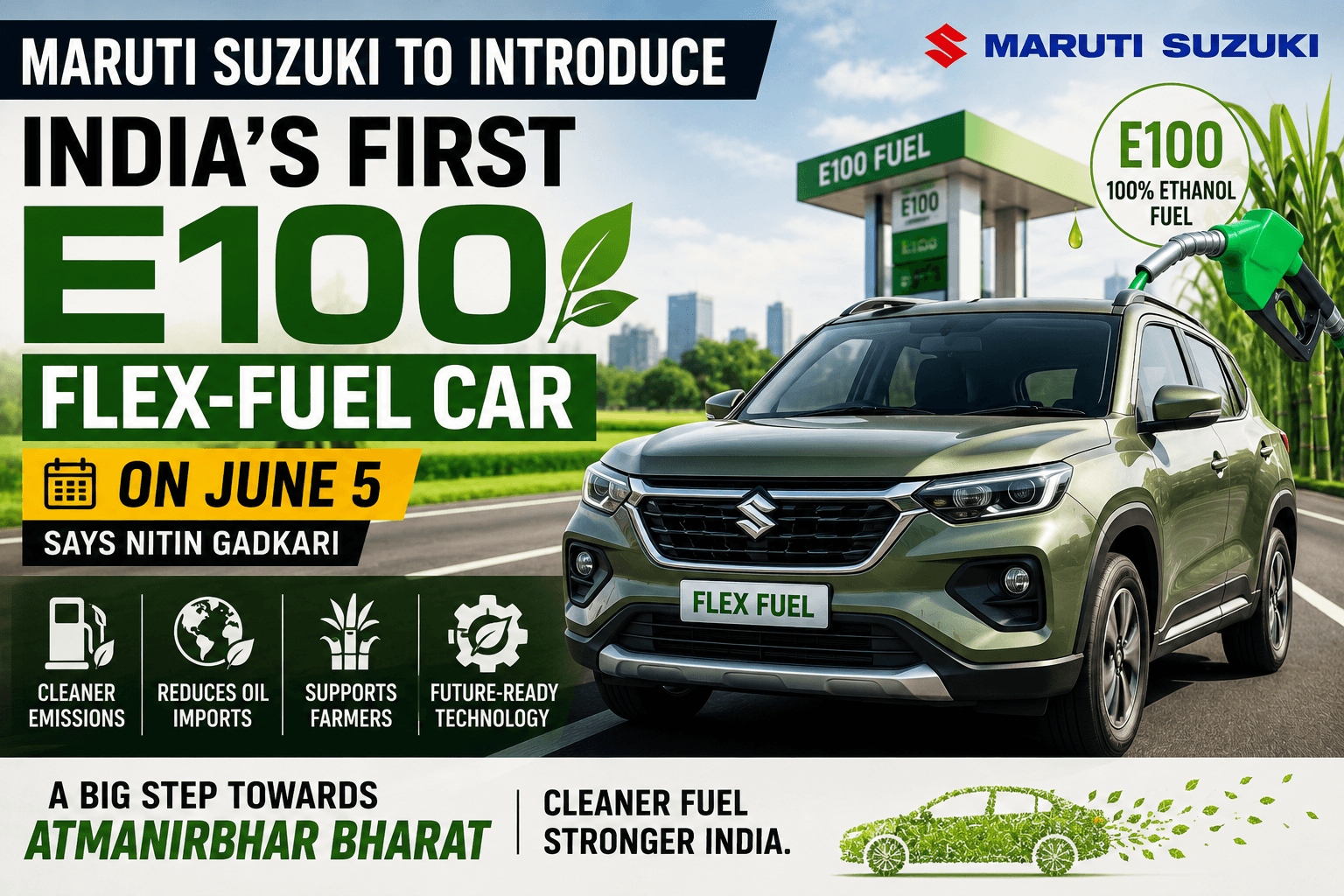
India’s automotive industry is preparing for a major milestone as Maruti Suzuki gets ready to introduce the country’s first E100 flex-fuel car on June 5. The announcement, made by Union Minister Nitin Gadkari, signals a major push toward ethanol-powered mobility and alternative fuel technologies in India.
The move is especially significant because it aligns with India’s broader strategy to:
- Reduce dependence on imported crude oil
- Lower vehicle emissions
- Promote renewable energy
- Support domestic ethanol production
While electric vehicles continue to dominate conversations about future mobility, ethanol-powered flex-fuel vehicles are emerging as another important solution for cleaner transportation.
For Indian automobile enthusiasts and car lovers, Maruti Suzuki’s E100 flex-fuel car could represent the beginning of a new chapter in the country’s automotive evolution.
India’s Big Step Toward Ethanol Mobility
The upcoming launch marks one of India’s most important developments in alternative fuel mobility.
Union Minister Nitin Gadkari has consistently advocated for:
- Ethanol blending
- Flex-fuel technology
- Biofuel adoption
- Reduced fossil fuel dependency
India has already accelerated its E20 fuel rollout across the country. However, E100 represents a far more aggressive step toward renewable fuel adoption.
The launch also highlights the government’s long-term vision of diversifying India’s transportation energy ecosystem beyond conventional petrol and diesel.
What Is an E100 Flex-Fuel Car?
Understanding E100 Fuel
E100 refers to:
- Fuel made entirely from ethanol
- 100% biofuel without petrol blending
Ethanol is typically produced using:
- Sugarcane
- Corn
- Agricultural waste
- Biomass sources
Unlike conventional petrol, ethanol is renewable and cleaner-burning.
How Flex-Fuel Engines Work
Flex-fuel vehicles are specially engineered to run on:
- Petrol
- Ethanol blends
- Pure ethanol fuels like E100
The engine management system automatically adjusts:
- Fuel injection
- Ignition timing
- Air-fuel ratio
depending on the fuel composition.
This flexibility allows drivers to use multiple fuel types without manual adjustments.
Difference Between Petrol and Ethanol Vehicles
Compared to regular petrol engines, E100-compatible vehicles require:
- Ethanol-resistant fuel lines
- Corrosion-resistant materials
- Specialized ECU calibration
- Modified fuel injectors
Regular petrol vehicles cannot safely run on pure E100 fuel without major modifications.
Why Maruti Suzuki Is Investing in Flex-Fuel Technology
Maruti Suzuki’s entry into flex-fuel mobility reflects changing industry priorities.
The company is likely focusing on:
- Lower emissions compliance
- Alternative fuel readiness
- Long-term sustainability
- Government policy alignment
India’s largest carmaker also understands that internal combustion engines may continue to play a major role in India for years, especially in regions where EV infrastructure remains limited.
Flex-fuel technology offers a practical bridge between conventional ICE vehicles and future electrified mobility.
Benefits of E100 Ethanol Cars
Lower Carbon Emissions
Ethanol-based fuels produce lower greenhouse gas emissions compared to traditional petrol.
Since ethanol comes from plant-based sources, part of the emitted carbon is offset during crop growth.
This helps reduce:
- Carbon monoxide emissions
- Tailpipe pollutants
- Overall carbon footprint
Reduced Oil Import Dependency
India imports a significant portion of its crude oil needs.
Increasing ethanol adoption can help:
- Reduce fuel import costs
- Improve energy security
- Strengthen economic stability
This remains one of the biggest drivers behind India’s ethanol strategy.
Support for Indian Agriculture
Ethanol production creates opportunities for:
- Sugarcane farmers
- Biofuel industries
- Rural economies
This makes flex-fuel technology economically attractive beyond just the automotive sector.
Renewable and Sustainable Fuel
Unlike fossil fuels, ethanol can be continuously produced using agricultural feedstock.
This makes E100 fuel part of a broader renewable energy ecosystem.
Challenges of E100 Fuel Adoption
Infrastructure Limitations
One major challenge is fuel availability.
India currently lacks:
- Widespread E100 fueling stations
- Dedicated ethanol supply chains
- Large-scale distribution infrastructure
Building this ecosystem will require significant investment.
Fuel Efficiency Concerns
Ethanol contains less energy per litre compared to petrol.
This means:
- Higher fuel consumption
- Potentially lower mileage
Although ethanol burns cleaner, efficiency trade-offs still exist.
Vehicle Compatibility
Only specially engineered flex-fuel vehicles can safely use E100.
Existing petrol vehicles are not designed for:
- High ethanol concentrations
- Ethanol corrosion characteristics
- Different combustion properties
Technical Changes in Flex-Fuel Vehicles
Flex-fuel engines require several modifications including:
- Upgraded fuel injectors
- Specialized sensors
- Corrosion-resistant fuel systems
- Modified combustion mapping
Ethanol also has:
- Higher octane rating
- Cooler combustion characteristics
This can potentially improve engine performance and reduce knocking.
What This Means for India’s Automotive Industry
The launch of India’s first E100 flex-fuel car could influence the future direction of the automotive market significantly.
Potential impacts include:
- Increased biofuel investments
- More flex-fuel vehicle launches
- Slower immediate dependence on EVs
- Expanded alternative fuel strategies
Automakers may increasingly explore:
- Hybrid ethanol vehicles
- Flex-fuel SUVs
- Ethanol-powered commercial vehicles
Maruti Suzuki’s Role in India’s Green Mobility Push
Maruti Suzuki has been gradually expanding its sustainable mobility strategy.
The company is already investing in:
- Hybrid vehicles
- CNG technology
- Flex-fuel systems
- Future EV platforms
Instead of relying solely on battery electric vehicles, Maruti appears focused on offering multiple low-emission mobility solutions tailored for Indian conditions.
Could Flex-Fuel Cars Become Mainstream in India?
The future of flex-fuel vehicles in India depends on several factors:
- Fuel availability
- Government incentives
- Infrastructure development
- Consumer awareness
If ethanol production and supply improve significantly, flex-fuel cars could become a practical option for millions of Indian buyers.
However, widespread adoption will take time.
Final Verdict
Maruti Suzuki’s upcoming E100 flex-fuel car represents one of the most important developments in India’s alternative fuel journey.
By introducing:
- Renewable ethanol fuel compatibility
- Cleaner combustion technology
- Reduced oil dependency potential
Maruti Suzuki could help accelerate India’s transition toward more sustainable mobility.
While electric vehicles continue gaining momentum, flex-fuel technology may emerge as a highly relevant parallel solution for India’s unique automotive and infrastructure landscape.
For Indian automobile enthusiasts and car lovers, the June 5 launch could mark the beginning of a major transformation in how India powers its vehicles.
What is an E100 flex-fuel car?
An E100 flex-fuel car can run on 100% ethanol fuel using specially designed engine and fuel system components.
Which Maruti Suzuki car will use E100 fuel?
The exact model has not yet been officially confirmed.
Is ethanol fuel better than petrol?
Ethanol produces lower emissions and is renewable, but it also has lower energy density than petrol.
Can regular cars run on E100 fuel?
No, only specially engineered flex-fuel vehicles can safely use pure ethanol fuel.
When will E100 fuel become widely available in India?
India is currently expanding ethanol infrastructure gradually, but nationwide E100 availability may still take several years.