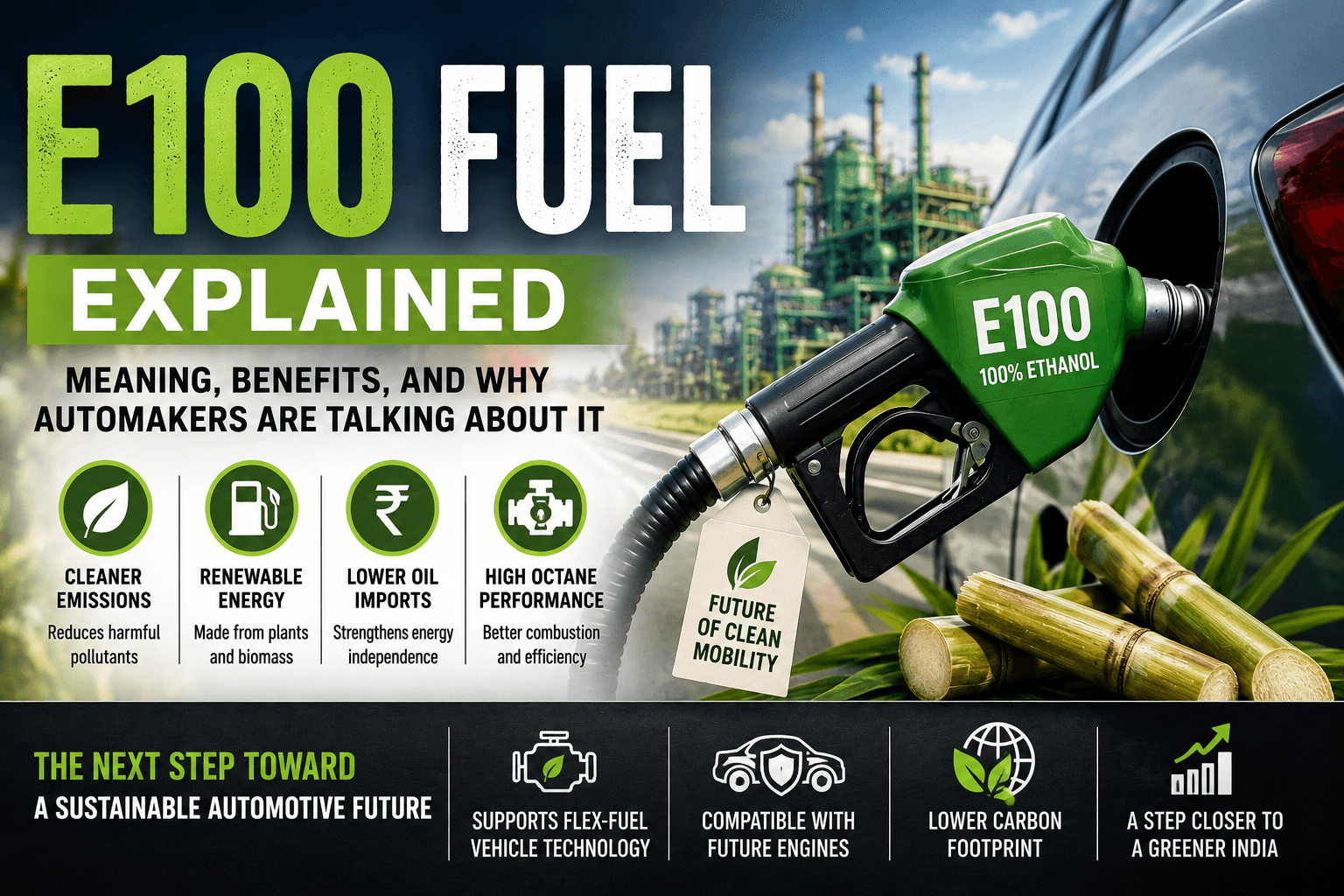
As the global automotive industry searches for cleaner and more sustainable alternatives to conventional petrol and diesel, ethanol-based fuels are gaining serious attention. One of the most talked-about developments recently is E100 fuel — a fuel composed entirely of ethanol.
Governments, automakers, and energy companies are increasingly discussing ethanol fuels because they offer a potential pathway toward lower emissions, reduced oil dependency, and improved energy sustainability.
In India especially, where fuel imports place enormous pressure on the economy, E100 fuel could eventually become an important part of the country’s long-term mobility strategy.
But what exactly is E100 fuel, how does it work, and why are automakers suddenly paying attention to it?
Let’s break it down.
What Is E100 Fuel?
E100 simply refers to fuel made from:
- 100% ethanol
- No petrol blending
Ethanol itself is an alcohol-based renewable fuel commonly produced from:
- Sugarcane
- Corn
- Biomass
- Agricultural waste
Currently, most countries use blended fuels such as:
- E10 (10% ethanol)
- E20 (20% ethanol)
India has already accelerated its E20 fuel rollout nationwide. However, E100 represents a much more aggressive shift toward renewable fuel usage.
Unlike traditional petrol, ethanol burns cleaner and produces fewer harmful emissions.
Why Is E100 Fuel Becoming Important?
Reducing Oil Dependency
India imports a massive portion of its crude oil requirements.
By increasing ethanol usage, the country can:
- Reduce fuel import bills
- Improve energy security
- Support local agriculture industries
This is one of the biggest reasons why policymakers are strongly promoting ethanol blending.
Lowering Vehicle Emissions
Environmental concerns are another major factor.
Compared to petrol, ethanol-based fuels can help reduce:
- Carbon monoxide emissions
- Particulate matter
- Greenhouse gas output
As global emission regulations become stricter, automakers are exploring alternative fuels more aggressively.
Supporting Renewable Energy Goals
Since ethanol is produced from renewable biological sources, E100 fuel aligns with broader sustainability and carbon-neutrality targets.
Many countries now view ethanol as a transitional solution alongside:
- Electric vehicles
- Hydrogen fuel
- Hybrid technologies
How E100 Fuel Works in Vehicles
Flex-Fuel Engine Technology
Vehicles running on E100 typically require:
- Flex-fuel engines
- Ethanol-compatible fuel systems
- Modified engine calibration
Flex-fuel vehicles can run on:
- Petrol
- Ethanol blends
- Pure ethanol
This gives consumers greater fuel flexibility.
Combustion Characteristics
Ethanol behaves differently from petrol during combustion.
Key characteristics include:
- Higher octane rating
- Cooler combustion temperatures
- Faster flame propagation
Higher octane levels can potentially improve engine performance and reduce knocking.
Engine Modifications Required
Because ethanol is chemically different from petrol, E100-compatible engines require:
- Corrosion-resistant fuel lines
- Specialized injectors
- Different air-fuel ratio tuning
- Enhanced cold-start systems
Regular petrol vehicles cannot safely run on pure E100 fuel without modifications.
Benefits of E100 Fuel
Lower Carbon Emissions
One of the biggest advantages of E100 is its lower carbon footprint.
Since ethanol comes from plant-based sources, part of the carbon released during combustion is offset by carbon absorbed during crop growth.
This makes ethanol significantly cleaner compared to fossil fuels.
Reduced Oil Imports
For countries like India, reducing crude oil imports can:
- Improve economic stability
- Reduce foreign exchange pressure
- Strengthen domestic energy independence
Renewable and Locally Produced
Unlike petrol, ethanol can be produced domestically using agricultural feedstock.
This also creates opportunities for:
- Farmers
- Rural industries
- Biofuel manufacturing sectors
Potential Performance Benefits
Because ethanol has a higher octane rating, performance-oriented engines can benefit from:
- Better combustion efficiency
- Higher compression ratios
- Improved throttle response
Some motorsport applications already use ethanol-based fuels for performance advantages.
Challenges and Limitations
Lower Energy Density
One drawback of ethanol is that it contains less energy per litre compared to petrol.
This means:
- Lower fuel efficiency
- Reduced driving range
Vehicles running on E100 may consume more fuel overall.
Infrastructure Requirements
E100 adoption would require:
- Specialized fuel stations
- Dedicated storage systems
- Modified fuel distribution infrastructure
Large-scale implementation remains challenging.
Engine Compatibility Issues
Existing petrol vehicles are not designed for E100.
Without proper modifications, pure ethanol can:
- Damage fuel systems
- Corrode components
- Affect engine durability
Cold Weather Starting Challenges
Ethanol engines may struggle with cold starts in low temperatures, though this is less problematic in India compared to colder countries.
Why Automakers Are Interested in E100
Automakers are investing in ethanol-compatible technology because:
- Governments are tightening emission norms
- Sustainability targets are becoming mandatory
- EV adoption remains gradual in many regions
Several manufacturers are already developing:
- Flex-fuel engines
- Ethanol-compatible hybrids
- Alternative combustion technologies
In India, brands like:
- Toyota
- Honda
- Maruti Suzuki
have shown increasing interest in flex-fuel technologies.
E100 Fuel in India
India’s ethanol strategy has accelerated significantly in recent years.
Key developments include:
- Nationwide E20 rollout
- Ethanol production expansion
- Government biofuel incentives
India’s strong sugarcane industry also supports ethanol production capacity.
Several pilot projects involving flex-fuel vehicles have already been showcased by automakers.
E100 vs Electric Vehicles
E100 and EVs represent two very different approaches to cleaner mobility.
E100 Advantages
- Faster refueling
- Existing ICE familiarity
- Lower infrastructure transition cost
EV Advantages
- Zero tailpipe emissions
- Higher efficiency
- Lower long-term operating costs
Many experts believe both technologies may coexist for years depending on market needs and infrastructure readiness.
Could E100 Fuel Become Mainstream in India?
E100 fuel still faces several technical and infrastructure hurdles before mass adoption becomes realistic.
However, growing government support and increasing automaker interest suggest ethanol-based mobility will continue expanding.
Potential future developments may include:
- More flex-fuel vehicles
- Dedicated ethanol infrastructure
- Improved engine technology
- Hybrid ethanol powertrains
India’s transition toward cleaner fuels is unlikely to rely on a single technology alone.
Final Verdict
E100 fuel represents one of the automotive industry’s most interesting alternative fuel solutions.
By offering:
- Renewable energy sourcing
- Lower emissions
- Reduced oil dependency
- Potential performance benefits
ethanol fuel could become an important component of India’s future mobility ecosystem.
While challenges remain, growing industry investment and government support indicate that E100 and flex-fuel technologies may play a larger role in the years ahead.
For Indian automobile enthusiasts and car lovers, understanding ethanol fuel technology is becoming increasingly important as the automotive world evolves beyond traditional petrol and diesel engines.
What is E100 fuel?
E100 is a fuel made entirely from ethanol without petrol blending.
Is E100 better than petrol?
E100 offers lower emissions and renewable sourcing benefits, but it also has lower energy density than petrol.
Can regular cars run on E100 fuel?
No, vehicles need specially designed flex-fuel engines and ethanol-compatible components.
Is E100 fuel available in India?
India is currently expanding E20 fuel usage, while E100 adoption remains limited and experimental.
Why are automakers investing in ethanol fuel?
Automakers are exploring ethanol fuels to meet emission regulations and reduce dependence on fossil fuels.