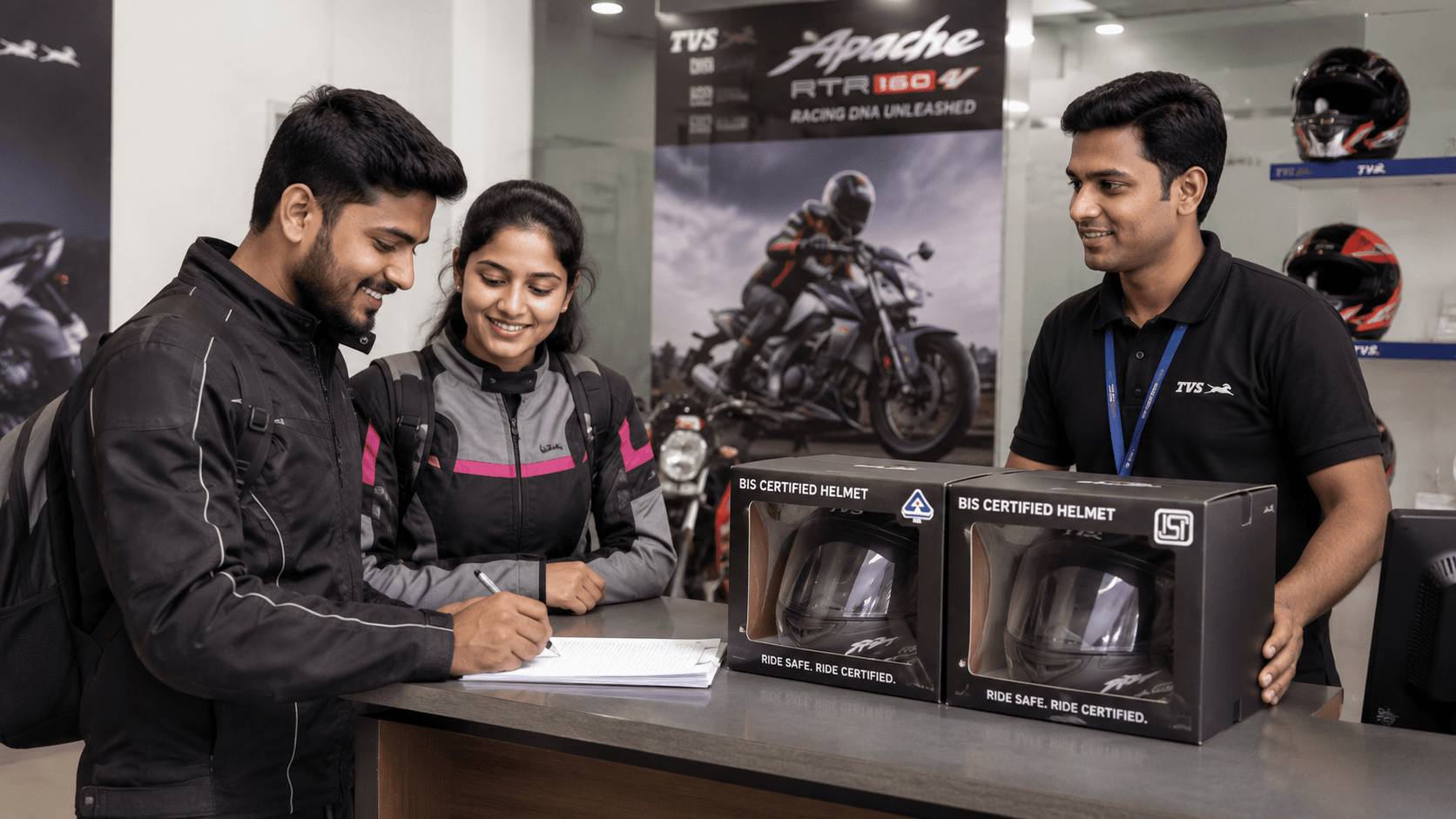
India’s two-helmet rule requires every dealer selling a new two-wheeler to supply two BIS-certified helmets – one for the rider and one for the pillion – as part of the on-road transaction. The rule was proposed by the Ministry of Road Transport and Highways (MoRTH) in a draft notification dated 23 June 2025 as an amendment to Rule 138(4)(f) of the Central Motor Vehicles Rules, 1989. It came into effect three months after the final gazette publication and now applies to all new two-wheelers across engine capacities. A parallel amendment made the Anti-Lock Braking System (ABS), conforming to IS 14664:2010, mandatory on all L2-category two-wheelers manufactured on or after 1 January 2026. Both helmets must carry a genuine ISI mark under IS 4151:2015. Section 129 of the Motor Vehicles Act, 1988 exemptions apply.
In this guide
- What is the two-helmet rule in one paragraph?
- When did the two-helmet rule actually come into force?
- What exactly does the rule say? (the legal text, decoded)
- What counts as a “BIS-certified” helmet under this rule?
- What about the ABS mandate that came at the same time?
- Who is exempt from the rule?
- What if you already own a two-wheeler bought before 2026?
- What should you demand at delivery in 2026?
- Are the free dealer-supplied helmets any good?
- What can dealers do if they run short of certified helmets?
- Penalties for dealers who don’t comply
- Does the rule apply to electric scooters and EVs?
- How the rule impacts two-wheeler prices
- Frequently asked questions
- Sources and references
What is the two-helmet rule in one paragraph?
The two-helmet rule is an amendment to Rule 138(4)(f) of the Central Motor Vehicles Rules, 1989, that requires every two-wheeler manufacturer or dealer to supply two BIS-certified protective helmets — conforming to IS 4151:2015 — with every new motorcycle or scooter sold in India. One helmet is for the rider; the second is for the pillion passenger. The rule was notified in draft form on 23 June 2025 by the Ministry of Road Transport and Highways and came into effect three months after the final gazette publication.
This replaces the earlier requirement, which obligated the dealer to supply only one BIS-certified helmet at the time of purchase. The pillion — statistically the more exposed and less protected of the two — was left to buy their own. Government analysis of crash data cited pillion under-protection as one of the largest single addressable gaps in India’s two-wheeler safety picture.
When did the two-helmet rule actually come into force?
The draft Central Motor Vehicles (Amendment) Rules, 2025 were published on 23 June 2025 for a 30-day public consultation. Under the draft text, the two-helmet requirement was set to take effect three months from the date of commencement of the final amendment rules — that is, three months after the final notification is published in the Gazette of India. The ABS mandate, by contrast, was locked to a specific manufacturing date: any L2-category two-wheeler produced on or after 1 January 2026.
The timeline, cleanly
- 23 June 2025: Draft notification of the Central Motor Vehicles (Amendment) Rules, 2025 published by MoRTH. Public consultation opens for 30 days.
- June–October 2025: Comments and objections filed by helmet manufacturers, two-wheeler OEMs, dealer associations and consumer groups. The Helmet Manufacturers Association (through Steelbird MD Rajeev Kapur) publicly flagged a possible supply-side shortfall and estimated that meeting demand would need approximately ₹6,000 crore of fresh investment and around 1 lakh new jobs.
- Late 2025: Final gazette notification of the amendment.
- 1 January 2026: ABS mandate takes effect for all newly manufactured L2-category two-wheelers, per Rule 96(4A).
- Three months after final gazette publication: The two-helmet supply obligation on manufacturers and dealers takes effect. By mid-2026, dealers across India are legally required to hand over two BIS-certified helmets with every new two-wheeler.
A note for careful readers: the ABS mandate’s “1 January 2026” date was written into the rule text itself. The two-helmet mandate’s effective date is tied to the gazette publication of the final amendment plus three months — not to a fixed calendar date. Some news coverage in early 2026 conflated the two dates. As of July 2026, the two-helmet rule is in force and dealers are required to comply.
What exactly does the rule say? (the legal text, decoded)
The operative text is an amendment to Rule 138(4)(f) of the Central Motor Vehicles Rules, 1989. It requires the manufacturer of a two-wheeler to supply two protective headgears conforming to BIS specifications at the time of purchase. The requirement does not apply to persons exempted under Section 129 of the Motor Vehicles Act, 1988.
The literal text (paraphrased from the draft notification)
“At the time of purchase of the two-wheeler, three months from the date of commencement of Central Motor Vehicles (Amendment) Rules, 2025, the manufacturer of the two-wheeler shall supply two protective headgears conforming to specifications prescribed by the Bureau of Indian Standards at the time of purchase of a two-wheeler.”
What the words mean in practice
- “Manufacturer of the two-wheeler” — the compliance obligation flows through the OEM (Hero, Honda, TVS, Bajaj, Royal Enfield, Yamaha, Suzuki, Ather, Ola Electric, TVS iQube manufacturers, and others). In practice, OEMs push the physical fulfilment down to their authorised dealer network, but the legal obligation sits at the manufacturer level.
- “Two protective headgears” — two helmets. Not one helmet and a headband; not one helmet with a “second helmet voucher”; not one helmet plus a discount coupon. Two actual, physical, BIS-certified helmets handed over at delivery.
- “Conforming to specifications prescribed by the Bureau of Indian Standards” — this refers to IS 4151:2015, the current mandatory Indian standard for two-wheeler helmets. Both helmets must carry a genuine embossed ISI mark and a valid BIS licence number in the CM/L format.
- “At the time of purchase” — the helmets must be delivered with the vehicle. Not shipped later, not promised on a follow-up invoice.
What counts as a “BIS-certified” helmet under this rule?
A BIS-certified helmet under this rule is one that has been certified by the Bureau of Indian Standards against IS 4151:2015 — the current Indian standard for two-wheeler protective helmets, in force under the Helmet for Riders of Two Wheeler Motor Vehicles (Quality Control) Order, 2020 (S.O. 4252(E) dated 26 November 2020). It must carry an embossed ISI mark, a printed IS 4151:2015 reference, and a unique BIS licence number in the CM/L format, verifiable through the free BIS Care app on Android and iOS.
The four things to physically check on each of the two helmets
- The ISI mark is embossed or moulded — never a peel-off sticker. Look for it on the rear of the shell, on the strap tag, or on the certification label bonded to the interior EPS liner.
- The IS 4151:2015 reference is printed nearby. If it says “IS 4151” without the year, ask; if it says “As per IS 4151” without a licence number, treat as suspect.
- A CM/L licence number is visible in the CM/L-XXXXXXX format. This is the unique BIS licence identifier for the manufacturer, and it is the single fastest way to verify authenticity.
- The licence checks out on the BIS Care app. Enter the CM/L number under “Verify Licence Details” — the app returns the manufacturer’s name, licence validity, and the models covered. If the licence shows as expired, cancelled, or if the model in your hand isn’t on the covered list, refuse the helmet.
A practical caution: the dealer-supplied helmets typically come from mainstream Indian manufacturers (Studds, Steelbird, Vega and their sub-brands). These are legitimate, BIS-certified brands. What varies is the quality tier — expect entry-level ABS-shell models sized to fit a broad range of head shapes, not premium touring helmets.
What about the ABS mandate that came at the same time?
The Central Motor Vehicles (Amendment) Rules, 2025 also amended Rule 96(4A) to require every L2-category two-wheeler manufactured on or after 1 January 2026 to be fitted with an Anti-Lock Braking System conforming to IS 14664:2010. Previously, ABS was mandatory only on two-wheelers with engine capacity above 125cc; lower-capacity models used a Combined Braking System (CBS). The new rule extends ABS to every new two-wheeler, regardless of engine size — including 110cc scooters like the Honda Activa and Hero Splendor variants.
What ABS actually does
ABS prevents the wheels from locking up during hard braking. On wet roads, gravel, or during panic braking, a locked wheel loses lateral grip and the two-wheeler slides. ABS releases and reapplies brake pressure many times per second, keeping the wheels rotating just below lock-up — the rider retains steering control and the stopping distance is typically shorter, especially on low-grip surfaces.
What “L2 category” means
- L1: mopeds and cycles fitted with an engine of less than 50cc and a maximum design speed under 50 km/h. These are NOT covered by the ABS mandate.
- L2: two-wheelers with engine capacity above 50cc or top speeds exceeding 50 km/h — including virtually every motorcycle and scooter sold in India today.
Who is exempt from the rule?
The two-helmet supply requirement does not apply to persons exempted under Section 129 of the Motor Vehicles Act, 1988. In practice, the primary category this covers is Sikh riders wearing a turban, who are constitutionally exempted from wearing a helmet while riding.
The exemption framework works as follows:
- Section 129 of the Motor Vehicles Act, 1988 is the parent legal provision that makes helmet use compulsory for two-wheeler riders. It also contains the exemption for Sikh riders wearing a turban.
- The two-helmet rule specifically states that its supply obligation does not apply to persons exempted under Section 129. In implementation, this typically means a Sikh buyer can decline one or both helmets in writing at the time of purchase.
- Practical dealer behaviour: most dealers still make the two helmets available in the box price, and buyers who wish to exercise the exemption sign a declaration to that effect.
- State-level rules may add narrower exemptions (medical conditions certified by a registered medical practitioner, for instance) — check your state’s Motor Vehicles Rules for local variations.
What if you already own a two-wheeler bought before 2026?
The two-helmet rule applies at the point of new-vehicle purchase. It does not retroactively require existing two-wheeler owners to acquire two helmets from their dealer. Existing owners are still governed by the underlying legal requirement in Section 129 of the Motor Vehicles Act, 1988 — every rider must wear an ISI-certified helmet, and in most states every pillion must too.
Practically:
- If you bought your two-wheeler before the two-helmet rule came into effect, your dealer is not required to hand you a second helmet retrospectively.
- You are still legally required to wear an ISI-certified helmet whenever you ride, and — under Section 129 as amended in most state MV rules — to ensure your pillion wears one too.
- If you frequently ride with a pillion and do not already own two BIS-certified helmets, buying a second one is a routine expense: expect ₹1,500–₹4,000 for a genuinely certified entry-to-mid tier helmet.
- Second-hand vehicle purchase from an individual (not a dealer) is a private transaction and does not trigger the two-helmet supply obligation.
What should you demand at delivery in 2026?
When you take delivery of a new two-wheeler in 2026 in India, you should demand two ISI-certified helmets included in the on-road price, both with embossed ISI marks, IS 4151:2015 references, valid CM/L licence numbers, and matching invoice line items. Verify each licence number using the BIS Care app before you leave the showroom. If the dealer supplies only one helmet, refuses to supply two, or provides helmets without genuine BIS certification, you have a legal grievance under Rule 138(4)(f) and can escalate to MoRTH or the state Transport Commissioner.
The delivery-day checklist
- Two physical helmets, before you sign delivery. Not vouchers, not IOUs, not “we’ll courier the second one.” Two boxed helmets in your hand.
- Verify the ISI mark on each is embossed. Peel-off stickers are the single most common red flag for fake certification.
- Read the CM/L number on each helmet’s strap tag or shell. Enter it in the BIS Care app. Confirm the manufacturer name, active licence status, and that the model in your hand is on the covered list.
- Get an itemised invoice. Both helmets should appear as separate line items on the vehicle purchase invoice, including brand and model. If the invoice only reflects “two-wheeler on-road price” without a helmet line, ask for a supplementary receipt showing helmet make, model, and BIS reference.
- Ask for fit before you accept. If the dealer only stocks a single size, ask them to swap for the correct size. A wrong-size dealer helmet is still legal to sell to you, but it is not safe to use, and the dealer has strong incentive to accommodate a size swap at delivery.
- Preserve the box, tags, and warranty card. Dealer-supplied helmets often carry a 6–12 month manufacturer warranty against defects. Keep the paperwork with your vehicle documents.
Are the free dealer-supplied helmets any good?
The helmets supplied under the two-helmet rule are legally required to be BIS-certified — meaning they meet IS 4151:2015 and are safe for daily use. In practice, they are entry-level ABS or polycarbonate-shell open-face or basic full-face models from mainstream Indian manufacturers (Studds, Steelbird, Vega and their sub-brands). They are adequate for short urban commutes but rarely deliver the fit refinement, comfort padding quality, or feature set of a helmet you would choose yourself in the ₹3,000–₹8,000 range.
What to realistically expect
- Shell material: ABS or polycarbonate. Genuine ISI-certified but at the value end of the material spectrum.
- Type: typically open-face or basic full-face. Modular or premium sport helmets are almost never bundled.
- Weight: generally 1200–1450 g — legal under the 1500 g IS 4151:2015 cap, but on the heavier side of a comfortable daily commute.
- Visor: plain, single-visor. Do not expect Pinlock-ready or drop-down sun visors at this tier.
- Fit finish: sizing is offered in a limited XS–XL range with generic interior padding. Fit tolerances are wider than a well-chosen aftermarket helmet.
- Warranty: 6–12 months against manufacturing defects, typically direct with the helmet brand rather than the vehicle dealer.
The realistic pattern: most regular riders upgrade the primary helmet within 6–12 months for better fit and features, while keeping the dealer helmet as a pillion or spare helmet. Given that both helmets came free with the vehicle, this is a rational upgrade path.
What can dealers do if they run short of certified helmets?
The rule places the supply obligation squarely on the manufacturer, not on the buyer. A dealer running short of certified helmets is not permitted to complete a sale without both helmets, and cannot pass the burden onto the customer through vouchers, discount coupons or delayed delivery. In practice, the OEM-dealer supply chain has adjusted through 2025 and early 2026 — the Helmet Manufacturers Association raised early warnings of a possible supply gap, and major Indian helmet producers ramped capacity significantly. Steelbird alone scaled to 60,000 helmets per day.
What a compliant dealer response looks like
- Delaying the delivery of the vehicle until the second helmet is in stock is legally acceptable — the dealer cannot deliver the vehicle without the helmets.
- Offering the buyer a choice between two helmet size/style options within the dealer’s available BIS-certified inventory is acceptable.
- Substituting with a different but equally BIS-certified helmet brand is acceptable, provided it meets IS 4151:2015 and the buyer accepts the size and fit.
- Handing over one helmet plus a voucher, a promise, or a discount code for the second helmet is NOT compliant.
- Handing over a non-ISI helmet (even temporarily) is NOT compliant and is separately punishable under the BIS Act, 2016.
Penalties for dealers who don’t comply
Non-compliance by dealers can attract action on multiple legal fronts. Under the Motor Vehicles Act, 1988, dealer licence action and driving-licence-related consequences may apply. Under the BIS Act, 2016, supplying non-ISI helmets attracts fines up to ₹5 lakh or 10 times the value of the goods, imprisonment up to two years, seizure of stock, and cancellation of any BIS licence held. State transport departments have added their own compliance mechanisms — Uttar Pradesh, for instance, requires helmet details to be uploaded to the vehicle registration portal, without which the Registration Certificate is not issued.
The layered penalty structure
- Motor Vehicles Act, 1988 (dealer non-compliance): licence action, delayed or refused vehicle registration, and possible consequences for the dealer’s trade certificate.
- BIS Act, 2016 (if non-ISI helmets are supplied): under Sections 17 and 29, fine up to ₹5 lakh or 10 times the value of the goods (whichever is higher), imprisonment up to two years, or both. Seizure under Section 28.
- State-level portals (example: Uttar Pradesh): helmet make, model and BIS licence details must be uploaded to the vehicle registration system before an RC is issued. Non-upload means no RC — which effectively blocks the sale.
- Consumer protection: a buyer who receives non-compliant helmets can complain via the BIS Care app, file a consumer complaint under the Consumer Protection Act, 2019, and escalate to MoRTH.
Does the rule apply to electric scooters and EVs?
Yes. The two-helmet rule applies to all L2-category two-wheelers, and this includes electric scooters and electric motorcycles above 50cc-equivalent output or capable of speeds above 50 km/h. The Ather 450, Ola S1 Pro, TVS iQube, Bajaj Chetak Electric, Ampere Nexus, Vida V1 and comparable models are all covered. The ABS mandate under the same amendment likewise applies to L2 electric two-wheelers manufactured on or after 1 January 2026.
What electric two-wheelers are NOT covered
- Low-speed electric scooters that do not exceed 25 km/h and have a motor output at or below 250 W — these fall outside the L2 category, do not require registration under the Motor Vehicles Act, and are not covered by the two-helmet rule.
- Electric cycles and pedelecs — not two-wheelers under the L2 definition.
Every mainstream electric scooter and electric motorcycle sold at an authorised dealer in India today falls into L2, so the rule covers the mainstream EV market fully.
How the rule impacts two-wheeler prices
The combined effect of the two-helmet rule and the parallel ABS mandate raised on-road prices of new two-wheelers by an estimated ₹3,000 to ₹8,000, depending on segment. Entry-level 110cc scooters and commuter motorcycles saw the largest proportional impact — where ABS was previously not standard — while the two-helmet component adds roughly ₹1,500 to ₹3,000 to the sticker price for two entry-tier BIS-certified helmets. Manufacturers absorbed some of the cost to protect the volume segment; the balance passed through to buyers.
| Segment | Typical price impact | Main driver |
| Entry commuter (100–125cc) | ₹4,000–₹8,000 | ABS added for the first time + two helmets |
| Mid-segment (125–160cc) | ₹2,500–₹5,000 | Two helmets; ABS may have been present |
| Premium (160cc+, sport, ADV) | ₹1,500–₹3,000 | Two helmets only; ABS already fitted |
| Electric scooter (mainstream L2) | ₹3,000–₹6,000 | ABS + two helmets across the range |
The buyer’s realistic view: the two helmets alone would cost you ₹3,000–₹5,000 at a helmet retailer for equivalent BIS-certified models — so the bundled deal is not a pure price hike; it is a legally-required inclusion at approximately its market value. What some buyers dislike is the loss of choice: you cannot opt for a single premium helmet at the same total cost.
Frequently asked questions
Do I have to accept the two helmets if I already own good ones?
Under the current implementation, the supply obligation sits with the manufacturer or dealer, not with the buyer. Most buyers accept the two helmets bundled into the on-road price and use them as spares or pillion helmets. Some dealers may offer a limited price adjustment if you decline, but this is not a statutory right — the rule does not create a buyer-side opt-out mechanism.
Can I ask for one bigger helmet instead of two standard ones?
No. The rule specifically requires two protective headgears — not one, and not one plus an equivalent value. The intent is to physically remove the “I don’t have a spare helmet for my pillion” excuse from day one of ownership.
What if the dealer tries to charge me extra for the helmets?
The helmets are meant to be supplied by the manufacturer via the dealer at the time of purchase — priced into the on-road cost, not billed as an add-on. If a dealer is charging separately for the mandatory helmets on top of the on-road price for the vehicle, that is not compliant. Ask for a written breakdown, and escalate to the OEM’s customer service if unresolved.
Are the two helmets the same size and model?
Not necessarily. In most dealer implementations, the buyer selects sizes for both the rider and the pillion at the time of purchase from the dealer’s available BIS-certified stock. Some dealers offer a limited choice between two models (typically one basic full-face and one open-face) so the rider and pillion can pick according to comfort.
Does the rule apply if I buy a two-wheeler from a used-vehicle showroom?
The rule applies to the sale of new two-wheelers by manufacturers and their authorised dealers. Second-hand vehicle sales — either through a used-vehicle dealer or between individuals — do not trigger the two-helmet supply obligation. However, the underlying requirement that both rider and pillion wear ISI-certified helmets while riding still applies to all vehicles on the road, regardless of purchase channel.
What if I refuse to buy any helmet because I ride alone?
The rule is manufacturer-side, not buyer-side. You cannot buy the vehicle without the two helmets being delivered, and the on-road price includes them. The only formal exemption is under Section 129 of the Motor Vehicles Act, 1988 — primarily for Sikh riders wearing a turban — and that has to be exercised through a written declaration.
Can I sell one of the free helmets since I don’t need two?
There is no rule against reselling a helmet you own. But bear in mind that a BIS-licensed retail sale is regulated — you can hand it to a family member or sell it to an individual without issue, but running an unlicensed second-hand helmet business could attract BIS Act attention. Realistically, keep the second helmet as a spare or pillion helmet; buyers of used helmets are wary because of fit hygiene and prior-impact history.
Are dealers currently complying with the rule in 2026?
Compliance has improved substantially since the rule took effect, but implementation quality varies. Larger authorised OEM dealerships in metros are generally compliant. Smaller multi-brand or fringe dealerships have shown variable behaviour — occasionally offering only one helmet, or supplying counterfeit-ISI helmets to make up numbers. The BIS Care app verification step at delivery is your defence.
Does the rule apply to Bharat-stage vehicles or specific engine sizes only?
It applies to all two-wheelers sold new in India — every L2-category vehicle regardless of BS emission stage, engine capacity, or fuel type (petrol, electric, or others).
What if my two-wheeler was manufactured before Jan 2026 but sold to me in 2026?
The ABS mandate covers vehicles manufactured on or after 1 January 2026, so a pre-2026 build without ABS can still be sold. The two-helmet supply obligation, though, attaches to the point-of-sale to the buyer — so even if the vehicle was manufactured earlier, if it is being sold new to you now, the dealer should supply two BIS-certified helmets. In practice, dealers are clearing older stock with the two-helmet supply included.
What if I want to upgrade — can I pay extra for premium helmets at delivery?
Many dealers offer an upgrade path — accept the two bundled helmets and pay a top-up to upgrade one to a higher-tier model. This is a commercial arrangement, not a legal requirement, and terms vary by dealer. It is often the simplest way to get a better-fitting or feature-rich primary helmet without buying separately later.
How this guide was researched
This guide is based on the text of the draft Central Motor Vehicles (Amendment) Rules, 2025 (Ministry of Road Transport and Highways, dated 23 June 2025), the final gazette notification of the amendment, IS 4151:2015 (Bureau of Indian Standards, CED 22 committee), the Helmet for Riders of Two Wheeler Motor Vehicles (Quality Control) Order, 2020 (S.O. 4252(E) dated 26 November 2020), Section 129 and Section 194D of the Motor Vehicles Act, 1988, Sections 17, 28 and 29 of the BIS Act, 2016, verified news coverage from Autocar India, Autocar Professional, ANI and government wire services, industry data from the Helmet Manufacturers Association including public statements by Rajeev Kapur (Steelbird MD), and on-ground observations of dealer delivery practice across Mumbai, Delhi, Bengaluru and Pune in the first half of 2026. Figures and status positions are current as of July 2026.
Sources and references
- Ministry of Road Transport and Highways. Draft Central Motor Vehicles (Amendment) Rules, 2025 — amending Rule 96(4A) and Rule 138(4)(f), notified 23 June 2025.
- Ministry of Road Transport and Highways. Final gazette notification of the Central Motor Vehicles (Amendment) Rules, 2025.
- Bureau of Indian Standards. IS 4151:2015 — Protective Helmet for Two Wheeler Riders — Specification (Fourth Revision), reaffirmed 2020.
- Ministry of Road Transport and Highways. Helmet for Riders of Two Wheeler Motor Vehicles (Quality Control) Order, 2020 — S.O. 4252(E) dated 26 November 2020.
- Motor Vehicles Act, 1988. Section 129 (mandatory helmet use with exemption for Sikh riders wearing a turban) and Section 194D (penalty for non-compliance).
- BIS Act, 2016. Sections 17, 28 and 29 (enforcement, search and seizure, penalties).
- Bureau of Indian Standards. IS 14664:2010 — Anti-Lock Braking System for two-wheeled and three-wheeled motor vehicles.
- Autocar Professional. Government Issues Notification to Mandate ABS, 2 Helmets in All 2-Wheelers.
- ANI news wire. “Mandatory two-helmet rule could cut two-wheeler deaths by 25%: Steelbird MD” — 14 January 2026.
- BIS Care app. Bureau of Indian Standards — free on Google Play Store and Apple App Store.
- Press Information Bureau. “Helmet — More Than Just a Shell” — Government of India release on BIS enforcement activity, FY 2024–25.
Related buying guides
- How to Choose a Helmet in India — The 2026 Buyer’s Guide
- ISI, BIS and IS 4151:2015 Explained — What the Mark on Your Helmet Actually Means
- How to Verify an ISI-Certified Helmet Using the BIS Care App (Step-by-Step)
- Fake vs Real ISI Helmets — 9 Signs of a Counterfeit
- Best Helmet Brands in India 2026 — Ranked by Category
- Best Helmets Under ₹3,000 in India